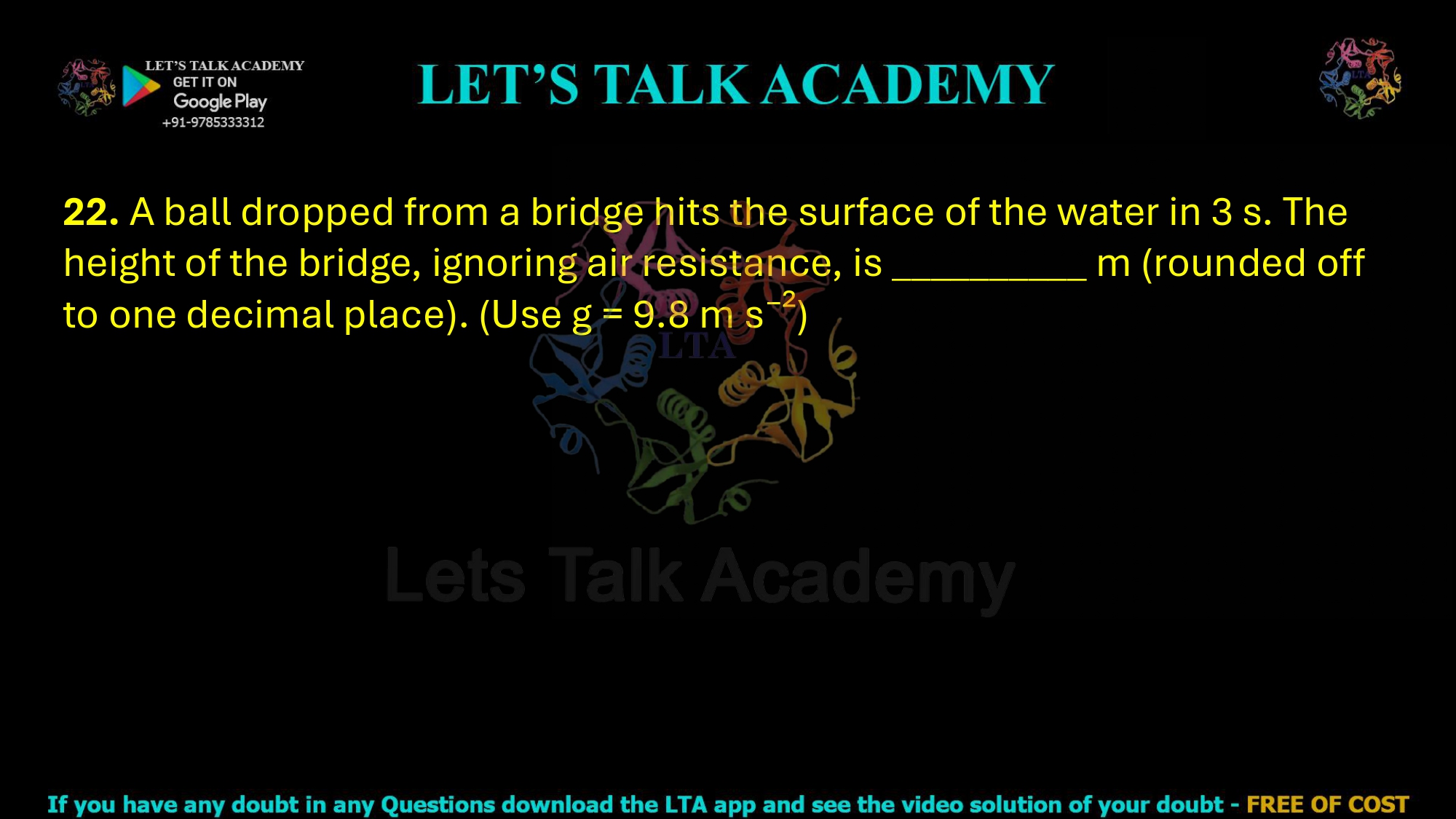
22. A ball dropped from a bridge hits the surface of the water in 3 s. The height of the bridge, ignoring air resistance, is __________ m (rounded off to one decimal place). (Use g = 9.8 m s⁻²)
Calculate the Height of a Bridge When a Ball Takes 3 Seconds to Hit the Water
Correct Answer: 44.1 m
Understanding the Free-Fall Motion of the Ball
This question describes a ball that is dropped from a bridge and reaches the surface of the water after 3 seconds. Since the ball is dropped rather than thrown, its initial velocity is zero. The ball then accelerates downward because of Earth’s gravitational attraction.
Ignoring air resistance means that gravity is the only force responsible for the downward acceleration of the ball. Therefore, the ball undergoes uniformly accelerated motion with a constant acceleration equal to the acceleration due to gravity.
To calculate the height of the bridge, we use the equation of motion that relates displacement, initial velocity, acceleration, and time:
s = ut + (1/2)at2
For a freely falling object, the acceleration a is equal to g. Therefore:
s = ut + (1/2)gt2
Given Values in the Question
The ball is dropped from the bridge, so its initial velocity is:
u = 0 m/s
The time taken by the ball to reach the water is:
t = 3 s
The acceleration due to gravity is:
g = 9.8 m s−2
The displacement s of the ball is equal to the height of the bridge. Therefore, we need to calculate the distance travelled by the freely falling ball during the 3-second interval.
Step-by-Step Calculation of the Height of the Bridge
Step 1: Apply the Equation of Motion
The displacement of an object moving with constant acceleration is given by:
s = ut + (1/2)at2
For the falling ball, a = g. Therefore:
s = ut + (1/2)gt2
Step 2: Use the Initial Velocity of the Dropped Ball
Since the ball is dropped from rest:
u = 0
Therefore, the term ut becomes zero, and the equation simplifies to:
s = (1/2)gt2
Step 3: Substitute the Given Values
Substituting g = 9.8 m s−2 and t = 3 s:
s = (1/2) × 9.8 × (3)2
Since:
(3)2 = 9
We obtain:
s = (1/2) × 9.8 × 9
s = 4.9 × 9
s = 44.1 m
Therefore, the height of the bridge is 44.1 m.
Why Is the Initial Velocity Equal to Zero?
The word “dropped” has an important physical meaning in this problem. When an object is dropped, it is released without being given any initial upward or downward velocity. Therefore, its initial velocity at the instant of release is zero.
After release, gravity continuously increases the downward velocity of the ball. This is why the ball covers more distance during each successive second of its fall.
Why Can the Height Be Calculated Using Free-Fall Motion?
The question specifically asks us to ignore air resistance. Under this condition, the ball falls only under the influence of gravity. Its acceleration remains constant at 9.8 m s−2 throughout the motion.
Since the ball travels from the top of the bridge to the water surface, its total vertical displacement is equal to the height of the bridge. Therefore, calculating the distance travelled during 3 seconds directly gives the required bridge height.
Checking the Result
For an object dropped from rest, the distance fallen is proportional to the square of the time:
s ∝ t2
Using the relation s = (1/2)gt2, a falling time of 3 seconds gives a distance of 44.1 m. This is physically reasonable because a freely falling object reaches a speed of approximately 29.4 m/s after 3 seconds and covers an average distance consistent with the calculated height.
Final Answer
The height of the bridge is 44.1 m.
Using the free-fall equation s = ut + (1/2)gt2, with initial velocity u = 0, gravitational acceleration g = 9.8 m s−2, and time t = 3 s, the height of the bridge is calculated as 44.1 m.


