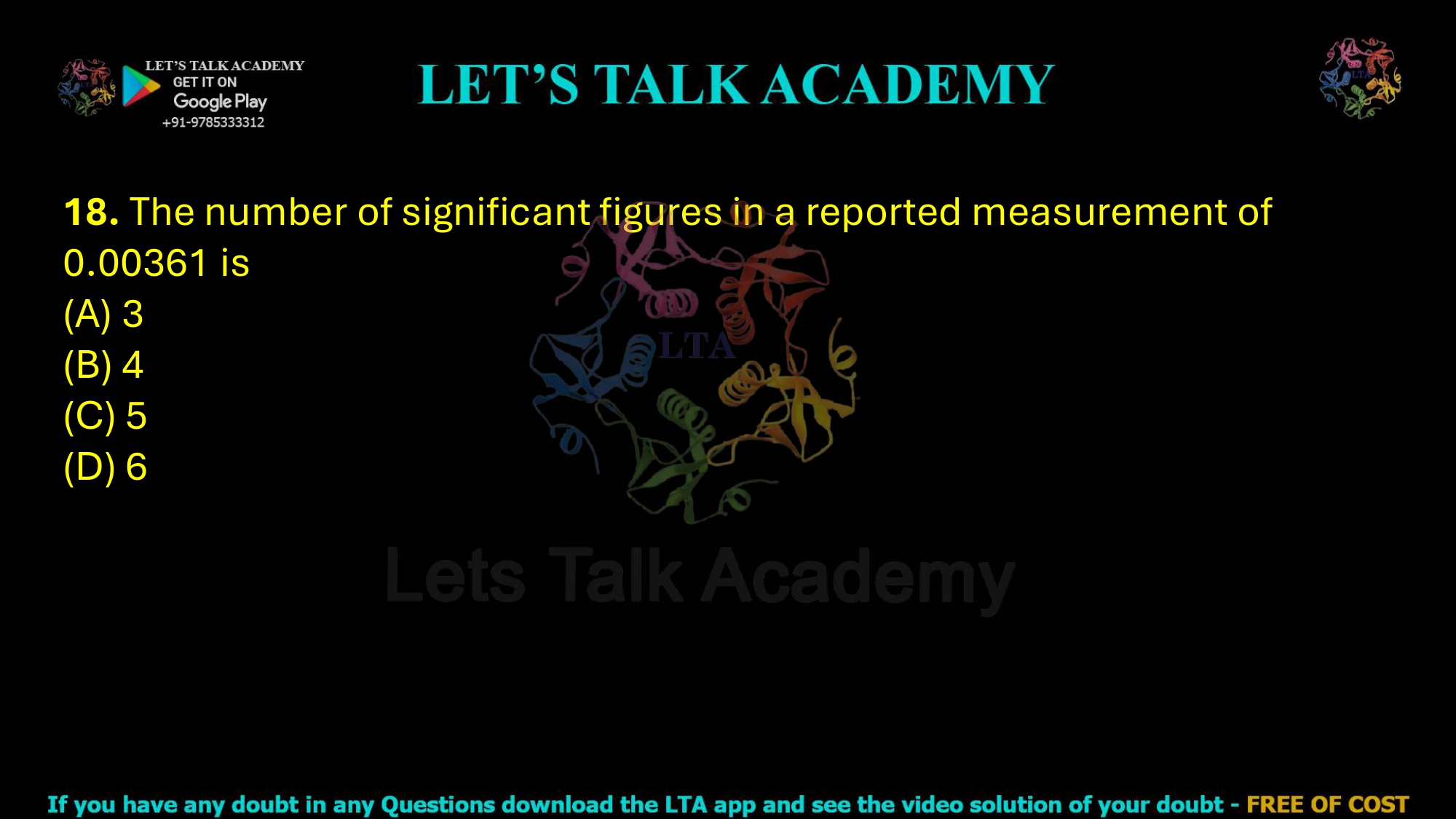
18. The number of significant figures in a reported measurement of 0.00361 is
(A) 3
(B) 4
(C) 5
(D) 6
Number of Significant Figures in 0.00361: Detailed Explanation
Correct Answer: (A) 3
Understanding Significant Figures in a Measurement
Significant figures, also called significant digits, are the digits in a measured quantity that carry meaningful information about its precision. They include all digits that are known with certainty together with the first uncertain or estimated digit.
To determine the number of significant figures in a reported measurement, it is important to identify which digits represent actual measured information and which zeros are present only to indicate the position of the decimal point.
The reported measurement given in this question is:
0.00361
At first glance, this number contains several zeros. However, all written digits are not necessarily significant. The position and purpose of a zero determine whether it should be counted as a significant figure.
Rule for Leading Zeros in Significant Figures
Zeros that appear before the first non-zero digit are called leading zeros. Leading zeros are not significant because they do not provide information about the precision of the measurement. Their only purpose is to locate the decimal point and indicate the magnitude of the number.
In the measurement 0.00361, the zeros appearing before the digit 3 are leading zeros. Therefore, none of these zeros is counted as a significant figure.
The digits that actually carry significant information are:
3, 6, and 1
Therefore, the total number of significant figures is:
3 significant figures
Step-by-Step Counting of Significant Figures in 0.00361
Step 1: Identify the First Non-Zero Digit
Starting from the left side of the number 0.00361, the first non-zero digit is 3. All zeros appearing before this digit are leading zeros and are therefore not significant.
Step 2: Count All Digits from the First Non-Zero Digit
Beginning with the first non-zero digit, the significant digits are:
3 → first significant figure
6 → second significant figure
1 → third significant figure
Hence, the reported measurement 0.00361 contains exactly 3 significant figures.
Scientific Notation Method for Checking the Answer
Another reliable way to determine the number of significant figures is to express the measurement in scientific notation.
The number 0.00361 can be written as:
3.61 × 10⁻³
In scientific notation, the digits in the coefficient determine the number of significant figures. The coefficient here is 3.61, which contains three digits: 3, 6, and 1.
The power of ten does not affect the number of significant figures. Therefore, 3.61 × 10⁻³ has 3 significant figures.
Detailed Analysis of Each Option
Option (A): 3
Option (A) is correct. The measurement 0.00361 contains three significant digits: 3, 6, and 1. The zeros before 3 are leading zeros and are not counted. Therefore, the total number of significant figures is 3.
Option (B): 4
Option (B) is incorrect. A count of four significant figures would require one of the leading zeros to be treated as significant. However, zeros appearing before the first non-zero digit in a decimal number are not significant. Hence, the measurement does not contain four significant figures.
Option (C): 5
Option (C) is incorrect. This answer results from counting additional leading zeros as significant digits. These zeros only indicate the position of the decimal point and do not represent measured precision. Therefore, they must not be included in the significant-figure count.
Option (D): 6
Option (D) is incorrect. Counting six significant figures would mean treating almost every written digit, including the leading zeros, as significant. This violates the basic rule that zeros before the first non-zero digit are not significant.
Why Are the Zeros in 0.00361 Not Significant?
The value 0.00361 can be expressed in different units without changing its precision. For example, changing the position of the decimal point by using scientific notation gives 3.61 × 10⁻³. The meaningful measured digits remain 3, 6, and 1.
The zeros do not tell us anything additional about how precisely the quantity was measured. They simply show that the number is smaller than one. For this reason, they are classified as leading zeros and excluded from the count of significant figures.
Important Rules for Counting Significant Figures
All non-zero digits are always significant. For example, the number 361 contains three significant figures because all three digits are non-zero.
Zeros between two non-zero digits are also significant. For example, 3.061 contains four significant figures because the zero lies between significant non-zero digits.
Leading zeros are not significant. For example, 0.00361 has three significant figures because the zeros before 3 only locate the decimal point.
Trailing zeros to the right of a decimal point are significant when they follow a non-zero digit. For example, 3.6100 contains five significant figures because the final two zeros indicate the precision of the reported measurement.
Comparison with Similar Measurements
The number 0.00361 has 3 significant figures because only 3, 6, and 1 are significant. In comparison, 0.003610 has 4 significant figures because the final zero appears after a non-zero digit in a decimal measurement and therefore indicates additional precision.
Similarly, 0.0036100 has 5 significant figures. This comparison shows that leading zeros do not affect the number of significant figures, while trailing zeros written after the decimal and after a non-zero digit can be significant.
Final Answer
The number of significant figures in the reported measurement 0.00361 is 3. Therefore, the correct answer is Option (A).
Conclusion
To count significant figures in 0.00361, the leading zeros must first be ignored because they only indicate the position of the decimal point. The remaining digits, 3, 6, and 1, are all significant. Thus, the measurement contains 3 significant figures, making Option (A) the correct answer.


