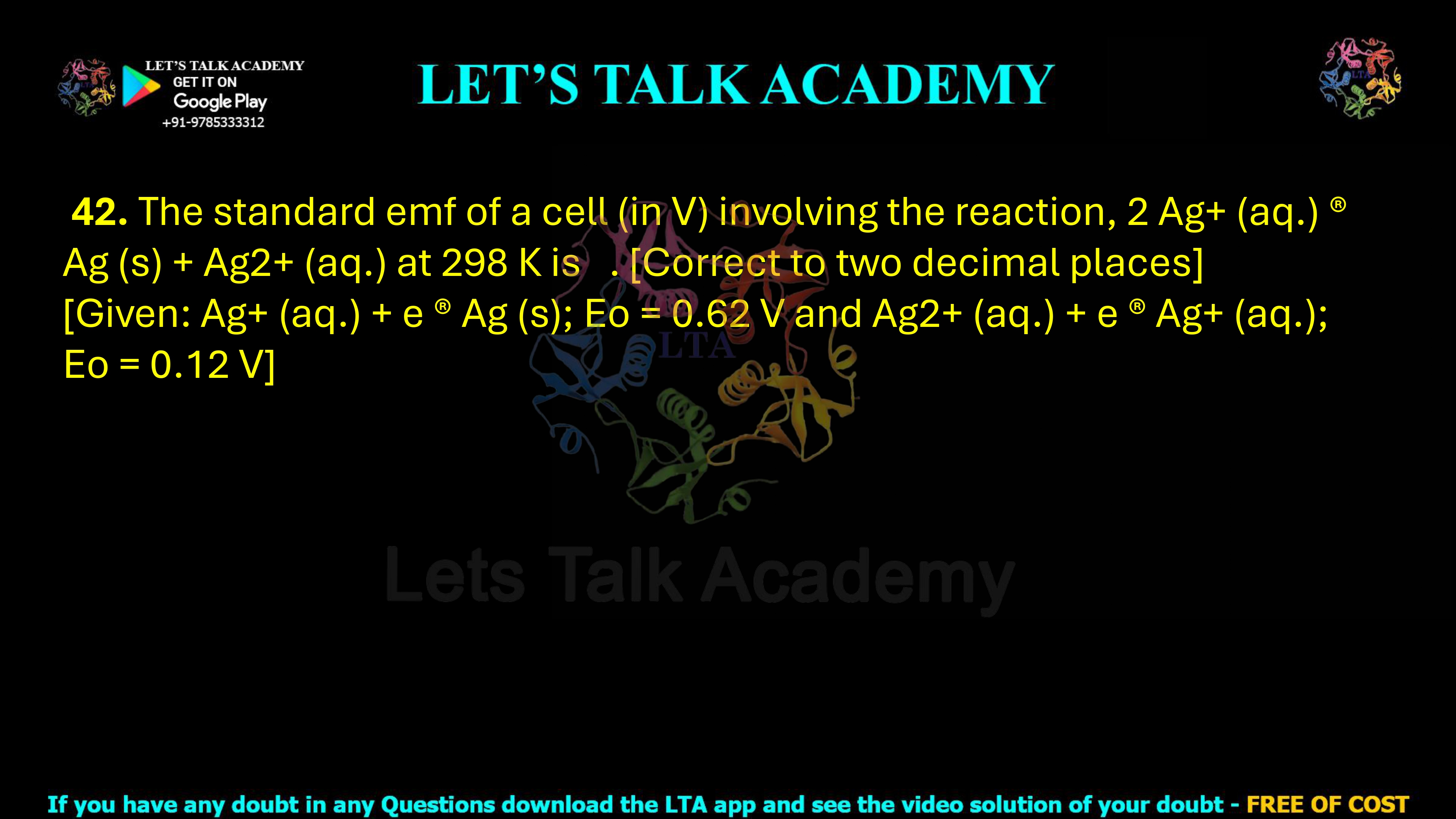
42. The standard EMF of a cell, in volts, involving the following reaction at 298 K is _____, correct to two decimal places.
2Ag+(aq) → Ag(s) + Ag2+(aq)
Given:
Ag+(aq) + e− → Ag(s); E° = 0.62 V
Ag2+(aq) + e− → Ag+(aq); E° = 0.12 V
Calculate the Standard EMF of the Cell for the Reaction 2Ag⁺ → Ag + Ag²⁺
Correct Answer: 0.50 V
Detailed Explanation of the Standard EMF Calculation
This electrochemistry problem asks us to calculate the standard EMF or standard cell potential for a reaction in which Ag+ ions simultaneously undergo reduction and oxidation. One Ag+ ion gains an electron and forms metallic silver, while another Ag+ ion loses an electron and forms Ag2+.
The overall reaction is:
2Ag+(aq) → Ag(s) + Ag2+(aq)
This is a disproportionation reaction because the same species, Ag+, undergoes both reduction and oxidation. To calculate the standard cell potential correctly, we must identify the cathode half-reaction and the anode half-reaction and then apply the standard EMF equation.
Step 1: Identify the Reduction Half-Reaction
In the overall reaction, one Ag+ ion is converted into metallic silver:
Ag+(aq) → Ag(s)
The oxidation state of silver decreases from +1 in Ag+ to 0 in Ag(s). A decrease in oxidation state represents reduction. Therefore, the reduction half-reaction is:
Ag+(aq) + e− → Ag(s)
The given standard reduction potential is:
E°reduction = +0.62 V
Reduction always occurs at the cathode. Therefore, the Ag+/Ag electrode acts as the cathode in this cell.
Step 2: Identify the Oxidation Half-Reaction
The second transformation in the overall reaction is:
Ag+(aq) → Ag2+(aq)
Here, the oxidation state of silver increases from +1 to +2. An increase in oxidation state represents oxidation. Therefore, Ag+ loses one electron:
Ag+(aq) → Ag2+(aq) + e−
However, the value given in the question is written for the reverse reduction reaction:
Ag2+(aq) + e− → Ag+(aq); E° = +0.12 V
Since the actual cell reaction requires the reverse process, the oxidation potential is:
E°oxidation = −0.12 V
Oxidation occurs at the anode. Therefore, the Ag2+/Ag+ redox couple functions as the anode half-cell in the required direction.
Step 3: Add the Two Half-Reactions
The reduction half-reaction is:
Ag+(aq) + e− → Ag(s)
The oxidation half-reaction is:
Ag+(aq) → Ag2+(aq) + e−
Adding the two half-reactions gives:
Ag+(aq) + e− + Ag+(aq) → Ag(s) + Ag2+(aq) + e−
The electron appears on both sides and cancels, giving:
2Ag+(aq) → Ag(s) + Ag2+(aq)
This is exactly the overall reaction given in the question, confirming that the half-reactions have been selected in the correct directions.
Step 4: Calculate the Standard Cell Potential
The standard cell potential can be calculated using:
E°cell = E°cathode − E°anode
In this formula, both values are taken as standard reduction potentials.
For the cathode:
E°cathode = +0.62 V
For the anode redox couple:
E°anode = +0.12 V
Therefore:
E°cell = 0.62 − 0.12
E°cell = 0.50 V
Thus, the standard EMF of the cell is:
0.50 V
Alternative Calculation Using Reduction and Oxidation Potentials
The same result can be obtained by adding the reduction potential of the cathode and the oxidation potential of the anode.
The cathodic reduction potential is:
E°reduction = +0.62 V
The anodic oxidation potential is:
E°oxidation = −0.12 V
Therefore:
E°cell = E°reduction + E°oxidation
E°cell = 0.62 + (−0.12)
E°cell = 0.50 V
Both methods give exactly the same answer.
Why Is the Given Reaction a Disproportionation Reaction?
A disproportionation reaction is a redox reaction in which the same chemical species undergoes oxidation and reduction simultaneously. In the present reaction, silver begins in the +1 oxidation state as Ag+.
One Ag+ ion is reduced:
Ag+ → Ag
The oxidation state changes from:
+1 → 0
At the same time, another Ag+ ion is oxidized:
Ag+ → Ag2+
The oxidation state changes from:
+1 → +2
Thus, the same intermediate oxidation state, +1, simultaneously changes to a lower oxidation state of 0 and a higher oxidation state of +2. Therefore, the reaction is classified as a disproportionation reaction.
Why Is the Electrode Potential Not Multiplied by the Stoichiometric Coefficient?
The overall reaction contains two Ag+ ions, but the electrode potentials must not be multiplied by stoichiometric coefficients. Standard electrode potential is an intensive property, which means its value does not depend on the amount of substance involved.
Therefore, even if a half-reaction is multiplied by 2, 3, or any other number to balance electrons, the value of E° remains unchanged.
For example:
Ag+ + e− → Ag; E° = 0.62 V
If the equation were multiplied by two:
2Ag+ + 2e− → 2Ag
the standard reduction potential would still be:
E° = 0.62 V
This is why the correct calculation is simply 0.62 − 0.12, not a calculation involving multiplication of the electrode potentials by reaction coefficients.
Meaning of the Positive Standard Cell Potential
The calculated standard cell potential is:
E°cell = +0.50 V
A positive standard cell potential indicates that the cell reaction is thermodynamically spontaneous in the forward direction under standard conditions.
The relationship between standard Gibbs free energy change and standard cell potential is:
ΔG° = −nFE°cell
Since E°cell is positive, ΔG° is negative. Therefore, the reaction:
2Ag+(aq) → Ag(s) + Ag2+(aq)
is thermodynamically spontaneous under the standard conditions corresponding to the supplied electrode potentials.
Understanding the Cathode and Anode in This Cell
At the cathode, reduction occurs:
Ag+(aq) + e− → Ag(s)
At the anode, oxidation occurs:
Ag+(aq) → Ag2+(aq) + e−
The electron released during oxidation at the anode is consumed during reduction at the cathode. When the two processes are added, the electrons cancel and produce the overall disproportionation reaction.
Direct Formula Method
For a quick calculation, use the two given standard reduction potentials directly:
E°cell = Higher reduction potential − Lower reduction potential
E°cell = 0.62 − 0.12
E°cell = 0.50 V
The half-reaction with the higher reduction potential occurs as reduction, while the half-reaction with the lower reduction potential is reversed and occurs as oxidation.
Final Answer
The standard EMF of the cell is 0.50 V. The Ag+/Ag half-reaction acts as the cathodic reduction with E° = 0.62 V, while the Ag2+/Ag+ half-reaction is reversed to act as the oxidation process. Therefore:
E°cell = E°cathode − E°anode
E°cell = 0.62 − 0.12 = 0.50 V
Hence, the required answer, correct to two decimal places, is 0.50 V.


