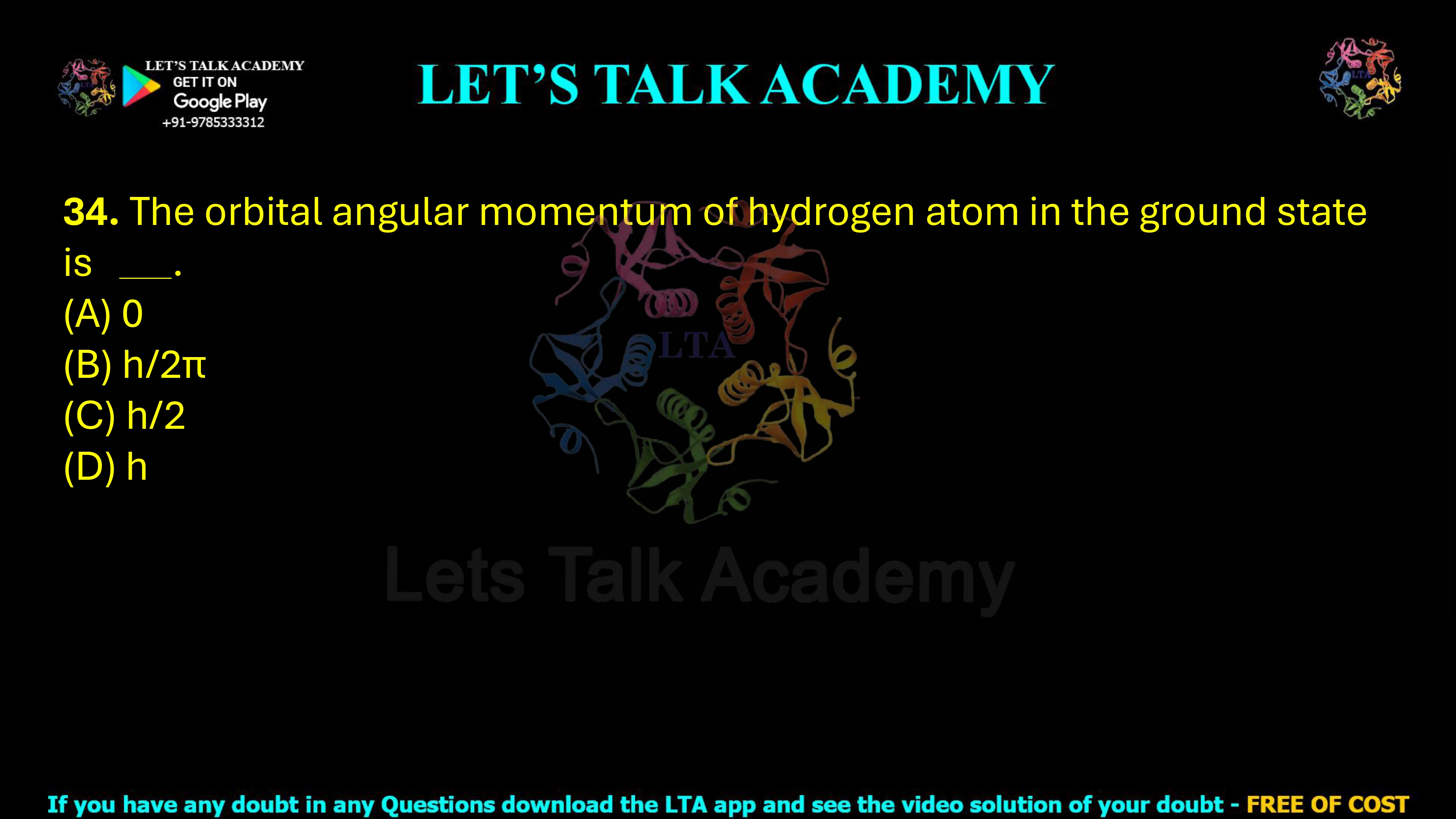
34. The orbital angular momentum of hydrogen atom in the ground state is _____.
(B) h/2π
(C) h/2
(D) h
Orbital Angular Momentum of Hydrogen Atom in the Ground State – Detailed Solution
Correct Answer: Option (A) 0
How to Find the Orbital Angular Momentum of Hydrogen Atom in Ground State
To determine the orbital angular momentum of hydrogen atom in the ground state, we need to identify the quantum numbers associated with the ground-state electron and then apply the quantum mechanical formula for the magnitude of orbital angular momentum.
The ground state of a hydrogen atom is the lowest possible energy state of its electron. In this state, the electron occupies the 1s orbital. The notation 1s provides the information required to determine both the principal quantum number and the orbital angular momentum quantum number.
For the 1s orbital, the principal quantum number is n = 1 and the azimuthal or orbital angular momentum quantum number is l = 0. Substituting l = 0 into the formula for orbital angular momentum gives a value of zero.
Quantum Mechanical Formula for Orbital Angular Momentum
Magnitude of Orbital Angular Momentum
According to quantum mechanics, the magnitude of the orbital angular momentum of an electron is given by:
L = √[l(l + 1)] ħ
where L represents the magnitude of orbital angular momentum, l is the azimuthal quantum number and ħ is the reduced Planck constant.
The reduced Planck constant is related to Planck’s constant by:
ħ = h/2π
Therefore, the orbital angular momentum formula can also be written as:
L = √[l(l + 1)] × h/2π
The value of orbital angular momentum therefore depends directly on the value of the azimuthal quantum number l.
Step-by-Step Calculation for the Hydrogen Ground State
Step 1: Identify the Ground-State Orbital of Hydrogen
A hydrogen atom contains only one electron. In the ground state, this electron occupies the lowest available energy level, which is the 1s orbital.
The electronic configuration of the hydrogen atom in its ground state is:
1s1
Therefore, the orbital involved in this question is an s orbital.
Step 2: Determine the Value of the Azimuthal Quantum Number
The azimuthal quantum number l depends on the type of orbital occupied by the electron. The standard values are:
s orbital → l = 0
p orbital → l = 1
d orbital → l = 2
f orbital → l = 3
Since the electron in the ground-state hydrogen atom occupies the 1s orbital:
l = 0
Step 3: Substitute l = 0 into the Orbital Angular Momentum Formula
The magnitude of orbital angular momentum is:
L = √[l(l + 1)] ħ
Substituting l = 0:
L = √[0(0 + 1)] ħ
L = √0 ħ
L = 0
Therefore, the orbital angular momentum of the hydrogen atom in its ground state is zero.
Why the Answer Is Not h/2π
The quantity h/2π is equal to ħ, the reduced Planck constant. However, the magnitude of orbital angular momentum is not always equal to ħ. It depends on the azimuthal quantum number according to the expression √[l(l + 1)]ħ.
For the hydrogen atom in the ground state, l = 0. Therefore, the multiplying factor √[l(l + 1)] becomes zero, and the orbital angular momentum is also zero.
Hence, Option (B), h/2π, is incorrect.
Explanation of Each Option
Option (A): 0
This is the correct answer. The hydrogen atom in the ground state has its electron in the 1s orbital. For an s orbital, l = 0. Therefore:
L = √[0(0 + 1)]ħ = 0
Option (B): h/2π
This option represents the reduced Planck constant ħ. The orbital angular momentum of an electron is given by √[l(l + 1)]ħ and is not automatically equal to ħ. Since l = 0 for the 1s ground state, the actual orbital angular momentum is zero.
Option (C): h/2
This value is not obtained from the quantum mechanical expression for the orbital angular momentum of the 1s electron. The correct formula depends on the azimuthal quantum number l, which is zero in the hydrogen ground state.
Option (D): h
Planck’s constant h itself is not the orbital angular momentum of the electron in the ground state. Applying the correct quantum mechanical formula with l = 0 gives zero.
Orbital Angular Momentum and the 1s Orbital
The term “s orbital” corresponds to an orbital angular momentum quantum number of zero. This is true not only for the 1s orbital but for every s orbital, including 2s, 3s and higher s states. Whenever l = 0, the magnitude of orbital angular momentum is zero.
The hydrogen atom in its ground state occupies the 1s orbital, so it is a direct example of a quantum state with zero orbital angular momentum. This result follows from quantum mechanics and should not be confused with the electron’s intrinsic spin angular momentum, which is a different physical quantity.
Orbital Angular Momentum Is Different from Spin Angular Momentum
The electron possesses intrinsic spin angular momentum even when its orbital angular momentum is zero. The question specifically asks for orbital angular momentum, so only the quantum number l is used in the calculation.
For the ground-state hydrogen atom:
Orbital quantum number: l = 0
Orbital angular momentum: L = 0
The existence of electron spin does not change this answer because spin angular momentum and orbital angular momentum are separate quantum mechanical properties.
Final Answer
The electron of a hydrogen atom in the ground state occupies the 1s orbital. For an s orbital, the azimuthal quantum number is l = 0. Using the orbital angular momentum formula:
L = √[l(l + 1)]ħ
L = √[0(0 + 1)]ħ = 0
Therefore, the orbital angular momentum of the hydrogen atom in the ground state is 0.
Correct Option: (A) 0


