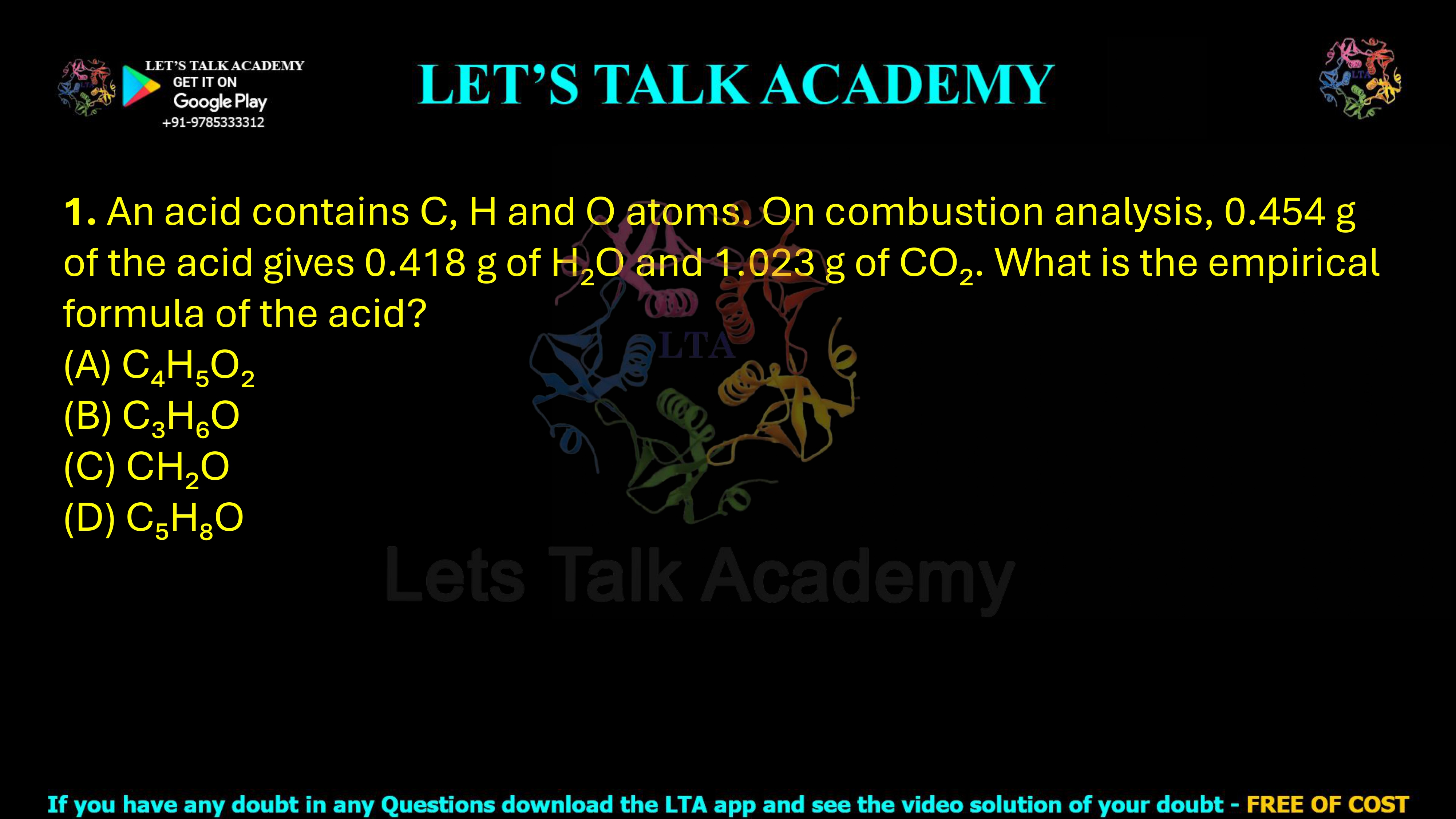
1. An acid contains carbon (C), hydrogen (H), and oxygen (O) atoms. On combustion analysis, 0.454 g of the acid gives 0.418 g of H2O and 1.023 g of CO2. What is the empirical formula of the acid?
(B) C3H6O
(C) CH2O
(D) C5H8O
Combustion Analysis Empirical Formula: How to Find the Formula of an Acid
Correct Answer: (B) C3H6O
This combustion analysis empirical formula problem can be solved by determining the amounts of carbon, hydrogen, and oxygen present in the original 0.454 g sample. During complete combustion, all the carbon atoms present in the acid are converted into carbon dioxide (CO2), while all the hydrogen atoms are converted into water (H2O). Therefore, the masses of CO2 and H2O produced allow us to calculate the moles of carbon and hydrogen in the original compound. The amount of oxygen is then obtained by subtracting the masses of carbon and hydrogen from the total mass of the acid.
Step-by-Step Solution of the Combustion Analysis Problem
Step 1: Calculate the Moles of Carbon from Carbon Dioxide
The combustion of the acid produces 1.023 g of CO2. Since every one mole of carbon dioxide contains exactly one mole of carbon atoms, the number of moles of CO2 formed is equal to the number of moles of carbon present in the original acid sample.
Molar mass of CO2 = 44 g mol−1
Moles of CO2 = 1.023 / 44 = 0.02325 mol
Therefore, moles of carbon (C) = 0.02325 mol.
To calculate the mass of carbon present in the original sample, the number of moles of carbon is multiplied by its atomic mass.
Mass of carbon = 0.02325 × 12 = 0.279 g
Thus, the original 0.454 g acid sample contains approximately 0.279 g of carbon.
Step 2: Calculate the Moles of Hydrogen from Water
The combustion analysis produces 0.418 g of H2O. First, the number of moles of water must be calculated. The molar mass of water is 18 g mol−1.
Moles of H2O = 0.418 / 18 = 0.02322 mol
Each molecule of H2O contains two hydrogen atoms. Therefore, one mole of water contains two moles of hydrogen atoms. The moles of hydrogen present in the original acid are consequently twice the number of moles of water formed.
Moles of hydrogen (H) = 2 × 0.02322 = 0.04644 mol
Since the atomic mass of hydrogen is approximately 1 g mol−1, the mass of hydrogen in the original sample is:
Mass of hydrogen = 0.04644 × 1 = 0.04644 g
Therefore, the acid sample contains approximately 0.04644 g of hydrogen.
Step 3: Calculate the Mass and Moles of Oxygen
The compound contains only carbon, hydrogen, and oxygen. We already know the total mass of the acid and have calculated the masses of carbon and hydrogen. Therefore, the mass of oxygen can be determined by subtracting the combined masses of carbon and hydrogen from the total mass of the acid.
Mass of oxygen = Total mass of acid − (Mass of carbon + Mass of hydrogen)
Mass of oxygen = 0.454 − (0.279 + 0.04644)
Mass of oxygen = 0.454 − 0.32544 = 0.12856 g
Now, the number of moles of oxygen is calculated by dividing its mass by the atomic mass of oxygen, which is 16 g mol−1.
Moles of oxygen (O) = 0.12856 / 16 = 0.008035 mol
Therefore, the original acid contains approximately 0.008035 mol of oxygen atoms.
Step 4: Determine the Simplest Whole-Number Mole Ratio
The calculated number of moles of each element is:
C = 0.02325 mol
H = 0.04644 mol
O = 0.008035 mol
To obtain the empirical formula, all the mole values are divided by the smallest value, which is 0.008035.
C = 0.02325 / 0.008035 ≈ 2.89 ≈ 3
H = 0.04644 / 0.008035 ≈ 5.78 ≈ 6
O = 0.008035 / 0.008035 = 1
Therefore, the simplest whole-number ratio of carbon, hydrogen, and oxygen is approximately:
C : H : O = 3 : 6 : 1
Hence, the empirical formula of the acid is:
C3H6O
Why Option (B) C3H6O Is Correct
Option (B), C3H6O, matches the experimentally calculated mole ratio of approximately 3:6:1. The combustion data show that the acid contains about three moles of carbon atoms and six moles of hydrogen atoms for every one mole of oxygen atoms. Because an empirical formula represents the simplest whole-number ratio of atoms in a compound, C3H6O is the correct empirical formula.
Explanation of All Options
Option (A): C4H5O2
This option gives a carbon-to-hydrogen-to-oxygen ratio of 4:5:2. However, the combustion analysis calculations produce a ratio close to 3:6:1. The calculated oxygen content is also much lower than would be expected for a formula containing two oxygen atoms relative to four carbon atoms. Therefore, C4H5O2 does not agree with the experimental data and is incorrect.
Option (B): C3H6O
This option gives the elemental ratio 3:6:1, which matches the mole ratio obtained from the combustion analysis. The carbon content is determined from CO2, the hydrogen content is determined from H2O, and the oxygen content is calculated by mass difference. All three calculations support C3H6O, making option (B) the correct answer.
Option (C): CH2O
The formula CH2O has a carbon-to-hydrogen-to-oxygen ratio of 1:2:1. Although the carbon-to-hydrogen ratio of 1:2 is consistent with the experimental data, the relative amount of oxygen is too high. The actual calculated ratio is approximately 3:6:1 rather than 1:2:1. Therefore, CH2O cannot be the empirical formula.
Option (D): C5H8O
This option represents a carbon-to-hydrogen-to-oxygen ratio of 5:8:1. The experimental mole ratio obtained from the given masses is approximately 3:6:1. Since the carbon and hydrogen proportions in C5H8O do not match the combustion data, this option is also incorrect.
Final Answer
From 1.023 g of CO2, the moles of carbon are calculated as approximately 0.02325 mol. From 0.418 g of H2O, the moles of hydrogen are approximately 0.04644 mol. The remaining mass of the 0.454 g acid sample corresponds to approximately 0.008035 mol of oxygen. Dividing all these mole values by the smallest value gives the simplest ratio C:H:O ≈ 3:6:1.
Therefore, the empirical formula of the acid is C3H6O.
Correct Option: (B) C3H6O


