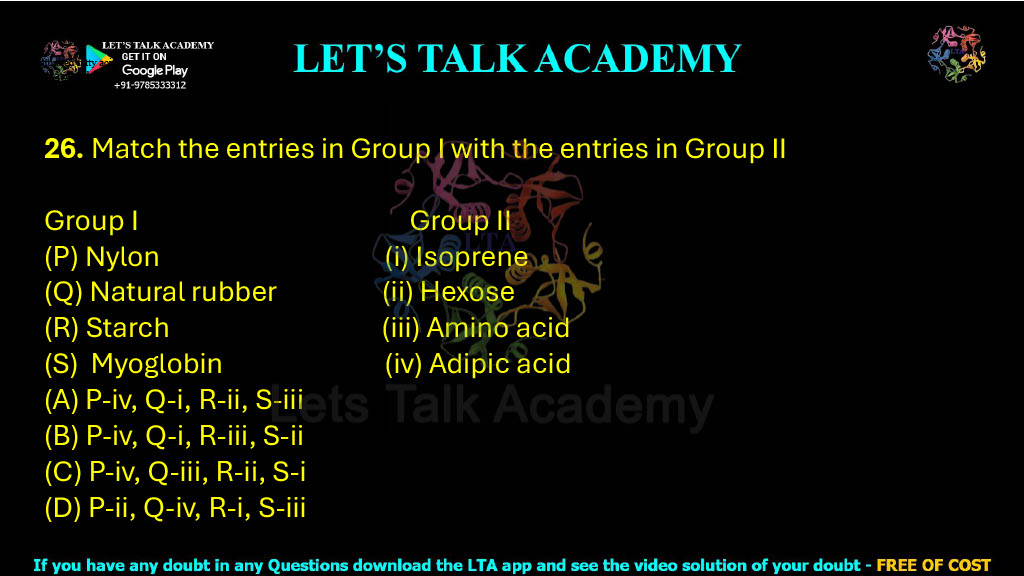
26. Match the entries in Group I with the entries in Group II
Group I Group II
(P) Nylon (i) Isoprene
(Q) Natural rubber (ii) Hexose
(R) Starch (iii) Amino acid
(S) Myoglobin (iv) Adipic acid
(A) P-iv, Q-i, R-ii, S-iii
(B) P-iv, Q-i, R-iii, S-ii
(C) P-iv, Q-iii, R-ii, S-i
(D) P-ii, Q-iv, R-i, S-iii
Correct Answer
(A) P-iv, Q-i, R-ii, S-iii
Introduction
Polymers are large macromolecules formed by the repeated joining of smaller molecules known as monomers. They are broadly classified into natural polymers, which occur in living organisms, and synthetic polymers, which are manufactured industrially. Understanding the relationship between polymers and their constituent monomers is one of the most fundamental concepts in biochemistry, molecular biology, and polymer chemistry.
Natural polymers such as starch, proteins, and natural rubber are synthesized biologically and perform essential structural and physiological functions. Synthetic polymers such as nylon are produced through industrial polymerization reactions and are widely used in textiles, engineering materials, and biomedical devices. Correctly identifying the building blocks of these polymers requires an understanding of both their chemical composition and biological significance.
Understanding the Concept Behind the Question
The objective of this question is to identify the basic repeating unit or principal building block associated with each polymer.
- Nylon is synthesized using adipic acid and hexamethylenediamine.
- Natural rubber is formed by polymerization of isoprene units.
- Starch is composed of repeating glucose (hexose) molecules.
- Myoglobin is a protein constructed from amino acids.
Thus, the correct matching becomes:
- P → iv
- Q → i
- R → ii
- S → iii
This corresponds to Option (A).
Why Nylon Matches with Adipic Acid (P → iv)
Nylon
Nylon is one of the most important synthetic polyamide polymers. The most common variety, Nylon-6,6, is produced through a condensation polymerization reaction between adipic acid and hexamethylenediamine.
During polymer formation, the carboxyl groups of adipic acid react with the amino groups of hexamethylenediamine, producing long polyamide chains while releasing water molecules. The resulting polymer exhibits remarkable tensile strength, elasticity, abrasion resistance, and chemical stability, making it useful in textiles, ropes, engineering plastics, parachutes, fishing lines, and medical sutures.
Since adipic acid is one of the principal monomers required for Nylon-6,6 synthesis, Nylon correctly matches with Adipic Acid (iv).
Therefore,
P → iv
Why Natural Rubber Matches with Isoprene (Q → i)
Natural Rubber
Natural rubber is a biopolymer obtained primarily from the latex of the rubber tree (Hevea brasiliensis). It is composed almost entirely of repeating units of cis-1,4-isoprene.
The monomer isoprene (2-methyl-1,3-butadiene) undergoes polymerization to produce long flexible chains that possess remarkable elasticity. This elasticity arises because the cis configuration allows the polymer chains to coil and stretch without breaking.
Natural rubber is extensively used in automobile tires, gloves, footwear, adhesives, elastic materials, and numerous industrial products.
Since isoprene is the monomer of natural rubber,
Q → i
Why Starch Matches with Hexose (R → ii)
Starch
Starch is the principal storage polysaccharide of plants and serves as one of the most important dietary sources of carbohydrates for humans. It consists entirely of glucose molecules, which belong to the class of sugars known as hexoses because each molecule contains six carbon atoms.
Starch is composed of two components:
- Amylose, containing α(1→4) glycosidic linkages.
- Amylopectin, containing α(1→4) linkages with α(1→6) branch points.
Both polymers are constructed exclusively from glucose, a six-carbon monosaccharide.
Therefore,
R → ii (Hexose)
Why Myoglobin Matches with Amino Acid (S → iii)
Myoglobin
Myoglobin is a globular protein responsible for oxygen storage in skeletal and cardiac muscle. Like all proteins, it is synthesized through the polymerization of amino acids connected by peptide bonds.
Human myoglobin contains approximately 153 amino acid residues folded into a compact tertiary structure surrounding a heme prosthetic group. The amino acid sequence determines the final three-dimensional structure, which is essential for oxygen binding and release.
Since proteins are polymers of amino acids,
S → iii
Why Option (A) Is Correct
Option (A) correctly identifies every polymer and its corresponding building block.
- Nylon → Adipic Acid
- Natural Rubber → Isoprene
- Starch → Hexose (Glucose)
- Myoglobin → Amino Acid
Every match is scientifically accurate.
Therefore,
Option (A) is the correct answer.
Why Option (B) Is Incorrect
Although this option correctly matches Nylon with adipic acid and Natural Rubber with isoprene, it incorrectly matches starch with amino acids and myoglobin with hexose.
Starch is a carbohydrate polymer composed of glucose molecules, whereas myoglobin is a protein composed of amino acids.
Hence,
Option (B) is incorrect.
Why Option (C) Is Incorrect
This option incorrectly associates Natural Rubber with amino acids and Myoglobin with isoprene.
Natural rubber is a polymer of isoprene, while myoglobin is a protein synthesized from amino acids.
Therefore,
Option (C) is incorrect.
Why Option (D) Is Incorrect
This option incorrectly matches every polymer except myoglobin.
Nylon is not composed of hexose molecules.
Natural rubber is not synthesized from adipic acid.
Starch is not composed of isoprene.
Therefore,
Option (D) is incorrect.
Comparison of the Given Polymers
| Polymer | Building Block | Polymer Type | Biological Function |
|---|---|---|---|
| Nylon | Adipic acid + Hexamethylenediamine | Synthetic polymer | Industrial material |
| Natural Rubber | Isoprene | Natural polymer | Elasticity |
| Starch | Glucose (Hexose) | Polysaccharide | Energy storage |
| Myoglobin | Amino acids | Protein | Oxygen storage |
Biological and Industrial Importance
Each of these polymers plays a unique role in biology or industry. Starch functions as the principal carbohydrate reserve in plants and serves as an important dietary energy source for humans. Myoglobin enables efficient oxygen storage in muscle tissue, allowing sustained aerobic metabolism during physical activity.
In contrast, natural rubber provides flexibility and elasticity because of its cis-polyisoprene structure, making it indispensable for numerous commercial applications. Nylon, one of the earliest synthetic polymers, revolutionized the textile and plastics industries because of its high mechanical strength and durability.
Understanding these polymers also highlights the diversity of macromolecular chemistry, demonstrating how different monomers produce materials with entirely different biological and physical properties.
Common Mistakes in Competitive Examinations
One of the most common mistakes is confusing starch with proteins. Students occasionally associate starch with amino acids because both are biological macromolecules. However, starch is composed exclusively of glucose molecules, whereas proteins are polymers of amino acids.
Another frequent error is remembering only one monomer of Nylon-6,6. While adipic acid is correctly listed in the options, students should remember that hexamethylenediamine is the second monomer involved in Nylon-6,6 synthesis.
Some students also confuse natural rubber with synthetic rubber. Natural rubber is always composed of cis-isoprene units, whereas synthetic rubbers are manufactured from different monomers depending on their intended application.
High-Yield Points
- Nylon-6,6 → Adipic acid + Hexamethylenediamine.
- Natural Rubber → Polymer of cis-isoprene.
- Starch → Polymer of glucose (hexose).
- Myoglobin → Protein composed of amino acids.
- Proteins contain peptide bonds.
- Starch contains glycosidic bonds.
Frequently Asked Questions
Why is adipic acid associated with Nylon?
Adipic acid reacts with hexamethylenediamine during condensation polymerization to produce Nylon-6,6, one of the most widely used synthetic polyamides.
Why is starch matched with hexose instead of glucose?
Glucose belongs to the class of six-carbon sugars called hexoses. Since “hexose” is provided in the options, it correctly represents the monomeric unit of starch.
Is myoglobin made of amino acids?
Yes. Myoglobin is a globular protein composed of approximately 153 amino acids arranged into a compact tertiary structure surrounding a heme group.
Key Takeaways
Matching polymers with their constituent monomers is a fundamental concept in biochemistry and polymer science. Nylon is synthesized using adipic acid and hexamethylenediamine, natural rubber is a polymer of isoprene, starch is a polysaccharide composed of glucose (hexose) units, and myoglobin is a protein constructed from amino acids. Understanding these relationships not only helps solve matching questions but also provides insight into the structural diversity and biological functions of natural and synthetic polymers.
Final Answer
Correct Option: (A) P-iv, Q-i, R-ii, S-iii
Explanation
The correct matching is:
- Nylon → Adipic Acid (iv) because Nylon-6,6 is synthesized from adipic acid and hexamethylenediamine.
- Natural Rubber → Isoprene (i) because it is composed of repeating cis-isoprene units.
- Starch → Hexose (ii) because it is a polysaccharide made of glucose, which is a six-carbon (hexose) sugar.
- Myoglobin → Amino Acid (iii) because it is a globular protein composed of amino acid residues.
Therefore, the correct combination is P-iv, Q-i, R-ii, S-iii, making Option (A) the correct answer.


