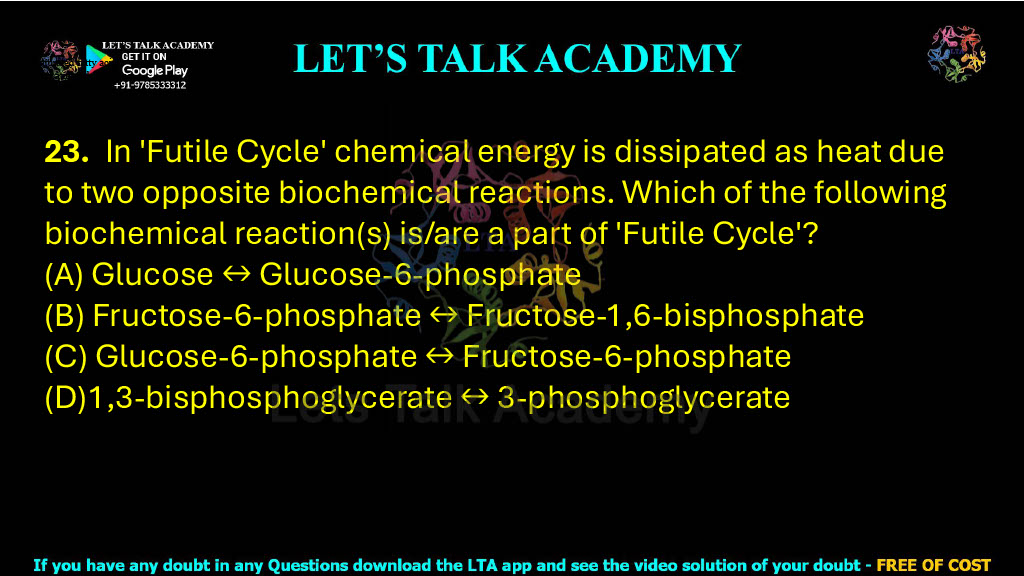
23. In ‘Futile Cycle’ chemical energy is dissipated as heat due to two opposite biochemical reactions. Which of the following biochemical reaction(s) is/are a part of ‘Futile Cycle’?
(A) Glucose ↔ Glucose-6-phosphate
(B) Fructose-6-phosphate ↔ Fructose-1,6-bisphosphate
(C) Glucose-6-phosphate ↔ Fructose-6-phosphate
(D)1,3-bisphosphoglycerate ↔ 3-phosphoglycerate
Futile Cycle in Biochemistry | Which Glycolytic and Gluconeogenic Reactions Form a Futile Cycle?
Correct Answer
(A) Glucose ↔ Glucose-6-phosphate
(B) Fructose-6-phosphate ↔ Fructose-1,6-bisphosphate
Introduction
Living cells continuously regulate metabolic pathways to maintain a balance between energy production and energy consumption. One of the most fascinating regulatory mechanisms in metabolism is the futile cycle, also known as a substrate cycle. Although the term “futile” suggests that these reactions are wasteful, they actually play essential roles in metabolic regulation, heat production, and rapid adaptation to changing physiological conditions.
A futile cycle occurs when two opposing metabolic reactions operate simultaneously, converting one metabolite into another and then immediately converting it back again. The overall result is continuous ATP hydrolysis without any net production of useful metabolic intermediates. Instead, the chemical energy stored in ATP is released as heat, contributing to thermogenesis. These cycles are especially important in tissues involved in energy balance, such as the liver, skeletal muscle, and brown adipose tissue.
Questions related to futile cycles frequently appear in CSIR NET Life Sciences, GATE Biotechnology, IIT JAM, CUET PG, NEET PG, and university examinations because they integrate concepts of glycolysis, gluconeogenesis, enzyme regulation, and bioenergetics.
Understanding the Concept Behind the Question
A futile cycle requires two different enzymes that catalyze opposite irreversible reactions. One reaction generally belongs to glycolysis, while the opposing reaction belongs to gluconeogenesis.
During one step, ATP is consumed to convert a substrate into its phosphorylated product. In the reverse direction, a different enzyme removes the phosphate group through hydrolysis rather than regenerating ATP. Consequently, each complete cycle consumes ATP and releases its energy as heat.
The two classical futile cycles in carbohydrate metabolism are:
1. Glucose ⇌ Glucose-6-phosphate
- Forward enzyme: Hexokinase (or Glucokinase)
- Reverse enzyme: Glucose-6-phosphatase
2. Fructose-6-phosphate ⇌ Fructose-1,6-bisphosphate
- Forward enzyme: Phosphofructokinase-1 (PFK-1)
- Reverse enzyme: Fructose-1,6-bisphosphatase (FBPase-1)
Both reactions consume ATP during phosphorylation but do not regenerate ATP during dephosphorylation, leading to heat generation.
Therefore, the correct answers are Options (A) and (B).
Why Option (A) Is Correct
Glucose ↔ Glucose-6-phosphate
This represents one of the best-known futile cycles in carbohydrate metabolism. During glycolysis, hexokinase catalyzes the phosphorylation of glucose to glucose-6-phosphate using one molecule of ATP.
Glucose + ATP → Glucose-6-phosphate + ADP
During gluconeogenesis or glycogen breakdown in certain tissues, glucose-6-phosphatase catalyzes the reverse reaction.
Glucose-6-phosphate + H₂O → Glucose + Pi
Notice that ATP consumed in the forward reaction is not regenerated during the reverse reaction. Instead, the phosphate group is simply hydrolyzed. Consequently, continuous operation of these opposing reactions results in ATP consumption and heat production without any net metabolic gain.
Therefore, this reaction pair forms a classic futile cycle.
Hence, Option (A) is correct.
Why Option (B) Is Correct
Fructose-6-phosphate ↔ Fructose-1,6-bisphosphate
This is the most extensively studied futile cycle in glycolysis and gluconeogenesis.
In glycolysis, phosphofructokinase-1 (PFK-1) catalyzes:
Fructose-6-phosphate + ATP → Fructose-1,6-bisphosphate + ADP
In gluconeogenesis, fructose-1,6-bisphosphatase catalyzes:
Fructose-1,6-bisphosphate + H₂O → Fructose-6-phosphate + Pi
Again, ATP is consumed during phosphorylation but is not regenerated during the reverse reaction. Instead, the phosphate is removed by hydrolysis, causing the chemical energy of ATP to be released as heat.
This substrate cycle also serves as an important regulatory point controlled by AMP, ATP, citrate, and fructose-2,6-bisphosphate.
Therefore, Option (B) is also correct.
Why Option (C) Is Incorrect
Glucose-6-phosphate ↔ Fructose-6-phosphate
This reaction is catalyzed by phosphoglucose isomerase.
Unlike the previous reactions, this step is completely reversible and does not involve ATP hydrolysis. It simply converts an aldose sugar into a ketose sugar through an isomerization reaction.
Because there is no ATP consumption and no separate opposing enzyme, this reaction does not generate heat through ATP dissipation and therefore cannot form a futile cycle.
Hence, Option (C) is incorrect.
Why Option (D) Is Incorrect
1,3-Bisphosphoglycerate ↔ 3-Phosphoglycerate
This step involves phosphoglycerate kinase, which catalyzes a reversible substrate-level phosphorylation reaction during glycolysis.
1,3-Bisphosphoglycerate + ADP ⇌ 3-Phosphoglycerate + ATP
Since the reaction is freely reversible and ATP produced during glycolysis can be regenerated in the reverse direction, there is no continuous ATP wastage.
Furthermore, this reaction uses the same enzyme in both directions rather than two different irreversible enzymes. Therefore, it does not satisfy the definition of a futile cycle.
Hence, Option (D) is incorrect.
What Is a Futile Cycle?
A futile cycle consists of two opposing irreversible reactions catalyzed by different enzymes.
General representation:
A + ATP → B + ADP
↓
B + H₂O → A + Pi
Overall reaction:
ATP + H₂O → ADP + Pi + Heat
Notice that the metabolite returns to its original form while ATP is consumed. Thus, the only net outcome is the release of energy as heat.
Biological Importance of Futile Cycles
Although the name suggests that futile cycles are metabolically wasteful, they serve several important physiological functions. One of their primary roles is thermogenesis, the production of heat without performing external work. This mechanism contributes to body temperature regulation, particularly in newborn mammals and animals exposed to cold environments.
Futile cycles also allow cells to respond rapidly to changing metabolic demands. Because both opposing enzymes are already present, altering their relative activities through hormonal or allosteric regulation enables rapid shifts between glycolysis and gluconeogenesis without waiting for new enzyme synthesis. This provides fine control over metabolic flux and helps maintain glucose homeostasis.
Comparison of the Given Reactions
| Reaction | ATP Consumed? | Two Opposing Enzymes? | Futile Cycle? |
|---|---|---|---|
| Glucose ⇌ Glucose-6-phosphate | Yes | Yes | Yes |
| Fructose-6-phosphate ⇌ Fructose-1,6-bisphosphate | Yes | Yes | Yes |
| Glucose-6-phosphate ⇌ Fructose-6-phosphate | No | No | No |
| 1,3-Bisphosphoglycerate ⇌ 3-Phosphoglycerate | ATP Conserved | Same Enzyme | No |
High-Yield Points
- Futile cycle is also called a substrate cycle.
-
Net reaction:
ATP + H₂O → ADP + Pi + Heat
- Major futile cycles occur between:
- Hexokinase ↔ Glucose-6-phosphatase
- PFK-1 ↔ Fructose-1,6-bisphosphatase
- Heat is produced because ATP energy is dissipated.
- Futile cycles contribute to thermogenesis and metabolic regulation.
Frequently Asked Questions
Why is a futile cycle called “futile”?
Although ATP is continuously consumed and released as heat without producing a net metabolic product, the cycle is not truly useless. It plays important roles in metabolic regulation and thermogenesis.
Why are different enzymes required?
Irreversible reactions cannot simply reverse under physiological conditions. Therefore, cells use different enzymes for the forward and reverse reactions, enabling independent regulation.
Do futile cycles occur in healthy individuals?
Yes. Controlled futile cycling occurs normally in many tissues and contributes to metabolic flexibility, temperature regulation, and hormonal control of carbohydrate metabolism.
Key Takeaways
A futile cycle consists of two opposing irreversible biochemical reactions that continuously convert one metabolite into another and back again while consuming ATP and releasing its energy as heat. The classical examples occur between glucose and glucose-6-phosphate and between fructose-6-phosphate and fructose-1,6-bisphosphate, where ATP is hydrolyzed without any net metabolic gain. In contrast, reversible glycolytic reactions such as the interconversion of glucose-6-phosphate and fructose-6-phosphate or the phosphoglycerate kinase reaction do not constitute futile cycles because they do not result in continuous ATP dissipation.
Final Answer
Correct Answers: (A) Glucose ↔ Glucose-6-phosphate and (B) Fructose-6-phosphate ↔ Fructose-1,6-bisphosphate
Explanation
A futile cycle occurs when two opposing irreversible metabolic reactions are catalyzed by different enzymes, resulting in continuous ATP hydrolysis and heat generation without any net change in metabolite concentration. The glucose ⇌ glucose-6-phosphate cycle involves hexokinase and glucose-6-phosphatase, while the fructose-6-phosphate ⇌ fructose-1,6-bisphosphate cycle involves PFK-1 and fructose-1,6-bisphosphatase. Both cycles consume ATP in one direction and remove phosphate by hydrolysis in the opposite direction, leading to energy dissipation as heat. Therefore, the correct answers are Options (A) and (B).


