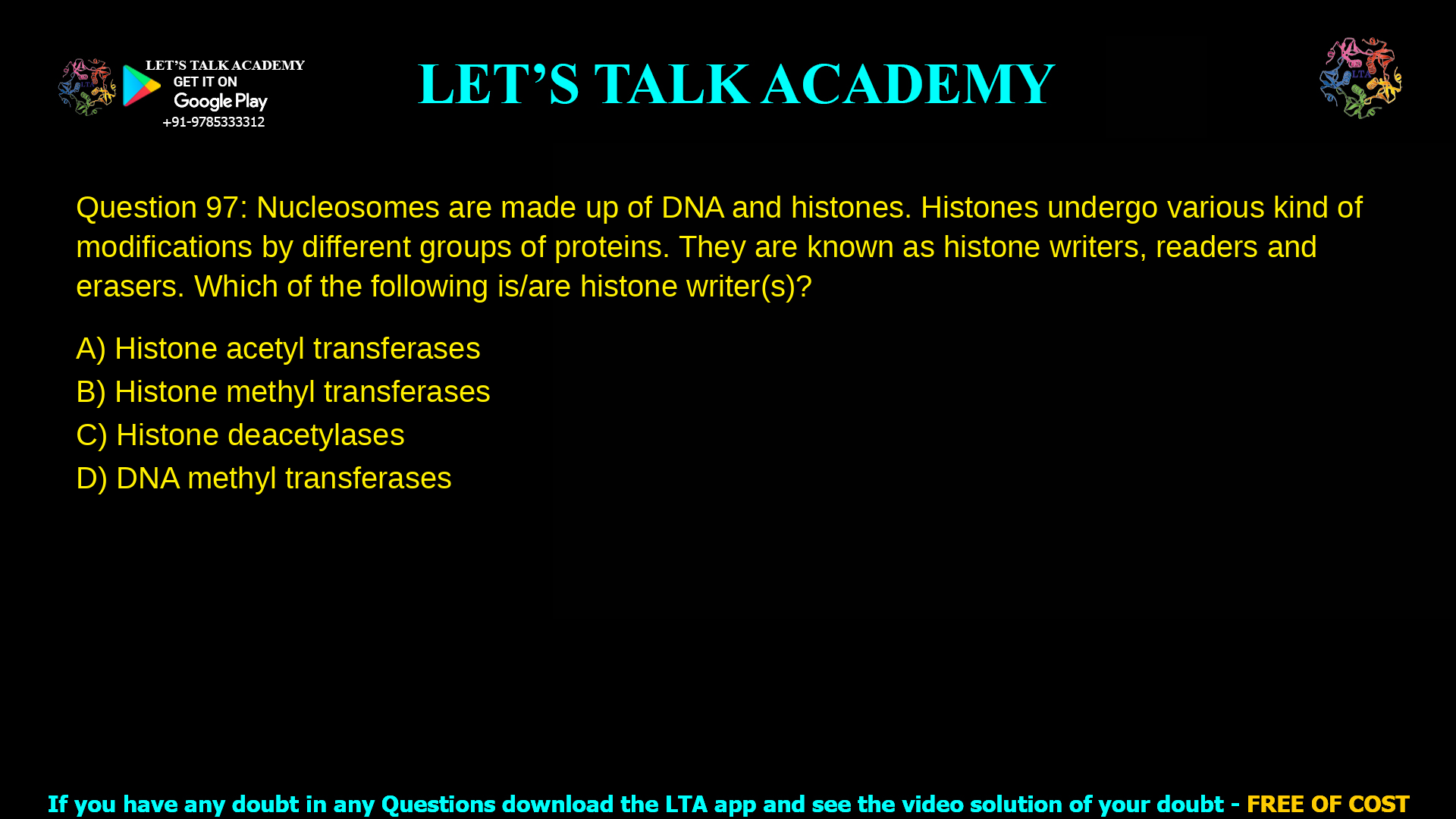
Q.97 Nucleosomes are made up of DNA and histones. Histones undergo various kind of
modifications by different groups of proteins. They are known as histone writers,
readers and erasers. Which of the following is/are histone writer(s)?
(A) Histone acetyl transferases
(B) Histone methyl transferases
(C) Histone deacetylases
(D) DNA methyl transferases
Histone acetyltransferases (HATs) and histone methyltransferases (HMTs) serve as histone writers by adding acetyl and methyl groups to histone tails, respectively. These enzymes facilitate chromatin remodeling for gene regulation, while the correct answer to the question is options (A) and (B).
Option Analysis
Histone writers deposit chemical modifications like acetylation or methylation onto histones.
-
(A) Histone acetyl transferases: These enzymes transfer acetyl groups from acetyl-CoA to lysine residues on histones, reducing positive charge and promoting open chromatin for transcription; classified as writers.
-
(B) Histone methyl transferases: These add methyl groups to lysine or arginine residues using S-adenosylmethionine, influencing both activation and repression based on site; recognized as writers.
-
(C) Histone deacetylases: These remove acetyl groups from histones, tightening chromatin and suppressing transcription; function as erasers, not writers.
-
(D) DNA methyl transferases: These methylate cytosine in DNA, not histones directly, though they interact with chromatin; not histone writers.
Nucleosomes, the basic units of chromatin made of DNA wrapped around histone proteins, undergo modifications by histone writers, readers, and erasers to regulate gene expression. Histone writers, such as histone acetyl transferases and histone methyl transferases, add acetyl or methyl groups to histone tails, influencing chromatin structure. These enzymes play crucial roles in epigenetic control, relevant for CSIR NET Life Sciences preparation.
Roles of Histone Writers
Histone writers deposit post-translational modifications (PTMs) on histones to alter chromatin accessibility.
-
Histone acetyl transferases (HATs) neutralize lysine charges, opening chromatin for transcription.
-
Histone methyl transferases (HMTs) add methyl groups, with site-specific effects like H3K4me3 for activation or H3K9me3 for repression.
-
Examples include p300/CBP for acetylation and SET domain proteins for methylation.
Distinguishing Erasers
Histone deacetylases (HDACs) remove acetyl groups as erasers, compacting chromatin. DNA methyl transferases target DNA cytosines, not histones.
Biological Significance
These modifications form the “histone code,” affecting DNA replication, repair, and diseases like cancer when dysregulated. Understanding histone writers aids competitive exams like CSIR NET.


5 Comments
Vikram
January 4, 2026👍🏻
Vikram
January 4, 2026🤚🏻
Meenakshi Choudhary
January 8, 2026Histone acetyltransferases (HATs) and histone methyltransferases (HMTs) serve as histone writers by adding acetyl and methyl groups to histone tails.
Komal Pareek
January 8, 2026A&B
Sonal Nagar
January 8, 2026HAT & HMT