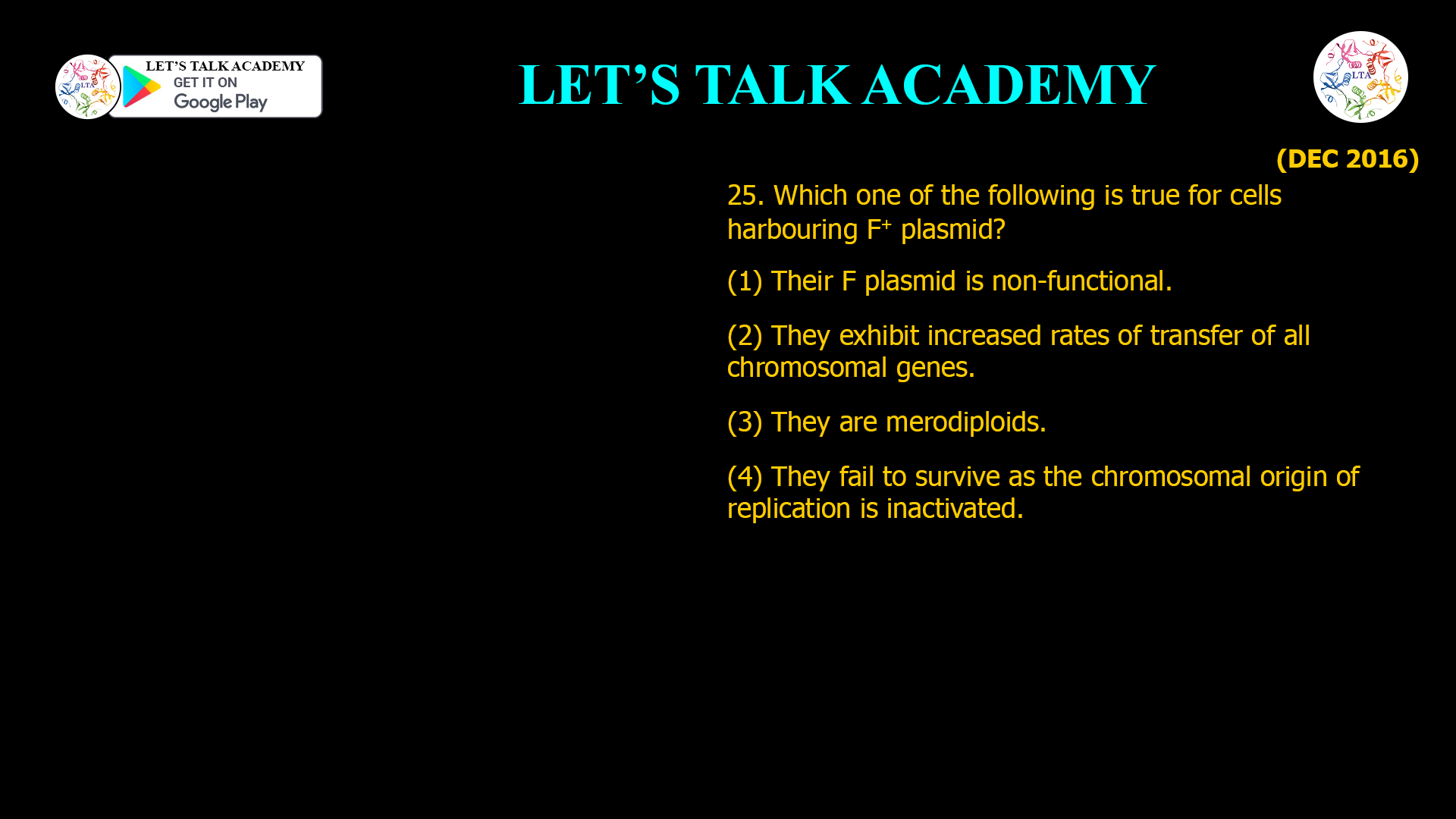
25. Which one of the following is true for cells harbouring F+ plasmid?
(1) Their F plasmid is non-functional.
(2) They exhibit increased rates of transfer of all chromosomal genes.
(3) They are merodiploids.
(4) They fail to survive as the chromosomal origin of replication is inactivated.
Cells harboring the F+ plasmid are bacterial cells that possess the functional F (fertility) plasmid, which enables them to form a sex pilus and transfer genetic material to F- cells via conjugation. Among the options given, the true statement is that such cells are merodiploids.
Explanation of each option:
(1) Their F plasmid is non-functional.
This is false because F+ cells contain a functional F plasmid that allows them to transfer the plasmid through conjugation. Without a functional F plasmid, cells would not be able to form the conjugative pilus or transfer DNA.
(2) They exhibit increased rates of transfer of all chromosomal genes.
This is incorrect for F+ cells. Increased rates of chromosomal gene transfer are characteristic of Hfr (high-frequency recombination) cells, where the F plasmid is integrated into the bacterial chromosome. F+ cells contain the F plasmid as an independent plasmid, so they mainly transfer plasmid DNA, not chromosomal genes.
(3) They are merodiploids.
This is correct. When an F’ plasmid (a variant of F plasmid with some chromosomal genes) is present, the cell can carry two copies of some genes and is termed a merodiploid. Cells harboring F plasmids in general can form partial diploids for certain genes, especially in the case of F’ plasmids.
(4) They fail to survive as the chromosomal origin of replication is inactivated.
This is false. The chromosomal origin of replication (oriC) is unaffected in F+ cells because the F plasmid replicates independently of the chromosomal DNA. F+ cells survive normally.
Introduction: Cells harboring the F+ plasmid play a crucial role in bacterial conjugation, a process essential for gene transfer and genetic diversity. Knowing the true characteristics of these cells aids microbiology students and researchers in understanding bacterial genetics.
Detailed Explanation:
-
F+ cells contain a functional F plasmid, enabling them to form conjugation pili and transfer genetic material to F- recipient cells.
-
Unlike Hfr cells, F+ cells do not exhibit increased chromosomal gene transfer as the F plasmid remains independent.
-
Cells with F’ plasmids are merodiploids, carrying partial diploid genetic content due to plasmid-encoded chromosomal genes.
-
The chromosomal origin of replication remains active, ensuring normal cell survival and replication in F+ cells.
This knowledge is vital for understanding bacterial conjugation mechanisms, plasmid biology, and the genetic implications of F plasmids in microbial populations.
Each aspect of this explanation aligns with the current understanding of bacterial fertility factors, distinguishing F+, Hfr, and F’ cells by their plasmid characteristics and gene transfer abilities.


1 Comment
Juber Khan
February 21, 2026Option 3 is right cella harboring the f+ plasmid play a role in conjugatio means transfer of genes , the cell can carry two copies of genes is termed a merodiploid