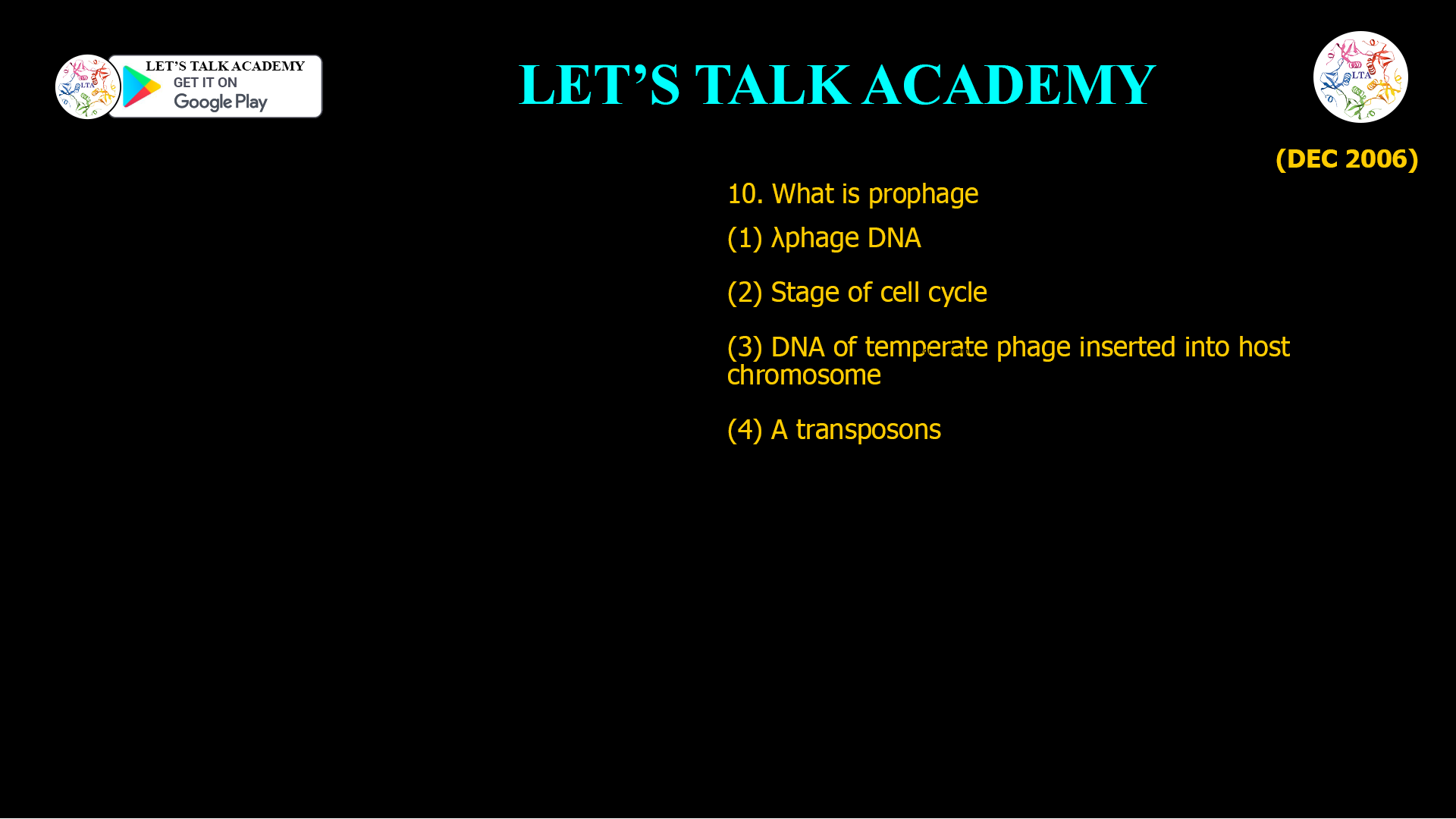
10. What is prophage
(1) λ phage DNA
(2) Stage of cell cycle
(3) DNA of temperate phage inserted into host chromosome
(4) A transposons
Introduction
Prophage represents a key stage in the lysogenic cycle of temperate phages, where the phage genome integrates into the bacterial host chromosome, enabling dormant replication alongside host DNA. This concept is essential for CSIR NET Life Sciences aspirants studying molecular biology and virology, distinguishing lysogeny from lytic infection. Explore the MCQ solution below with detailed option explanations for exam preparation.
Correct Answer
The correct option is (3) DNA of temperate phage inserted into host chromosome.
A prophage forms when a temperate bacteriophage’s genome integrates into the host bacterium’s chromosome during lysogeny, remaining dormant and replicating with the host DNA until induced to enter the lytic cycle. This integration, often via site-specific recombination, defines lysogenic bacteria as lysogens, contrasting with virulent phages that always lyse hosts.
Option Analysis
-
(1) λ phage DNA: Incorrect, as λ phage DNA exemplifies a prophage when integrated but does not define prophage universally; prophage applies to any temperate phage genome in this state, not just λ.
-
(2) Stage of cell cycle: Incorrect, since prophage relates to viral lysogeny in bacteria, not eukaryotic or prokaryotic cell cycle phases like G1, S, or M.
-
(3) DNA of temperate phage inserted into host chromosome: Correct, capturing the precise integration of temperate phage DNA as prophage, which can excise under stress like UV light for lysis.
-
(4) A transposons: Incorrect, as transposons are mobile genetic elements that jump within genomes via transposase, unlike prophages which are integrated phage genomes with lysogenic functions.
Prophage in Lysogenic Cycle
Temperate phages like λ follow lysogeny by inserting DNA via integrase, forming a stable prophage that confers immunity to superinfection and aids horizontal gene transfer. Induction via SOS response excises the prophage, shifting to lytic production of virions. Prophages enhance bacterial evolution by carrying virulence or adaptive genes.


1 Comment
Juber Khan
February 21, 2026(Specialized td ) During lysogenic cycle phage chromosome integrate with baterial host chromosome then 〰️form stable prophage