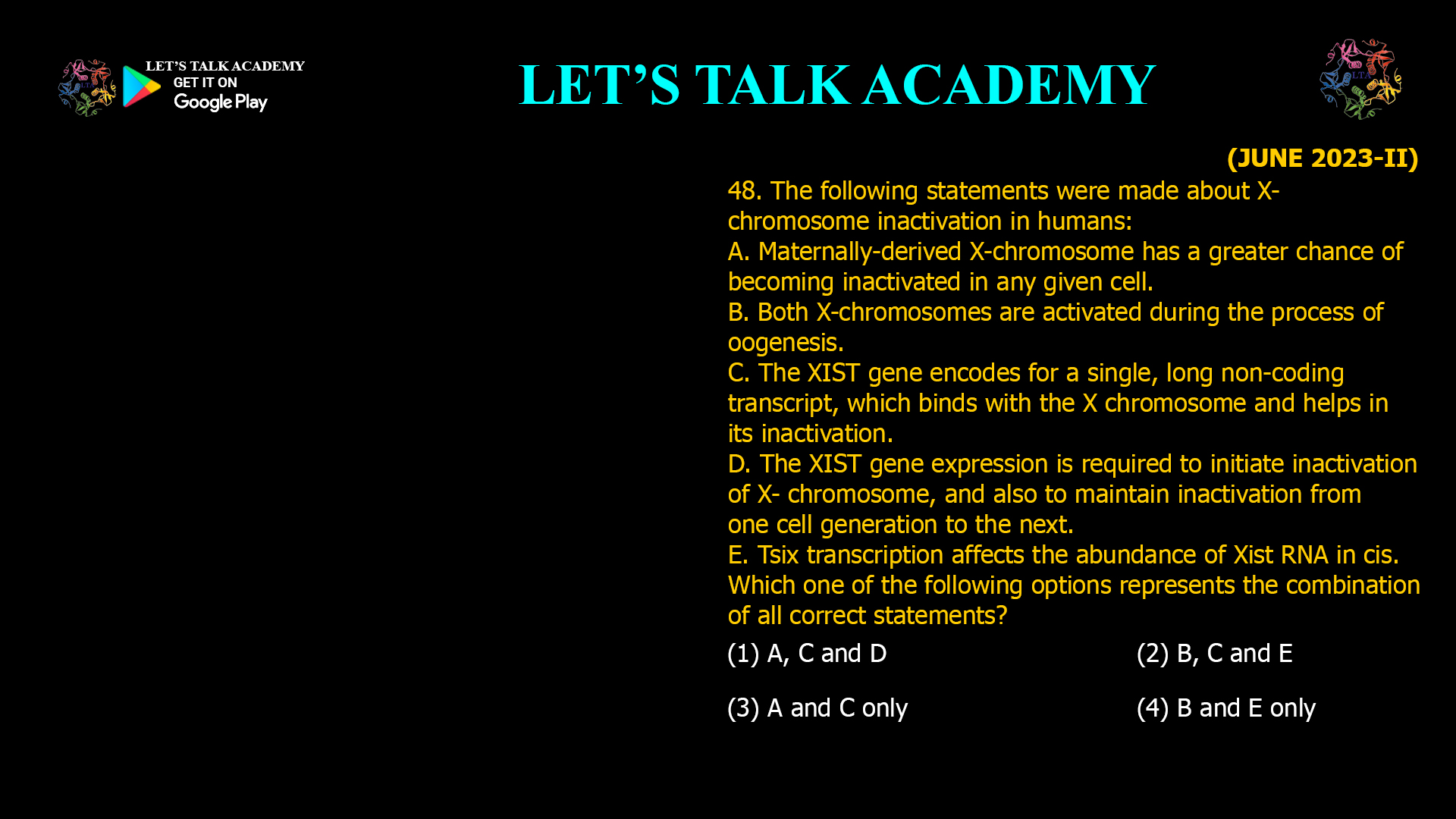
48. The following statements were made about X- chromosome inactivation in humans:
A. Maternally-derived X-chromosome has a greater chance of becoming inactivated in any given cell.
B. Both X-chromosomes are activated during the process of oogenesis.
C. The XIST gene encodes for a single, long non-coding transcript, which binds with the X chromosome and helps in its inactivation.
D. The XIST gene expression is required to initiateinactivation of X- chromosome, and also to maintaininactivation from one cell generation to the next.
E. Tsix transcription affects the abundance of Xist RNA in cis.
Which one of the following options represents the combination of all correct statements?
(1) A, C and D (2) B, C and E
(3) A and C only (4) B and E only
Introduction
X-chromosome inactivation (XCI) is an essential epigenetic process in female mammals that ensures dosage compensation by silencing one of the two X chromosomes. This process involves complex regulation by non-coding RNAs and chromatin modifications. Here, we evaluate key statements about XCI in humans to identify the correct combination based on current scientific understanding.
Evaluating the Statements
A. Maternally-derived X-chromosome has a greater chance of becoming inactivated in any given cell.
-
In placental mammals like humans, XCI is random, meaning either the maternal or paternal X chromosome can be inactivated in any given cell.
-
Skewed inactivation can occur but is not the norm or programmed.
-
Therefore, statement A is incorrect.
B. Both X-chromosomes are activated during the process of oogenesis.
-
During oogenesis, both X chromosomes are generally active before the onset of XCI in embryonic development.
-
This statement is correct.
C. The XIST gene encodes for a single, long non-coding transcript, which binds with the X chromosome and helps in its inactivation.
-
XIST produces a long non-coding RNA that coats the X chromosome in cis, initiating silencing.
-
This is a well-established fact.
-
Statement C is correct.
D. The XIST gene expression is required to initiate inactivation of X-chromosome, and also to maintain inactivation from one cell generation to the next.
-
XIST expression is essential for initiation of XCI.
-
Maintenance of XCI also involves XIST and various epigenetic modifications.
-
Statement D is correct.
E. Tsix transcription affects the abundance of Xist RNA in cis.
-
Tsix is the antisense transcript of Xist and regulates Xist expression in cis, affecting XCI choice.
-
This regulatory relationship is well documented.
-
Statement E is correct.
Correct Combination of Statements
-
Statements B, C, and E are correct.
-
Statements A is incorrect.
-
Statement D is correct but not included in the options with B, C, E.
Among the given options, (2) B, C and E best represents the combination of all correct statements.
Conclusion
In humans, X-chromosome inactivation is a random process initiated and maintained by the XIST long non-coding RNA, with Tsix playing a regulatory role in controlling Xist RNA levels. Both X chromosomes are active during oogenesis before XCI is established in embryonic development.
Answer:
The correct option is (2) B, C and E.


