
1. Transcriptional Inhibitors
Transcription is the process by which genetic information stored in DNA is copied into RNA. It is a fundamental step in gene expression and provides the first major route through which cells regulate the production of proteins and functional RNAs. Because transcription is essential for cellular survival, development, differentiation, and adaptation, molecules that interfere with this process can have profound biological effects.
Transcriptional inhibitors are molecules that reduce or prevent RNA synthesis by interfering with one or more steps of transcription. They may act directly on RNA polymerase, bind to DNA, interfere with transcription factors, inhibit elongation, alter chromatin structure, or affect regulatory proteins required for productive transcription.
The effect of a transcriptional inhibitor depends strongly on its molecular target. Some inhibitors are highly selective for a particular RNA polymerase, whereas others affect transcription more broadly. For example, rifampicin primarily targets bacterial RNA polymerase, while α-amanitin is particularly effective against eukaryotic RNA polymerase II. Actinomycin D, in contrast, acts mainly by binding DNA and interfering with transcriptional progression rather than selectively targeting one RNA polymerase.
Understanding transcriptional inhibitors is important because they provide useful tools for studying gene expression and also illustrate how transcription can be disrupted at the molecular level.
1.1 Definition of Transcriptional Inhibitors
Transcriptional inhibitors are chemical compounds, toxins, antibiotics, or experimental molecules that interfere with the synthesis of RNA from a DNA template.
A transcriptional inhibitor may interfere with:
- RNA polymerase binding to DNA
- Formation of the transcription initiation complex
- Promoter recognition
- DNA unwinding
- Initiation of RNA synthesis
- Escape of RNA polymerase from the promoter
- Elongation of the growing RNA chain
- Translocation of RNA polymerase along DNA
- RNA processing and maturation
- Transcription termination
Therefore, transcriptional inhibition does not necessarily mean that RNA polymerase itself has been directly destroyed. An inhibitor can affect any component or molecular event that is essential for productive transcription.
1.2 General Principle of Transcriptional Inhibition

During normal transcription, RNA polymerase recognizes a promoter, interacts with regulatory proteins, locally separates the DNA strands, and begins RNA synthesis using ribonucleoside triphosphates. During elongation, the polymerase moves along the DNA template while extending the RNA molecule.
A transcriptional inhibitor can interrupt this sequence at different stages.
For example:
DNA → Promoter recognition → Initiation → Elongation → Termination
An inhibitor may act at:
↓
Promoter recognition
↓
Initiation
↓
Elongation
↓
RNA synthesis
The final consequence is a reduction in the amount of newly synthesized RNA. However, the extent and speed of inhibition depend on the inhibitor, its concentration, cellular uptake, target polymerase, and the particular gene being transcribed.
2. Classification of Transcriptional Inhibitors
Transcriptional inhibitors can be classified according to their molecular targets and mechanisms of action.
2.1 Inhibitors of Bacterial RNA Polymerase
Bacterial cells generally contain a single major multisubunit RNA polymerase responsible for transcription of most cellular genes. Because bacterial RNA polymerase differs substantially from eukaryotic RNA polymerases, it provides an important selective target for antibacterial compounds.
Important bacterial transcriptional inhibitors include:
- Rifampicin
- Rifamycin derivatives
- Streptolydigin
- Fidaxomicin and related compounds
Among these, rifampicin is one of the best-known examples.
2.2 Inhibitors of Eukaryotic RNA Polymerases
Eukaryotic cells possess several nuclear RNA polymerases with specialized functions.
RNA polymerase I primarily synthesizes precursor ribosomal RNA.
RNA polymerase II synthesizes most messenger RNAs and several regulatory RNAs.
RNA polymerase III synthesizes tRNAs, 5S rRNA, and certain other small RNAs.
Some inhibitors show considerable selectivity for one polymerase, whereas others affect multiple polymerases.
2.3 DNA-Interacting Transcriptional Inhibitors
Some compounds do not directly bind RNA polymerase. Instead, they interact with DNA and interfere with the ability of RNA polymerase to progress along the template.
Actinomycin D is a classic example. It binds DNA, particularly through interactions associated with GC-rich sequences, and interferes with transcriptional elongation.
2.4 Transcription-Elongation Inhibitors
Transcription elongation requires coordinated movement of RNA polymerase and regulation by several factors. Compounds such as DRB and flavopiridol can interfere with regulatory kinases involved in RNA polymerase II transcriptional elongation.
2.5 Inhibitors of Transcription-Associated Factors
Transcription is not carried out by RNA polymerase alone. Transcription factors, chromatin regulators, kinases, helicases, and other proteins participate in the process.
Consequently, inhibition of these factors can indirectly suppress transcription even when RNA polymerase remains structurally intact.
3. Rifampicin as a Transcriptional Inhibitor

3.1 Introduction
Rifampicin, also called rifampin, is a rifamycin-class compound that primarily inhibits bacterial RNA polymerase.
Its selective action results from structural differences between bacterial RNA polymerase and eukaryotic nuclear RNA polymerases. This makes bacterial RNA polymerase an effective antimicrobial target.
3.2 Mechanism of Action
Rifampicin binds to the β subunit of bacterial RNA polymerase near the RNA exit channel.
Its binding interferes with the early stages of RNA chain extension. When RNA polymerase begins synthesizing RNA, rifampicin prevents the nascent RNA from being extended beyond a short length.
Thus, the principal effect is:
DNA template → RNA polymerase → short RNA transcript → inhibition of further extension
Rifampicin therefore strongly affects transcription initiation and early RNA extension rather than simply destroying RNA polymerase.
3.3 Biological Significance
The selective inhibition of bacterial RNA polymerase makes rifampicin an important antimicrobial agent. It also serves as a classic experimental example for understanding bacterial transcription.
An important limitation is the development of resistance. Mutations in genes encoding bacterial RNA polymerase can reduce rifampicin binding and consequently confer resistance.
4. α-Amanitin

4.1 Introduction
α-Amanitin is a highly potent cyclic peptide toxin associated with poisonous Amanita mushrooms.
It is particularly important in molecular biology because it can strongly inhibit eukaryotic RNA polymerase II. RNA polymerase III is also affected but is substantially less sensitive, whereas RNA polymerase I is comparatively resistant.
4.2 Target of α-Amanitin
The principal target of α-amanitin is RNA polymerase II, particularly the largest subunit, RPB1.
The compound binds near the catalytic region of the polymerase and interferes with the molecular movements required for productive transcription. Structural and biochemical studies indicate that α-amanitin restricts polymerase translocation along the DNA-RNA hybrid.
4.3 Effect on Transcription
The binding of α-amanitin greatly reduces the rate of RNA synthesis by RNA polymerase II.
One important characteristic is that its effects in living cells can develop relatively slowly. In addition, exposure can lead to degradation of the RPB1 subunit, contributing to prolonged transcriptional inhibition.
4.4 Importance in Molecular Biology
α-Amanitin is widely used experimentally to distinguish transcription carried out by different eukaryotic RNA polymerases.
For example, because RNA polymerase II is much more sensitive to α-amanitin than RNA polymerase I, changes in RNA synthesis following treatment can help researchers determine which polymerase is responsible for a particular transcriptional activity.
5. Actinomycin D
5.1 Introduction
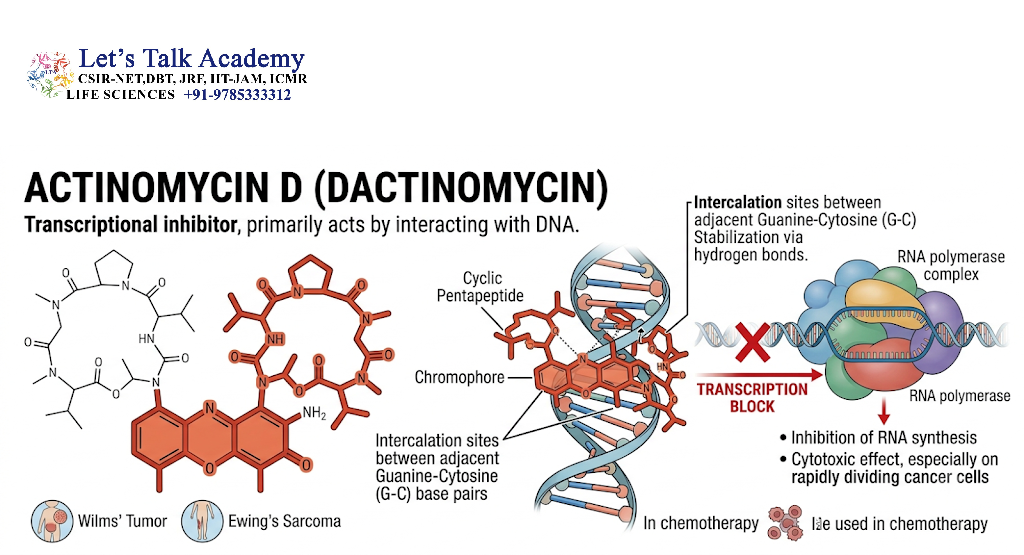
Actinomycin D, also known as dactinomycin, is a transcriptional inhibitor that primarily acts by interacting with DNA.
Unlike α-amanitin, which directly targets RNA polymerase II, actinomycin D affects transcription by binding to DNA and creating an obstacle to RNA polymerase progression.
5.2 Structure and DNA Binding
Actinomycin D contains a phenoxazine ring system associated with two cyclic peptide chains.
The planar portion of the molecule intercalates between DNA base pairs, with a preference for particular sequence contexts, especially GC-rich regions.
This interaction changes the local properties of DNA and interferes with the movement of transcription complexes.
5.3 Mechanism of Transcriptional Inhibition
Actinomycin D mainly inhibits transcriptional elongation.
The general mechanism can be represented as:
Actinomycin D → DNA intercalation → obstruction of RNA polymerase movement → reduced RNA elongation
It can affect transcription mediated by multiple eukaryotic RNA polymerases, although their sensitivities are not identical.
5.4 Effect on Different RNA Polymerases
Different classes of transcription show different sensitivities to actinomycin D. Ribosomal RNA transcription by RNA polymerase I can be particularly sensitive at relatively low concentrations, while higher concentrations can affect RNA polymerase II and III transcription.
This concentration-dependent behavior is important when interpreting experimental results.
6. DRB and Transcriptional Elongation

6.1 Introduction
DRB, or 5,6-dichloro-1-β-D-ribofuranosylbenzimidazole, is a compound historically used to study transcriptional elongation.
Rather than simply preventing RNA polymerase from binding DNA, DRB interferes with regulatory processes that are necessary for efficient elongation by RNA polymerase II.
6.2 Mechanism
Efficient RNA polymerase II elongation depends on phosphorylation of the carboxy-terminal domain of the largest RNA polymerase II subunit and the action of elongation-associated kinases.
DRB can inhibit kinases involved in these regulatory pathways, including CDK9-containing complexes, thereby reducing productive transcriptional elongation.
6.3 Experimental Importance
DRB has been useful for investigating:
- RNA polymerase II elongation
- Promoter-proximal pausing
- CTD phosphorylation
- Regulation of transcriptional processivity
- Transcriptional recovery after inhibitor removal
Because its effects are not absolutely specific to one transcriptional pathway, experimental conclusions should be interpreted carefully.
7. Flavopiridol
7.1 Introduction
Flavopiridol is a small-molecule inhibitor of cyclin-dependent kinases and can strongly affect transcriptional elongation.
It is particularly relevant to studies involving CDK9 and positive transcription elongation factor b, commonly called P-TEFb.
7.2 Mechanism
P-TEFb promotes productive RNA polymerase II elongation by phosphorylating components of the transcription machinery.
When CDK9 activity is inhibited, phosphorylation-dependent transition into productive elongation is impaired. Consequently, transcription of many genes can decrease.
Flavopiridol, like DRB, illustrates an important principle: transcription can be inhibited indirectly by targeting regulatory enzymes rather than RNA polymerase itself.
8. Triptolide
8.1 Introduction
Triptolide is a natural compound that has been studied as a relatively rapid inhibitor of eukaryotic transcription.
Its mechanism differs from classical DNA intercalators because it can interfere with the transcription machinery itself.
8.2 Effect on RNA Polymerase II
Studies have shown that triptolide can cause rapid inhibition of RNA polymerase II-dependent transcription and can promote degradation of the largest RNA polymerase II subunit, RPB1.
This makes triptolide useful as an experimental tool for examining the immediate consequences of transcriptional shutdown.
9. Other Mechanisms of Transcriptional Inhibition

Transcription can be inhibited through several additional mechanisms.
9.1 Inhibition of Promoter Recognition
Some compounds interfere with the interaction between transcription factors and promoter DNA.
If promoter recognition is prevented, RNA polymerase cannot efficiently assemble into a functional initiation complex.
9.2 Inhibition of Transcription Initiation
An inhibitor may prevent the formation or activation of the transcription initiation complex.
This results in fewer transcription events and therefore a reduction in newly synthesized RNA.
9.3 Inhibition of DNA Unwinding
Transcription requires localized separation of DNA strands. If DNA unwinding is prevented, RNA polymerase cannot access the template strand efficiently.
Compounds that alter DNA structure can therefore indirectly inhibit transcription.
9.4 Inhibition of RNA Polymerase Translocation
During elongation, RNA polymerase must move along the DNA template.
An inhibitor that restricts this movement can cause polymerase pausing or stalling.
α-Amanitin is a prominent example of an inhibitor that interferes with the molecular movements associated with RNA polymerase II translocation.
9.5 Premature Termination
Some transcriptional inhibitors cause RNA synthesis to terminate before the transcript reaches its normal endpoint.
The resulting RNA is often incomplete and may be rapidly degraded.
9.6 Inhibition Through Chromatin Modification
In eukaryotic cells, DNA is packaged into chromatin. Transcription requires appropriate chromatin accessibility.
Therefore, compounds that alter histone modification, nucleosome positioning, chromatin remodeling, or DNA methylation can indirectly change transcription.
10. Transcriptional Inhibitors in Prokaryotes and Eukaryotes
10.1 Prokaryotic Transcription
Bacteria generally possess one major RNA polymerase, although different sigma factors redirect the enzyme toward different groups of promoters.
Because bacterial RNA polymerase is structurally distinct from eukaryotic RNA polymerases, it can be selectively targeted by compounds such as rifampicin.
10.2 Eukaryotic Transcription
Eukaryotes contain multiple nuclear RNA polymerases with specialized functions.
| RNA Polymerase | Major Products | Relative Sensitivity to α-Amanitin |
|---|---|---|
| RNA Polymerase I | Major precursor rRNA | Relatively resistant |
| RNA Polymerase II | mRNA and several regulatory RNAs | Highly sensitive |
| RNA Polymerase III | tRNA, 5S rRNA and other small RNAs | Less sensitive than Pol II |
The differential sensitivity of the polymerases is particularly useful in experimental biology.
11. Comparison of Major Transcriptional Inhibitors
| Inhibitor | Major Target | Principal Mechanism | Major System |
|---|---|---|---|
| Rifampicin | Bacterial RNA polymerase | Blocks early RNA extension | Bacteria |
| α-Amanitin | RNA polymerase II | Interferes with polymerase translocation | Eukaryotes |
| Actinomycin D | DNA | DNA intercalation and obstruction of transcription | Prokaryotes and eukaryotes |
| DRB | Transcription-associated kinases | Reduces productive elongation | Eukaryotes |
| Flavopiridol | CDK9 and related kinases | Inhibits transcriptional elongation | Eukaryotes |
| Triptolide | Transcription machinery | Rapid transcriptional suppression and effects on RNAP II | Eukaryotes |
The table demonstrates that transcriptional inhibitors do not all work in the same manner. Their targets range from DNA and RNA polymerase to protein kinases and other transcription-associated components.
12. Effects of Transcriptional Inhibition on Cells

12.1 Reduction in RNA Synthesis
The immediate consequence of transcriptional inhibition is usually a reduction in the production of newly synthesized RNA.
However, pre-existing RNA molecules may remain in the cell until they undergo normal degradation.
Therefore:
Transcription inhibition ≠ immediate disappearance of all RNA
This distinction is important when interpreting experimental data.
12.2 Reduction in Protein Synthesis
Because mRNA synthesis is reduced, the production of many proteins eventually decreases.
However, this effect is usually delayed compared with the inhibition of RNA synthesis because existing mRNA and proteins can persist for different periods.
12.3 Changes in Cellular Growth
Strong or prolonged transcriptional inhibition can interfere with:
- Cell growth
- Cell-cycle progression
- Metabolism
- Differentiation
- Stress responses
- DNA damage responses
- Cell survival
The precise outcome depends on the cell type and the degree of transcriptional inhibition.
12.4 Effects on the Nucleolus
Inhibition of ribosomal RNA transcription can produce pronounced changes in nucleolar organization.
The nucleolus is the major site of ribosome biogenesis, and inhibition of RNA polymerase I-dependent transcription can disturb nucleolar structure and function.
12.5 Activation of Stress Responses
Global transcriptional inhibition can trigger cellular stress pathways.
For example, disruption of ribosome biogenesis can influence p53 regulation and contribute to cell-cycle arrest or apoptosis in appropriate cellular contexts.
13. Transcriptional Inhibition Does Not Affect All Genes Equally
An important concept is that transcriptional inhibitors do not necessarily suppress every gene to exactly the same degree.
Gene sensitivity can depend on:
- Promoter structure
- Transcription rate
- RNA polymerase occupancy
- Elongation efficiency
- Gene length
- DNA sequence
- Chromatin organization
- Stability of the transcript
- Dependence on specific transcription factors
Some genes may show rapid decreases in transcription, whereas others may continue to be transcribed for a considerable period.
Interestingly, global transcriptional inhibition can sometimes increase the expression of particular genes through feedback mechanisms. For example, inhibition of transcription can alter regulatory pathways that indirectly stimulate specific stress-responsive genes.
14. Reversible and Irreversible Transcriptional Inhibition

14.1 Reversible Inhibition
A reversible inhibitor temporarily interferes with transcription, but transcription can resume after the inhibitor is removed or its concentration falls.
This property is valuable in experimental studies because researchers can compare:
Before treatment → During inhibition → After recovery
DRB and some kinase inhibitors have been used in this type of experimental design.
14.2 Irreversible or Long-Lasting Inhibition
Some inhibitors produce prolonged effects because they cause stable molecular damage or promote degradation of essential transcription machinery.
α-Amanitin is an important example because its interaction with RNA polymerase II can lead to prolonged inhibition and RPB1 degradation in cells.
15. Factors Affecting the Efficiency of Transcriptional Inhibitors
The effectiveness of an inhibitor is influenced by several variables.
15.1 Concentration
Increasing inhibitor concentration generally increases transcriptional inhibition up to a biological limit. However, higher concentrations can also increase nonspecific effects and cellular toxicity.
15.2 Cellular Uptake
An inhibitor must reach its molecular target.
A compound may be extremely potent in a purified biochemical system but less effective in living cells if it enters cells poorly.
15.3 Target Accessibility
The molecular target must be accessible to the inhibitor.
DNA-associated compounds may be influenced by chromatin structure, while protein-targeting compounds depend on the availability and conformation of their target proteins.
15.4 Stability
The stability of the inhibitor within the experimental system can affect the duration and strength of transcriptional inhibition.
15.5 Cell Type
Different cell types can respond differently to the same inhibitor because of differences in:
- Uptake mechanisms
- Metabolic activity
- RNA polymerase abundance
- Transcriptional programs
- Drug efflux systems
- Stress-response pathways
16. Experimental Detection of Transcriptional Inhibition

Transcriptional inhibition can be evaluated using several experimental approaches.
16.1 Measurement of Newly Synthesized RNA
New RNA synthesis can be measured using nucleotide-labeling approaches or metabolic labeling techniques.
These methods help distinguish newly produced RNA from RNA that was synthesized before treatment.
16.2 RNA Sequencing
RNA sequencing can reveal changes in transcript abundance following transcriptional inhibition.
However, transcript abundance reflects both synthesis and RNA degradation. Therefore, RNA-sequencing data should not automatically be interpreted as a direct measurement of transcription rate.
16.3 Nuclear Run-On Approaches
Nuclear run-on methods measure transcriptionally engaged RNA polymerases and can provide more direct information about transcriptional activity.
16.4 Chromatin-Based Methods
Techniques such as chromatin immunoprecipitation can be used to examine the occupancy of RNA polymerase II and transcription-associated proteins on specific genes.
16.5 Microscopic Analysis
Transcriptional inhibition can produce changes in nuclear organization, including alterations in nucleolar structure and redistribution of transcription-associated proteins.
17. Biological and Research Applications
17.1 Studying Gene Expression
Transcriptional inhibitors provide experimental tools for determining how rapidly RNA is produced and degraded.
17.2 Studying RNA Stability
If transcription is temporarily blocked, researchers can monitor the disappearance of existing RNA over time.
This helps estimate RNA half-life.
17.3 Studying Transcriptional Elongation
Compounds that specifically affect elongation are useful for understanding promoter-proximal pausing, polymerase movement, and transcriptional processivity.
17.4 Studying RNA Polymerase Function
Selective inhibitors can help determine which RNA polymerase is responsible for a particular RNA population.
17.5 Antimicrobial Applications
Bacterial RNA polymerase is an important antimicrobial target. Rifamycin compounds demonstrate how selective inhibition of bacterial transcription can interfere with microbial growth.
17.6 Pharmacological Research
Because transcription is essential for cell proliferation and survival, transcriptional machinery has been investigated as a pharmacological target in several disease contexts, including cancer research.
18. Important Conceptual Differences Among Major Inhibitors
It is useful to distinguish the major inhibitors based on their primary targets.
Rifampicin: primarily targets bacterial RNA polymerase.
α-Amanitin: primarily targets eukaryotic RNA polymerase II and, at higher concentrations, affects RNA polymerase III.
Actinomycin D: primarily interacts with DNA and interferes with transcriptional progression.
DRB: interferes with transcriptional regulation, particularly elongation-associated kinase activity.
Flavopiridol: inhibits CDK activity and can suppress RNA polymerase II elongation.
Triptolide: rapidly suppresses transcription and can affect RNA polymerase II stability.
19. Limitations of Transcriptional Inhibitors
Although transcriptional inhibitors are valuable experimental tools, they must be interpreted carefully.
19.1 Lack of Absolute Specificity
Some inhibitors affect multiple cellular processes in addition to transcription.
For example, DNA-interacting compounds can influence DNA replication and cellular stress responses.
19.2 Cytotoxicity
Strong transcriptional inhibition can cause cellular stress and death, making it difficult to distinguish direct transcriptional effects from secondary consequences.
19.3 Concentration-Dependent Effects
An inhibitor may selectively affect one transcriptional process at one concentration but produce broader effects at higher concentrations.
19.4 Delayed Biological Responses
A decrease in RNA synthesis does not necessarily produce an immediate decrease in protein levels because existing RNA and proteins may remain functional.
19.5 Cell-Type Dependence
The same inhibitor can produce different outcomes in different organisms, tissues, or cell types.
20. Transcriptional Inhibitors and Gene Regulation
Transcriptional inhibition provides an important way to understand the dynamic nature of gene regulation.
Gene expression is not simply an ON or OFF process. Instead, transcription involves multiple regulatory stages:
Chromatin accessibility → Promoter recognition → Initiation → Promoter escape → Elongation → RNA processing → Termination
An inhibitor acting at any one of these stages can change the final RNA output.
This concept is particularly important in eukaryotic cells because transcription is closely integrated with chromatin remodeling, RNA processing, nuclear organization, and signaling pathways.


