
1. Introduction
Gene expression is a highly regulated process that allows cells to produce the RNA and proteins required for their survival, growth, differentiation, and response to environmental conditions. Transcription is one of the most important control points in gene expression.
Although RNA polymerase is responsible for synthesizing RNA, it does not independently determine which genes should be expressed. This decision is largely controlled by regulatory proteins called transcription factors.
Two major functional classes of transcription-regulatory proteins are:
- Transcription activators
- Transcription repressors
Transcription activators generally increase the expression of target genes, whereas transcription repressors generally decrease their expression.
These regulatory proteins interact with specific DNA sequences and with other components of the transcription machinery. They can influence gene expression by affecting promoter recognition, RNA polymerase recruitment, chromatin structure, enhancer-promoter communication, transcription initiation, and elongation.
A simplified representation is:
Activator → increased transcription
Repressor → decreased transcription
However, their mechanisms are more complex than this simple distinction. Activators and repressors often function through large protein complexes and can influence several stages of transcription.
2. Definition of Transcription Activators
2.1 Basic Definition
A transcription activator is a regulatory protein that increases the transcription of a target gene by interacting with regulatory DNA sequences and/or components of the transcription machinery.
Activators may bind to:
- enhancers,
- promoter-proximal regulatory elements,
- promoters,
- other gene-regulatory DNA sequences.
After binding, they can recruit proteins that facilitate transcription.
2.2 Main Functions
Transcription activators can:
- recruit RNA polymerase,
- recruit general transcription factors,
- recruit Mediator,
- recruit coactivators,
- promote chromatin remodeling,
- increase histone acetylation,
- stabilize transcription complexes,
- promote productive elongation.
3. Definition of Transcription Repressors
3.1 Basic Definition
A transcription repressor is a regulatory protein that decreases transcription of a target gene.
Repressors can bind directly to DNA or function through interactions with other regulatory proteins.
They may act by:
- blocking activator binding,
- interfering with RNA polymerase recruitment,
- recruiting corepressors,
- promoting chromatin compaction,
- recruiting histone deacetylases,
- inhibiting transcription initiation,
- reducing productive elongation.
4. Importance of Activators and Repressors
Cells contain large numbers of genes, but only a specific subset needs to be expressed at any particular time.
For example, genes required for muscle-cell function should be expressed at appropriate levels in muscle cells, whereas genes associated with unrelated cell types may remain inactive.
Activators and repressors help establish these cell-specific expression patterns.
They are therefore important for:
- cell differentiation,
- development,
- metabolism,
- growth,
- cellular signaling,
- environmental adaptation,
- stress responses,
- maintenance of cellular identity.
5. Structure of Transcription Activators and Repressors

Many transcription regulators contain several functional domains.
A simplified structure is:
DNA-binding domain + regulatory domain + protein-interaction domain
5.1 DNA-Binding Domain
The DNA-binding domain recognizes specific DNA sequences.
Common DNA-binding motifs include:
- zinc fingers,
- helix-turn-helix domains,
- homeodomains,
- basic helix-loop-helix domains,
- basic leucine zipper domains.
5.2 Activation Domain
An activation domain is a region of an activator that interacts with components of the transcription machinery or coactivator proteins.
Activation domains can recruit:
- Mediator,
- chromatin-remodeling complexes,
- histone acetyltransferases,
- general transcription factors.
5.3 Repression Domain
Repressors may contain repression domains that interact with:
- corepressors,
- histone deacetylases,
- chromatin-remodeling complexes,
- other inhibitory proteins.
6. DNA Binding by Activators and Repressors
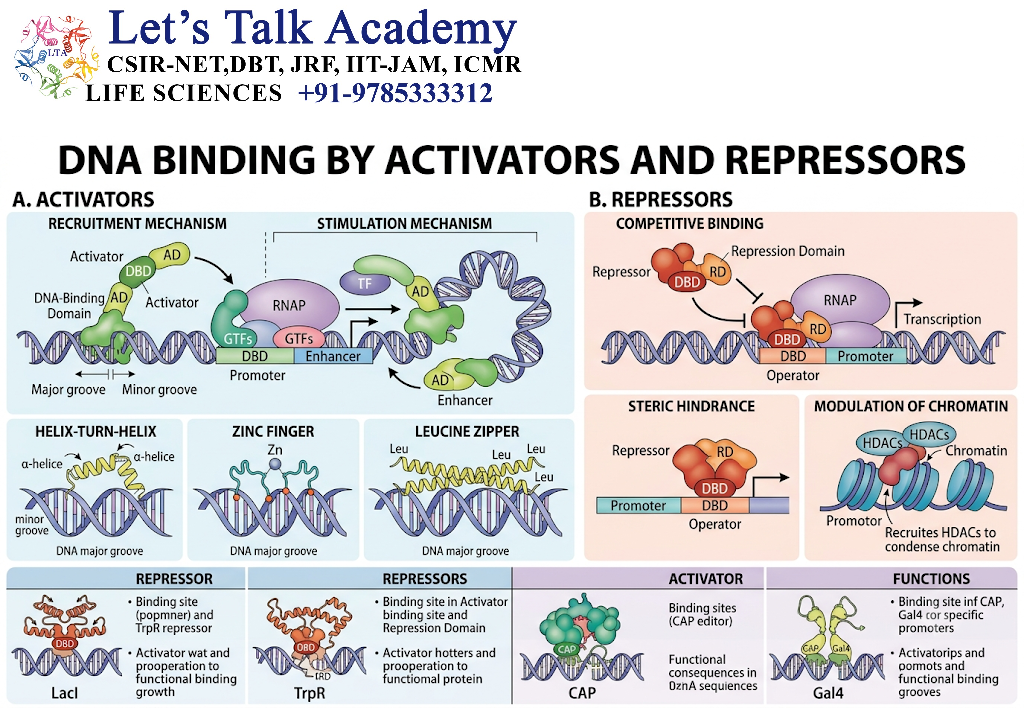
6.1 Sequence-Specific DNA Recognition
Many activators and repressors recognize specific nucleotide sequences.
These sequences are usually located in:
- promoters,
- enhancers,
- silencers,
- promoter-proximal regulatory regions.
The transcription factor binds the DNA through its DNA-binding domain.
6.2 Specificity
DNA-binding specificity allows a transcription factor to regulate particular genes rather than all genes in the genome.
However, transcriptional specificity depends on more than DNA sequence alone. It can also depend on:
- chromatin accessibility,
- transcription-factor concentration,
- interaction partners,
- cellular signaling,
- post-translational modification.
7. Transcriptional Activation

7.1 Basic Mechanism
Transcriptional activation generally involves the following sequence:
Activator synthesis or activation
↓
Activator enters nucleus
↓
Activator binds regulatory DNA
↓
Coactivator recruitment
↓
Chromatin remodeling
↓
Enhancer-promoter communication
↓
Transcription machinery assembly
↓
RNA polymerase recruitment
↓
Increased transcription
7.2 Recruitment of Transcription Machinery
Activators can interact with components of the transcription machinery.
These interactions can increase the probability that RNA polymerase will be recruited to the promoter and begin productive transcription.
8. Activator-Mediated Recruitment of Mediator

The Mediator complex is an important component of eukaryotic transcription regulation.
Activator proteins can interact with Mediator at enhancer regions.
Mediator can then communicate with promoter-associated transcription machinery and RNA polymerase II.
The simplified mechanism is:
Activator → Enhancer
↓
Mediator recruitment
↓
Promoter communication
↓
RNA Polymerase II recruitment/stabilization
↓
Transcription
9. Activators and Chromatin Remodeling

9.1 Chromatin as a Regulatory Barrier
Eukaryotic DNA is wrapped around histone proteins to form nucleosomes.
This organization can reduce accessibility of regulatory DNA.
Activators can recruit chromatin-remodeling complexes that alter nucleosome organization.
9.2 ATP-Dependent Remodeling
ATP-dependent chromatin-remodeling complexes use energy from ATP hydrolysis to reposition or restructure nucleosomes.
This can expose:
- promoter elements,
- enhancer sequences,
- transcription-factor-binding sites.
As a result, transcription machinery can gain better access to DNA.
10. Activators and Histone Acetylation
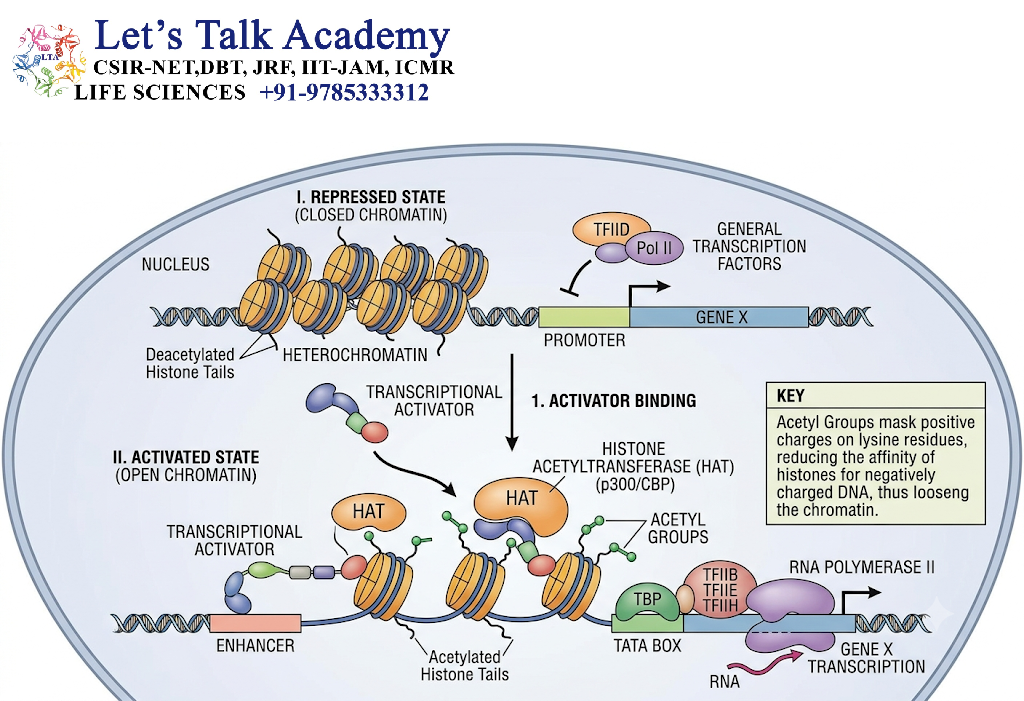
Activators can recruit histone acetyltransferases (HATs).
HATs add acetyl groups to specific lysine residues in histone proteins.
Histone acetylation is often associated with transcriptionally active chromatin.
A simplified pathway is:
Activator
↓
HAT recruitment
↓
Histone acetylation
↓
Chromatin accessibility increases
↓
Transcription machinery access increases
↓
Transcription increases
Histone acetylation is not simply an automatic “on switch”; its effects depend on the specific histone residue, genomic region, and proteins recruited by the modification.
11. Enhancers and Activators
11.1 Enhancer
An enhancer is a regulatory DNA element that can increase transcription of a target gene.
Enhancers may be located:
- upstream of a gene,
- downstream of a gene,
- within introns,
- at considerable distances from the promoter.
11.2 Activator Binding
Activator proteins bind specific sequences within enhancers.
The enhancer-bound activator then recruits regulatory proteins that communicate with the promoter.
11.3 DNA Looping
Because enhancers can be far from promoters, DNA looping brings them into functional proximity.
The process can be represented as:
Activator binds enhancer
↓
DNA looping
↓
Enhancer-promoter interaction
↓
Mediator/coactivator recruitment
↓
Transcription machinery assembly
↓
Gene activation
12. Transcriptional Repression
12.1 Basic Mechanism
Transcriptional repression can occur through several mechanisms.
A simplified pathway is:
Repressor activation
↓
DNA binding
↓
Corepressor recruitment
↓
Chromatin modification or transcription-machinery inhibition
↓
Reduced transcription
12.2 Direct Repression
A repressor can directly interfere with transcription machinery.
For example, it may prevent:
- activator binding,
- RNA polymerase recruitment,
- general transcription-factor assembly.
13. Repressors and Corepressors
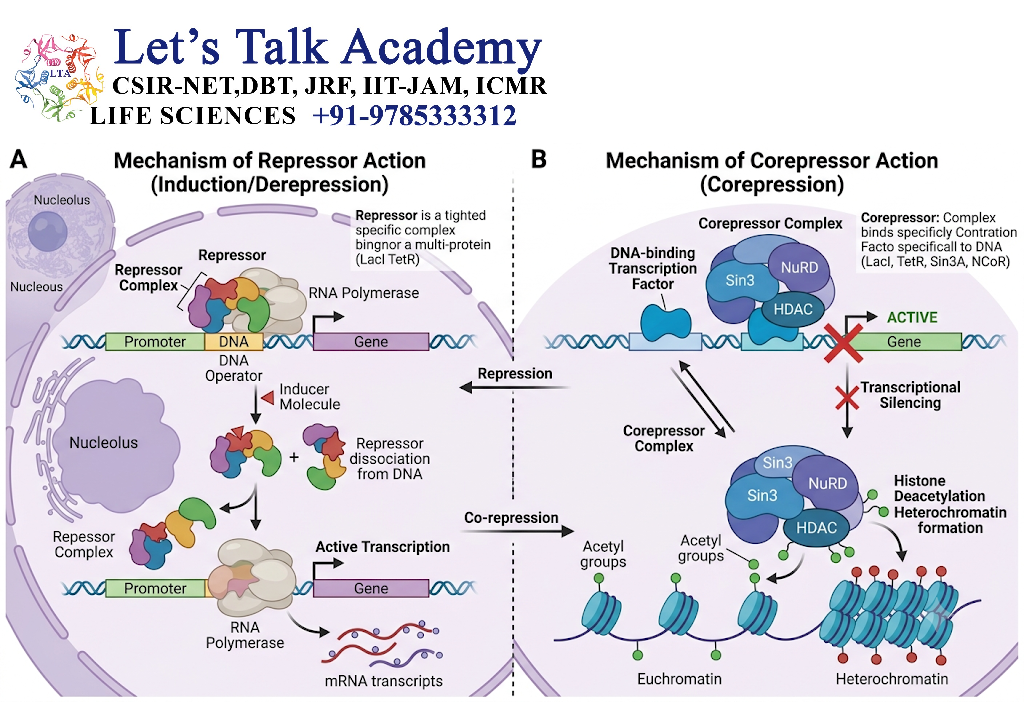
13.1 Definition
A corepressor is a protein or protein complex that assists a transcriptional repressor in reducing gene expression.
Corepressors often do not need to bind DNA directly.
Instead, they are recruited by DNA-bound repressors.
13.2 Corepressor Functions
Corepressors may recruit:
- histone deacetylases,
- chromatin-remodeling proteins,
- histone-modifying enzymes,
- DNA methylation-associated factors,
- other repressive complexes.
14. Repressors and Histone Deacetylation

Histone deacetylases remove acetyl groups from histone proteins.
This can promote a chromatin environment that is less accessible to transcription machinery.
A simplified mechanism is:
Repressor binds DNA
↓
Corepressor recruited
↓
HDAC recruited
↓
Histone deacetylation
↓
Reduced chromatin accessibility
↓
Transcription decreases
Again, the relationship between histone acetylation and transcription depends on genomic context and the particular chromatin environment.
15. Repressors and Chromatin Compaction

Some repressors recruit complexes that promote formation of more compact chromatin.
Compact chromatin can restrict access of transcription factors and RNA polymerase to DNA.
Therefore:
Repressor → repressive chromatin environment → reduced DNA accessibility → reduced transcription
16. Competitive Repression
A repressor can compete with an activator for the same or overlapping DNA-binding site.
If the repressor occupies the site, the activator cannot bind efficiently.
For example:
Activator + DNA → activation
but
Repressor + DNA → activator excluded → reduced transcription
This mechanism is particularly effective when activator and repressor binding sites overlap.
17. Quenching
In quenching, a repressor interferes with an activator without necessarily preventing the activator from binding DNA.
The repressor may interact directly with the activator and prevent it from recruiting the transcription machinery.
Thus:
Activator binds DNA
↓
Repressor interacts with activator
↓
Activator function inhibited
↓
Transcription decreases
18. Direct Interaction with RNA Polymerase

Some transcription repressors can interfere directly with RNA polymerase.
They may prevent:
- polymerase recruitment,
- promoter clearance,
- productive initiation.
This provides a rapid mechanism for transcriptional inhibition.
19. Activator and Repressor Competition
Many genes are regulated by the balance between activators and repressors.
For example:
Strong activator activity + weak repression → high transcription
Strong repression + weak activator activity → low transcription
Balanced activity → intermediate transcription
This allows cells to produce different levels of gene expression rather than simply turning genes completely on or off.
20. Positive and Negative Regulation
20.1 Positive Regulation
Positive regulation occurs when a regulatory protein increases transcription.
Usually:
Activator → increased gene expression
20.2 Negative Regulation
Negative regulation occurs when a regulatory protein decreases transcription.
Usually:
Repressor → decreased gene expression
These concepts are particularly important in bacterial operons and are also applicable to many eukaryotic regulatory systems.
21. Activators in Bacteria

Bacterial activators commonly increase transcription by interacting with RNA polymerase or promoter-associated components.
An activator may:
- increase RNA polymerase binding,
- stabilize the polymerase-promoter complex,
- promote transition into transcription initiation.
A classic example is CAP/CRP regulation of the lac operon.
22. CAP/CRP-Mediated Activation

When glucose levels are low, intracellular cyclic AMP can rise.
cAMP binds to CAP/CRP.
The cAMP-CAP/CRP complex binds a regulatory DNA site near the lac promoter.
This interaction helps RNA polymerase initiate transcription efficiently.
The system therefore links cellular metabolic conditions to gene expression.
23. Activators in Eukaryotes

Eukaryotic activators commonly function through multiple mechanisms.
They can:
- bind enhancers,
- recruit Mediator,
- recruit chromatin-remodeling complexes,
- recruit histone-modifying enzymes,
- promote enhancer-promoter communication,
- facilitate general transcription-factor assembly.
24. Repressors in Bacteria

Bacterial repressors often bind operator sequences.
When a repressor occupies the operator, it can prevent RNA polymerase from efficiently transcribing the structural genes.
The lac repressor provides a classical example.
25. Lac Repressor
25.1 Basic Mechanism
The lac repressor binds the operator in the absence of an appropriate inducer signal.
This reduces transcription of genes required for lactose utilization.
When lactose is present, its regulatory derivative allolactose interacts with the repressor and decreases its ability to bind the operator.
As a result, repression is relieved.
25.2 Biological Significance
This mechanism prevents unnecessary production of proteins required for lactose metabolism when lactose is unavailable.
26. Activators and Repressors in the lac Operon
The lac system demonstrates both negative and positive regulation.
Negative regulation
Lac repressor → operator binding → transcription reduced
Positive regulation
cAMP-CAP/CRP → regulatory-site binding → transcription enhanced
Therefore, efficient lac operon expression depends on both the absence of strong repression and the presence of appropriate activation.
27. Trp Operon Repression
The trp operon provides an example of negative regulation.
When tryptophan is abundant:
Tryptophan
↓
Binds trp repressor
↓
Repressor becomes active
↓
Operator binding
↓
Transcription decreases
When tryptophan is scarce, repression is reduced and transcription can increase.
28. Activator and Repressor Networks
Transcription factors rarely act in complete isolation.
One transcription factor may regulate another transcription factor.
For example:
TF-A → activates TF-B
TF-B → represses Gene C
TF-A → activates Gene D
This creates regulatory networks that allow cells to coordinate the expression of many genes.
29. Combinatorial Regulation
A single gene can be controlled by several activators and repressors.
The final transcriptional output depends on their combined activities.
For example:
Activator A + Activator B → strong activation
Activator A + Repressor C → reduced activation
Repressor C + Repressor D → strong repression
This is called combinatorial control.
It is a major principle of eukaryotic gene regulation.
30. Signal-Dependent Activation
Activators can be activated by extracellular or intracellular signals.
A general mechanism is:
External signal
↓
Receptor
↓
Signal-transduction pathway
↓
Activator modification
↓
Activator enters or functions in nucleus
↓
DNA binding
↓
Target-gene activation
This mechanism allows cells to convert environmental information into changes in gene expression.
31. Signal-Dependent Repression
Signals can also activate repressors or inhibit activators.
For example:
Signal
↓
Regulatory pathway
↓
Repressor activation
↓
DNA binding/corepressor recruitment
↓
Target-gene repression
Thus, cellular signaling can either increase or decrease transcription.
32. Post-Translational Regulation
Activators and repressors can be regulated after their synthesis.
Important post-translational modifications include:
- phosphorylation,
- acetylation,
- methylation,
- ubiquitination,
- sumoylation.
These modifications can affect:
- DNA binding,
- protein stability,
- nuclear localization,
- interaction with coactivators,
- interaction with corepressors.
33. Nuclear Localization
Many transcription regulators need to reach the nucleus to regulate genes.
A signaling pathway can control their localization.
For example:
Inactive activator in cytoplasm
↓
Cellular signal
↓
Protein modification
↓
Nuclear import
↓
DNA binding
↓
Gene activation
This allows rapid control of gene expression.
34. Steroid Hormone Receptors
Steroid hormone receptors provide an important example of transcription factors regulated by small molecules.
Steroid hormones can cross the plasma membrane because of their lipid-soluble nature.
The hormone binds its intracellular receptor.
The hormone-receptor complex can then interact with specific DNA regulatory sequences.
The receptor recruits coactivators or corepressors and changes transcription of target genes.
35. Activators and Repressors in Development
Development requires precise patterns of gene activation and repression.
During development:
- some genes must be activated,
- others must remain repressed,
- gene expression must change at specific times,
- different cell types must express different gene sets.
Transcription activators and repressors establish these patterns.
36. Role in Cell Differentiation
Differentiated cells express distinct sets of genes.
For example, a neuron expresses a different collection of genes from a liver cell even though both contain essentially the same genome.
Specific combinations of activators and repressors help establish these differences.
37. Pioneer Transcription Factors
Some transcription factors called pioneer factors can recognize target sequences in relatively inaccessible chromatin.
They can initiate chromatin changes that allow additional regulatory proteins to bind.
Pioneer factors are particularly important in:
- development,
- differentiation,
- cell-fate determination.
38. Enhancer-Promoter Communication
Activator function often depends on communication between distant regulatory regions.
The mechanism includes:
- Activator binding to enhancer
- Recruitment of coactivators
- DNA looping
- Mediator interaction
- Promoter-associated machinery recruitment
- RNA polymerase II activation
This creates a functional connection between enhancer and promoter.
39. Silencers and Repressors
Silencers are regulatory DNA sequences that decrease gene expression.
Repressors bind to silencers and recruit corepressors.
The resulting complexes can:
- reduce chromatin accessibility,
- inhibit activator function,
- interfere with transcription machinery,
- promote repressive chromatin.
Thus:
Silencer + Repressor + Corepressor → reduced transcription
40. Regulation of Transcriptional Elongation
Activators and repressors can influence not only transcription initiation but also elongation.
RNA polymerase II may pause shortly after initiation.
Regulatory factors can determine whether RNA polymerase:
- remains paused,
- enters productive elongation,
- undergoes termination.
Therefore, transcriptional control can occur after initiation has already begun.
41. Transcriptional Bursting
Gene transcription often occurs in bursts rather than at a perfectly continuous rate.
Activators can influence:
- frequency of transcriptional bursts,
- duration of active transcription,
- number of RNA molecules produced during a burst.
Repressors can reduce these parameters.
This contributes to cell-to-cell variation in gene expression.
42. Epigenetic Regulation
Activators and repressors can influence epigenetic states.
They may recruit proteins involved in:
- histone modification,
- DNA methylation,
- chromatin remodeling,
- nucleosome repositioning.
These mechanisms can create relatively stable differences in gene activity.
43. Activators, Repressors and Chromatin State
The relationship can be summarized as:
Activator-associated pathway
Activator → coactivator → chromatin opening → transcription increases
Repressor-associated pathway
Repressor → corepressor → chromatin restriction → transcription decreases
These pathways are simplified models; individual genes can involve much more complex combinations of regulatory mechanisms.
44. Direct and Indirect Regulation
44.1 Direct Regulation
A transcription factor directly binds a regulatory DNA sequence.
Example:
Repressor → operator
44.2 Indirect Regulation
A regulatory protein affects another transcription factor or chromatin regulator, which then influences transcription.
Example:
Signal → regulator A → transcription factor B → target gene
Both mechanisms are common in gene regulatory networks.
45. Comparison of Transcription Activators and Repressors
| Feature | Transcription Activators | Transcription Repressors |
|---|---|---|
| General effect | Increase transcription | Decrease transcription |
| Common DNA sites | Enhancers, promoters, regulatory elements | Silencers, operators, regulatory elements |
| Major partners | Coactivators, Mediator, HATs | Corepressors, HDACs, repressive complexes |
| Chromatin effect | Often promotes accessibility | Often promotes reduced accessibility |
| RNA polymerase | Facilitates recruitment/activity | Can inhibit recruitment/activity |
| Gene expression | Increased | Decreased |
| Function | Gene activation | Gene repression |
46. Comparison of Coactivators and Corepressors
| Feature | Coactivators | Corepressors |
|---|---|---|
| Function | Assist activation | Assist repression |
| Direct DNA binding | Usually not required | Usually not required |
| Common partners | Activators | Repressors |
| Chromatin effect | Often increases accessibility | Often decreases accessibility |
| Examples of associated activities | HATs, Mediator, chromatin remodeling | HDACs, repressive chromatin complexes |
47. Positive and Negative Control
Gene regulation can involve both positive and negative mechanisms.
Positive control
A regulatory protein increases transcription.
Activator → transcription increases
Negative control
A regulatory protein decreases transcription.
Repressor → transcription decreases
A single gene may be under both types of control simultaneously.
48. Integrated Mechanism of Activation
A detailed model of transcriptional activation is:
1. Cellular signal
↓
2. Activator activation
↓
3. Activator enters nucleus
↓
4. Activator binds enhancer
↓
5. Coactivator recruitment
↓
6. Histone modification
↓
7. Chromatin remodeling
↓
8. DNA looping
↓
9. Mediator recruitment
↓
10. Promoter recognition
↓
11. General transcription-factor assembly
↓
12. RNA polymerase II recruitment
↓
13. Promoter opening
↓
14. Transcription initiation
↓
15. Productive elongation
↓
16. RNA production
49. Integrated Mechanism of Repression
A detailed model of transcriptional repression is:
1. Repressor activation
↓
2. Repressor binds regulatory DNA
↓
3. Corepressor recruitment
↓
4. Histone deacetylation or other repressive modifications
↓
5. Chromatin accessibility decreases
↓
6. Activator function may be blocked
↓
7. Transcription machinery recruitment decreases
↓
8. RNA polymerase activity decreases
↓
9. Transcription decreases
50. Biological Significance
50.1 Cell Differentiation
Activators and repressors establish cell-specific gene-expression patterns.
50.2 Development
They regulate genes responsible for developmental processes.
50.3 Metabolism
They regulate genes encoding metabolic enzymes and transport proteins.
50.4 Environmental Response
They allow cells to respond to changes such as:
- temperature,
- nutrients,
- oxidative conditions,
- stress,
- extracellular signals.
50.5 Cellular Homeostasis
They maintain appropriate levels of gene expression required for normal cellular activity.
50.6 Cell Identity
Stable patterns of activation and repression help maintain specialized cell states.


