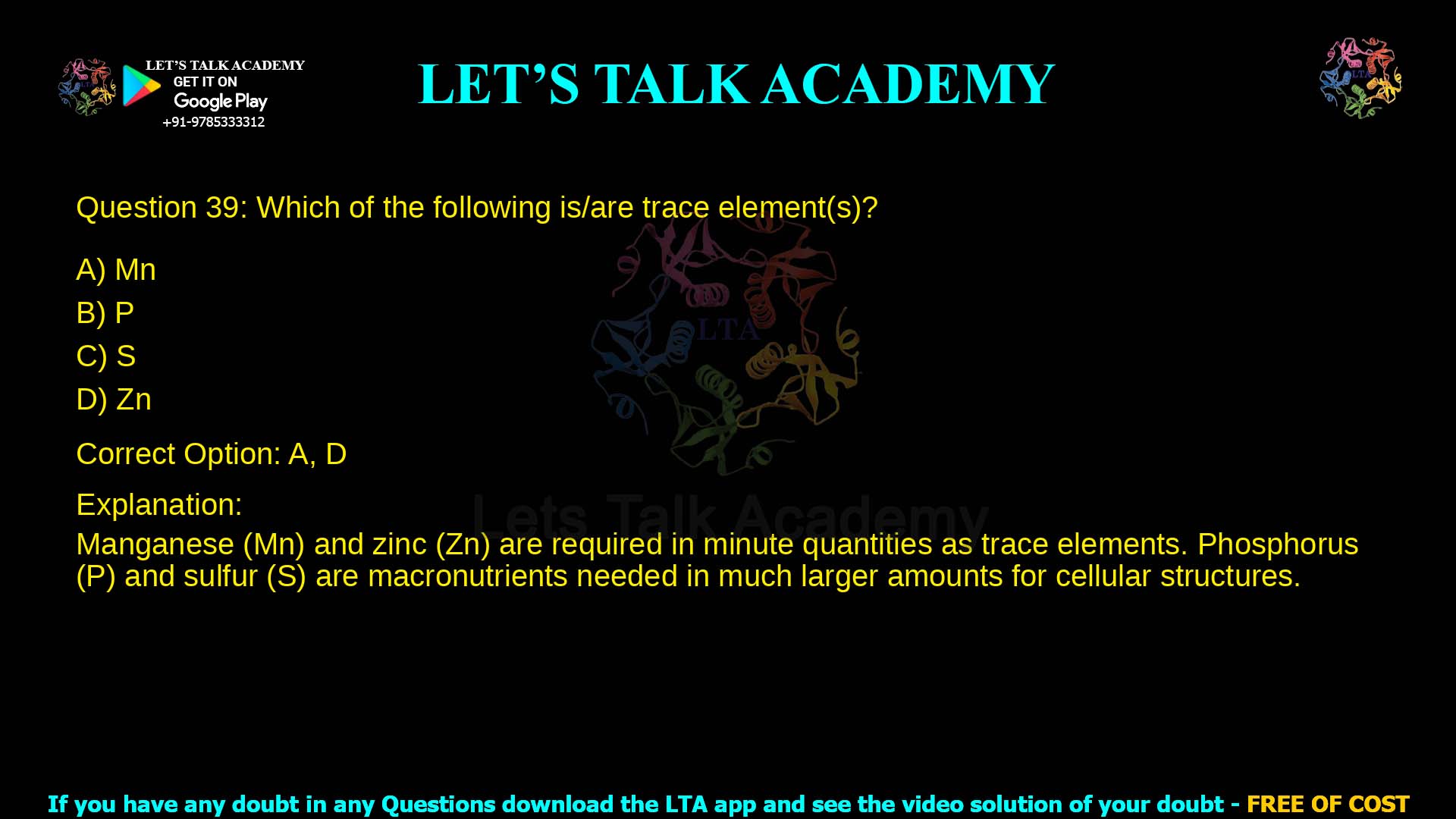
Q.39 Which of the following is/are trace element(s)?
(A) Mn
(B) P
(C) S
(D) Zn
Mn and Zn are trace elements (micronutrients) required by plants in very small amounts, while P and S are macronutrients needed in larger quantities.
Option Analysis
-
(A) Mn (Manganese): Manganese qualifies as a trace element. Plants require it in minute quantities (typically <100 ppm in tissue) for enzyme activation in photosynthesis and nitrogen metabolism.
-
(B) P (Phosphorus): Phosphorus does not qualify as a trace element. It is a primary macronutrient essential for ATP, DNA, and root development, absorbed in large amounts (>1000 ppm).
-
(C) S (Sulfur): Sulfur is not a trace element. Classified as a secondary macronutrient, it supports protein synthesis and chlorophyll formation, required at higher levels than micronutrients.
-
(D) Zn (Zinc): Zinc is a trace element. It functions as a cofactor in enzymes for auxin synthesis and protein metabolism, needed only in trace amounts.
Correct answer: (A) and (D).
Plants rely on 17 essential mineral nutrients, divided into macronutrients and trace elements (micronutrients) based on quantity required. Trace elements in plants like Mn and Zn are vital yet needed in tiny doses (<100 ppm), while P and S demand larger supplies. This classification is key for CSIR NET Life Sciences exam prep on plant nutrition.
Macronutrients vs Trace Elements
Macronutrients form the bulk of plant tissue (>1000 ppm), supporting structure and energy. Trace elements in plants act as enzyme cofactors despite low needs.
| Nutrient | Category | Tissue Concentration | Key Role |
|---|---|---|---|
| Mn | Trace element | <100 ppm | Photosynthesis, enzyme activation |
| P | Macronutrient | >1000 ppm | Energy transfer (ATP), nucleic acids |
| S | Macronutrient | 1000-4000 ppm | Amino acids, vitamins |
| Zn | Trace element | <100 ppm | Enzyme function, growth hormones |
Deficiencies in trace elements in plants cause specific symptoms like chlorosis, unlike macronutrient shortages.
Roles in Plant Physiology
-
Manganese activates water-splitting in photosystem II.
-
Zinc stabilizes RNA and aids pollination.
-
Phosphorus drives respiration; excess P locks out Zn.
-
Sulfur builds cysteine for stress resistance.
For CSIR NET, recall: primary macros (N,P,K), secondary (Ca,Mg,S), traces (Fe,Mn,Zn,B,Cu,Mo,Cl,Ni).


