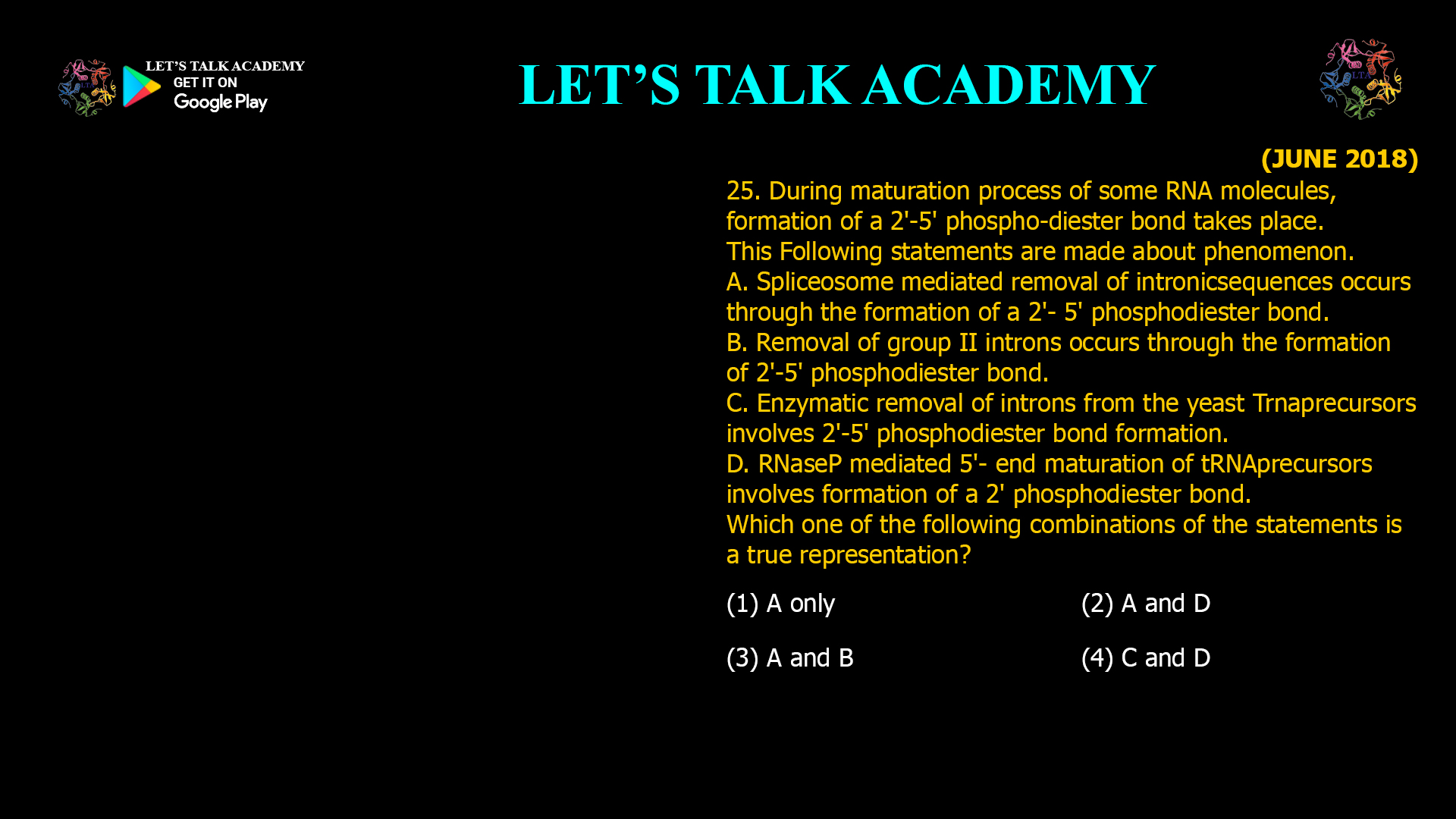
25. During maturation process of some RNA molecules, formation of a 2′-5′ phospho-diester bond takes place. This Following statements are made about phenomenon.
A. Spliceosome mediated removal of intronic sequences occurs through the formation of a 2′- 5′ phosphodiester bond.
B. Removal of group II introns occurs through the formation of 2′-5′ phosphodiester bond.
C. Enzymatic removal of introns from the yeast tRNA precursors involves 2′-5′ phosphodiester bond formation.
D. RNaseP mediated 5′- end maturation of tRNA precursors involves formation of a 2′ phosphodiester bond.
Which one of the following combinations of the statements is a true representation?
(1) A only (2) A and D
(3) A and B (4) C and D
The correct combination of true statements regarding the formation of 2′-5′ phosphodiester bonds during RNA maturation is:
(3) A and B
Explanation:
A. Spliceosome mediated removal of intronic sequences occurs through the formation of a 2′-5′ phosphodiester bond.
This is true. During spliceosome-mediated splicing of pre-mRNA, the first step involves the 2′-OH of the branch point adenosine attacking the 5′ splice site phosphate, forming a characteristic 2′-5′ phosphodiester bond in the lariat intermediate. This branched structure is essential for intron removal and exon ligation.
B. Removal of group II introns occurs through the formation of 2′-5′ phosphodiester bond.
This is also true. Group II introns self-splice via a mechanism similar to spliceosomal splicing, involving the formation of a 2′-5′ phosphodiester bond at the branch point to create a lariat intermediate.
C. Enzymatic removal of introns from the yeast tRNA precursors involves 2′-5′ phosphodiester bond formation.
This is false. Yeast tRNA introns are removed by a different enzymatic pathway involving endonucleolytic cleavage and ligation, but it does not involve a 2′-5′ phosphodiester bond or lariat formation.
D. RNase P mediated 5′-end maturation of tRNA precursors involves formation of a 2′ phosphodiester bond.
This is false. RNase P cleaves the 5′ leader sequence of pre-tRNA to generate the mature 5′ end but does not form 2′-5′ phosphodiester bonds; it is an endonuclease that cleaves phosphodiester bonds without forming branched linkages.
Summary Table
| Statement | True/False | Explanation |
|---|---|---|
| A | True | Spliceosomal lariat formation involves 2′-5′ phosphodiester bond. |
| B | True | Group II intron self-splicing also forms 2′-5′ phosphodiester bonds. |
| C | False | Yeast tRNA intron removal is enzymatic but does not form 2′-5′ bonds. |
| D | False | RNase P cleaves 5′ leader without forming 2′-5′ bonds. |
Conclusion
The formation of a 2′-5′ phosphodiester bond is a hallmark of the lariat intermediate in spliceosome-mediated splicing (statement A) and group II intron self-splicing (statement B). It is not involved in yeast tRNA intron removal or RNase P-mediated tRNA maturation. Therefore, the correct answer is:
(3) A and B


5 Comments
Suman bhakar
June 4, 2025✅✅
Lokesh Kumawat
June 8, 2025Done
Kabeer narwal
June 11, 2025👍👍
Divya rani
November 3, 2025A and B are correct because in Group ll splicing there is 2′-5′ PDB and in spliceosome mediated removal of introns , spliceosome lariat formation involves the of 2′-5′ PDB.
Heena Mahlawat
November 5, 2025A and B