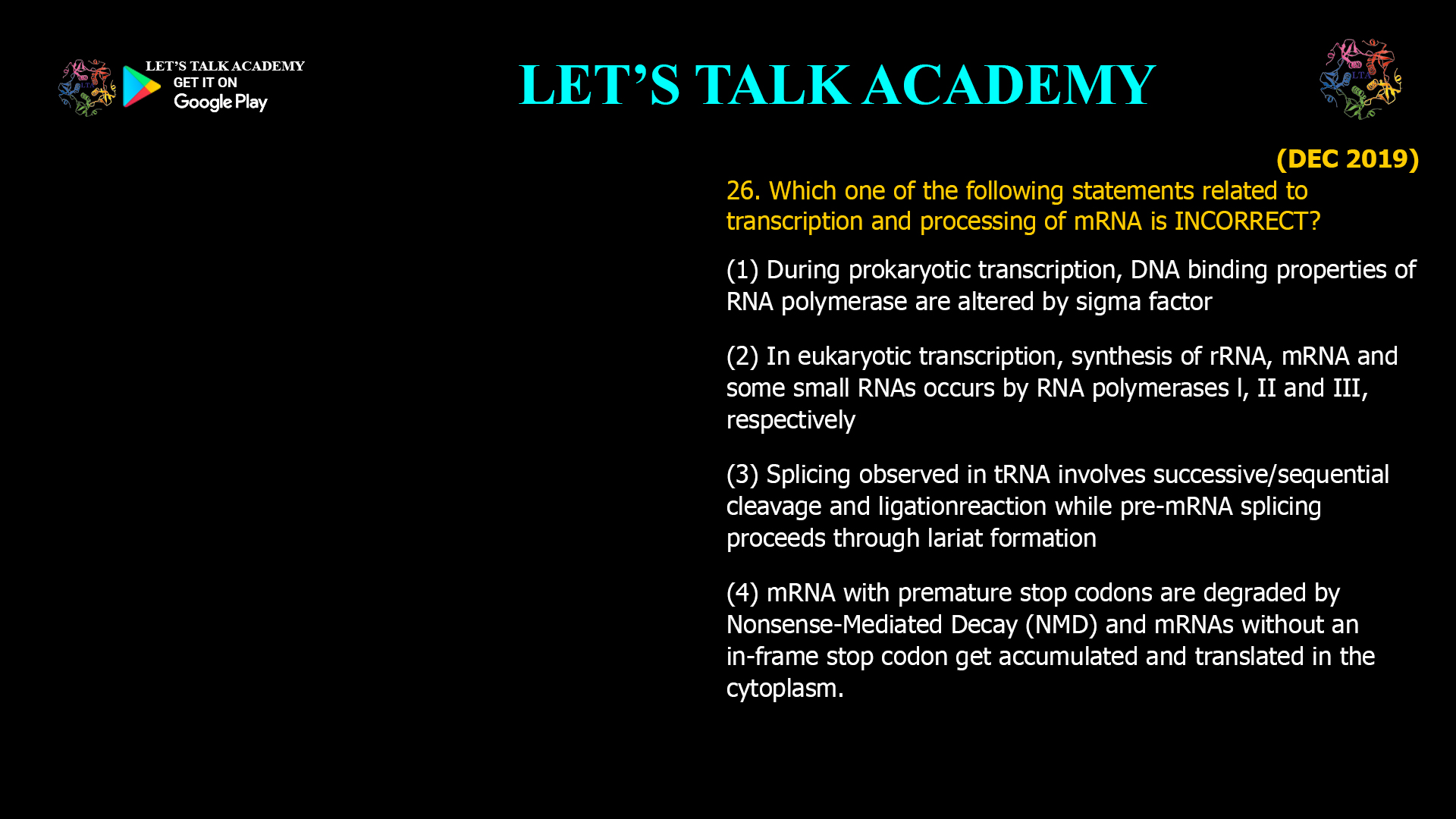
26. Which one of the following statements related to transcription and processing of mRNA is INCORRECT?
(1) During prokaryotic transcription, DNA binding properties of RNA polymerase are altered by sigma factor
(2) In eukaryotic transcription, synthesis of rRNA, mRNA and some small RNAs occurs by RNA polymerases l, II and III, respectively
(3) Splicing observed in tRNA involves successive/sequential cleavage and ligation reaction while pre-mRNA splicing proceeds through lariat formation
(4) mRNA with premature stop codons are degraded by Nonsense-Mediated Decay (NMD) and mRNAs without an in-frame stop codon get accumulated and translated in the cytoplasm.
The incorrect statement related to transcription and processing of mRNA among the given options is:
(4) mRNA with premature stop codons are degraded by Nonsense-Mediated Decay (NMD) and mRNAs without an in-frame stop codon get accumulated and translated in the cytoplasm.
Explanation of Each Statement:
(1) During prokaryotic transcription, DNA binding properties of RNA polymerase are altered by sigma factor
This is correct. In prokaryotes, the sigma factor binds to the core RNA polymerase to form the holoenzyme, which specifically recognizes promoter sequences and initiates transcription. The sigma factor alters the DNA binding specificity of RNA polymerase to promoters.
(2) In eukaryotic transcription, synthesis of rRNA, mRNA and some small RNAs occurs by RNA polymerases I, II and III, respectively
This is correct.
-
RNA polymerase I synthesizes most rRNAs (except 5S rRNA).
-
RNA polymerase II synthesizes mRNA and some snRNAs.
-
RNA polymerase III synthesizes 5S rRNA, tRNAs, and some small RNAs.
(3) Splicing observed in tRNA involves successive/sequential cleavage and ligation reaction while pre-mRNA splicing proceeds through lariat formation
This is correct.
-
Pre-mRNA splicing involves formation of a lariat intermediate via a 2′-5′ phosphodiester bond at the branch point.
-
tRNA intron removal occurs by endonucleolytic cleavage and ligation without lariat formation.
(4) mRNA with premature stop codons are degraded by Nonsense-Mediated Decay (NMD) and mRNAs without an in-frame stop codon get accumulated and translated in the cytoplasm
This is incorrect.
-
While it is true that mRNAs with premature stop codons are targeted for degradation by NMD, mRNAs without an in-frame stop codon do not get translated and accumulate. Instead, such aberrant mRNAs are usually rapidly degraded by other quality control mechanisms like nonstop decay (NSD) or exosome-mediated decay to prevent production of aberrant proteins. They do not accumulate or get translated efficiently in the cytoplasm.
Summary Table
| Statement | Correct/Incorrect | Explanation |
|---|---|---|
| (1) | Correct | Sigma factor directs RNA polymerase to promoters in prokaryotes. |
| (2) | Correct | Eukaryotic RNA polymerases I, II, III transcribe rRNA, mRNA, and small RNAs, respectively. |
| (3) | Correct | tRNA splicing involves cleavage and ligation; pre-mRNA splicing uses lariat formation. |
| (4) | Incorrect | mRNAs without stop codons do not accumulate or get translated; they are degraded by quality control pathways. |
Conclusion
The incorrect statement is (4) because mRNAs lacking an in-frame stop codon are not translated or accumulated but are instead rapidly degraded by cellular surveillance mechanisms. The other statements accurately describe key aspects of transcription and mRNA processing.


6 Comments
Suman bhakar
June 4, 2025✅✅
Lokesh Kumawat
June 8, 2025Done 👍
Prami Masih
June 11, 2025Done 8
Santosh Saini
November 3, 2025mRNA with premature stop codons are degraded by nonsense mediated decay(NMD) and mRNAs without an in- frame stop codon get accumulated and translated in the cytoplasm
Heena Mahlawat
November 5, 2025Option 4
Sakshi Kanwar
November 8, 2025mRNA with premature stop codons are degraded by Nonsense-Mediated Decay (NMD) and mRNAs without an in-frame stop codon get accumulated and translated in the cytoplasm