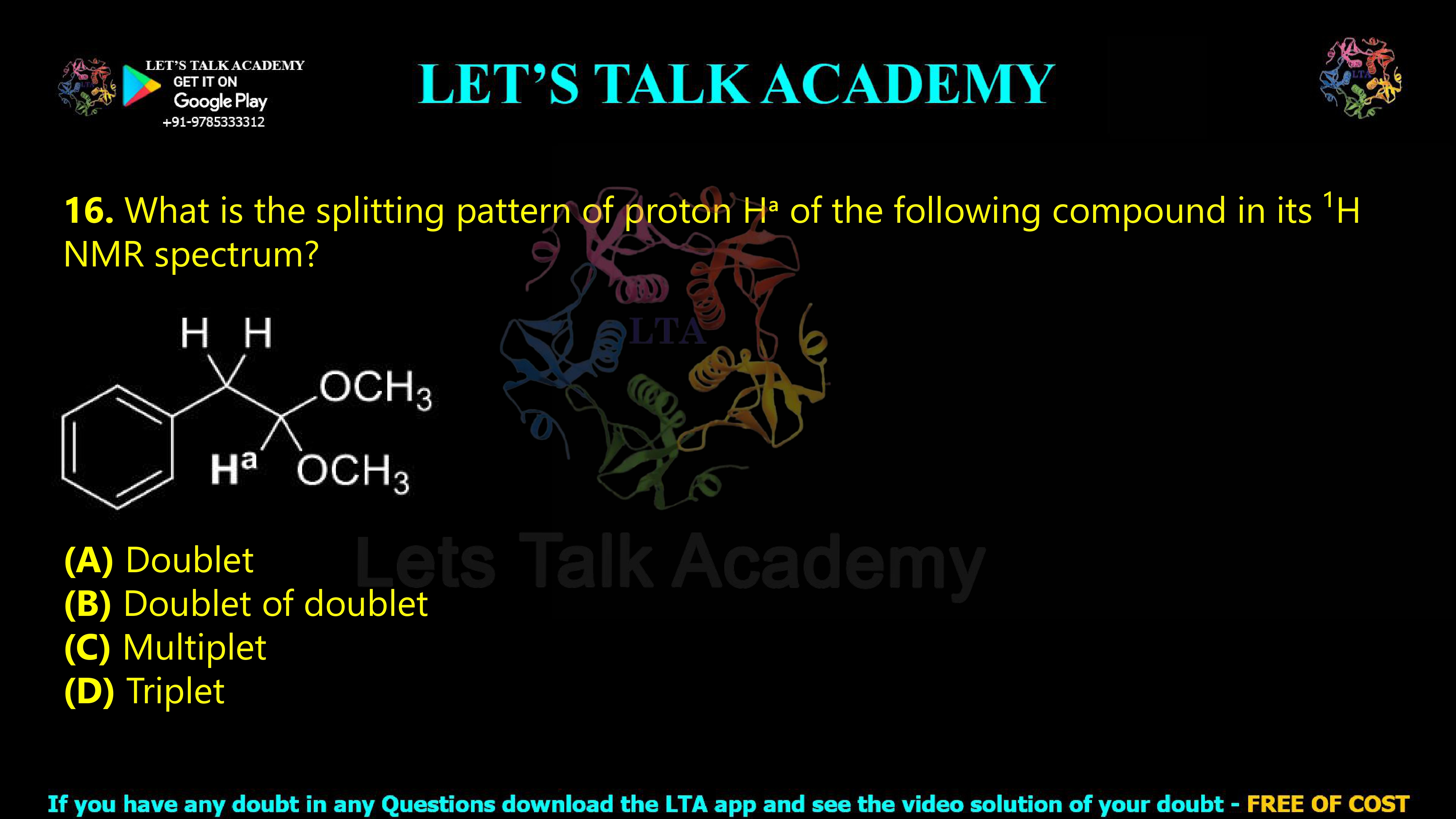
15. What is the splitting pattern of proton Hᵃ of the following compound in its ¹H NMR spectrum?
(A) Doublet
(B) Doublet of doublet
(C) Multiplet
(D) Triplet
What Is the Splitting Pattern of Proton Ha in the Given Compound in Its ¹H NMR Spectrum?
Correct Answer: (D) Triplet
The correct answer is Option (D), Triplet. The proton labeled Ha is attached to the carbon bearing two methoxy groups, and the carbon directly adjacent to Ha is a methylene carbon containing two equivalent neighboring protons.
In the usual first-order interpretation of a ¹H NMR spectrum, a proton coupled to n equivalent neighboring protons is split into n + 1 lines. Since Ha has two equivalent neighboring methylene protons:
n = 2
Therefore:
Number of peaks = n + 1
Number of peaks = 2 + 1 = 3
A signal containing three lines is called a triplet. Therefore, proton Ha appears as a triplet in the expected first-order ¹H NMR spectrum.
The two methoxy groups do not split Ha because spin-spin coupling is generally considered through the relevant neighboring bonding network, and the methyl protons of the OCH3 groups are separated from Ha by oxygen atoms. The principal resolved splitting of Ha is therefore caused by the two protons of the adjacent CH2 group.
Understanding the Structure Before Predicting the NMR Splitting Pattern
The most important step in solving a proton NMR splitting question is to identify the exact position of the proton being observed and then examine the protons on neighboring atoms that can produce spin-spin coupling.
The compound shown in the question can be represented in simplified form as:
C6H5–CH2–CH(OCH3)2
The proton labeled Ha is the single proton attached to the acetal carbon:
C6H5–CH2–CHa(OCH3)2
On one side of Ha, there is a CH2 group containing two protons. On the other two bonds of the same carbon, there are methoxy substituents. Therefore, the neighboring methylene protons are the key nuclei that determine the principal splitting pattern of Ha.
Step-by-Step Determination of the Splitting Pattern of Ha
Step 1: Identify the Proton Being Observed
The proton being analyzed is Ha. It is attached to the carbon containing two methoxy substituents:
–CH2–CHa(OCH3)2
Ha is therefore a methine proton because it is the only hydrogen directly attached to that carbon.
Step 2: Identify the Adjacent Proton-Bearing Carbon
The carbon directly adjacent to the Ha-bearing carbon is a methylene carbon:
C6H5–CH2–CHa(OCH3)2
This CH2 group contains two neighboring protons capable of coupling with Ha.
Step 3: Count the Equivalent Neighboring Protons
The neighboring methylene group contains:
n = 2 equivalent protons
These two neighboring protons split the resonance of Ha.
Step 4: Apply the n + 1 Rule
The basic first-order NMR splitting rule is:
Number of lines = n + 1
For proton Ha:
n = 2
Therefore:
Number of lines = 2 + 1 = 3
Step 5: Name the Three-Line Splitting Pattern
A proton signal split into three lines is called a:
Triplet
Therefore, the splitting pattern of Ha is a triplet.
What Is the n + 1 Rule in ¹H NMR Spectroscopy?
The n + 1 rule is one of the most useful principles for predicting simple first-order splitting patterns in proton NMR spectroscopy. According to this rule, a proton or group of equivalent protons coupled to n equivalent neighboring protons generally gives a signal containing n + 1 lines.
The relationship is:
Multiplicity = n + 1
If there are no equivalent neighboring protons, the observed signal generally appears as a singlet. One equivalent neighboring proton produces a doublet. Two equivalent neighboring protons produce a triplet, while three equivalent neighboring protons produce a quartet.
For Ha in the present compound, there are two equivalent neighboring methylene protons. Therefore, the n + 1 rule predicts three lines.
Two neighboring protons → 2 + 1 = 3 lines → Triplet
Why Does Ha Appear as a Triplet?
The triplet arises from spin-spin coupling between Ha and the two neighboring methylene protons. Nuclear spins can influence the local magnetic environment experienced by nearby nonequivalent nuclei through chemical bonds.
The two neighboring spin-½ protons can adopt different combinations of spin states. These combinations create three effective magnetic environments for Ha. As a result, the original resonance of Ha is split into three closely spaced lines.
The possible combined spin arrangements of two equivalent neighboring protons produce the characteristic triplet pattern. Therefore, the splitting is not caused by Ha itself but by its coupling interaction with the adjacent CH2 protons.
What Is the Expected Intensity Ratio of the Triplet?
An ideal first-order triplet consists of three lines with the relative intensity ratio:
1 : 2 : 1
The outer two lines have equal intensity, while the central line has approximately twice the intensity of either outer line.
This pattern arises from the number of possible spin combinations of the two equivalent neighboring protons and corresponds to the coefficients in the appropriate row of Pascal’s triangle.
Therefore, the Ha signal can be described as:
Triplet → 3 lines → Relative intensity ratio 1 : 2 : 1
Why Are the Two Methylene Protons Treated as Equivalent?
The two protons of the neighboring CH2 group are treated as an equivalent proton set in the standard first-order interpretation expected for this question. They therefore produce the same effective coupling relationship with Ha.
When a proton is split by two equivalent neighboring protons, the individual coupling effects combine into a simple triplet rather than generating four separately resolved lines.
This point is essential for distinguishing a triplet from a doublet of doublet. A doublet of doublet would require Ha to experience two distinct, nonequivalent coupling interactions with different coupling constants. In the intended interpretation of the structure, the neighboring CH2 protons act as one equivalent set, so Ha gives a triplet.
What Is Spin-Spin Coupling in Proton NMR?
Spin-spin coupling, also called scalar coupling or J coupling, is the interaction between the nuclear spins of nearby nonequivalent nuclei transmitted through chemical bonds.
A proton does not always produce a single resonance line. If nearby protons have different spin states, they can slightly alter the local magnetic field experienced by the observed proton. This creates several closely spaced resonance conditions and causes signal splitting.
In the present molecule, Ha is coupled to the two protons of the neighboring CH2 group. Their combined spin states produce three resonance lines, resulting in a triplet.
What Type of Coupling Occurs Between Ha and the CH2 Protons?
The coupling between Ha and the neighboring methylene protons occurs through three chemical bonds:
Ha–C–C–H
Coupling transmitted through three bonds is commonly called vicinal coupling and is represented as 3JHH.
Vicinal proton-proton coupling is extremely common in organic molecules and is responsible for many familiar splitting patterns in ¹H NMR spectra.
Here, the vicinal interaction between Ha and the two neighboring methylene protons produces the observed triplet.
Why Option (A) Doublet Is Incorrect
Option (A), Doublet, is incorrect because a doublet is generally produced when an observed proton is split by only one equivalent neighboring proton.
According to the n + 1 rule:
n = 1
Number of lines = 1 + 1 = 2
However, Ha in the given molecule is adjacent to a CH2 group containing two protons, not one proton.
Therefore:
n = 2
Number of lines = 2 + 1 = 3
Since three lines form a triplet, a doublet is not the correct answer.
Why Option (B) Doublet of Doublet Is Incorrect
Option (B), Doublet of doublet, is incorrect for the standard first-order interpretation of the compound because the two neighboring methylene protons are treated as an equivalent proton set.
A doublet of doublet is typically observed when one proton is independently coupled to two nonequivalent protons with two different coupling constants. The first coupling splits the original signal into a doublet, and the second distinct coupling splits each component again, producing four lines.
The general requirement for a doublet of doublet can be represented as:
Coupling to proton Hb with Jab + coupling to nonequivalent proton Hc with a different Jac
In the present question, the expected treatment is different. Ha is coupled to two equivalent neighboring methylene protons, so the two coupling interactions combine according to the n + 1 rule.
Therefore:
Two equivalent neighboring protons → Triplet
and not:
Two nonequivalent neighboring protons → Doublet of doublet
Thus, Option (B) is incorrect.
When Would a Doublet of Doublet Be Expected?
A doublet of doublet would be expected if the observed proton were coupled to two magnetically nonequivalent neighboring protons and the two coupling constants were different.
Suppose Ha were coupled separately to Hb and Hc, with:
Jab ≠ Jac
The coupling with Hb would first split the Ha signal into two lines. The second independent coupling with Hc would then split each of those lines again, giving a doublet of doublet.
That is not the intended first-order splitting relationship in this question, where the neighboring methylene protons are treated as an equivalent set.
Why Option (C) Multiplet Is Incorrect
Option (C), Multiplet, is incorrect because the splitting pattern can be assigned more specifically as a triplet.
The term multiplet is generally used when a signal has a complex splitting pattern that cannot be conveniently described as a simple singlet, doublet, triplet or quartet. Complex multiplets often result from coupling to several sets of nonequivalent protons or from overlapping signals.
For Ha, the coupling relationship is straightforward. The proton is split by two equivalent neighboring protons.
Therefore:
n + 1 = 2 + 1 = 3
The resulting three-line signal has a specific name: triplet. Since a more precise multiplicity can be assigned, the general term multiplet is not the best answer.
Why Option (D) Triplet Is Correct
Option (D), Triplet, is correct because Ha is coupled to two equivalent protons on the neighboring methylene carbon.
The calculation is direct:
Number of equivalent neighboring protons = 2
Number of lines = n + 1
Number of lines = 2 + 1 = 3
Three lines correspond to a triplet. The ideal relative intensity ratio is 1 : 2 : 1.
Therefore, Option (D) correctly describes the splitting pattern of proton Ha.
Do the Methoxy Protons Split Ha?
The structure contains two methoxy groups attached to the same carbon as Ha:
–CH(OCH3)2
The protons of each OCH3 group are not treated as ordinary adjacent protons for applying the simple n + 1 rule to Ha. The coupling pathway between Ha and a methoxy proton extends through the acetal carbon, oxygen atom and methyl carbon before reaching the proton.
Such longer-range coupling through oxygen is generally not resolved in the simple spectrum considered in this question. Therefore, the six methoxy protons do not convert the Ha signal into a more highly split multiplet.
The dominant splitting is caused by the two neighboring CH2 protons.
Why Does Ha Not Couple with the Aromatic Protons?
The phenyl ring contains several aromatic protons, but these protons are separated from Ha by a relatively long sequence of chemical bonds.
The structural pathway is approximately:
Ha–C–CH2–Caromatic–Haromatic
The ordinary splitting pattern of Ha is not determined by simply counting every proton anywhere in the molecule. Only protons that show significant resolved spin-spin coupling should be considered.
The two methylene protons provide the important vicinal coupling to Ha, whereas the distant aromatic protons do not determine its principal first-order multiplicity.
Equivalent and Nonequivalent Protons in NMR Splitting
The distinction between equivalent and nonequivalent neighboring protons is fundamental to predicting NMR multiplicity.
If an observed proton is coupled to two equivalent neighboring protons, both neighboring protons have the same effective coupling relationship with the observed proton. The result is a simple triplet.
If the observed proton is coupled to two nonequivalent neighboring protons with different coupling constants, the signal can become a doublet of doublet.
Therefore:
Two equivalent neighboring protons → Triplet
Two nonequivalent neighboring protons with different J values → Doublet of doublet
For the question shown, the expected first-order analysis treats the two methylene protons as equivalent, leading to the triplet answer.
Difference Between a Triplet and a Doublet of Doublet
A triplet and a doublet of doublet can both arise from coupling relationships involving two neighboring protons, but the equivalence of those protons determines the final pattern.
In a triplet, the observed proton is coupled to two equivalent neighboring protons. Since both coupling interactions have the same effective coupling constant, overlapping lines combine to produce three lines with the intensity ratio 1 : 2 : 1.
In a doublet of doublet, the observed proton is coupled independently to two nonequivalent protons. If the coupling constants are different, four separate lines are observed.
The distinction can be summarized as:
Triplet → 3 lines → Two equivalent neighboring protons
Doublet of doublet → Usually 4 lines → Two nonequivalent neighboring protons with different coupling constants
The present structure gives the triplet pattern expected in the question.
Role of the Coupling Constant in the Ha Signal
The spacing between adjacent lines of the Ha triplet is described by the coupling constant, J, which is measured in hertz.
Since the two neighboring methylene protons are treated as equivalent in the first-order analysis, they produce the same effective coupling interaction with Ha. The three lines of the triplet are therefore equally spaced.
An ideal triplet has:
Three equally spaced lines
One characteristic coupling constant, J
Relative intensity ratio of 1 : 2 : 1
These features distinguish a simple triplet from more complex splitting patterns.
How to Solve Similar ¹H NMR Splitting Questions
To solve similar proton NMR splitting questions, first identify the proton whose signal is being analyzed. Next, examine the directly neighboring proton-bearing atoms and determine which protons can produce significant spin-spin coupling.
After identifying the neighboring protons, determine whether they are equivalent or nonequivalent. If they form one equivalent set, the n + 1 rule can usually be applied directly in a simple first-order spectrum.
For the present compound:
Observed proton = Ha
Neighboring proton set = CH2
Number of equivalent neighboring protons = 2
Predicted multiplicity = 2 + 1 = 3 lines
Splitting pattern = Triplet
Complete Evaluation of All Options
Option (A): Doublet
This option is incorrect. A doublet would require one equivalent neighboring proton. Ha has two neighboring methylene protons, so the signal does not split into only two lines.
Option (B): Doublet of Doublet
This option is incorrect in the expected first-order interpretation. A doublet of doublet would require two distinct nonequivalent coupling partners with different coupling constants. The two neighboring methylene protons are treated as an equivalent set, producing a triplet.
Option (C): Multiplet
This option is incorrect. The splitting can be assigned specifically as a simple triplet, so the broader description “multiplet” is unnecessary.
Option (D): Triplet
This option is correct. Ha is split by two equivalent neighboring methylene protons. According to the n + 1 rule, two neighboring protons produce three lines.
Final Answer
Correct Answer: (D) Triplet
The proton Ha is located in the structural unit:
C6H5–CH2–CHa(OCH3)2
The carbon adjacent to Ha is a methylene carbon containing two equivalent neighboring protons. Applying the n + 1 rule:
n = 2
Number of lines = n + 1
Number of lines = 2 + 1 = 3
A three-line signal is called a triplet and ideally has a relative intensity ratio of 1 : 2 : 1.
(A) Doublet → Incorrect
(B) Doublet of doublet → Incorrect
(C) Multiplet → Incorrect
(D) Triplet → Correct
Therefore, the splitting pattern of proton Ha in the given compound is a triplet.


