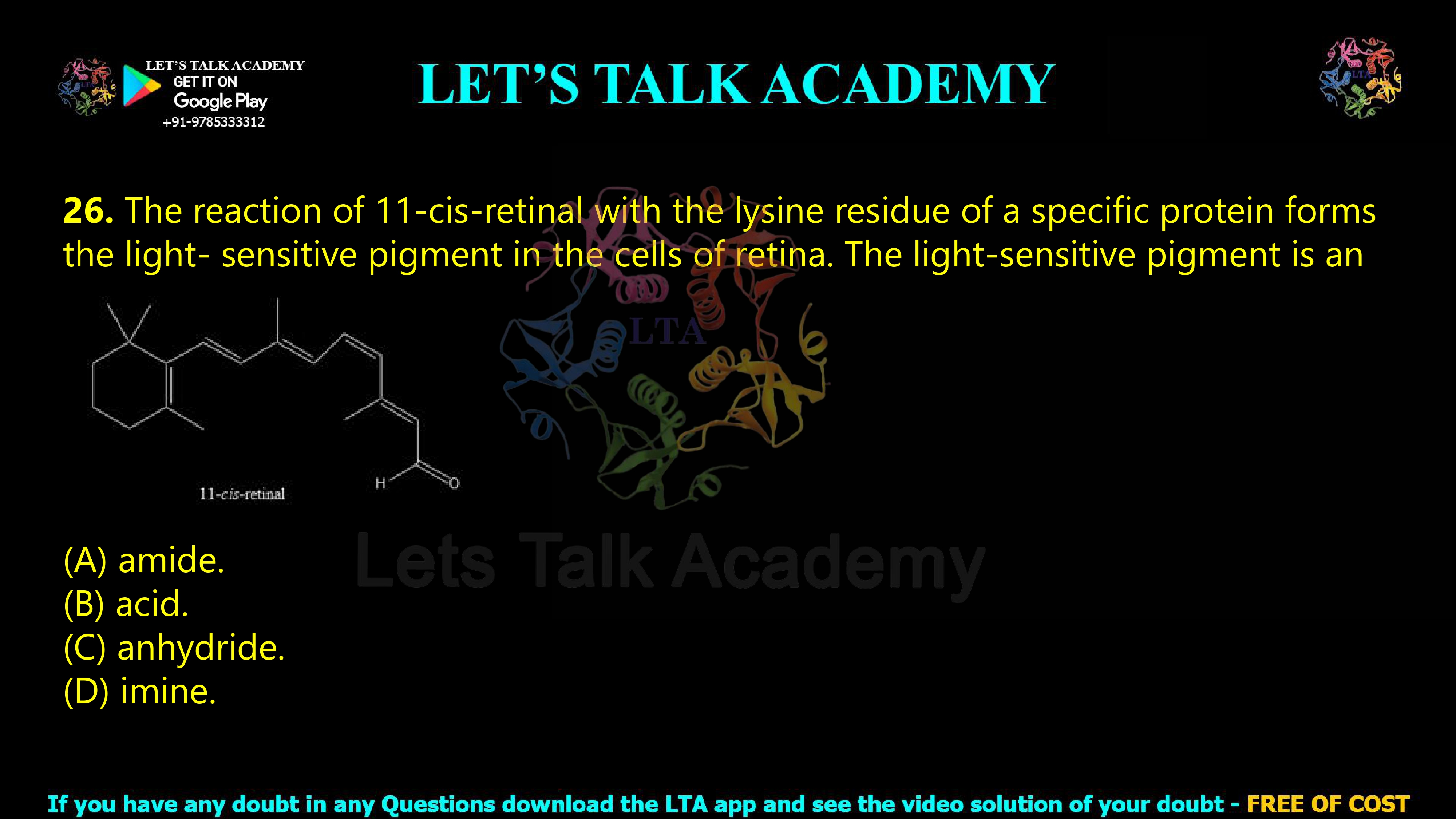
25. The reaction of 11-cis-retinal with the lysine residue of a specific protein forms the light- sensitive pigment in the cells of retina. The light-sensitive pigment is an
(A) amide.
(B) acid.
(C) anhydride.
(D) imine.
Reaction of 11-cis-Retinal with Lysine in the Light-Sensitive Pigment of Retina
Correct Answer
Correct Option: (D) Imine
The correct answer is imine. The key to solving this question lies in identifying the functional groups that react with each other. The molecule 11-cis-retinal contains an aldehyde group (–CHO), while the side chain of a lysine residue in the specific retinal protein contains a primary amino group (–NH2).
When an aldehyde reacts with a primary amine, a condensation reaction occurs. During this reaction, a molecule of water is eliminated and a carbon-nitrogen double bond, C=N, is formed. A compound containing this carbon-nitrogen double bond is called an imine. In biological chemistry, this type of linkage is also commonly called a Schiff base.
The reaction can be represented in a simplified form as:
R–CHO + H2N–R′ → R–CH=N–R′ + H2O
Therefore, the aldehyde group of 11-cis-retinal reacts with the amino group of lysine to form an imine linkage.
11-cis-Retinal + Lysine amino group → Imine (Schiff base) + Water
Hence, Option (D) Imine is the correct answer.
Understanding the Chemistry of 11-cis-Retinal
11-cis-Retinal Contains an Aldehyde Functional Group
To understand the reaction, it is important to examine the structure of 11-cis-retinal. Retinal is derived from vitamin A and contains a long conjugated chain of alternating single and double bonds. At one end of the molecule, it possesses an aldehyde functional group.
The important reactive group can be represented as:
–CHO
This aldehyde group contains a carbonyl carbon bonded to a hydrogen atom. The carbonyl carbon is electrophilic because the oxygen atom withdraws electron density from the carbon through the polar carbon-oxygen double bond.
Therefore, the aldehyde group of 11-cis-retinal can react with a suitable nucleophile. In this biological system, the nucleophile is the amino group of a lysine residue present in the protein opsin.
Why Does the Lysine Residue React with 11-cis-Retinal?
Lysine Contains a Reactive Amino Group
Lysine is an amino acid with a side chain that terminates in an amino group. Its side chain can be represented as:
–(CH2)4–NH2
The terminal amino group of lysine contains a nitrogen atom with a lone pair of electrons. This nitrogen can act as a nucleophile and attack the electrophilic carbonyl carbon of the aldehyde group present in 11-cis-retinal.
Thus, the two essential reacting groups are:
11-cis-Retinal: Aldehyde group (–CHO)
Lysine residue: Primary amino group (–NH2)
The general organic chemistry principle is:
Aldehyde + Primary amine → Imine + Water
This single reaction principle provides the direct answer to the question.
Step-by-Step Mechanism of Imine Formation
Step 1: Nucleophilic Attack on the Carbonyl Carbon
The aldehyde group of 11-cis-retinal contains a polarized carbonyl bond. The oxygen atom carries partial negative character, while the carbonyl carbon carries partial positive character.
The amino group of the lysine residue contains a lone pair of electrons on nitrogen. This nitrogen attacks the electrophilic carbonyl carbon of retinal, resulting in the formation of a new carbon-nitrogen bond.
This nucleophilic addition produces an intermediate in which both the amino group and hydroxyl group are associated with the same carbon atom.
Step 2: Formation of the Carbinolamine Intermediate
After proton transfers occur, a carbinolamine intermediate is formed. This intermediate contains both a hydroxyl group and an amino-derived group attached to the carbon that was originally the carbonyl carbon.
The intermediate can be represented in a simplified form as:
R–CH(OH)–NH–R′
This intermediate is not the final product. It undergoes dehydration to produce the stable carbon-nitrogen double bond characteristic of an imine.
Step 3: Elimination of Water
The carbinolamine intermediate loses a molecule of water. This is why the reaction is classified as a condensation reaction.
After water is removed, a double bond forms between carbon and nitrogen:
C=N
The resulting product is an imine or Schiff base.
The overall transformation is:
Retinal–CHO + H2N–Lysine → Retinal–CH=N–Lysine + H2O
What Is an Imine?
An Imine Contains a Carbon-Nitrogen Double Bond
An imine is an organic compound containing a carbon-nitrogen double bond. Its general functional group can be represented as:
R2C=NR′
Imines are generally formed when an aldehyde or ketone reacts with a primary amine. The reaction involves nucleophilic addition followed by the elimination of water.
In the visual pigment system, the aldehyde is 11-cis-retinal and the primary amino group is supplied by a lysine residue in the protein. Therefore, the product contains a C=N linkage and is correctly classified as an imine.
What Is a Schiff Base?
The Retinal-Lysine Linkage Is a Schiff Base
The term Schiff base is commonly used for an imine formed by the condensation of a carbonyl compound with a primary amine. The retinal-lysine linkage in the visual pigment is a classic biological example of Schiff base formation.
The aldehyde group of retinal reacts with the amino group of lysine to form the carbon-nitrogen double bond:
Retinal–CH=N–Lysine
In the functional visual pigment, this linkage is commonly present as a protonated Schiff base. Protonation strongly influences the electronic properties of retinal and contributes to the ability of the pigment to absorb visible light.
Therefore, the terms imine and Schiff base describe the essential chemical nature of the linkage formed between 11-cis-retinal and lysine.
Formation of the Light-Sensitive Pigment in the Retina
11-cis-Retinal Combines with Opsin
The light-sensitive visual pigment in rod cells is formed when 11-cis-retinal binds to a specific protein called opsin. The combination of retinal and opsin produces the visual pigment known as rhodopsin.
The important relationship is:
11-cis-Retinal + Opsin → Rhodopsin
The retinal molecule is covalently attached to a lysine residue of the protein through an imine or Schiff base linkage.
Therefore, the chemical bond connecting the light-absorbing retinal molecule to the protein is not an amide, acid or anhydride. It is an imine linkage.
How Light Initiates the Visual Process
11-cis-Retinal Undergoes Photoisomerization
The conjugated double-bond system of 11-cis-retinal allows the molecule to absorb visible light. When the retinal chromophore absorbs a photon, it undergoes a rapid structural transformation.
The key change is:
11-cis-Retinal → all-trans-Retinal
This light-induced process is called photoisomerization. The conversion changes the shape of the retinal molecule and consequently changes the conformation of the associated protein.
This conformational change initiates a biochemical signaling pathway that ultimately generates the electrical response responsible for visual perception.
Thus, the imine linkage between retinal and lysine is part of a highly specialized molecular system that converts light energy into a biological signal.
Detailed Explanation of Every Option
Option (A): Amide
Option (A) is incorrect. An amide generally forms when a carboxylic acid or an activated carboxylic acid derivative reacts with an amine. The characteristic functional group of an amide is:
–C(=O)–N–
For example:
Carboxylic acid derivative + Amine → Amide
However, 11-cis-retinal does not contain a carboxylic acid group at its reactive end. It contains an aldehyde group. When an aldehyde reacts with a primary amine, the product is an imine rather than an amide.
Therefore, the retinal-lysine linkage is not an amide, and Option (A) is incorrect.
Option (B): Acid
Option (B) is incorrect. A carboxylic acid contains the functional group:
–COOH
The reaction between the aldehyde group of retinal and the amino group of lysine does not produce a carboxylic acid. No oxidation of the aldehyde to a carboxylic acid is involved in the formation of the visual pigment.
Instead, the amino group attacks the aldehyde carbonyl, followed by dehydration and formation of a carbon-nitrogen double bond.
Therefore, the product is not an acid.
Option (C): Anhydride
Option (C) is incorrect. An acid anhydride contains two acyl groups connected through an oxygen atom. Its characteristic functional group is:
R–C(=O)–O–C(=O)–R′
Anhydrides are generally associated with reactions involving carboxylic acids or their derivatives. Neither the aldehyde group of retinal nor the amino group of lysine can directly produce an acid anhydride through the reaction described in the question.
Therefore, Option (C) is incorrect.
Option (D): Imine
Option (D) is correct. The aldehyde group of 11-cis-retinal reacts with the primary amino group of the lysine residue. After nucleophilic addition and elimination of water, a carbon-nitrogen double bond is formed.
The reaction is:
R–CHO + H2N–R′ → R–CH=N–R′ + H2O
The product containing the C=N functional group is an imine. In this biological context, the linkage is also called a Schiff base.
Therefore, Option (D) Imine is the correct answer.
Comparison of the Four Functional Groups
| Functional Group | Characteristic Structure | Typical Formation | Correct for Retinal-Lysine Reaction? |
|---|---|---|---|
| Amide | –C(=O)–N– | Carboxylic acid derivative + amine | No |
| Acid | –COOH | Oxidation or other carboxylic acid-forming reactions | No |
| Anhydride | –C(=O)–O–C(=O)– | Combination of acyl groups through oxygen | No |
| Imine | C=N | Aldehyde or ketone + primary amine | Yes |
The Central Organic Chemistry Principle Behind the Question
Identify the Reacting Functional Groups First
The most efficient way to solve this question is to identify the two reacting functional groups. The terminal group of 11-cis-retinal is an aldehyde, while the lysine side chain provides a primary amino group.
The relevant reaction is:
Aldehyde + Primary amine → Imine + Water
Applying this principle directly gives:
11-cis-Retinal + Lysine → Retinal-Lysine Imine
Therefore, the chemical identity of the light-sensitive retinal-protein linkage is an imine.
Final Answer
11-cis-Retinal contains an aldehyde group, while the lysine residue of the specific retinal protein contains a primary amino group. The amino group reacts with the aldehyde carbonyl group through nucleophilic addition followed by the elimination of water.
This condensation reaction produces a carbon-nitrogen double bond:
C=N
A compound containing this linkage is called an imine, and the retinal-lysine linkage is also known as a Schiff base.
The overall reaction can be summarized as:
11-cis-Retinal + Lysine amino group → Imine (Schiff base) + H2O
Therefore:
Correct Option: (D) Imine


