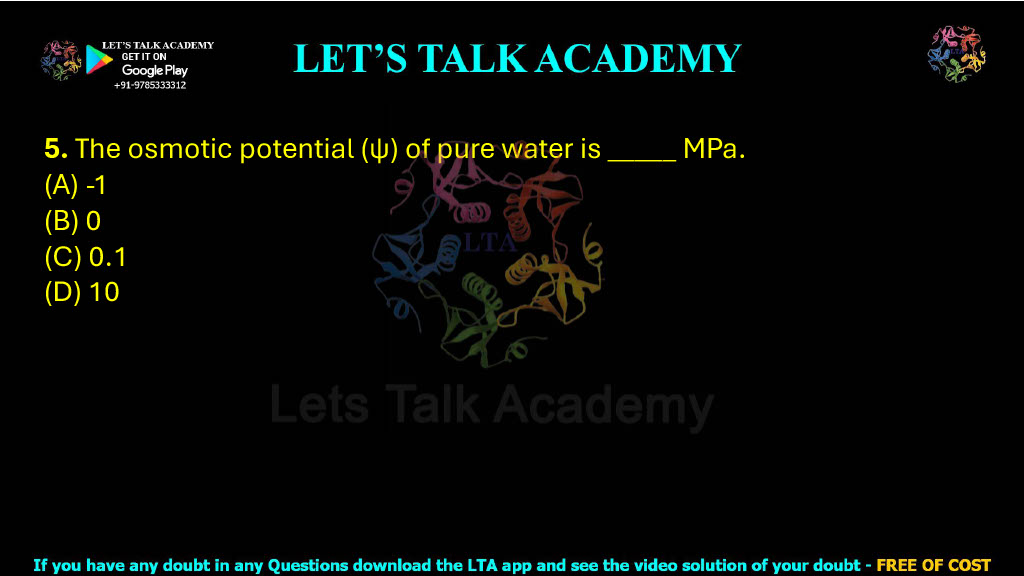
5. The osmotic potential (ψ) of pure water is _____ MPa.
(A) -1
(B) 0
(C) 0.1
(D) 10
Osmotic Potential (Ψs) of Pure Water Explained
Introduction
Water movement is one of the most fundamental physiological processes in plants. It governs seed germination, nutrient absorption, transpiration, photosynthesis, cell expansion, stomatal movement, and overall plant growth. The movement of water from one region to another depends on differences in water potential (Ψw), a thermodynamic concept that predicts the direction in which water will move. Water always moves from a region of higher water potential to a region of lower water potential until equilibrium is established.
Water potential consists of different components, among which osmotic potential (Ψs), also known as solute potential, is one of the most important. Osmotic potential measures the effect of dissolved solutes on the free energy of water. The addition of solutes lowers the free energy of water molecules, making the osmotic potential increasingly negative. Pure water contains no dissolved solutes and therefore has the highest possible free energy.
Correct Answer
Correct Option: (B) 0 MPa
Detailed Explanation
Osmotic potential (Ψs), also known as solute potential, represents the reduction in water potential caused by dissolved solutes. When solutes dissolve in water, they decrease the free energy of water molecules because some water molecules become associated with solute particles. As a result, the osmotic potential becomes negative.
Pure water contains no dissolved solutes. Therefore, there is no reduction in its free energy due to dissolved substances. By international convention, the osmotic potential of pure water is assigned a value of 0 MPa. Since every solution contains one or more dissolved solutes, every solution has an osmotic potential that is lower than that of pure water and is therefore expressed as a negative value.
The relationship between water potential and its components is represented by the equation:
Ψw = Ψs + Ψp
where:
- Ψw = Water potential
- Ψs = Osmotic (solute) potential
- Ψp = Pressure potential
For pure water under standard atmospheric pressure, both the water potential and osmotic potential are equal to 0 MPa.
Explanation of Each Option
Option (A): -1 MPa
This option is incorrect. An osmotic potential of −1 MPa indicates the presence of dissolved solutes. Pure water has no dissolved solutes and therefore cannot have a negative osmotic potential.
Option (B): 0 MPa
This option is correct. Pure water contains no solutes, so its osmotic potential is defined as 0 MPa. This serves as the reference point for measuring water potential in biological systems.
Option (C): 0.1 MPa
This option is incorrect. Osmotic potential of pure water cannot be positive. The addition of solutes only decreases water potential, making it negative.
Option (D): 10 MPa
This option is incorrect. Osmotic potential is never positive in biological systems. A value of +10 MPa is not applicable for pure water.
Why Option (B) is Correct
Pure water contains no dissolved solutes that can reduce its free energy. Therefore, its osmotic potential is assigned a standard value of 0 MPa. Every solution containing solutes has an osmotic potential lower than zero.
Why the Other Options are Incorrect
Why Option (A) is Incorrect
A negative osmotic potential indicates dissolved solutes, which are absent in pure water.
Why Option (C) is Incorrect
Osmotic potential cannot be positive because dissolved solutes always lower water potential.
Why Option (D) is Incorrect
Positive osmotic potential values are not assigned to pure water in plant physiology.
Comparison of All Options
| Option | Osmotic Potential | Correct or Incorrect | Reason |
|---|---|---|---|
| A | -1 MPa | Incorrect | Represents a solution containing solutes |
| B | 0 MPa | Correct | Standard value for pure water |
| C | 0.1 MPa | Incorrect | Osmotic potential cannot be positive |
| D | 10 MPa | Incorrect | Not applicable to pure water |
Components of Water Potential
| Component | Symbol | Function |
|---|---|---|
| Water Potential | Ψw | Total free energy of water |
| Osmotic (Solute) Potential | Ψs | Effect of dissolved solutes |
| Pressure Potential | Ψp | Effect of hydrostatic pressure |
| Matric Potential | Ψm | Effect of adsorption to surfaces |
| Gravitational Potential | Ψg | Effect of gravity on water movement |
Water Potential in Different Conditions
| Condition | Water Potential (Ψw) | Osmotic Potential (Ψs) |
|---|---|---|
| Pure Water | 0 MPa | 0 MPa |
| Dilute Solution | Negative | Negative |
| Concentrated Solution | More Negative | More Negative |
| Living Plant Cell under Turgor | Depends on Ψs and Ψp | Negative |
Factors Affecting Osmotic Potential
| Factor | Effect on Osmotic Potential |
|---|---|
| Increase in Solute Concentration | Makes Ψs more negative |
| Dilution of Solution | Raises Ψs toward zero |
| Pure Water | Ψs = 0 MPa |
| Salt Accumulation | Decreases water potential |
Biological Significance
Water potential and osmotic potential regulate nearly every aspect of plant water relations. Root water absorption, movement of water through xylem, maintenance of cell turgor, stomatal opening and closing, cell enlargement, and seed germination all depend on differences in water potential. Since pure water has the highest water potential and an osmotic potential of 0 MPa, it serves as the universal reference point for understanding water movement in plants. The increasingly negative osmotic potential of solutions allows water to move into cells by osmosis, maintaining plant hydration and supporting physiological processes.
Final Answer
Correct Option: (B) 0 MPa
The osmotic potential (Ψs) of pure water is 0 MPa because pure water contains no dissolved solutes. It serves as the standard reference point in plant physiology, and the addition of any solute decreases osmotic potential, making it increasingly negative.


