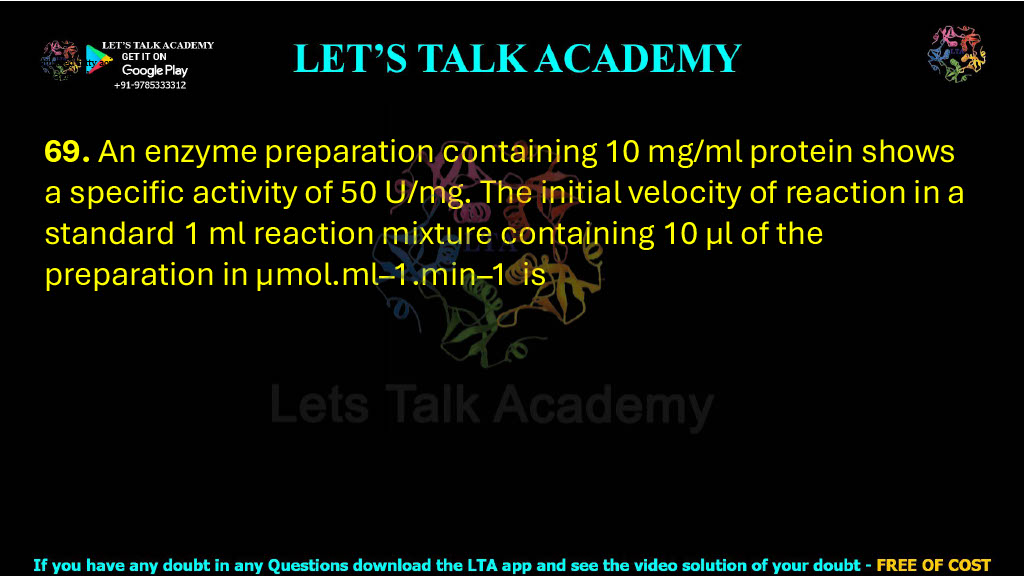
69. An enzyme preparation containing 10 mg/ml protein shows a specific activity of 50 U/mg. The initial velocity of reaction in a standard 1 ml reaction mixture containing 10 µl of the preparation in µmol.ml–1.min–1 is
How to Calculate Initial Reaction Velocity from Specific Activity?
Correct Answer
5 µmol ml⁻¹ min⁻¹
Introduction
Enzyme activity measurements are fundamental in biochemistry, molecular biology, biotechnology, and clinical diagnostics. Rather than measuring the amount of enzyme protein alone, biochemists determine the catalytic activity of an enzyme by quantifying the rate at which it converts substrate into product. One of the most important parameters used during enzyme purification is specific activity, which expresses the enzyme activity per milligram of protein. As purification progresses, contaminating proteins are removed and the specific activity increases, making it an excellent indicator of enzyme purity.
Specific activity is commonly expressed in Units per milligram (U/mg), where one enzyme unit (1 U) is defined as the amount of enzyme that catalyzes the formation of 1 µmol of product per minute under specified assay conditions.
Understanding the Concept Behind the Question
The given data are:
Protein concentration = 10 mg/ml
Specific activity = 50 U/mg
Volume of enzyme used = 10 µl
Total reaction volume = 1 ml
The objective is to calculate the initial reaction velocity expressed as:
µmol ml⁻¹ min⁻¹
Step 1. Calculate the Amount of Protein Added
Protein concentration:
10 mg/ml
Enzyme volume added:
10 µl = 0.01 ml
Protein present in the reaction:
Protein = Concentration × Volume
= 10 mg/ml × 0.01 ml
= 0.1 mg
Thus,
Protein added = 0.1 mg
Step 2. Calculate Total Enzyme Activity
Specific activity represents enzyme units per milligram of protein.
Therefore,
Total Activity = Specific Activity × Protein Amount
= 50 U/mg × 0.1 mg
= 5 U
Thus,
Total enzyme activity = 5 Units
Step 3. Convert Enzyme Units into Reaction Velocity
By definition:
1 Unit = 1 µmol of product formed per minute
Therefore,
5 Units = 5 µmol/min
Since the total reaction volume is 1 ml, the reaction velocity becomes:
5 µmol min⁻¹ / 1 ml
= 5 µmol ml⁻¹ min⁻¹
Final Calculation
Initial Velocity = 5 µmol ml⁻¹ min⁻¹
Formula Used
Specific Activity
Specific Activity = Total Activity / Protein Amount
Total Activity
Total Activity = Specific Activity × Protein Amount
Protein Amount
Protein = Protein Concentration × Volume Added
Initial Velocity
Reaction Velocity = Total Activity / Total Reaction Volume
Biological Importance
Specific activity is one of the most widely used parameters during enzyme purification because it reflects the proportion of active enzyme relative to total protein. As purification proceeds, contaminating proteins decrease while enzyme activity remains relatively constant, resulting in higher specific activity. This parameter is also important in pharmaceutical enzyme production, industrial biotechnology, clinical enzymology, and quality control of recombinant proteins.
Calculating enzyme activity from specific activity allows researchers to compare enzyme preparations, determine purification efficiency, and standardize biochemical assays.
High-Yield Points
- 1 Enzyme Unit (U) = 1 µmol of product formed per minute.
- Specific Activity = Units per milligram of protein (U/mg).
- Protein amount = Concentration × Volume.
- Total enzyme activity = Specific Activity × Protein amount.
- Higher specific activity indicates greater enzyme purity.
- Specific activity generally increases during enzyme purification.
Frequently Asked Questions
What is specific activity?
Specific activity is the enzyme activity per milligram of total protein and is expressed as Units per milligram (U/mg).
Why is specific activity important?
It serves as an indicator of enzyme purity. As contaminants are removed during purification, the specific activity increases.
What does one enzyme unit represent?
One enzyme unit (1 U) is the amount of enzyme that catalyzes the conversion of 1 µmol of substrate into product per minute under defined assay conditions.
Key Takeaways
To determine the initial reaction velocity, the amount of protein added to the reaction mixture is first calculated from the protein concentration and enzyme volume. Multiplying this protein amount by the specific activity gives the total enzyme activity in units. Since one enzyme unit corresponds to one micromole of product formed per minute, the enzyme preparation generates 5 µmol of product each minute. Because the reaction volume is 1 ml, the initial reaction velocity is 5 µmol ml⁻¹ min⁻¹.
Final Answer
Initial Velocity = 5 µmol ml⁻¹ min⁻¹
Explanation
The enzyme preparation contains 10 mg of protein per millilitre, and 10 µl (0.01 ml) of this preparation is added to the reaction mixture. Therefore, the amount of protein present is:
10 mg/ml × 0.01 ml = 0.1 mg
The specific activity is 50 U/mg, so the total enzyme activity is:
50 U/mg × 0.1 mg = 5 U
Since 1 Unit = 1 µmol of product formed per minute, the enzyme produces 5 µmol of product per minute. Because the total reaction volume is 1 ml, the initial reaction velocity is:
5 µmol ml⁻¹ min⁻¹
Therefore, the correct answer is:
5 µmol ml⁻¹ min⁻¹.


