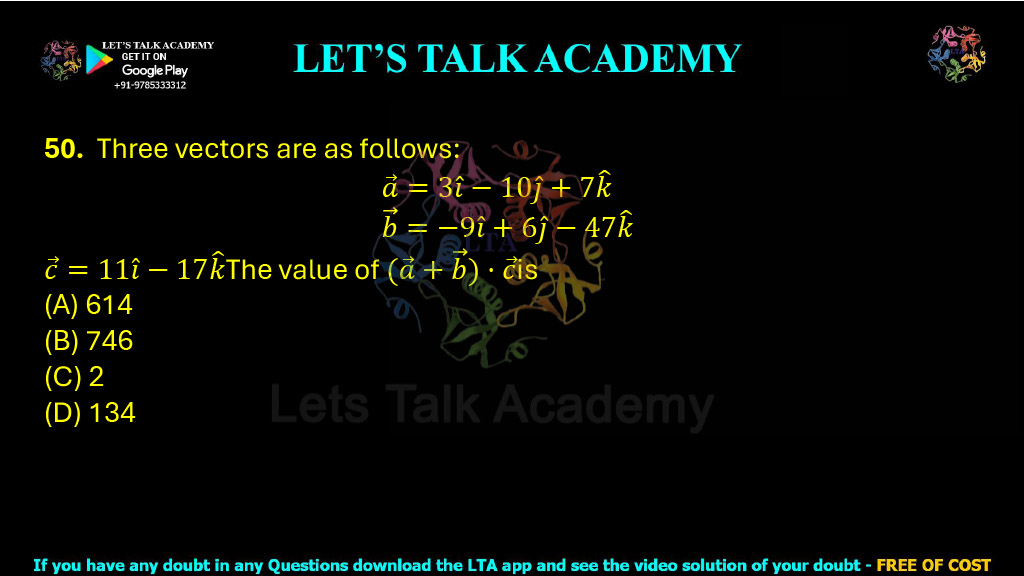
50. Three vectors are as follows:
a⃗ = 3î − 10ĵ + 7k̂
b⃗ = −9î + 6ĵ − 47k̂
c⃗ = 11ĵ − 17k̂
The value of (a⃗ + b⃗) · c⃗ is _______.
(A) 614
(B) 746
(C) 2
(D) 134
Find the Value of (a⃗ + b⃗) · c⃗ Using Vector Addition and Dot Product
Understanding the Given Vector Problem
This question is based on two fundamental operations involving vectors: vector addition and the dot product, which is also called the scalar product. We are given three vectors a⃗, b⃗, and c⃗, and we need to evaluate the expression:
(a⃗ + b⃗) · c⃗
The correct order of calculation is important. We first add the corresponding components of vectors a⃗ and b⃗. After obtaining the vector a⃗ + b⃗, we calculate its dot product with c⃗.
The given vectors are:
a⃗ = 3î − 10ĵ + 7k̂
b⃗ = −9î + 6ĵ − 47k̂
c⃗ = 11ĵ − 17k̂
Since the vector c⃗ has no î-component, its coefficient of î is zero. Therefore, in component form:
c⃗ = 0î + 11ĵ − 17k̂
Writing the Three Vectors in Component Form
Writing vectors in component form makes addition and dot-product calculations easier and reduces the possibility of sign errors.
For the first vector:
a⃗ = (3, −10, 7)
For the second vector:
b⃗ = (−9, 6, −47)
For the third vector:
c⃗ = (0, 11, −17)
We now add the first two vectors component by component.
Finding the Vector a⃗ + b⃗
The sum of two vectors is obtained by adding their corresponding î, ĵ, and k̂ components. Therefore:
a⃗ + b⃗ = (3î − 10ĵ + 7k̂) + (−9î + 6ĵ − 47k̂)
Grouping the corresponding components:
a⃗ + b⃗ = (3 − 9)î + (−10 + 6)ĵ + (7 − 47)k̂
Now simplify each component separately.
Calculating the î-Component
The î-component is:
3 − 9 = −6
Therefore, the resulting î-component is:
−6î
Calculating the ĵ-Component
The ĵ-component is:
−10 + 6 = −4
Therefore, the resulting ĵ-component is:
−4ĵ
Calculating the k̂-Component
The k̂-component is:
7 − 47 = −40
Therefore, the resulting k̂-component is:
−40k̂
Combining the three components gives:
a⃗ + b⃗ = −6î − 4ĵ − 40k̂
In component form:
a⃗ + b⃗ = (−6, −4, −40)
Formula for the Dot Product of Two Vectors
If two vectors are:
u⃗ = u1î + u2ĵ + u3k̂
and:
v⃗ = v1î + v2ĵ + v3k̂
then their dot product is:
u⃗ · v⃗ = u1v1 + u2v2 + u3v3
The dot product is a scalar quantity, which means the final answer is an ordinary number rather than a vector.
Calculating (a⃗ + b⃗) · c⃗
We have:
a⃗ + b⃗ = (−6, −4, −40)
and:
c⃗ = (0, 11, −17)
Using the dot-product formula:
(a⃗ + b⃗) · c⃗ = (−6)(0) + (−4)(11) + (−40)(−17)
Now calculate the three products:
(−6)(0) = 0
(−4)(11) = −44
(−40)(−17) = 680
Therefore:
(a⃗ + b⃗) · c⃗ = 0 − 44 + 680
Hence:
(a⃗ + b⃗) · c⃗ = 636
Verification Using the Distributive Property of the Dot Product
The result can also be verified using the distributive property:
(a⃗ + b⃗) · c⃗ = a⃗ · c⃗ + b⃗ · c⃗
First, calculate a⃗ · c⃗:
a⃗ · c⃗ = (3)(0) + (−10)(11) + (7)(−17)
Therefore:
a⃗ · c⃗ = 0 − 110 − 119
Hence:
a⃗ · c⃗ = −229
Now calculate b⃗ · c⃗:
b⃗ · c⃗ = (−9)(0) + (6)(11) + (−47)(−17)
Therefore:
b⃗ · c⃗ = 0 + 66 + 799
Hence:
b⃗ · c⃗ = 865
Adding the two results:
(a⃗ + b⃗) · c⃗ = −229 + 865
Therefore:
(a⃗ + b⃗) · c⃗ = 636
This confirms the result obtained by first adding the vectors and then taking the dot product.
Comparison With the Given Options
The direct calculation from the vector components visible in the provided image gives:
(a⃗ + b⃗) · c⃗ = 636
However, 636 is not present among the visible answer options. The options shown are 614, 746, 2, and 134. Therefore, the provided question image appears to contain either a printing issue, an unclear vector component, or an incorrect set of answer options.
Option (A): 614
This option does not match the value obtained from the vectors as visibly written in the question. Using a⃗ = (3, −10, 7), b⃗ = (−9, 6, −47), and c⃗ = (0, 11, −17), the result is 636, not 614.
Option (B): 746
This option also does not match the direct dot-product calculation. The correct arithmetic from the visible vector components gives −44 + 680 = 636.
Option (C): 2
This option is incorrect for the visible data. The dot product contains a large positive contribution from (−40)(−17) = 680, so the final result cannot be 2.
Option (D): 134
This option also does not agree with the vectors shown in the image. Direct substitution into the scalar-product formula gives 636.
Final Answer
From the vectors visible in the provided question:
a⃗ + b⃗ = −6î − 4ĵ − 40k̂
Therefore:
(a⃗ + b⃗) · c⃗ = (−6)(0) + (−4)(11) + (−40)(−17)
= 0 − 44 + 680
Hence:
(a⃗ + b⃗) · c⃗ = 636
Correct Value From the Visible Data: 636
Note: Since 636 is not among the printed options, the source question or its options likely contain a typographical or image-reading inconsistency.


