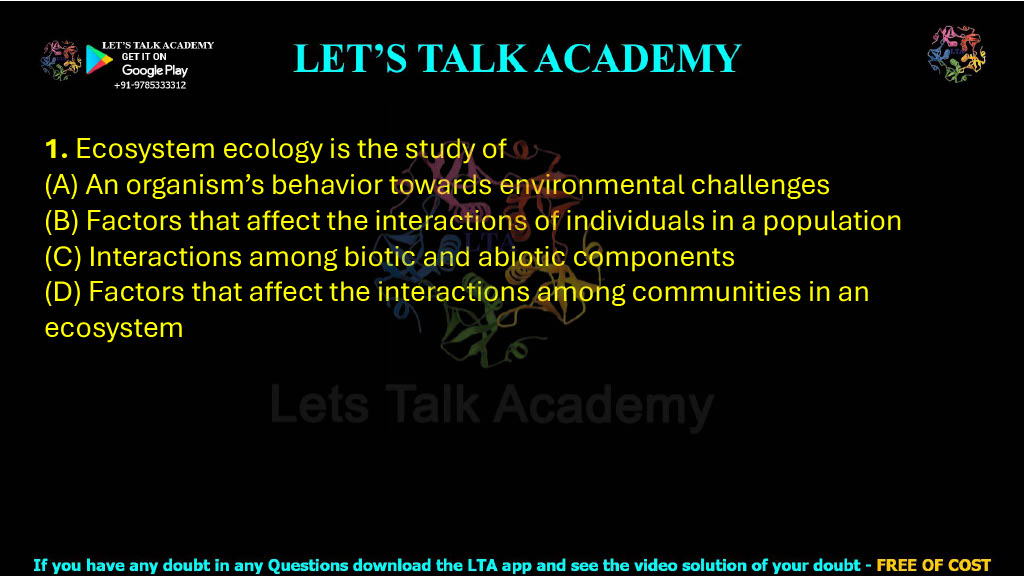
1. Ecosystem ecology is the study of
(A) An organism’s behavior towards environmental challenges
(B) Factors that affect the interactions of individuals in a population
(C) Interactions among biotic and abiotic components
(D) Factors that affect the interactions among communities in an ecosystem
Ecosystem Ecology Is the Study of Interactions Among Biotic and Abiotic Components
Correct Option: (C) Interactions among biotic and abiotic components
Ecosystem ecology is the branch of ecology that studies the interactions between the living and non-living components of an ecosystem. Therefore, the correct answer is Option (C), interactions among biotic and abiotic components. This field examines how organisms interact with the physical and chemical environment and how energy and nutrients move through ecological systems.
An ecosystem is not made up only of plants, animals, and microorganisms. It also includes non-living environmental components such as sunlight, water, air, soil, temperature, minerals, and nutrients. Ecosystem ecology brings these two major parts together and studies how they influence one another. For example, plants use sunlight, carbon dioxide, water, and mineral nutrients to produce organic matter through photosynthesis. Herbivores obtain energy by feeding on plants, carnivores obtain energy by consuming other organisms, and decomposers return nutrients to the environment by breaking down dead organic matter.
The central idea behind ecosystem ecology is therefore the functional connection between the biotic components and abiotic components of an ecosystem.
What Is Ecosystem Ecology?
Ecosystem ecology is the scientific study of the relationships between organisms and the physical environment in which they live. It focuses on the movement of energy and matter through an ecosystem and examines how biological communities interact with environmental factors.
The term biotic components refers to all living organisms in an ecosystem. These include producers such as green plants and algae, consumers such as herbivores and carnivores, and decomposers such as bacteria and fungi. These organisms interact through feeding relationships, competition, decomposition, and other biological processes.
The term abiotic components refers to the non-living physical and chemical factors of the environment. Important abiotic components include sunlight, temperature, water, soil, atmospheric gases, pH, salinity, and mineral nutrients.
Ecosystem ecology studies how these living and non-living components are connected. For instance, the amount of rainfall can influence plant productivity, plant productivity can determine the amount of food available to herbivores, and the abundance of herbivores can influence predator populations. In this way, a change in one component of an ecosystem can affect many other components.
Why Option (C) Is the Correct Answer
Interactions Among Biotic and Abiotic Components
Option (C) is correct because ecosystem ecology specifically studies interactions among biotic and abiotic components.
The living and non-living components of an ecosystem are continuously interacting. Green plants absorb water and mineral nutrients from the soil, obtain carbon dioxide from the atmosphere, and capture solar energy. Animals depend directly or indirectly on plants for food. Decomposers break down dead organisms and organic wastes, releasing nutrients back into the soil and water.
These interactions form the functional basis of an ecosystem. Ecosystem ecologists study processes such as primary productivity, energy flow, decomposition, nutrient cycling, carbon cycling, nitrogen cycling, and the exchange of matter between organisms and their environment.
For example, consider a forest ecosystem. Trees, shrubs, animals, fungi, and microorganisms represent the biotic components. Sunlight, rainfall, temperature, soil, and mineral nutrients represent the abiotic components. The forest ecosystem functions because these two groups of components continuously interact with each other.
Therefore, the phrase “interactions among biotic and abiotic components” provides the most accurate definition of ecosystem ecology.
Detailed Explanation of Option (A)
An Organism’s Behavior Towards Environmental Challenges
Option (A) is incorrect because it mainly describes organismal ecology rather than ecosystem ecology.
Organismal ecology focuses on how an individual organism responds to environmental conditions. It examines the physiological, morphological, and behavioral adaptations that allow an organism to survive and reproduce in a particular environment.
For example, a desert animal may avoid extreme daytime temperatures by becoming nocturnal. A plant growing in an arid region may develop thick leaves, reduced leaf surfaces, deep roots, or water-storage tissues. These are examples of individual organisms responding to environmental challenges.
The key feature of organismal ecology is its focus on the individual organism. Ecosystem ecology, in contrast, has a much broader perspective because it studies interactions between entire biological communities and their physical and chemical environment.
Therefore, Option (A) does not define ecosystem ecology.
Detailed Explanation of Option (B)
Factors That Affect the Interactions of Individuals in a Population
Option (B) is incorrect because it is more closely related to population ecology.
A population consists of individuals of the same species living in a particular geographical area at a particular time. Population ecology studies the factors that influence population size, population density, age structure, distribution, birth rate, death rate, immigration, emigration, and population growth.
Interactions among individuals of the same species may include competition for food, mates, territory, nesting sites, and other limited resources. Population ecologists also study density-dependent and density-independent factors that regulate population growth.
For example, the study of how food availability affects the population size of deer in a forest is mainly a question of population ecology. Similarly, studying how competition among individuals influences population growth also falls under population ecology.
Although populations are important parts of ecosystems, ecosystem ecology is not limited to interactions among individuals within a population. It studies the broader relationship between living organisms and non-living environmental factors.
Therefore, Option (B) is not the correct answer.
Detailed Explanation of Option (D)
Factors That Affect the Interactions Among Communities in an Ecosystem
Option (D) is incorrect because ecological communities are not usually treated as multiple interacting units within a single ecosystem in the way this statement suggests.
A biological community consists of populations of different species living and interacting in the same area. Community ecology primarily examines interactions among different species, including competition, predation, herbivory, parasitism, mutualism, and commensalism.
For example, competition between two plant species, predation of rabbits by foxes, pollination of flowers by insects, and parasitism of a host by a parasite are studied mainly under community ecology.
The phrase “interactions among communities” does not provide the standard definition of ecosystem ecology. Ecosystem ecology extends beyond biological interactions and specifically includes the relationship between the biotic community and the abiotic environment.
Therefore, Option (D) is less accurate than Option (C).
Levels of Ecological Organization
Understanding the different levels of ecological organization makes this question easier to interpret. Ecology can be studied at several levels, and each level focuses on a different type of biological relationship.
At the organismal level, the focus is on how an individual organism responds and adapts to its environment. This is closest to Option (A).
At the population level, the focus is on individuals of the same species and the factors controlling their abundance, distribution, and population growth. This is closest to Option (B).
At the community level, the focus is on interactions among populations of different species, such as competition, predation, mutualism, and parasitism.
At the ecosystem level, the focus expands to include both the biological community and the physical environment. This level therefore studies interactions between biotic and abiotic components, making Option (C) the correct answer.
Major Components Studied in Ecosystem Ecology
Ecosystem ecology examines several fundamental processes that determine how ecosystems function. One major area is energy flow. Most ecosystems receive energy from sunlight, which is captured by primary producers through photosynthesis. This energy then moves through herbivores, carnivores, and decomposers.
Another major area is nutrient cycling. Unlike energy, nutrients are recycled within ecosystems. Elements such as carbon, nitrogen, phosphorus, and sulfur move between organisms and the physical environment through biological, chemical, and geological processes.
Ecosystem ecologists also study primary productivity, which represents the rate at which producers convert energy into organic matter. They examine decomposition, through which dead organic material is broken down and nutrients are returned to the environment.
All these processes demonstrate why ecosystem ecology must include both living organisms and non-living environmental factors.
Biotic Components of an Ecosystem
Biotic components include all living parts of an ecosystem. They are commonly classified into producers, consumers, and decomposers.
Producers, also known as autotrophs, manufacture organic food from inorganic substances. Green plants, algae, and some microorganisms are important producers.
Consumers obtain energy by feeding on other organisms. Herbivores consume plants, carnivores consume animals, and omnivores consume both plant and animal material.
Decomposers, particularly bacteria and fungi, break down dead organisms and organic wastes. This process releases nutrients back into the environment, making them available again to producers.
The activities of these organisms cannot be fully understood without considering the abiotic environment in which they live.
Abiotic Components of an Ecosystem
Abiotic components are the non-living factors that influence the structure and functioning of an ecosystem. Sunlight provides the primary energy source for most ecosystems. Temperature affects metabolic activity and the geographical distribution of organisms. Water availability strongly influences productivity and species distribution.
Soil provides physical support, water, and mineral nutrients to terrestrial plants. Atmospheric gases such as oxygen and carbon dioxide are essential for respiration and photosynthesis. Other factors, including pH, salinity, nutrient availability, and humidity, can determine which organisms are able to survive in a particular habitat.
The continuous interaction of these abiotic factors with living organisms is the central subject of ecosystem ecology.
Difference Between Population, Community, and Ecosystem Ecology
Population ecology primarily focuses on individuals of the same species. Community ecology focuses on interactions among different species. Ecosystem ecology includes the biological community as well as the non-living environment.
This distinction is essential for answering ecology questions correctly. Whenever a question emphasizes biotic and abiotic interactions, energy flow, productivity, decomposition, or nutrient cycling, it is generally referring to ecosystem ecology.
Final Answer
Ecosystem ecology studies the functional relationships between living organisms and the non-living physical and chemical environment. It examines how biotic components such as plants, animals, and microorganisms interact with abiotic components such as sunlight, water, soil, temperature, and nutrients.
Therefore, the correct answer is:
Correct Option: (C) Interactions among biotic and abiotic components


