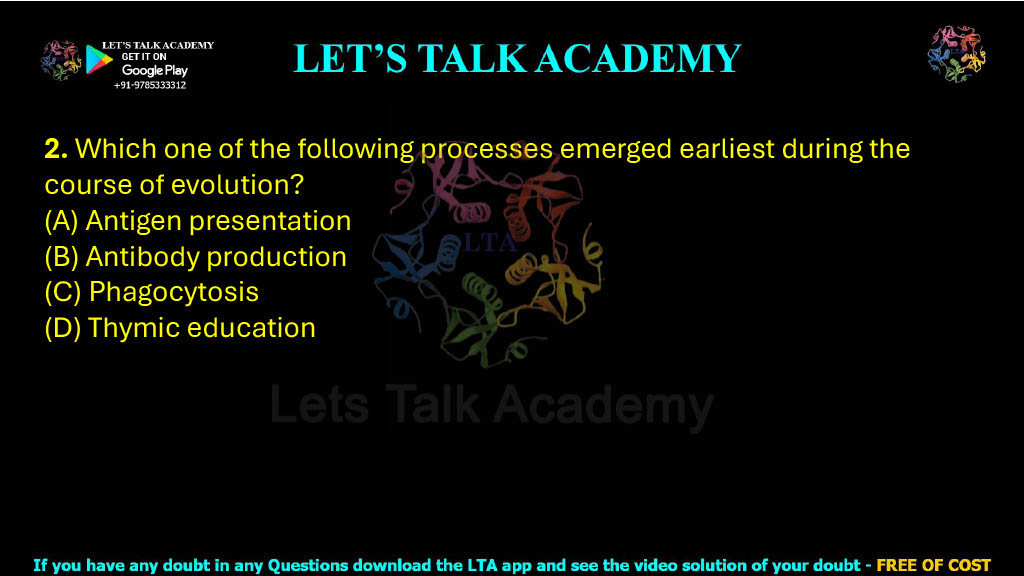
2. Which one of the following processes emerged earliest during the course of evolution?
(A) Antigen presentation
(B) Antibody production
(C) Phagocytosis
(D) Thymic education
Which Immune Process Emerged Earliest During Evolution?
Correct Option: (C) Phagocytosis
Among the processes listed in the question, phagocytosis emerged earliest during the course of evolution. Phagocytosis is an ancient cellular process in which a cell surrounds, engulfs, and internalizes relatively large particles. These particles may include microorganisms, food particles, dead cells, and cellular debris.
The evolutionary origin of phagocytosis is much older than the specialized immune mechanisms associated with vertebrate adaptive immunity. Long before antibodies, T lymphocytes, specialized antigen-presenting cells, or the thymus evolved, early eukaryotic cells were already capable of engulfing particles from their environment.
Therefore, Option (C), phagocytosis, is the correct answer.
Why Did Phagocytosis Emerge Earliest During Evolution?
Phagocytosis is considered one of the most ancient cellular mechanisms because its original function was probably related to nutrition rather than immunity. Early unicellular eukaryotic organisms had to obtain nutrients from their surroundings. One effective method was to engulf solid food particles and digest them inside intracellular vesicles.
This primitive feeding mechanism later became extremely useful for defense against microorganisms. In modern animals, specialized immune cells such as macrophages and neutrophils use phagocytosis to capture and destroy invading microorganisms.
The evolutionary history of phagocytosis therefore illustrates an important biological principle: an ancient cellular process that originally evolved for one purpose can later be adapted for another function. A mechanism initially associated with feeding became a central component of innate immunity.
Because phagocytosis existed in ancient unicellular eukaryotes, it appeared much earlier than the specialized adaptive immune processes represented by antigen presentation, antibody production, and thymic education.
What Is Phagocytosis?
Phagocytosis literally means “cell eating.” It is a form of endocytosis in which a cell engulfs relatively large particles by extending its plasma membrane around them.
During phagocytosis, the cell first recognizes and attaches to a particle. The plasma membrane then extends around the target, often through projections called pseudopodia. Eventually, the particle becomes completely enclosed within a membrane-bound intracellular vesicle known as a phagosome.
The phagosome commonly fuses with lysosomes to form a phagolysosome. Lysosomal enzymes and other antimicrobial mechanisms then digest or destroy the engulfed material.
In unicellular organisms such as amoebae, phagocytosis is primarily used for feeding. In multicellular animals, it performs additional roles in immune defense, removal of dead cells, tissue maintenance, and inflammation.
Phagocytosis as an Ancient Feeding Mechanism
The earliest function of phagocytosis was likely the acquisition of nutrients. Primitive eukaryotic cells could increase their chances of survival by engulfing other cells or organic particles and digesting them internally.
This ability gave phagocytic cells access to concentrated sources of nutrients. As eukaryotic life became more complex, the same basic machinery could be used to remove harmful microorganisms and damaged cells.
Even today, free-living unicellular eukaryotes use phagocytosis for nutrition. This supports the conclusion that phagocytosis is evolutionarily much older than the specialized immune mechanisms of vertebrates.
Phagocytosis in Innate Immunity
In modern vertebrates, phagocytosis is an essential component of innate immunity. Innate immunity provides rapid defense against pathogens and does not depend on the highly specific antigen receptors characteristic of adaptive immunity.
Macrophages are major phagocytic cells that engulf microorganisms, dead cells, and tissue debris. Neutrophils are also highly effective phagocytes and are often rapidly recruited to sites of infection.
The presence of phagocytic defense mechanisms across many diverse groups of organisms indicates that this process has deep evolutionary origins.
Detailed Explanation of Option (A)
Antigen Presentation
Option (A) is incorrect because specialized antigen presentation evolved later than phagocytosis.
Antigen presentation is a sophisticated immune process in which cells process proteins and display peptide fragments on their surfaces for recognition by T lymphocytes. In vertebrates, this process is closely associated with major histocompatibility complex molecules.
During antigen presentation, proteins are broken into smaller peptide fragments. These peptides become associated with specialized antigen-presenting molecules and are transported to the cell surface. T cells then examine these peptide-containing complexes through their antigen receptors.
This mechanism is a key connection between innate and adaptive immunity. For example, a phagocytic cell may first engulf a microorganism and later present microbial antigens to T cells.
The important evolutionary point is that the basic act of engulfing particles through phagocytosis existed before specialized antigen processing and presentation systems evolved. Antigen presentation therefore represents a later and more complex immune innovation.
For this reason, Option (A) is not the earliest process listed.
Detailed Explanation of Option (B)
Antibody Production
Option (B) is incorrect because antibody production is a specialized feature of adaptive immunity and evolved much later than phagocytosis.
Antibodies are highly specific proteins produced by differentiated B lymphocytes known as plasma cells. Each antibody recognizes particular molecular structures called antigens.
The production of antibodies requires a complex biological system. It depends on specialized lymphocytes, mechanisms for generating diverse antigen receptors, clonal selection, cellular activation, and differentiation.
Antibody-mediated immunity allows vertebrates to recognize enormous numbers of different antigens with remarkable specificity. It also contributes to immunological memory, enabling faster and stronger responses after repeated exposure to the same antigen.
These sophisticated features could only arise after the evolution of complex multicellular organisms and specialized immune systems. In contrast, phagocytosis was already present in ancient unicellular eukaryotes.
Therefore, antibody production evolved much later and cannot be the earliest process listed in the question.
Detailed Explanation of Option (C)
Phagocytosis
Option (C) is correct because phagocytosis is the most ancient evolutionary process among the given choices.
Phagocytosis does not require antibodies, T cells, B cells, a thymus, or a specialized adaptive immune system. A single eukaryotic cell can perform the process using its plasma membrane, cytoskeleton, intracellular vesicles, and digestive machinery.
Its ancient origin is also reflected in the fact that phagocytosis occurs in unicellular organisms that lack specialized immune organs. The process originally served as a mechanism of feeding and was later adapted for host defense.
In multicellular organisms, phagocytosis became increasingly specialized. Certain cells evolved to recognize, engulf, and destroy pathogens efficiently. Nevertheless, the fundamental cellular process is much older than vertebrate adaptive immunity.
Therefore, phagocytosis is the best answer.
Detailed Explanation of Option (D)
Thymic Education
Option (D) is incorrect because thymic education is a highly specialized process associated with the vertebrate adaptive immune system.
Thymic education refers to the selection and maturation of developing T lymphocytes in the thymus. T cells must learn to recognize foreign antigens while avoiding dangerous reactions against the body’s own tissues.
During their development, immature T cells undergo selection processes. Cells capable of appropriately interacting with self major histocompatibility complex molecules receive survival signals, while many cells that react too strongly against self components are eliminated or functionally controlled.
This process is essential for creating a functional and self-tolerant T-cell population. However, it depends on the existence of a thymus, specialized T lymphocytes, antigen receptors, and complex molecular recognition systems.
These features appeared relatively late in evolutionary history compared with the ancient cellular process of phagocytosis. Therefore, thymic education cannot be the earliest process among the given choices.
Evolutionary Transition from Cellular Feeding to Immune Defense
The evolution of phagocytosis provides a powerful example of how existing biological mechanisms can acquire new functions over time. Early eukaryotic cells probably used phagocytosis mainly to obtain nutrients. The ability to recognize particles, reorganize the cytoskeleton, extend the plasma membrane, and digest internalized material was already present.
When multicellular organisms evolved, these cellular capabilities could be adapted for defense. Specialized cells began using phagocytosis to eliminate invading microorganisms and remove damaged cells.
Later, increasingly complex immune mechanisms evolved. Phagocytic cells became capable not only of engulfing microorganisms but also of communicating with other immune cells. In vertebrates, some phagocytic cells acquired specialized roles in antigen processing and presentation.
Thus, the evolutionary sequence moved from a basic cellular engulfment mechanism toward increasingly specialized systems of immune recognition and regulation.
Innate Immunity Evolved Before Adaptive Immunity
The answer to this question can also be understood by comparing innate and adaptive immunity.
Innate immunity is evolutionarily ancient. It relies on relatively conserved mechanisms that provide rapid defense against pathogens. Important components include physical barriers, antimicrobial molecules, pattern-recognition systems, inflammation, and phagocytic cells.
Adaptive immunity evolved later and provides highly specific recognition and immunological memory. Antibody production and T-cell-mediated responses are major components of adaptive immunity.
Phagocytosis belongs to the ancient cellular and innate defense mechanisms, whereas antibody production and thymic education depend on highly specialized adaptive immune systems. Specialized antigen presentation to T cells is also closely linked to adaptive immunity.
Therefore, the evolutionary age of innate cellular processes strongly supports phagocytosis as the correct answer.
Relationship Between Phagocytosis and Antigen Presentation
Phagocytosis and antigen presentation are connected in modern immune systems, but they did not necessarily evolve at the same time.
A macrophage can engulf a microorganism through phagocytosis. The internalized microbial proteins can then be processed into peptide fragments. Some of these fragments may subsequently be displayed to T cells.
This relationship shows that an ancient cellular process became integrated into a newer and more complex immune system. Phagocytosis provided a mechanism for capturing external material, while antigen presentation later added the ability to communicate information about that material to specialized lymphocytes.
Therefore, phagocytosis is evolutionarily more ancient than specialized antigen presentation.
Evolutionary Order of the Processes Given in the Question
Among the four choices, phagocytosis has the deepest evolutionary origin because it existed as a fundamental cellular process in ancient eukaryotes.
Antigen presentation represents a more specialized system of immune recognition and communication. Antibody production requires the evolution of B lymphocytes and complex adaptive immune mechanisms. Thymic education requires specialized T lymphocytes and the thymus.
Although the exact evolutionary history of immune mechanisms is complex, the broad comparison is clear: phagocytosis predates the highly specialized processes of vertebrate adaptive immunity.
Final Answer
Phagocytosis is an ancient cellular process that originally evolved as a mechanism for engulfing and digesting food particles in early eukaryotic cells. It was later adapted for immune defense and became a major component of innate immunity.
Antigen presentation, antibody production, and thymic education are more specialized immune processes associated with complex vertebrate immune systems and therefore evolved later.
Correct Option: (C) Phagocytosis


