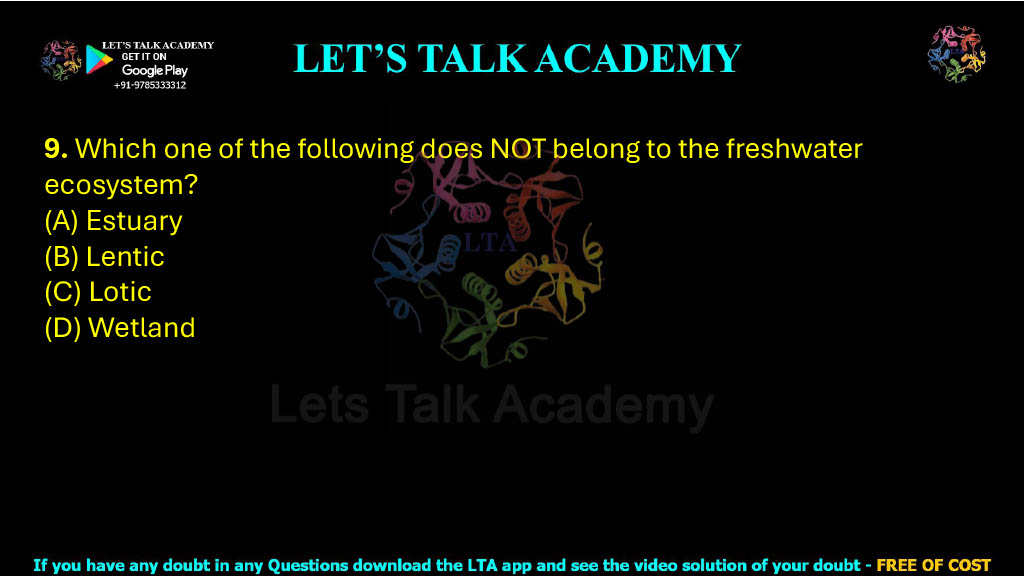
9. Which one of the following does NOT belong to the freshwater ecosystem?
(A) Estuary
(B) Lentic
(C) Lotic
(D) Wetland
Which One of the Following Does NOT Belong to the Freshwater Ecosystem?
Detailed Explanation of the Correct Answer
The correct answer is (A) Estuary because an estuary is not considered a true freshwater ecosystem. An estuary is a transitional aquatic ecosystem where freshwater flowing from rivers and streams meets and mixes with saltwater from the sea or ocean. This mixing produces water with an intermediate salt concentration known as brackish water.
Freshwater ecosystems are aquatic environments characterized by very low concentrations of dissolved salts. Rivers, streams, lakes, ponds, and many wetlands are included in this category. Estuaries are different because their water chemistry is strongly influenced by both freshwater and seawater. Therefore, they are generally classified as transitional or brackish-water ecosystems rather than purely freshwater ecosystems.
The key point in this question is the word “freshwater.” Lentic, lotic, and wetland ecosystems are commonly included among the major categories of freshwater ecosystems, whereas an estuary represents the meeting zone between a river and the sea.
What Is a Freshwater Ecosystem?
A freshwater ecosystem is an aquatic ecosystem in which the water contains a very low concentration of dissolved salts. Freshwater ecosystems support a wide variety of plants, animals, microorganisms, and ecological interactions. They are essential for biodiversity, nutrient cycling, water purification, flood regulation, and the survival of terrestrial as well as aquatic organisms.
Freshwater ecosystems are commonly classified into lentic ecosystems, lotic ecosystems, and wetlands. Lentic ecosystems contain standing or relatively still water, while lotic ecosystems contain continuously flowing water. Wetlands are water-saturated ecosystems that form a transition between aquatic and terrestrial environments.
This classification makes the question easier to understand. Since lentic, lotic, and wetland ecosystems are recognized freshwater ecosystem categories, the option that does not belong is the estuary.
Why Is Estuary the Correct Answer?
Option (A) Estuary — Does Not Belong to the Freshwater Ecosystem
An estuary is a partially enclosed coastal water body where freshwater from rivers mixes with saltwater from the ocean. Because of this mixing, estuarine water is generally brackish rather than purely fresh. Salinity in an estuary may change continuously depending on tides, river discharge, rainfall, evaporation, and distance from the sea.
Estuaries are highly productive ecosystems because rivers bring nutrients from the land while tidal movements introduce materials from the marine environment. These nutrient-rich conditions support phytoplankton, aquatic plants, fishes, crustaceans, molluscs, birds, and numerous microorganisms.
However, high productivity does not make an estuary a freshwater ecosystem. Its defining ecological feature is the interaction and mixing of freshwater with seawater. Therefore, estuary is the correct answer to the question asking which option does not belong to the freshwater ecosystem.
Estuaries also experience strong environmental fluctuations. Organisms living there must tolerate changing salinity, temperature, oxygen levels, and water movement. Such organisms are often adapted to a broad range of salinity conditions. This makes the estuarine environment ecologically distinct from stable freshwater lakes and continuously flowing freshwater rivers.
Why Are the Other Options Incorrect?
Option (B) Lentic — A Freshwater Ecosystem
A lentic ecosystem is a freshwater ecosystem characterized by standing or relatively still water. The word “lentic” is used for aquatic habitats where water does not flow continuously in one direction.
Common examples of lentic ecosystems include lakes, ponds, pools, and reservoirs. Although some internal movement may occur because of wind, temperature differences, or seasonal mixing, the water is generally considered standing compared with rivers and streams.
Lentic ecosystems often show distinct ecological zones. The shallow area near the shore may support rooted aquatic plants, while open-water regions contain phytoplankton and swimming organisms. Deeper regions may receive less light and may differ in temperature and dissolved oxygen concentration.
Because lakes and ponds are major examples of freshwater habitats, lentic clearly belongs to the freshwater ecosystem category. Therefore, option (B) is not the correct answer.
Option (C) Lotic — A Freshwater Ecosystem
A lotic ecosystem is a freshwater ecosystem characterized by continuously flowing water. Rivers, streams, brooks, and springs are common examples of lotic ecosystems.
Water movement is the most important feature of a lotic environment. The speed of flow influences oxygen availability, nutrient transport, sediment movement, and the types of organisms that can survive in the ecosystem. Fast-flowing streams often contain high levels of dissolved oxygen, while slow-moving river sections may accumulate finer sediments and organic matter.
Organisms living in lotic ecosystems frequently show special adaptations to flowing water. Some aquatic animals possess flattened bodies or attachment structures that prevent them from being swept away. Aquatic plants may have flexible stems and leaves that can tolerate water currents.
Since rivers and streams are fundamental components of freshwater ecology, lotic belongs to the freshwater ecosystem category. Therefore, option (C) is incorrect.
Option (D) Wetland — A Freshwater Ecosystem
A wetland is an ecosystem in which the soil remains permanently or seasonally saturated with water. Wetlands form an important transition zone between terrestrial and aquatic ecosystems.
Freshwater wetlands include marshes, swamps, bogs, and fens. These habitats support plants and animals adapted to waterlogged or oxygen-poor soil conditions. Wetland vegetation may include grasses, reeds, sedges, shrubs, and trees, depending on the type of wetland.
Wetlands perform several important ecological functions. They can store floodwater, trap sediments, remove pollutants, recycle nutrients, provide breeding habitats for animals, and support high levels of biodiversity. Many freshwater species depend on wetlands for feeding, reproduction, shelter, and migration.
Although some coastal wetlands can be saline or brackish, wetlands are commonly recognized as one of the major freshwater ecosystem categories in basic ecological classification. In the context of this question, wetland belongs to the freshwater ecosystem group. Therefore, option (D) is not the correct answer.
Major Types of Freshwater Ecosystems
Freshwater ecosystems can be broadly understood through three major categories. Lentic ecosystems contain standing water and include lakes and ponds. Lotic ecosystems contain flowing water and include rivers and streams. Wetland ecosystems occur where water saturates the soil either permanently or seasonally.
These three freshwater ecosystem types differ in water movement, depth, oxygen availability, vegetation, nutrient dynamics, and biological communities. Despite these differences, they all primarily involve freshwater conditions.
An estuary does not fit into this classification because it is influenced by seawater. It represents an ecological transition between riverine freshwater and the marine environment.
Difference Between Freshwater Ecosystems and Estuaries
The most important difference between a freshwater ecosystem and an estuary is salinity. Freshwater ecosystems contain very low concentrations of dissolved salts, whereas estuaries contain brackish water produced by the mixing of freshwater and seawater.
Freshwater ecosystems include ponds, lakes, rivers, streams, and freshwater wetlands. Estuaries are generally found near coastlines at the mouths of rivers. Freshwater organisms are adapted to low-salinity conditions, while estuarine organisms must often tolerate frequent changes in salinity caused by tides and variations in river flow.
Thus, even though both freshwater ecosystems and estuaries are aquatic environments, they differ significantly in water chemistry, location, physical conditions, and the adaptations of their organisms.
Final Answer
Correct Option: (A) Estuary
An estuary does not belong to the true freshwater ecosystem category because it is a transitional coastal ecosystem where freshwater from rivers mixes with saltwater from the sea, producing brackish water. In contrast, lentic ecosystems, lotic ecosystems, and freshwater wetlands are major categories of freshwater ecosystems.


