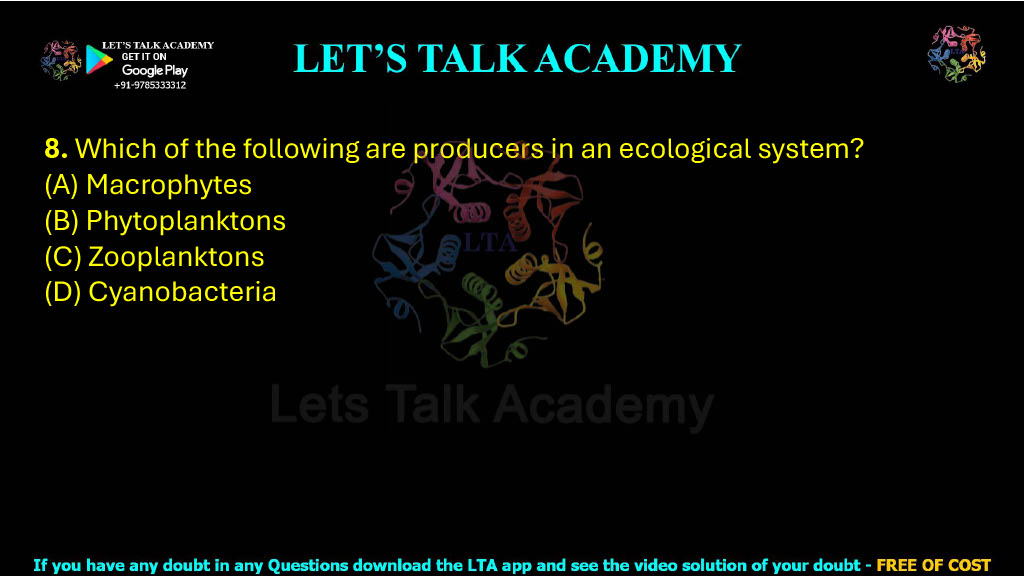
8. Which of the following are producers in an ecological system?
(A) Macrophytes
(B) Phytoplanktons
(C) Zooplanktons
(D) Cyanobacteria
Which of the Following Are Producers in an Ecological System?
Understanding Producers in an Ecological System
Producers are organisms that can synthesize organic food from simple inorganic substances. In most ecosystems, they capture solar energy through photosynthesis and convert carbon dioxide and water into energy-rich organic compounds. Because producers introduce energy into the biological component of an ecosystem, they form the first trophic level of almost every food chain.
The basic photosynthetic relationship can be represented as:
Carbon dioxide + Water + Light energy → Organic matter + Oxygen
The energy stored in organic matter then becomes available to herbivores and subsequently to organisms at higher trophic levels. For this reason, producers are also known as autotrophs or, more specifically in photosynthetic ecosystems, photoautotrophs.
Among the organisms listed in the question, macrophytes, phytoplankton, and cyanobacteria can carry out photosynthesis and produce organic matter. Zooplankton cannot synthesize their own food through photosynthesis and therefore function as consumers.
Thus, the correct options are (A), (B), and (D).
Why Are Macrophytes, Phytoplankton, and Cyanobacteria Producers?
All three groups possess the ability to capture light energy and convert inorganic carbon into organic compounds. However, they occupy different ecological niches and contribute to primary production in different ways.
Macrophytes are large aquatic plants that commonly dominate shallow regions and shorelines. Phytoplankton are microscopic photosynthetic organisms suspended in water and are major producers in open-water environments. Cyanobacteria are photosynthetic prokaryotes that contribute significantly to primary production in both aquatic and terrestrial ecosystems.
Although these groups differ structurally and taxonomically, they share one important ecological characteristic: they produce organic matter from inorganic substances and therefore occupy the producer level of the ecosystem.
Detailed Explanation of Option (A): Macrophytes
Why Are Macrophytes Producers?
Macrophytes are large aquatic plants that are visible without a microscope. They occur in freshwater habitats such as ponds, lakes, wetlands, rivers, and marshes. Depending on their growth form, macrophytes may be emergent, floating, submerged, or rooted with floating leaves.
Macrophytes contain photosynthetic pigments and use sunlight to synthesize organic matter. Through photosynthesis, they convert carbon dioxide and water into carbohydrates and other organic compounds. Therefore, they function as primary producers in aquatic ecosystems.
These plants are especially abundant in the littoral zone, where sunlight can reach the bottom and support the growth of rooted vegetation. Macrophytes contribute significantly to ecosystem productivity and also provide habitat, shelter, and breeding surfaces for numerous aquatic organisms.
Because macrophytes produce their own organic food through photosynthesis, Option (A) is correct.
Detailed Explanation of Option (B): Phytoplanktons
Why Are Phytoplankton Major Primary Producers?
Phytoplankton are microscopic photosynthetic organisms that drift or remain suspended in the water column. They are among the most important primary producers in aquatic ecosystems.
These organisms capture sunlight and use photosynthesis to convert inorganic carbon into organic matter. In ponds, lakes, rivers, and oceans, phytoplankton form the foundation of many aquatic food webs.
Zooplankton feed on phytoplankton, small fish may feed on zooplankton, and larger predators may consume those fish. Therefore, the energy captured initially by phytoplankton can move through several trophic levels.
Phytoplankton are especially important in open-water regions where large rooted plants cannot grow. Their photosynthetic activity contributes substantially to primary productivity and oxygen production.
Since phytoplankton synthesize their own organic matter through photosynthesis, Option (B) is correct.
Detailed Explanation of Option (C): Zooplanktons
Why Are Zooplankton Not Producers?
Zooplankton are small heterotrophic organisms that drift or swim weakly in aquatic environments. Unlike phytoplankton, they cannot perform photosynthesis and cannot manufacture their own food from inorganic substances.
Many zooplankton feed directly on phytoplankton and therefore function as primary consumers. Other zooplankton may consume smaller animals or microorganisms and can occupy higher consumer levels.
The basic aquatic food-chain relationship is often represented as:
Phytoplankton → Zooplankton → Small fish → Large fish
In this sequence, phytoplankton occupy the producer level, whereas zooplankton obtain energy by consuming other organisms. Therefore, zooplankton are heterotrophs rather than autotrophs.
Since they depend on pre-existing organic matter for nutrition, Option (C) is incorrect.
Detailed Explanation of Option (D): Cyanobacteria
Why Are Cyanobacteria Producers?
Cyanobacteria are photosynthetic prokaryotic organisms commonly known as blue-green bacteria. They contain photosynthetic pigments that allow them to capture solar energy and synthesize organic matter.
Unlike plants and eukaryotic algae, cyanobacteria do not possess membrane-bound chloroplasts. However, they contain specialized internal photosynthetic membranes where light-dependent reactions occur.
Cyanobacteria are found in freshwater, marine environments, moist soils, rocks, and many other habitats. In aquatic ecosystems, they may contribute significantly to primary productivity.
Some cyanobacteria can also fix atmospheric nitrogen, converting molecular nitrogen into biologically useful nitrogen compounds. This ability gives certain cyanobacteria an additional ecological role in nutrient cycling.
Because cyanobacteria carry out photosynthesis and produce organic matter from inorganic substances, Option (D) is correct.
Producers and Consumers in an Aquatic Ecosystem
The organisms listed in the question can be separated into producers and consumers according to their mode of nutrition.
Macrophytes are large photosynthetic aquatic plants and therefore act as producers. Phytoplankton are microscopic photosynthetic organisms and form a major producer community in open water. Cyanobacteria are photosynthetic prokaryotes and also contribute to primary production.
Zooplankton differ from these three groups because they cannot synthesize their own food. They obtain organic matter by feeding on phytoplankton or other organisms and therefore function as consumers.
This distinction can be summarized as:
Macrophytes → Producers
Phytoplankton → Producers
Zooplankton → Consumers
Cyanobacteria → Producers
Ecological Importance of Primary Producers
Primary producers form the energetic foundation of an ecological system. Solar energy cannot be used directly by most consumers. Producers capture this energy and store it in chemical bonds within organic molecules.
Herbivores obtain energy by consuming producers. Carnivores then obtain energy by consuming herbivores or other animals. Therefore, the energy available at higher trophic levels ultimately depends on primary production.
In aquatic ecosystems, macrophytes, phytoplankton, and cyanobacteria contribute to the production of organic matter and support complex food webs. They also influence oxygen levels, carbon cycling, nutrient dynamics, and ecosystem productivity.
Final Answer
The producers among the given organisms are macrophytes, phytoplankton, and cyanobacteria. These organisms can synthesize organic matter using light energy and therefore function as autotrophs at the first trophic level of an ecosystem. Zooplankton are heterotrophic consumers and depend on other organisms for food.
Therefore, the correct answer is (A), (B), and (D).


