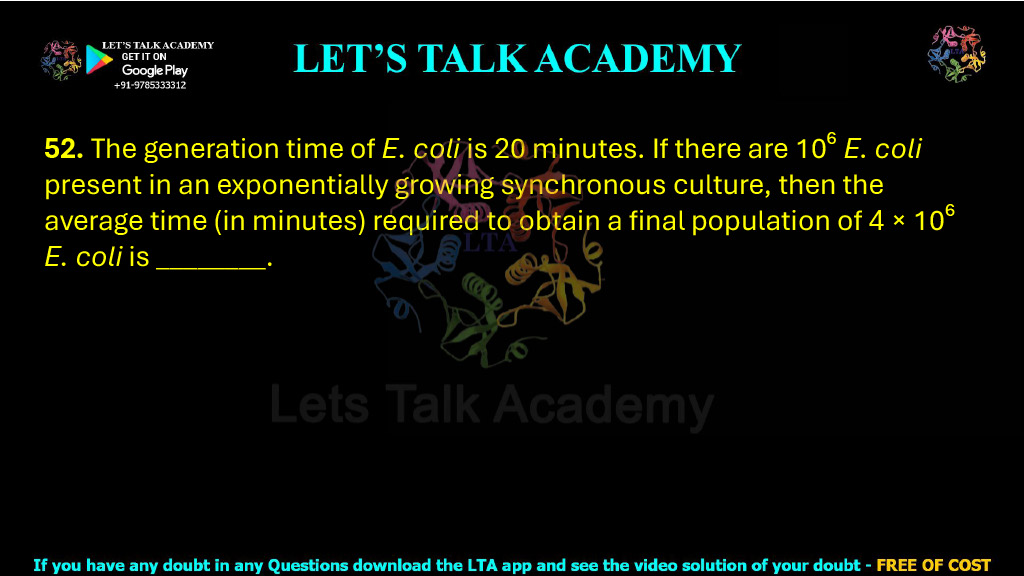
52. The generation time of E. coli is 20 minutes. If there are 10⁶ E. coli present in an exponentially growing synchronous culture, then the average time (in minutes) required to obtain a final population of 4 × 10⁶ E. coli is ________.
E. coli Generation Time Calculation: How Long Does It Take for 10⁶ Cells to Reach 4 × 10⁶ Cells?
Introduction
One of the most important characteristics of bacterial growth is its ability to increase exponentially through binary fission. Under ideal environmental conditions, each bacterial cell divides into two genetically identical daughter cells after a fixed interval known as the generation time or doubling time. Because every generation doubles the population, bacterial growth follows an exponential pattern rather than a linear one.
Escherichia coli (E. coli) is one of the best-studied bacterial species in microbiology. Under optimal laboratory conditions, its generation time is approximately 20 minutes. This rapid rate of multiplication makes E. coli an excellent model organism for studying microbial growth kinetics, molecular biology, genetics, biotechnology, and industrial fermentation.
Correct Answer
Correct Answer: 40 minutes
Detailed Explanation
During exponential growth, bacterial populations double after every generation. Therefore, the number of generations required can be calculated using the exponential growth equation:
N = N0 × 2n
where:
- N = Final number of bacterial cells
- N0 = Initial number of bacterial cells
- n = Number of generations
Step 1: Identify the Given Data
| Parameter | Value |
|---|---|
| Initial Population (N0) | 106 cells |
| Final Population (N) | 4 × 10⁶ cells |
| Generation Time (g) | 20 minutes |
Step 2: Calculate the Number of Generations
Using the growth equation:
4 × 106 = 106 × 2n
Dividing both sides by 106:
4 = 2n
Since:
22 = 4
Therefore,
n = 2 generations
Step 3: Calculate the Total Time
Total time required is:
Time = Number of Generations × Generation Time
Time = 2 × 20
Time = 40 minutes
Step-by-Step Calculation Summary
| Calculation Step | Result |
|---|---|
| Initial Population | 106 |
| Final Population | 4 × 10⁶ |
| Population Increase | 4-fold |
| Number of Generations | 2 |
| Generation Time | 20 minutes |
| Total Time | 40 minutes |
Alternative Logarithmic Method
The number of generations can also be calculated using logarithms:
n = log(N/N0) / log2
Substituting the values:
n = log(4 × 10⁶ / 106) / log2
n = log4 / log2
n = 2
Therefore,
Time = 2 × 20 = 40 minutes
Important Formulae for Bacterial Growth
| Formula | Application |
|---|---|
| N = N0 × 2n | Final bacterial population |
| n = log(N/N0) / log2 | Number of generations |
| Time = n × Generation Time | Total growth time |
| Generation Time = Time / n | Doubling time calculation |
Growth Pattern of the Culture
| Generation | Population | Time |
|---|---|---|
| 0 | 106 | 0 min |
| 1 | 2 × 10⁶ | 20 min |
| 2 | 4 × 10⁶ | 40 min |
Biological Significance
Generation time is one of the most important parameters in microbiology because it reflects how rapidly microorganisms reproduce under specific environmental conditions. Measuring generation time helps researchers optimize industrial fermentation, evaluate antimicrobial treatments, estimate microbial contamination, study microbial physiology, and predict bacterial population dynamics. Organisms with shorter generation times can adapt rapidly to changing environments and are frequently used in molecular biology and biotechnology research.
Final Answer
Initial Population = 106 cells
Final Population = 4 × 10⁶ cells
Number of Generations = 2
Generation Time = 20 minutes
Total Time = 2 × 20 = 40 minutes
Correct Answer: 40 minutes


