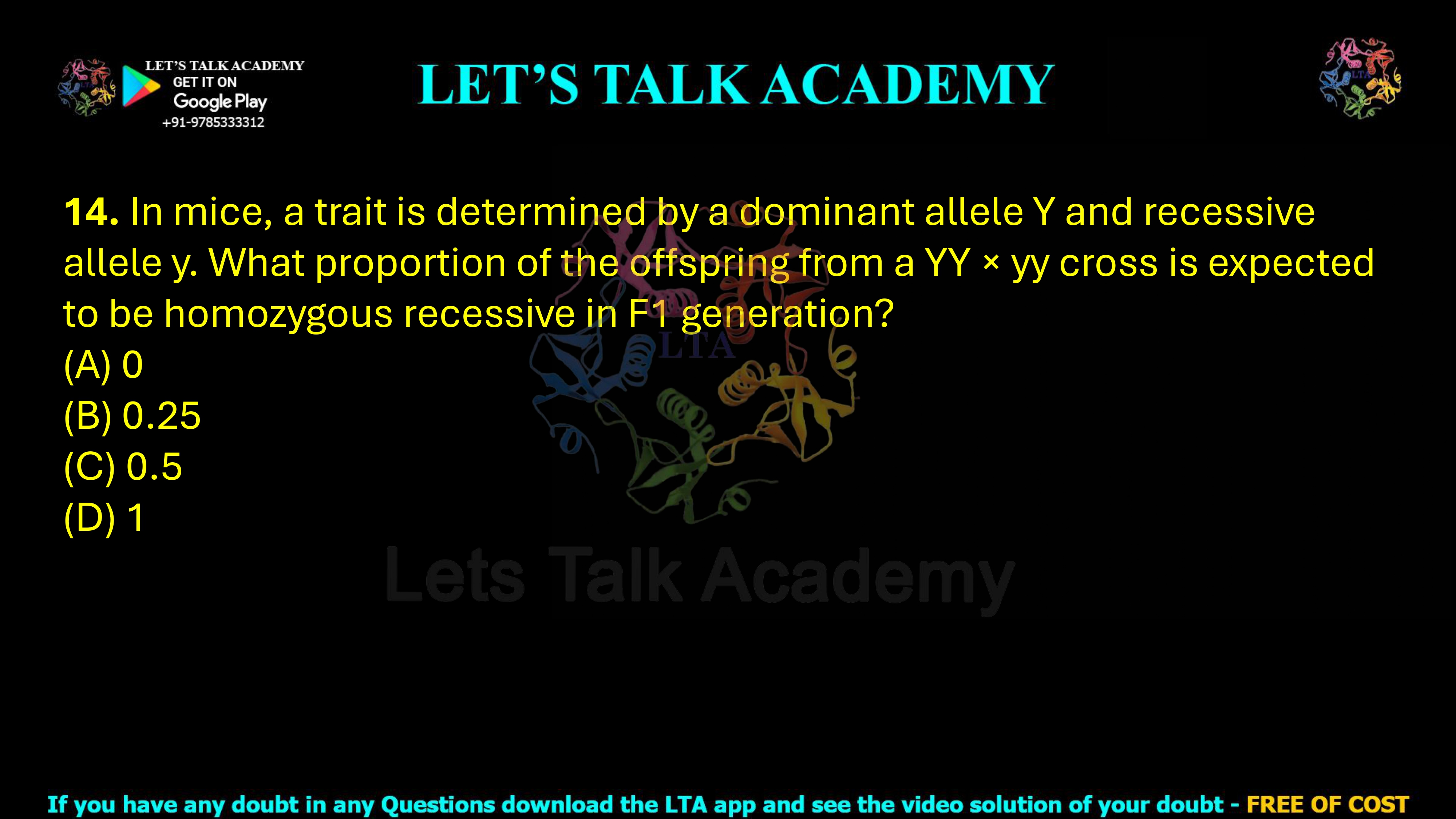
14. In mice, a trait is determined by a dominant allele Y and recessive allele y. What proportion of the offspring from a YY × yy cross is expected to be homozygous recessive in F1 generation?
(A) 0
(B) 0.25
(C) 0.5
(D) 1
YY × yy Cross in Mice: Homozygous Recessive Offspring in the F₁ Generation Explained
Introduction
Mendelian genetics forms the foundation of classical inheritance and explains how traits are transmitted from parents to offspring through genes. Every gene exists in different forms called alleles. In a diploid organism, one allele is inherited from each parent. Depending on whether the alleles are identical or different, an individual may be homozygous or heterozygous for a particular trait.
In this question, the dominant allele is represented by Y and the recessive allele by y. An individual with genotype YY is homozygous dominant, while an individual with genotype yy is homozygous recessive. When these two individuals are crossed, the inheritance pattern follows Mendel’s Law of Segregation, according to which each parent contributes only one allele to each gamete. By constructing a Punnett square, we can accurately predict the genotypes and phenotypes of the F1 generation.
Correct Answer
Correct Option: (A) 0
Detailed Explanation
The parental genotypes are:
Parent 1 = YY (Homozygous Dominant)
Parent 2 = yy (Homozygous Recessive)
The homozygous dominant parent can produce only one type of gamete containing the dominant allele Y. Similarly, the homozygous recessive parent can produce only one type of gamete containing the recessive allele y.
During fertilization, every offspring receives one allele from each parent. Therefore, all offspring inherit one dominant allele (Y) from one parent and one recessive allele (y) from the other parent.
Consequently, every F1 offspring has the genotype Yy.
Since no offspring inherit two recessive alleles (yy), the proportion of homozygous recessive individuals in the F1 generation is zero.
Punnett Square Analysis
| Y | Y | |
|---|---|---|
| y | Yy | Yy |
| y | Yy | Yy |
The Punnett square clearly shows that every offspring possesses the genotype Yy.
Genotypic Distribution in the F1 Generation
| Genotype | Proportion |
|---|---|
| YY | 0 |
| Yy | 1 (100%) |
| yy | 0 |
Phenotypic Distribution
| Phenotype | Proportion |
|---|---|
| Dominant Trait | 100% |
| Recessive Trait | 0% |
Explanation of Each Option
Option (A): 0
This option is correct. Since every offspring has genotype Yy, none are homozygous recessive (yy).
Option (B): 0.25
This option is incorrect. A frequency of 0.25 for the homozygous recessive genotype is expected in the F2 generation following a heterozygous cross (Yy × Yy), not in the F1 generation from YY × yy.
Option (C): 0.5
This option is incorrect. Half of the offspring cannot be homozygous recessive because the homozygous dominant parent contributes only the dominant allele Y.
Option (D): 1
This option is incorrect. All offspring are heterozygous (Yy), not homozygous recessive.
Why Option (A) is Correct
Every gamete produced by the YY parent contains only the dominant allele Y, while every gamete from the yy parent contains only the recessive allele y. Therefore, every F1 offspring has genotype Yy. Since the genotype yy is absent, the proportion of homozygous recessive offspring is 0.
Comparison of All Options
| Option | Proportion of Homozygous Recessive (yy) | Status |
|---|---|---|
| A | 0 | Correct |
| B | 0.25 | Incorrect |
| C | 0.50 | Incorrect |
| D | 1.00 | Incorrect |
Important Monohybrid Crosses
| Cross | Offspring Genotypes | Homozygous Recessive Frequency |
|---|---|---|
| YY × yy | 100% Yy | 0 |
| Yy × Yy | 1 YY : 2 Yy : 1 yy | 0.25 |
| Yy × yy | 1 Yy : 1 yy | 0.50 |
| yy × yy | 100% yy | 1.00 |
Biological Significance
This genetic cross demonstrates Mendel’s Law of Segregation, which states that the two alleles of a gene separate during gamete formation and reunite during fertilization. A cross between two homozygous parents carrying contrasting alleles produces genetically uniform F1 offspring, all of which are heterozygous and express the dominant phenotype. This principle forms the basis of classical genetics, plant breeding, animal breeding, and modern molecular genetics.
Final Answer
Cross:
YY × yy
F1 offspring:
100% Yy
Frequency of homozygous recessive (yy) individuals:
0
Correct Option: (A) 0


