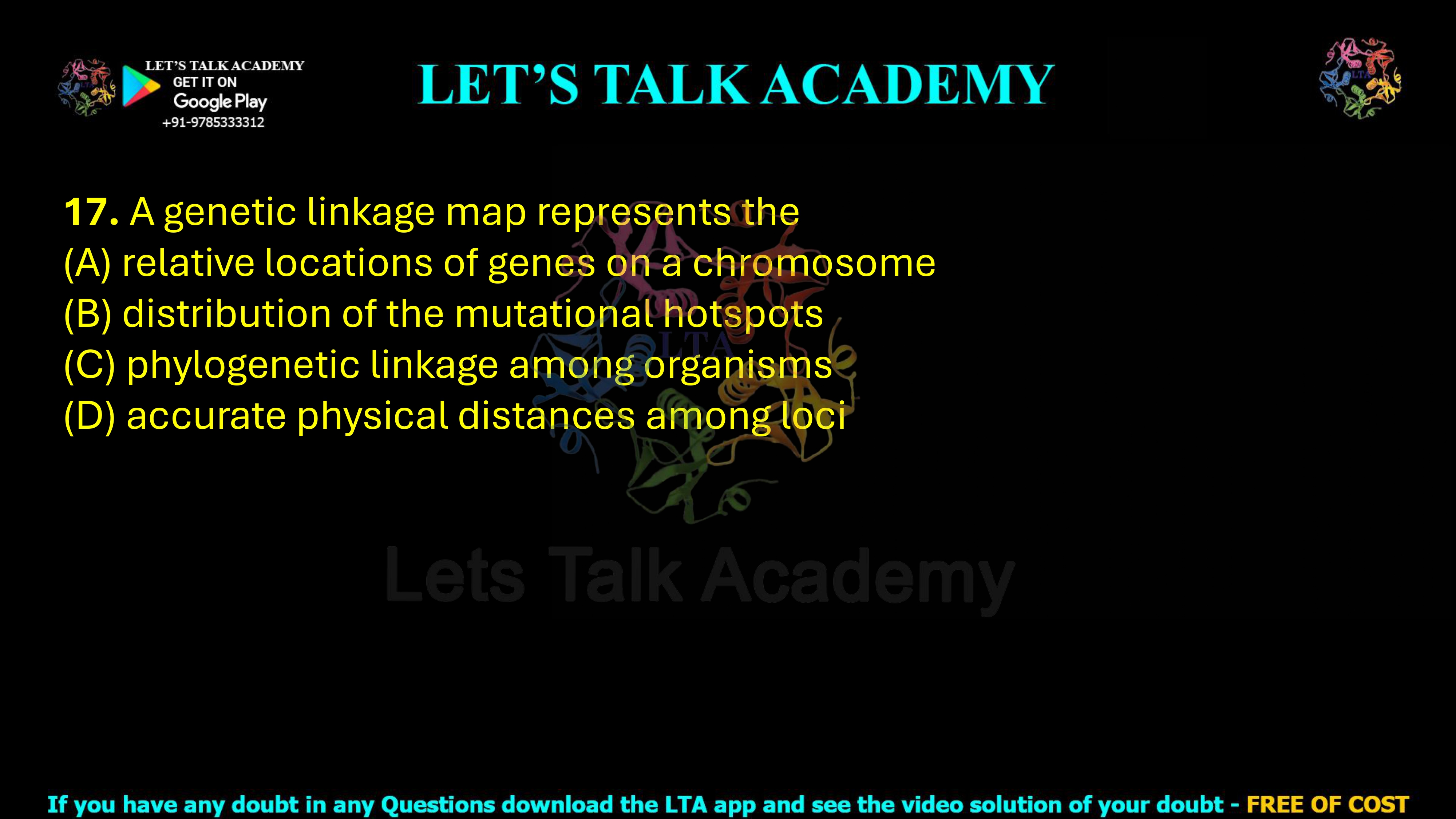
17. A genetic linkage map represents the
(A) relative locations of genes on a chromosome
(B) distribution of the mutational hotspots
(C) phylogenetic linkage among organisms
(D) accurate physical distances among loci
Genetic Linkage Map Explained: Relative Locations of Genes on a Chromosome
Introduction
One of the most important breakthroughs in classical genetics was the discovery that genes located on the same chromosome tend to be inherited together. This phenomenon, known as genetic linkage, forms the basis of genetic linkage mapping. A genetic linkage map is a diagram that illustrates the relative order and relative distances of genes on a chromosome based on how frequently recombination occurs between them during meiosis.
Unlike a physical map, which measures the exact number of DNA base pairs separating genes, a genetic linkage map estimates the distance between genes using recombination frequency. Genes that are physically close on a chromosome undergo crossing over less frequently than genes that are farther apart. Therefore, recombination frequency serves as an indirect measure of gene distance.
Correct Answer
Correct Option: (A) Relative locations of genes on a chromosome
Detailed Explanation
A genetic linkage map is constructed by studying the frequency of recombination between genes during meiosis. The closer two genes are located on the same chromosome, the lower the probability that crossing over will occur between them. Conversely, genes that are farther apart recombine more frequently.
Because recombination frequency reflects the likelihood of crossing over rather than the exact number of DNA base pairs, a genetic linkage map provides the relative positions of genes instead of their precise physical locations. Distances on a linkage map are expressed in centimorgans (cM), where 1 centimorgan corresponds to approximately 1% recombination frequency.
For example, if two genes show a recombination frequency of 10%, they are said to be approximately 10 cM apart. This value represents their genetic distance rather than their exact physical separation on the chromosome.
How a Genetic Linkage Map is Constructed
Researchers perform controlled genetic crosses and analyze the offspring to determine how frequently recombination occurs between different genes. The observed recombination frequencies are then used to arrange genes in their correct order and estimate their relative distances. The lower the recombination frequency, the closer the genes are likely to be on the chromosome.
Genetic Distance and Recombination
| Recombination Frequency | Genetic Distance |
|---|---|
| 1% | 1 centimorgan (1 cM) |
| 5% | 5 cM |
| 10% | 10 cM |
| 20% | 20 cM |
Explanation of Each Option
Option (A): Relative Locations of Genes on a Chromosome
This option is correct. Genetic linkage maps show the relative order and relative distances of genes based on recombination frequencies. They do not provide exact physical measurements but accurately describe how genes are arranged relative to one another.
Option (B): Distribution of the Mutational Hotspots
This option is incorrect. Mutational hotspots are genomic regions with unusually high mutation rates. Their distribution is studied using mutation analysis and genome sequencing, not genetic linkage maps.
Option (C): Phylogenetic Linkage Among Organisms
This option is incorrect. Phylogenetic relationships describe the evolutionary history of different organisms and are represented by phylogenetic trees, not linkage maps.
Option (D): Accurate Physical Distances Among Loci
This option is incorrect. Accurate physical distances are measured using physical maps, genome sequencing, or DNA mapping techniques and are expressed in base pairs (bp), kilobases (kb), or megabases (Mb). Genetic linkage maps estimate only relative distances based on recombination frequency.
Why Option (A) is Correct
A genetic linkage map is based on recombination frequencies observed during meiosis. Since recombination frequency reflects the probability of crossing over rather than the exact DNA length, the resulting map shows the relative arrangement of genes on a chromosome. Therefore, Option (A) correctly defines a genetic linkage map.
Difference Between Genetic Map and Physical Map
| Feature | Genetic Linkage Map | Physical Map |
|---|---|---|
| Distance Measurement | Recombination frequency | DNA length |
| Unit | Centimorgan (cM) | Base pairs (bp) |
| Shows | Relative gene positions | Exact physical positions |
| Basis | Crossing over during meiosis | DNA sequencing and molecular mapping |
Applications of Genetic Linkage Maps
| Application | Importance |
|---|---|
| Disease Gene Mapping | Locating genes responsible for inherited disorders |
| Plant Breeding | Marker-assisted selection |
| Animal Breeding | Identification of economically important traits |
| Evolutionary Genetics | Studying chromosome evolution |
| Genome Research | Supporting genome assembly and annotation |
Genetic Linkage vs Independent Assortment
Genes located on different chromosomes assort independently according to Mendel’s Second Law. However, genes located on the same chromosome exhibit linkage because they tend to be inherited together. Crossing over during meiosis can separate linked genes, and the frequency of this recombination provides the information required to construct genetic linkage maps.
Biological Significance
Genetic linkage maps have revolutionized genetics by allowing scientists to determine the arrangement of genes without directly sequencing DNA. They remain essential tools in gene discovery, disease diagnosis, crop improvement, livestock breeding, and evolutionary studies. Although modern genome sequencing provides complete physical maps, linkage maps continue to play an important role in identifying genes associated with inherited diseases and economically valuable traits.
Final Answer
A genetic linkage map is constructed using recombination frequencies and represents the relative order and relative locations of genes on a chromosome. It does not measure exact physical DNA distances.
Correct Option: (A) Relative locations of genes on a chromosome


