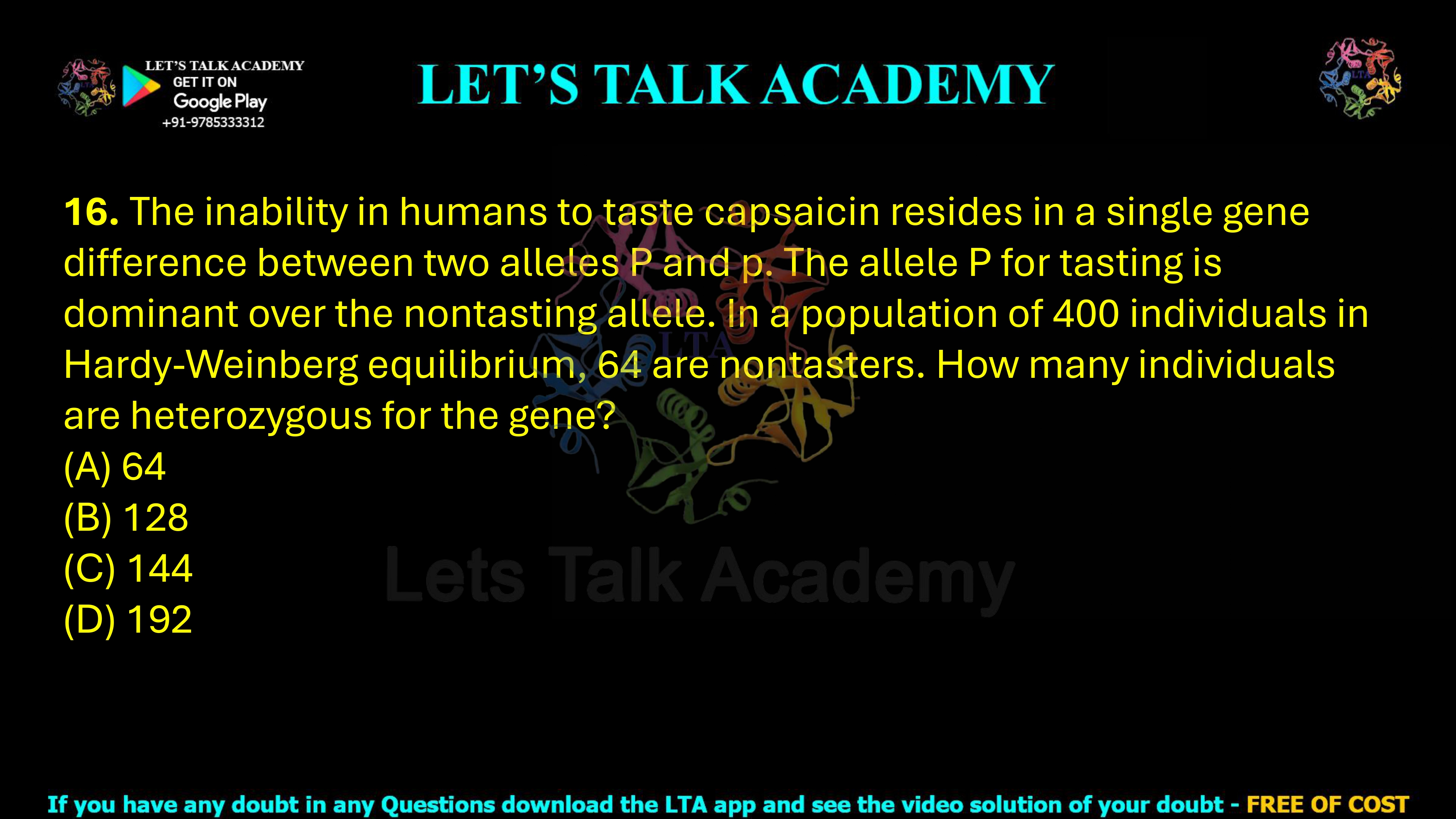
16. The inability in humans to taste capsaicin resides in a single gene difference between two alleles P and p. The allele P for tasting is dominant over the nontasting allele. In a population of 400 individuals in Hardy-Weinberg equilibrium, 64 are nontasters. How many individuals are heterozygous for the gene?
(A) 64
(B) 128
(C) 144
(D) 192
Hardy-Weinberg Equilibrium: Calculating the Number of Heterozygous Individuals in a Population
Introduction
The Hardy-Weinberg equilibrium is one of the most fundamental concepts in population genetics. Proposed independently by G. H. Hardy and Wilhelm Weinberg in 1908, it provides a mathematical model that predicts how allele and genotype frequencies remain constant from one generation to the next in an ideal population where no evolutionary forces are acting. This principle serves as the foundation for studying evolution, genetic diversity, disease inheritance, and population structure.
When a population satisfies the assumptions of Hardy-Weinberg equilibrium, the frequencies of the three possible genotypes can be calculated directly from allele frequencies using the equation p² + 2pq + q² = 1. Here, p² represents the frequency of homozygous dominant individuals, 2pq represents the frequency of heterozygous individuals, and q² represents the frequency of homozygous recessive individuals.
In this question, the inability to taste capsaicin is a recessive trait. Therefore, individuals who are non-tasters possess the homozygous recessive genotype (pp). By determining the frequency of this genotype, we can calculate the allele frequencies and subsequently determine the number of heterozygous individuals in the population.
Correct Answer
Correct Option: (D) 192
Detailed Explanation
The non-taster phenotype is recessive, which means only individuals with genotype pp express the trait. Therefore, the observed frequency of non-tasters represents the value of q² in the Hardy-Weinberg equation.
The total population consists of 400 individuals, and 64 individuals are non-tasters.
Thus,
q² = 64 / 400 = 0.16
Taking the square root:
q = √0.16 = 0.40
Since
p + q = 1
Therefore,
p = 1 − 0.40 = 0.60
The frequency of heterozygous individuals is:
2pq = 2 × 0.60 × 0.40
2pq = 0.48
The total number of heterozygous individuals is:
0.48 × 400 = 192
Step-by-Step Calculation
Step 1: Calculate the Frequency of Homozygous Recessive Individuals
q² = 64 / 400 = 0.16
Step 2: Calculate the Recessive Allele Frequency
q = √0.16 = 0.40
Step 3: Calculate the Dominant Allele Frequency
p = 1 − q
p = 1 − 0.40 = 0.60
Step 4: Calculate the Frequency of Heterozygotes
2pq = 2 × 0.60 × 0.40
2pq = 0.48
Step 5: Calculate the Number of Heterozygous Individuals
0.48 × 400 = 192
Calculation Summary
| Parameter | Calculation | Result |
|---|---|---|
| Total Population | – | 400 |
| Non-tasters (pp) | – | 64 |
| q² | 64 ÷ 400 | 0.16 |
| q | √0.16 | 0.40 |
| p | 1 − 0.40 | 0.60 |
| 2pq | 2 × 0.60 × 0.40 | 0.48 |
| Heterozygous Individuals | 0.48 × 400 | 192 |
Explanation of Each Option
Option (A): 64
This option is incorrect. Sixty-four represents the number of homozygous recessive (pp) individuals, not the heterozygous genotype.
Option (B): 128
This option is incorrect. It does not correspond to the Hardy-Weinberg calculation based on the given allele frequencies.
Option (C): 144
This option is incorrect. The heterozygous frequency calculated using the Hardy-Weinberg equation is 0.48, which corresponds to 192 individuals.
Option (D): 192
This option is correct. Applying the Hardy-Weinberg formula gives a heterozygous frequency of 0.48, and multiplying by the total population yields 192 heterozygous individuals.
Hardy-Weinberg Equation
| Expression | Meaning |
|---|---|
| p + q = 1 | Total allele frequency |
| p² | Frequency of homozygous dominant genotype |
| 2pq | Frequency of heterozygous genotype |
| q² | Frequency of homozygous recessive genotype |
| p² + 2pq + q² = 1 | Total genotype frequency |
Expected Genotype Distribution
| Genotype | Frequency | Number of Individuals |
|---|---|---|
| PP | 0.36 | 144 |
| Pp | 0.48 | 192 |
| pp | 0.16 | 64 |
Verification:
144 + 192 + 64 = 400
Biological Significance
The Hardy-Weinberg equilibrium provides the mathematical framework for predicting genotype frequencies from allele frequencies in a stable population. It is widely used in medical genetics to estimate carrier frequencies, identify disease prevalence, evaluate evolutionary changes, and study genetic variation within populations. In this example, although only 64 individuals express the recessive phenotype, the carrier (heterozygous) population is much larger, demonstrating why recessive alleles can remain common in populations.
Final Answer
Given:
Total population = 400
Non-tasters (pp) = 64
q² = 64/400 = 0.16
q = 0.40
p = 0.60
Heterozygous frequency = 2pq = 0.48
Number of heterozygous individuals = 0.48 × 400 = 192
Correct Option: (D) 192


