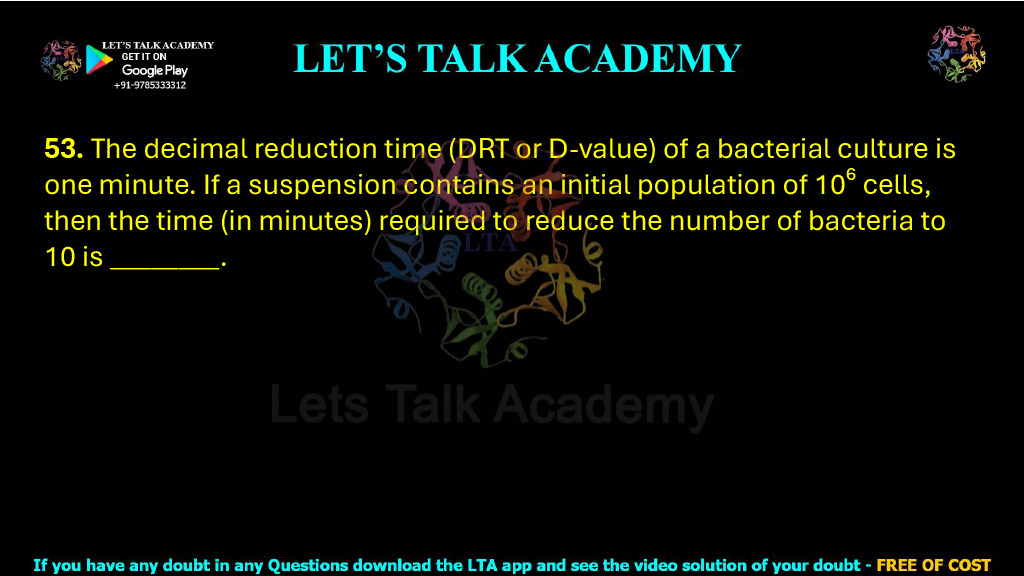
53. The decimal reduction time (DRT or D-value) of a bacterial culture is one minute. If a suspension contains an initial population of 10⁶ cells, then the time (in minutes) required to reduce the number of bacteria to 10 is ________.
Decimal Reduction Time (D-Value): Calculation, Formula, and Importance in Sterilization
Introduction
Sterilization is one of the most important processes in microbiology, biotechnology, pharmaceutical manufacturing, food processing, and medical sciences. Its primary objective is the complete destruction or removal of all viable microorganisms, including highly resistant bacterial endospores. Since microorganisms do not die simultaneously during sterilization, microbial death follows a predictable logarithmic pattern known as first-order death kinetics. This predictable behavior allows microbiologists to calculate the time required to reduce microbial populations to safe levels.
One of the most widely used parameters in sterilization studies is the Decimal Reduction Time (DRT), also called the D-value. The D-value represents the time required under specific sterilization conditions to reduce a microbial population by 90%, or by one logarithmic cycle (one log10). Because each D-value reduces the microbial population by one-tenth, repeated D-values progressively decrease the number of surviving microorganisms according to first-order kinetics.
Correct Answer
Correct Answer: 5 minutes
Detailed Explanation
The D-value is defined as the time required to reduce the microbial population by one logarithmic cycle, meaning only one-tenth of the original population survives after each D-value.
In this problem, the D-value is 1 minute. Therefore, every minute decreases the bacterial population by one log10.
Step 1: Identify the Given Data
| Parameter | Value |
|---|---|
| Initial Population (N0) | 106 cells |
| Final Population (N) | 10 cells = 101 |
| D-value | 1 minute |
Step 2: Calculate the Log Reduction Required
The bacterial population decreases from:
106 → 101
This corresponds to:
6 − 1 = 5 logarithmic reductions
Step 3: Calculate the Total Time
Each logarithmic reduction requires one D-value.
Total Time = Number of Log Reductions × D-value
Total Time = 5 × 1 minute
Total Time = 5 minutes
Step-by-Step Population Reduction
| Time (minutes) | Surviving Cells |
|---|---|
| 0 | 106 |
| 1 | 105 |
| 2 | 104 |
| 3 | 103 |
| 4 | 102 |
| 5 | 101 = 10 cells |
Formula Used
The standard equation relating D-value and microbial death is:
Time = D × (log N0 − log N)
Substituting the given values:
Time = 1 × (6 − 1)
Time = 5 minutes
Important Sterilization Formulae
| Formula | Purpose |
|---|---|
| D = Time for one log reduction | Decimal Reduction Time |
| Time = D × (log N0 − log N) | Total sterilization time |
| N = N0 × 10−t/D | Remaining microbial population |
| −log(N/N0) = t/D | First-order death kinetics |
Understanding the D-Value
| D-Value | Population Change |
|---|---|
| 1 D | 100% → 10% |
| 2 D | 10% → 1% |
| 3 D | 1% → 0.1% |
| 4 D | 0.1% → 0.01% |
| 5 D | 0.01% → 0.001% |
Biological Significance
The Decimal Reduction Time is one of the most important parameters used in sterilization validation. It allows microbiologists and industrial quality control specialists to determine how long a sterilization process must continue to eliminate microorganisms safely. D-values are widely used in pharmaceutical manufacturing, food preservation, medical device sterilization, and biotechnology industries to design effective sterilization protocols while maintaining product quality.
Final Answer
Initial Population = 106 cells
Final Population = 10 cells = 101
Log Reductions Required = 6 − 1 = 5
D-value = 1 minute
Total Time = 5 × 1 = 5 minutes
Correct Answer: 5 minutes


