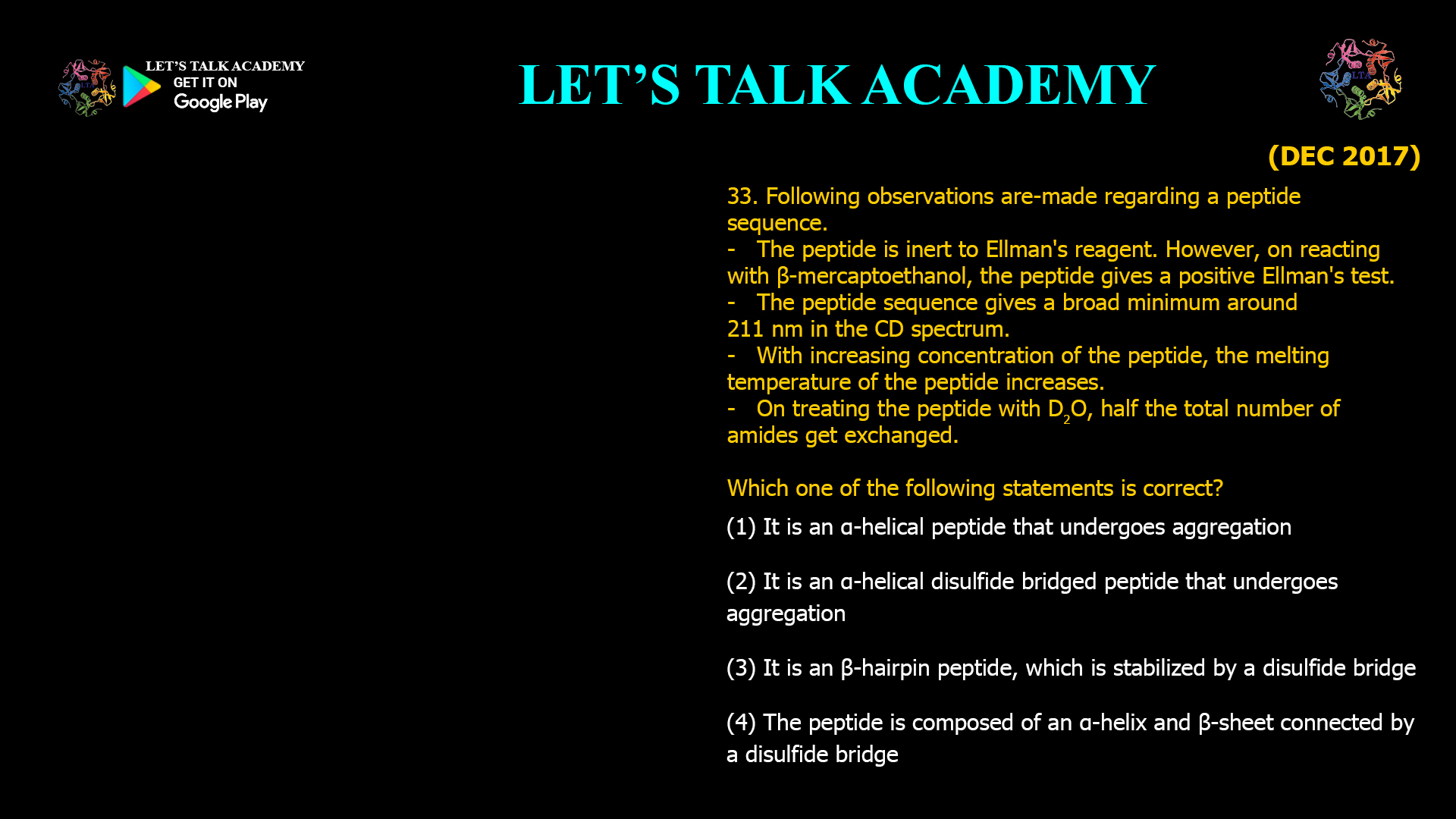
33. Following observations are made regarding a peptide sequence.
– The peptide is inert to Ellman’s reagent. However, on reacting with β-mercaptoethanol, the peptide gives a positive Ellman’s test.
– The peptide sequence gives a broad minimum around 211 nm in the CD spectrum.
– With increasing concentration of the peptide, the melting temperature of the peptide increases.
– On treating the peptide with D₂O, half the total number of amides get exchanged.
Which one of the following statements is correct?
(A) It is an α-helical peptide that undergoes aggregation.
(B) It is an α-helical disulfide-bridged peptide that undergoes aggregation.
(C) It is a β-hairpin peptide, which is stabilized by a disulfide bridge.
(D) The peptide is composed of an α-helix and β-sheet connected by a disulfide bridge.
Identifying a Disulfide-Bridged β-Hairpin Peptide Using Ellman’s Test, Circular Dichroism, and Hydrogen-Deuterium Exchange
Correct Answer
Option (3): It is a β-hairpin peptide, which is stabilized by a disulfide bridge.
Explanation
The conclusion is obtained by combining evidence from four independent experimental observations rather than interpreting any single experiment in isolation. Each observation provides structural information about the peptide, and together they describe a compact peptide containing a disulfide bond that adopts a β-hairpin conformation.
The peptide is initially unreactive toward Ellman’s reagent, indicating that no free sulfhydryl (-SH) groups are present. Ellman’s reagent reacts specifically with free thiol groups to produce a yellow-colored product. After treatment with β-mercaptoethanol, the peptide becomes positive in the Ellman’s assay. β-Mercaptoethanol is a reducing agent that cleaves disulfide bonds into two free cysteine thiol groups. The appearance of a positive Ellman’s test after reduction therefore demonstrates that the cysteine residues were originally linked through an intramolecular disulfide bridge.
The Circular Dichroism spectrum exhibits a broad minimum around 211 nm. This spectral feature is characteristic of β-sheet-rich structures and is commonly observed in β-hairpin peptides. In contrast, α-helices display two distinct negative bands near 208 nm and 222 nm, which are absent in this case. Therefore, the CD spectrum strongly supports a β-structured conformation rather than an α-helical one.
The melting temperature increases as the peptide concentration increases. Such behaviour is often observed when intermolecular interactions become stronger at higher concentrations, resulting in greater thermal stability. Although concentration-dependent stabilization can occur through molecular association, the remaining experimental evidence indicates that the fundamental folded unit is a β-hairpin stabilized by an internal disulfide bond rather than an α-helical aggregate.
Hydrogen-deuterium exchange experiments provide additional structural information. Only solvent-accessible amide hydrogens readily exchange with deuterium, whereas amides involved in stable hydrogen bonds exchange much more slowly. The observation that approximately half of the amide hydrogens undergo exchange indicates that a substantial portion of the peptide backbone is protected by persistent hydrogen bonding, which is consistent with the hydrogen-bonding network present in a β-hairpin structure.
Why Option (1) is Incorrect
This option describes an α-helical peptide undergoing aggregation. However, the CD spectrum does not display the characteristic α-helical minima at 208 nm and 222 nm. Furthermore, the experimental evidence clearly demonstrates the presence of a disulfide bond, which is completely ignored in this option. Since both the spectroscopic and biochemical observations contradict the proposed structure, this option is incorrect.
Why Option (2) is Incorrect
This option correctly recognizes the presence of a disulfide bridge but incorrectly assigns the peptide an α-helical conformation. The CD spectrum is inconsistent with an α-helix and instead supports a β-structured peptide. Because the assigned secondary structure is incorrect, this option cannot explain all the experimental observations.
Why Option (3) is Correct
This option explains every experimental observation. The negative Ellman’s test before reduction and the positive test after β-mercaptoethanol treatment demonstrate the existence of a disulfide bond. The CD spectrum is characteristic of a β-structured peptide, and the hydrogen-deuterium exchange experiment indicates that a significant fraction of backbone amides participate in stable hydrogen bonds. Together, these findings are entirely consistent with a β-hairpin whose folded conformation is stabilized by an intramolecular disulfide bridge.
Why Option (4) is Incorrect
This option proposes that the peptide contains both α-helical and β-sheet regions connected through a disulfide bond. If this were the case, the CD spectrum would generally contain spectral contributions from both structural elements, including the characteristic α-helical signal near 222 nm. Since the observed CD spectrum primarily supports a β-structure, there is no evidence for the coexistence of an α-helix within the peptide.
Role of Ellman’s Reagent in Detecting Disulfide Bonds
Ellman’s reagent, also known as 5,5′-dithiobis-(2-nitrobenzoic acid) (DTNB), specifically reacts with free sulfhydryl groups present in cysteine residues. A peptide lacking free thiols does not produce the characteristic yellow-colored product. When a reducing agent such as β-mercaptoethanol cleaves a disulfide bond, free thiol groups are generated, allowing the peptide to react with Ellman’s reagent. This sequence of observations provides direct evidence for the presence of a disulfide linkage.
Interpretation of the Hydrogen-Deuterium Exchange Experiment
Hydrogen-deuterium exchange measures the accessibility of backbone amide hydrogens to the solvent. Amide hydrogens that are exposed exchange rapidly with deuterium, whereas those involved in stable hydrogen bonds remain protected for longer periods. In compact β-hairpin structures, hydrogen bonds formed between adjacent β-strands protect a significant fraction of backbone amides from exchange, explaining why only about half of the amide hydrogens are replaced by deuterium.
Conclusion
The combined biochemical and spectroscopic evidence identifies the peptide as a β-hairpin stabilized by an intramolecular disulfide bridge. The reduction-dependent Ellman’s test confirms the presence of a disulfide bond, the CD spectrum supports a β-structured conformation, and the hydrogen-deuterium exchange experiment demonstrates the presence of stable backbone hydrogen bonding. Therefore, the correct answer is Option (3).


