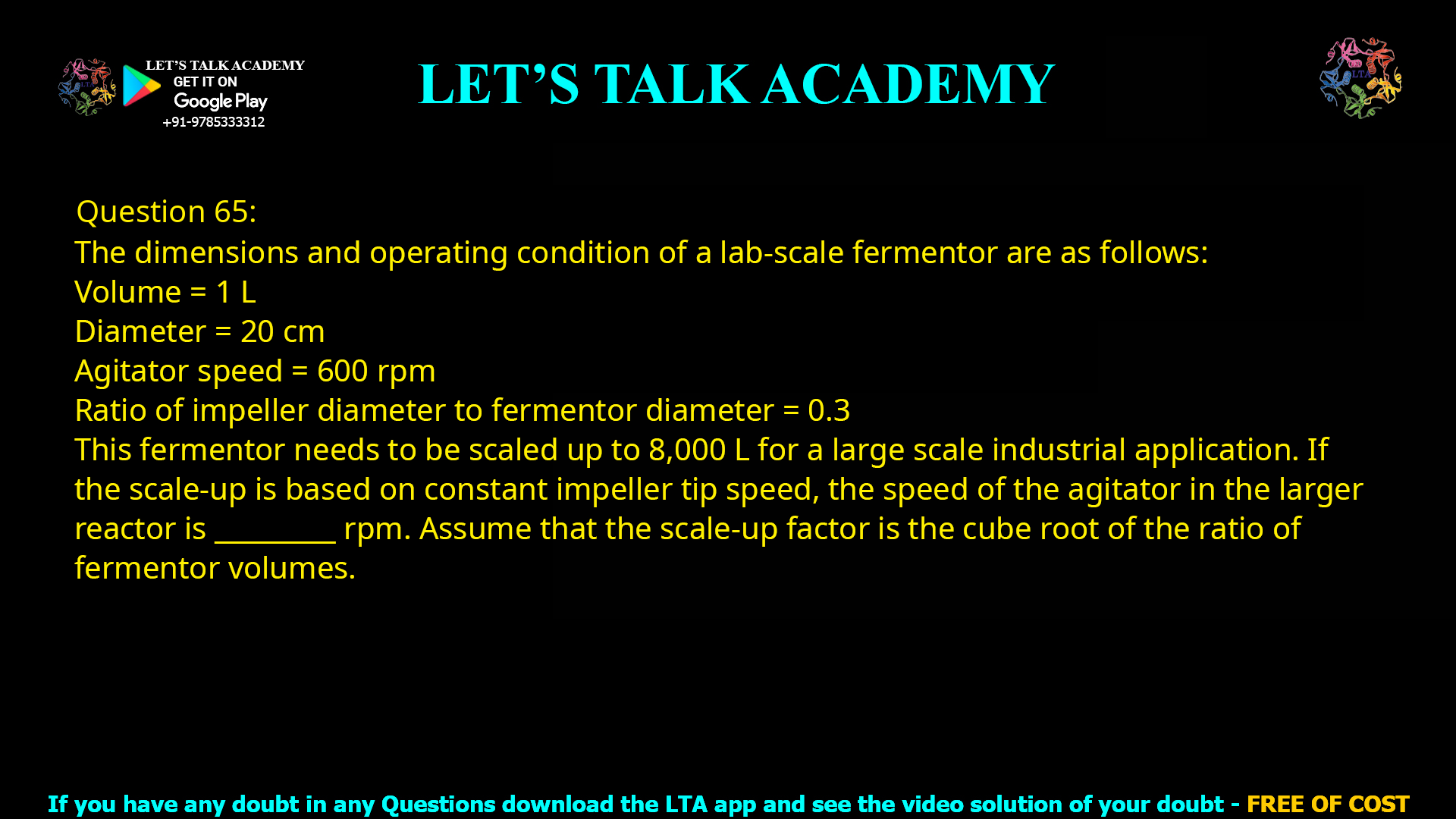
Q.65 The dimensions and operating condition of a lab–scale fermentor are as follows:
Volume = 1 L
Diameter = 20 cm
Agitator speed = 600 rpm
Ratio of impeller diameter to fermentor diameter = 0.3
This fermentor needs to be scaled up to 8,000 L for a large scale industrial application. If
the scale–up is based on constant impeller tip speed, the speed of the agitator in the larger
reactor is _________ rpm. Assume that the scale–up factor is the cube root of the ratio of
fermentor volumes.
Final Answer
Required agitator speed in the 8,000 L fermentor = 60 rpm
Given Data
Lab Fermentor
- Volume V1 = 1 L
- Tank diameter T1 = 20 cm
- Speed N1 = 600 rpm
- Impeller to tank diameter ratio D/T = 0.3 → D1 = 6 cm
Large Fermentor
- Volume V2 = 8000 L
- Same geometric ratio
Step 1 — Linear Scale Factor
S = (V2/V1)1/3 = (8000)1/3 = 20
Tank diameter T2 = S × T1 = 20 × 20 = 400 cm
Impeller diameter D2 = 0.3 × T2 = 0.3 × 400 = 120 cm
Step 2 — Constant Impeller Tip Speed
Tip speed vt = π D N
For scale-up: π D1 N1 = π D2 N2
Thus: D1 N1 = D2 N2
N2 = (D1 / D2) × N1
N2 = (6 / 120) × 600 = 60 rpm
Interpretation
The impeller diameter increased 20-fold, so the speed must decrease by exactly 20-fold to maintain the same πDN product.
Therefore, new agitation speed ≈ 60 rpm.
Understanding Typical MCQ Options
- 60 rpm → Correct (speed reduced by scale factor 20)
- 30 rpm → Incorrect (would imply only half needed reduction)
- 6 rpm → Incorrect (10× too low)
- 600 rpm → Incorrect (ignores scale-up rule entirely)
Correct speed always follows N ∝ 1/D when tip speed is constant.
SEO Introduction
Scaling up bioreactors while maintaining constant impeller tip speed is essential for protecting shear-sensitive cells and achieving consistent mass transfer. This example walks through the exact calculations needed to convert a 1 L laboratory fermentor operating at 600 rpm into an 8000 L production fermentor, ultimately determining the required working speed of 60 rpm.


