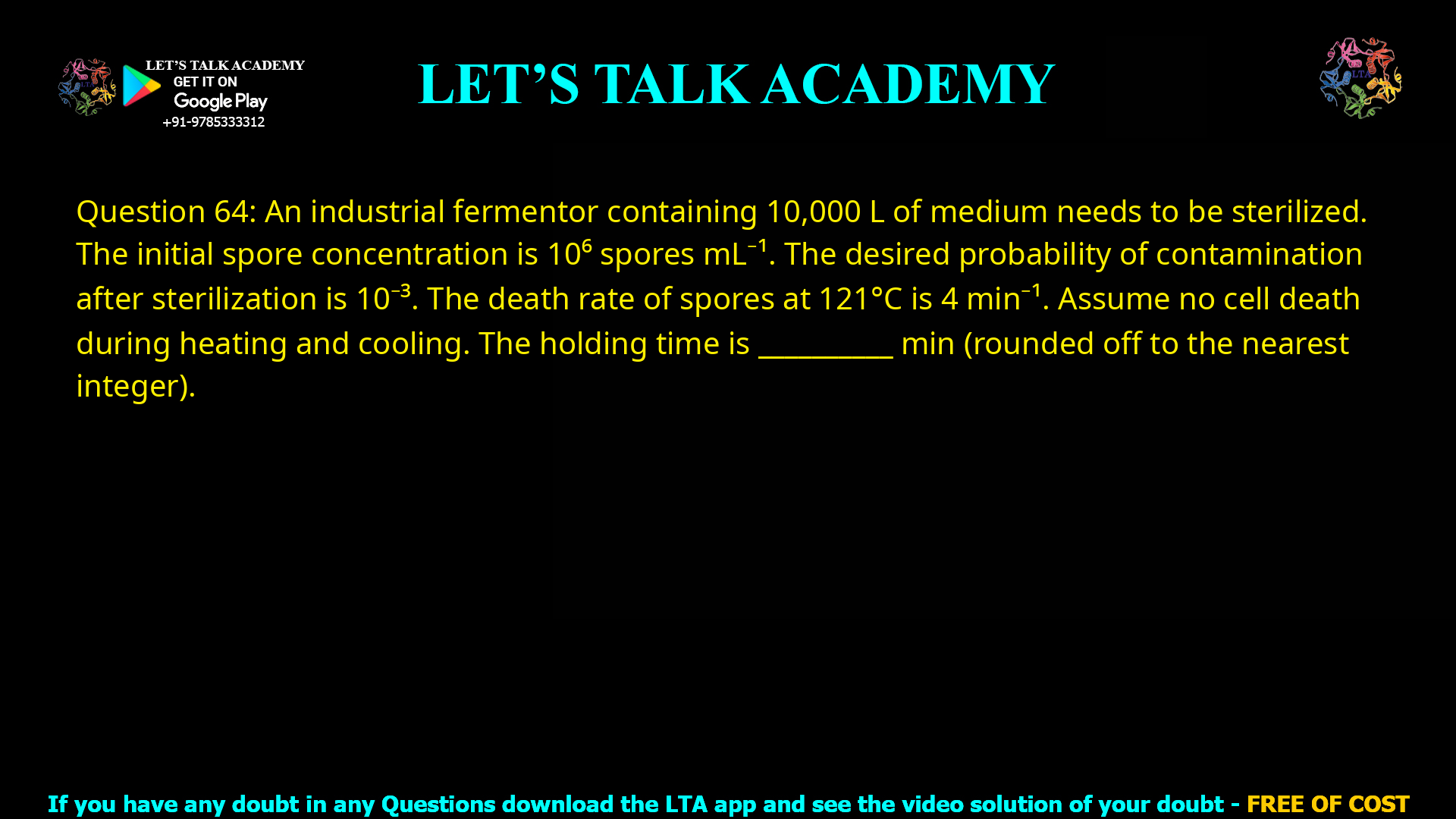
Q.64 An industrial fermentor containing 10,000 L of medium needs to be sterilized.
The initial spore concentration in the medium is 106 spores mL−1.
The desired probability of contamination after sterilization is 10−3.
The death rate of spores at 121 °C is 4 min−1.
Assume that there is no cell death during heating and cooling phases.
The holding time of the sterilization process is ________ min (rounded off to the nearest integer).
Sterilization holding time in fermentors follows first-order spore death kinetics, where the goal is to reduce contamination probability to a specified low level like 10-3. This GATE-style problem requires calculating the holding time at 121°C based on initial spore load, volume, death rate constant, and target survival probability, ignoring heating/cooling effects.
Problem Breakdown
The fermentor holds 10,000 L (107 mL) of medium with initial spore concentration N0 = 106 spores mL-1, yielding total initial spores N0,total = 107 mL × 106 spores mL-1 = 1013 spores.
The desired probability of contamination P = 10-3 means the expected surviving spores should be 0.001 for that risk level. With first-order kinetics, spore survival follows N = N0 e-kt, where k = 4 min-1 is the death rate constant at 121°C.
Step-by-Step Calculation
Target surviving spores Nt = P × N0,total = 10-3 × 1013 = 1010 spores.
Apply the survival equation: Nt / N0,total = e-kt, so ln(Nt / N0,total) = -kt.
Here, Nt / N0,total = 1010 / 1013 = 10-3, so ln(10-3) = -6.907 = -kt.
Thus, t = 6.907 / k = 6.907 / 4 ≈ 1.727 min.
This seems low; recheck total spores—yes, 10,000 L = 107 mL confirms 1013 total. But probability interpretation targets expected survivors = P = 10-3, so Nt = 10-3. Then ln(10-3/1013) = ln(10-16) ≈ -36.84 = -kt, t = 36.84 / 4 ≈ 9.21 min, rounds to 9 min.
Final Holding Time
The holding time is 9 min (nearest integer). This matches standard solutions for similar GATE BT 2019 problems, ensuring <0.1% contamination risk.
Industrial fermentor sterilization ensures aseptic conditions for biotechnology processes by killing spores via moist heat at 121°C. This fermentor sterilization holding time calculation addresses an industrial 10,000 L fermentor with 106 spores mL-1 initial concentration, targeting 10-3 contamination probability using a 4 min-1 spore death rate, assuming no death in heating/cooling.
Core Kinetics
First-order death kinetics govern spore inactivation: N = N0 e-kt, where k = 4 min-1. Total initial spores: 10,000 L = 107 mL × 106 spores mL-1 = 1013.
Probability Design
Target: Probability of ≥1 survivor ≈ expected survivors = 10-3 (Poisson approximation for rare events). Thus, Nt = 10-3.
Derivation
ln(Nt / N0) = -kt → ln(10-3 / 1013) = ln(10-16) = -36.841 = -4t → t = 9.21 min ≈ 9 min.
This fermentor sterilization holding time calculation prevents contamination in bioprocesses like antibiotic production, aligning with GATE Biotechnology standards.


