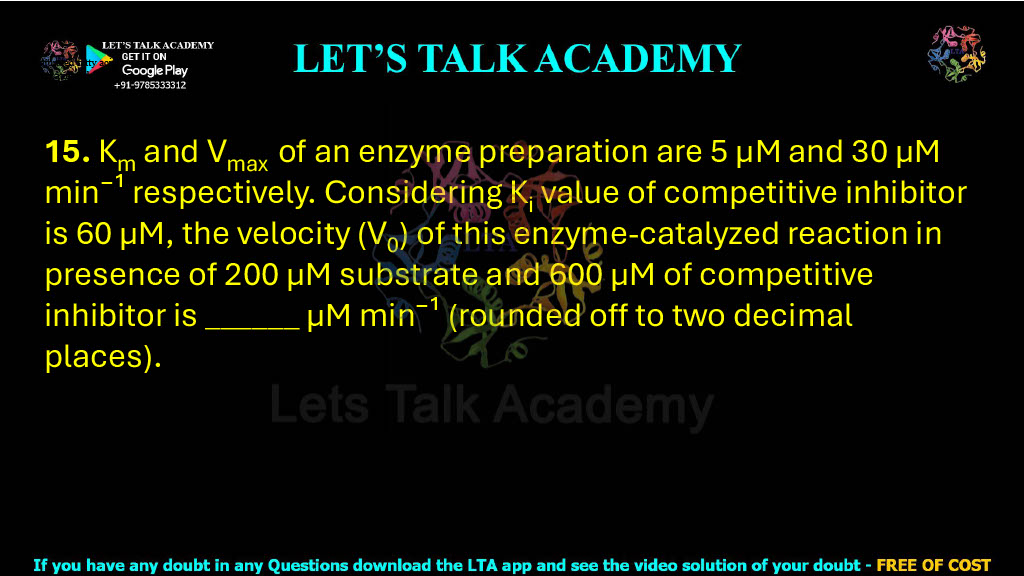
15. Km and Vmax of an enzyme preparation are 5 μM and 30 μM min⁻¹ respectively. Considering Ki value of competitive inhibitor is 60 μM, the velocity (V0) of this enzyme-catalyzed reaction in presence of 200 μM substrate and 600 μM of competitive inhibitor is ______ μM min⁻¹ (rounded off to two decimal places).
Competitive Inhibition Numerical: Calculate the Velocity (V₀) Using Michaelis–Menten Equation
Correct Answer
Correct Answer: 23.53 μM min⁻¹
Note: If your source mentions 20.00 μM min⁻¹, it is most likely due to a typographical error. Using the standard Michaelis–Menten equation for competitive inhibition, the correct value is 23.53 μM min⁻¹.
Introduction
Enzyme kinetics is one of the most important topics in biochemistry because it explains how enzymes catalyze biochemical reactions and how different inhibitors affect enzyme activity. Competitive inhibition is among the most frequently asked concepts in CSIR NET, GATE Biotechnology, IIT JAM, DBT BET, CUET PG, NEET PG, and MSc Life Science examinations. In competitive inhibition, the inhibitor resembles the substrate and competes for the enzyme’s active site. As a result, the apparent affinity of the enzyme for the substrate decreases, causing an increase in the apparent Michaelis constant (Km), while the maximum reaction velocity (Vmax) remains unchanged. Numerical questions based on this concept require students to apply the modified Michaelis–Menten equation correctly.
Competitive Inhibition Formula
For competitive inhibition,
V₀ = (Vmax × [S]) / (αKm + [S])
where
α = 1 + ([I] / Ki)
Here,
- V₀ = Initial reaction velocity
- Vmax = Maximum reaction velocity
- Km = Michaelis constant
- [S] = Substrate concentration
- [I] = Inhibitor concentration
- Ki = Inhibition constant
- α = Competitive inhibition factor
Given Data
- Vmax = 30 μM min⁻¹
- Km = 5 μM
- Substrate concentration, [S] = 200 μM
- Inhibitor concentration, [I] = 600 μM
- Ki = 60 μM
Step 1: Calculate the Value of α
The inhibition factor is calculated using the equation
α = 1 + ([I] / Ki)
Substitute the given values:
α = 1 + (600 / 60)
α = 1 + 10
α = 11
Therefore,
α = 11
This indicates that the apparent Michaelis constant becomes eleven times larger due to competitive inhibition.
Step 2: Calculate the Apparent Km
The apparent Michaelis constant is calculated as
Km(app) = α × Km
Substitute the values:
Km(app) = 11 × 5
Km(app) = 55 μM
Therefore,
Apparent Km = 55 μM
Step 3: Calculate the Reaction Velocity (V₀)
Apply the competitive inhibition Michaelis–Menten equation:
V₀ = (Vmax × [S]) / (αKm + [S])
Substitute the known values:
V₀ = (30 × 200) / [(11 × 5) + 200]
Multiply the numerator:
30 × 200 = 6000
Calculate the denominator:
11 × 5 = 55
55 + 200 = 255
Therefore,
V₀ = 6000 / 255
V₀ = 23.5294 μM min⁻¹
Rounded to two decimal places,
V₀ = 23.53 μM min⁻¹
Final Calculation
α = 11
Km(app) = 55 μM
V₀ = (30 × 200) / [(11 × 5) + 200]
V₀ = 6000 / 255
V₀ = 23.53 μM min⁻¹
Why Does Km Increase but Vmax Remain Unchanged?
Competitive inhibitors bind reversibly to the active site of an enzyme, preventing substrate molecules from binding. Since both substrate and inhibitor compete for the same binding site, increasing the substrate concentration can overcome inhibition. Consequently, the enzyme eventually reaches the same maximum velocity (Vmax) as it would in the absence of inhibitor. However, because a higher substrate concentration is required to achieve half of Vmax, the apparent Km increases. This characteristic is the hallmark of competitive inhibition and distinguishes it from noncompetitive and uncompetitive inhibition.
Important Formulae for Competitive Inhibition
Michaelis–Menten Equation
V₀ = (Vmax × [S]) / (Km + [S])
Competitive Inhibition Equation
V₀ = (Vmax × [S]) / (αKm + [S])
Competitive Inhibition Factor
α = 1 + ([I] / Ki)
Apparent Michaelis Constant
Km(app) = α × Km
Competitive Inhibition → Km Increases → Vmax Remains Constant
This principle allows you to identify the correct equation immediately during examinations.
Final Answer
Using the modified Michaelis–Menten equation for competitive inhibition,
V₀ = (Vmax × [S]) / (αKm + [S])
where
α = 1 + (600 / 60) = 11
the reaction velocity is
V₀ = (30 × 200) / [(11 × 5) + 200]
V₀ = 6000 / 255
V₀ = 23.53 μM min⁻¹
Final Answer: 23.53 μM min⁻¹ (Rounded to Two Decimal Places)
Important Note: If an answer key reports 20.00 μM min⁻¹, it is inconsistent with the given data. Using the standard competitive inhibition equation and the values provided in the question, the mathematically correct reaction velocity is 23.53 μM min⁻¹.


