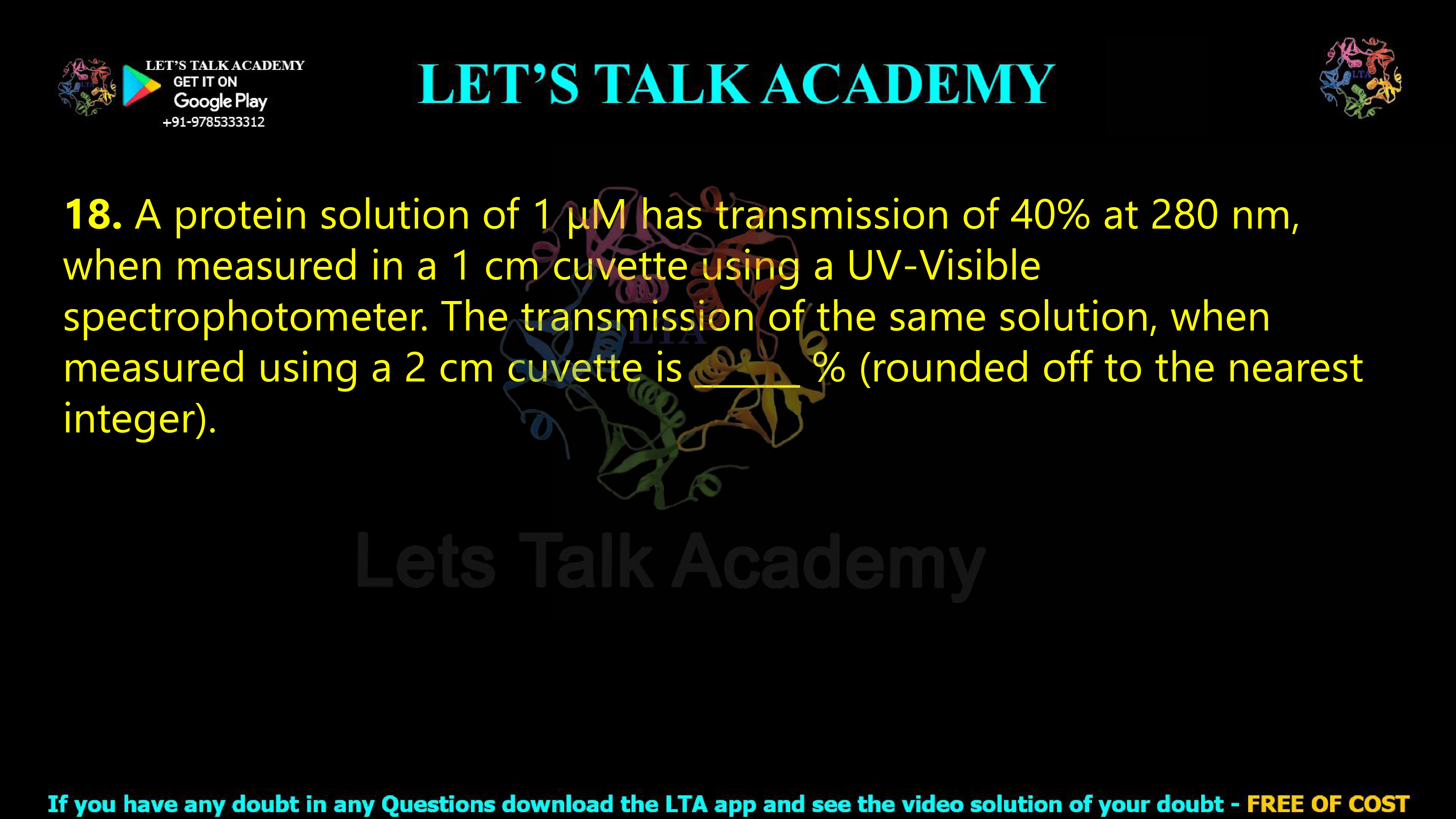
17. A protein solution of 1 μM has transmission of 40% at 280 nm, when measured in a 1 cm cuvette using a UV-Visible spectrophotometer. The transmission of the same solution, when measured using a 2 cm cuvette is ______ % (rounded off to the nearest integer).
How to Calculate Percentage Transmission When the Cuvette Path Length Is Doubled?
Correct Answer: 16%
The correct answer is 16%. When the same protein solution is measured at the same wavelength using a cuvette whose path length is increased from 1 cm to 2 cm, the absorbance doubles according to the Beer-Lambert law. However, percentage transmission does not decrease linearly with path length because transmittance and absorbance have a logarithmic relationship.
The initial percentage transmission is:
%T1 = 40%
Therefore, the fractional transmittance is:
T1 = 40/100 = 0.40
Absorbance and transmittance are related by:
A = −log10(T)
Thus, for the 1 cm cuvette:
A1 = −log10(0.40)
A1 ≈ 0.398
According to the Beer-Lambert law:
A = εcl
Since the molar absorptivity, concentration and wavelength remain unchanged, absorbance is directly proportional to the optical path length. Increasing the path length from 1 cm to 2 cm therefore doubles the absorbance:
A2 = 2A1
A2 = 2 × 0.398 = 0.796
Converting this new absorbance back into transmittance:
T2 = 10−A2
T2 = 10−0.796 = 0.16
Therefore:
%T2 = 0.16 × 100 = 16%
Hence, the transmission of the protein solution through a 2 cm cuvette is 16%.
Understanding the Information Given in the Question
This numerical problem combines three important concepts of UV-Visible spectroscopy: percentage transmission, absorbance and the Beer-Lambert law. The protein solution has a concentration of 1 μM and is examined at 280 nm. When the solution is placed in a cuvette with a 1 cm optical path length, 40% of the incident light is transmitted through the sample.
The question then changes only one experimental parameter: the cuvette path length. The same solution is measured at the same wavelength using a 2 cm cuvette. Since the protein concentration and wavelength remain unchanged, the effect of increasing path length can be determined directly from the Beer-Lambert law.
The given information is:
Protein concentration, c = 1 μM
Wavelength, λ = 280 nm
Initial path length, l1 = 1 cm
Initial percentage transmission, %T1 = 40%
New path length, l2 = 2 cm
The required quantity is:
New percentage transmission, %T2 = ?
Step 1: Convert Percentage Transmission into Fractional Transmittance
The question gives the transmission as a percentage, but the logarithmic absorbance equation uses fractional transmittance. Therefore, the first step is to convert 40% transmission into a decimal fraction.
The relationship is:
T = %T/100
Substituting the given value:
T1 = 40/100
Therefore:
T1 = 0.40
This means that 40% of the incident light passes through the 1 cm cuvette containing the protein solution.
Step 2: Calculate the Absorbance in the 1 cm Cuvette
Absorbance and transmittance are related by the equation:
A = −log10(T)
For the 1 cm cuvette:
T1 = 0.40
Therefore:
A1 = −log10(0.40)
Since:
log10(0.40) ≈ −0.39794
Therefore:
A1 ≈ 0.39794
Rounding suitably:
A1 ≈ 0.398
Thus, the absorbance of the protein solution in the 1 cm cuvette is approximately 0.398.
Step 3: Apply the Beer-Lambert Law
The Beer-Lambert law describes the relationship between absorbance, concentration and optical path length. It is expressed as:
A = εcl
where A is absorbance, ε is the molar extinction coefficient or molar absorptivity, c is the concentration of the absorbing substance and l is the optical path length of the cuvette.
In this problem, the same protein solution is used at the same wavelength. Therefore, both the concentration and molar absorptivity remain constant.
Consequently:
A ∝ l
This means that absorbance is directly proportional to path length.
The original path length is:
l1 = 1 cm
The new path length is:
l2 = 2 cm
Therefore, the path length has doubled.
Step 4: Calculate the Absorbance in the 2 cm Cuvette
Since absorbance is directly proportional to path length:
A2/A1 = l2/l1
Substituting the known values:
A2/0.39794 = 2/1
Therefore:
A2 = 2 × 0.39794
A2 = 0.79588
Thus, the absorbance of the same protein solution in the 2 cm cuvette is approximately:
A2 ≈ 0.796
Doubling the optical path length has therefore doubled the absorbance from approximately 0.398 to approximately 0.796.
Step 5: Convert the New Absorbance Back into Transmittance
The relationship between absorbance and transmittance is:
A = −log10(T)
Rearranging the equation:
T = 10−A
For the 2 cm cuvette:
A2 = 0.79588
Therefore:
T2 = 10−0.79588
T2 = 0.16
Thus, the fractional transmittance is 0.16.
Step 6: Convert Fractional Transmittance into Percentage Transmission
Percentage transmission is calculated using:
%T = T × 100
Therefore:
%T2 = 0.16 × 100
%T2 = 16%
The value is already a whole number, so rounding to the nearest integer gives:
Final Answer = 16%
Complete Calculation at a Glance
The complete solution can be written as follows:
Initial percentage transmission = 40%
T1 = 40/100 = 0.40
A1 = −log10(0.40)
A1 = 0.39794
Since the path length increases from 1 cm to 2 cm:
A2 = 2A1
A2 = 2 × 0.39794 = 0.79588
Now:
T2 = 10−0.79588
T2 = 0.16
Therefore:
%T2 = 0.16 × 100 = 16%
Final Answer: 16%
A Faster Mathematical Method for Solving the Problem
The problem can also be solved directly without separately calculating absorbance. Since the path length doubles, the transmitted fraction is effectively applied twice under ideal Beer-Lambert behavior.
For a 1 cm path length:
T1 = 0.40
For a 2 cm path length:
T2 = (T1)2
Therefore:
T2 = (0.40)2
T2 = 0.16
Converting to percentage transmission:
%T2 = 0.16 × 100 = 16%
This direct method gives exactly the same answer and follows from the logarithmic relationship between absorbance and transmittance.
Why Does Squaring the Initial Transmittance Work?
For the first 1 cm of optical path, the transmitted fraction is 0.40. If the same attenuation behavior continues through an additional 1 cm of the same solution, 40% of the light remaining after the first centimetre is transmitted through the second centimetre.
Therefore:
Fraction remaining after first 1 cm = 0.40
Fraction remaining after second 1 cm = 0.40 × 0.40
Final transmitted fraction = 0.16
Thus:
Final percentage transmission = 16%
This provides an intuitive explanation for why doubling the path length changes 40% transmission to 16%, rather than to 20%.
Why Does the Transmission Not Become 20%?
It may appear tempting to assume that doubling the cuvette path length simply halves the percentage transmission from 40% to 20%. This is not correct because percentage transmission does not have a linear relationship with path length.
According to the Beer-Lambert law, it is absorbance that is directly proportional to path length:
A ∝ l
Transmittance is related to absorbance logarithmically:
A = −log10(T)
Therefore, doubling the path length doubles the absorbance, but it does not simply divide the percentage transmission by two.
For the present question:
40% transmission at 1 cm does not become 20% at 2 cm.
Instead:
0.40 × 0.40 = 0.16
Therefore:
Transmission at 2 cm = 16%
What Is the Beer-Lambert Law?
The Beer-Lambert law is a fundamental relationship in absorption spectroscopy. It states that the absorbance of a solution is directly proportional to the concentration of the absorbing species and the optical path length through which the light travels.
The equation is:
A = εcl
where:
A = Absorbance
ε = Molar absorptivity or molar extinction coefficient
c = Concentration of the absorbing species
l = Optical path length
In the present problem, the protein concentration remains fixed at 1 μM, and the measurement wavelength remains fixed at 280 nm. Therefore, the molar absorptivity and concentration are constant. Only the path length changes.
As a result:
A2/A1 = l2/l1
Since the path length doubles, the absorbance also doubles.
What Is Transmittance in UV-Visible Spectroscopy?
Transmittance describes the fraction of incident light that passes through a sample. If I0 represents the intensity of light entering the sample and I represents the intensity of light leaving the sample, transmittance is defined as:
T = I/I0
Percentage transmission is:
%T = (I/I0) × 100
If a solution has 40% transmission, this means that 40% of the incident light reaches the detector after passing through the sample, while the remaining portion is removed from the transmitted beam through absorption and other possible optical processes.
For ideal Beer-Lambert behavior in this question:
%T = 40%
Therefore:
T = 0.40
What Is Absorbance in Spectrophotometry?
Absorbance is a logarithmic measure of how strongly a sample attenuates the incident light at a particular wavelength. It is related to transmittance by:
A = −log10(T)
It can also be written as:
A = log10(I0/I)
Because absorbance is logarithmic, a change in transmittance does not correspond to a simple linear change in absorbance.
For example, 40% transmittance corresponds to:
A = −log10(0.40) ≈ 0.398
When the path length doubles, the absorbance doubles to approximately 0.796. This new absorbance corresponds to 16% transmission.
Relationship Between Absorbance and Transmittance
Absorbance and transmittance describe the same measurement from different mathematical perspectives. High transmittance corresponds to low absorbance, while low transmittance corresponds to high absorbance.
The relationship is:
A = −log10(T)
and:
T = 10−A
Therefore, when absorbance increases because the optical path length becomes longer, the percentage of transmitted light decreases exponentially rather than linearly.
In this problem:
1 cm cuvette → A ≈ 0.398 → T = 40%
2 cm cuvette → A ≈ 0.796 → T = 16%
This relationship is the central principle needed to solve the question correctly.
Why Does Doubling the Path Length Double the Absorbance?
The Beer-Lambert law is:
A = εcl
For the same protein solution measured at the same wavelength, both ε and c remain constant. Therefore:
A ∝ l
If the original path length is 1 cm and the new path length is 2 cm:
l2 = 2l1
Therefore:
A2 = 2A1
The light travels through twice as much absorbing solution, so the optical attenuation increases accordingly under ideal Beer-Lambert conditions.
Why Is the Protein Measured at 280 nm?
Proteins are commonly analyzed at a wavelength of 280 nm because certain aromatic amino acid residues absorb ultraviolet light in this region. The major contribution usually comes from tryptophan and tyrosine residues, while phenylalanine generally contributes less strongly at 280 nm.
The exact absorbance of a protein at 280 nm depends on its amino acid composition and molecular structure. For this reason, measurements at 280 nm are widely used to estimate the concentration of purified proteins when an appropriate extinction coefficient is known.
However, the exact identity of the absorbing amino acids is not required for this calculation. The problem already provides the initial transmission, and the same protein solution is measured again at the same wavelength. Therefore, the essential variable is the change in cuvette path length.
Does the 1 μM Protein Concentration Need to Be Used Directly?
The concentration of the protein is given as 1 μM, but it does not need to be inserted numerically into the calculation. This is because the same solution is used in both measurements.
According to:
A = εcl
the concentration c remains constant. The molar absorptivity ε also remains constant because the same protein is measured at the same wavelength.
Therefore, when comparing the two measurements:
A2/A1 = l2/l1
The concentration and molar absorptivity cancel from the ratio. Thus, the 1 μM value provides experimental context but is not required for the final numerical calculation.
General Formula for Changing the Cuvette Path Length
For the same solution measured at the same wavelength, the relationship between two transmittance values and two path lengths can be derived from the Beer-Lambert law.
Since:
A = −log10(T)
and:
A ∝ l
then:
A2 = A1(l2/l1)
Therefore:
T2 = T1(l2/l1)
For this question:
l2/l1 = 2/1 = 2
Therefore:
T2 = (0.40)2
T2 = 0.16
%T2 = 16%
Using the General Formula in This Question
The general relationship is:
T2 = T1(l2/l1)
Substituting:
T1 = 0.40
l1 = 1 cm
l2 = 2 cm
Therefore:
T2 = (0.40)2/1
T2 = (0.40)2 = 0.16
Thus:
%T2 = 16%
Effect of Cuvette Path Length on Spectrophotometric Measurements
The optical path length of a cuvette determines how far light travels through the sample. A longer path length exposes the light to a greater amount of absorbing material, provided the concentration remains unchanged.
As the path length increases, absorbance increases directly according to the Beer-Lambert law. At the same time, transmittance decreases exponentially.
Therefore:
Longer path length → Higher absorbance → Lower transmittance
In this question, increasing the path length from 1 cm to 2 cm doubles the absorbance and reduces the transmission from 40% to 16%.
Final Answer
Correct Answer: 16%
The protein solution has an initial percentage transmission of 40% in a 1 cm cuvette.
Therefore:
T1 = 40/100 = 0.40
The initial absorbance is:
A1 = −log10(0.40) = 0.39794
According to the Beer-Lambert law, absorbance is directly proportional to path length. Increasing the cuvette path length from 1 cm to 2 cm doubles the absorbance:
A2 = 2 × 0.39794 = 0.79588
Converting the new absorbance into transmittance:
T2 = 10−0.79588 = 0.16
Therefore:
%T2 = 0.16 × 100 = 16%
The same result can be obtained directly because doubling the path length gives:
T2 = (T1)2 = (0.40)2 = 0.16
Therefore, the transmission of the protein solution in the 2 cm cuvette is 16%.


