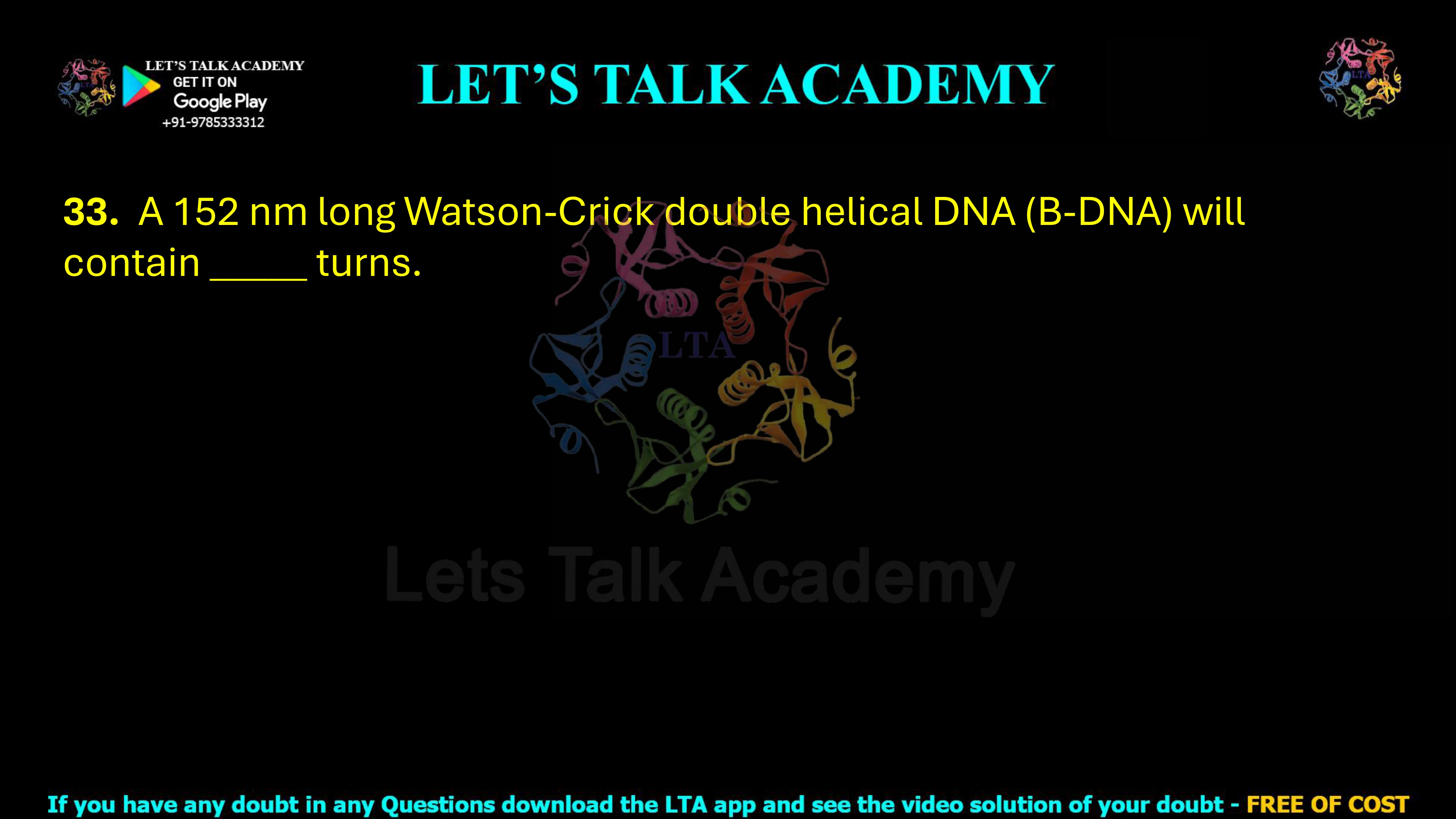
33. A 152 nm long Watson-Crick double helical DNA (B-DNA) will contain_____turns.
How Many Turns Are Present in a 152 nm Long Watson-Crick B-DNA Molecule?
Understanding the B-DNA Helical Turn Calculation
To calculate the number of turns present in a 152 nm long Watson-Crick double-helical DNA molecule, we need to know one fundamental structural property of B-DNA: the axial length occupied by one complete turn of the double helix.
In the classical Watson-Crick B-DNA structure, one complete helical turn has a pitch of approximately 3.4 nm. Therefore, if the total length of a DNA molecule is known, the number of helical turns can be calculated by dividing the total DNA length by the length of one complete turn.
The required calculation is:
Number of turns = Total length of DNA ÷ Length of one complete turn
Substituting the given values:
Number of turns = 152 nm ÷ 3.4 nm per turn
Number of turns = 44.7058
Therefore, a 152 nm long B-DNA molecule contains approximately 44.7 helical turns, which can be rounded to about 45 turns.
Step-by-Step Solution
Step 1: Identify the Length of the DNA Molecule
The total length of the Watson-Crick double-helical DNA molecule is given directly in the question:
Total DNA length = 152 nm
This value represents the axial length of the double-helical DNA molecule.
Step 2: Recall the Pitch of B-DNA
The pitch of a DNA helix is the axial distance covered by one complete turn of the double helix. For classical B-DNA, one complete helical turn extends approximately:
Pitch of B-DNA = 3.4 nm per turn
Therefore, every 3.4 nm of B-DNA length corresponds to one complete turn of the double helix.
Step 3: Calculate the Number of Helical Turns
The number of turns is calculated by dividing the total DNA length by the pitch of one complete B-DNA turn:
Number of turns = Total DNA length ÷ Pitch of B-DNA
Number of turns = 152 ÷ 3.4
Number of turns = 44.7058
Therefore:
Number of turns ≈ 44.7
If the answer is required as the nearest whole number, the DNA molecule contains approximately:
45 turns
Complete Calculation in a Single Expression
The entire calculation can be written in one simple expression:
Number of turns = 152 nm ÷ 3.4 nm per turn
Number of turns = 44.7 turns
Therefore, the 152 nm long B-DNA molecule contains approximately 44.7 turns, or about 45 complete helical turns when rounded to the nearest whole number.
What Is Watson-Crick B-DNA?
B-DNA is the classical right-handed double-helical form of DNA described by the Watson-Crick model. Under normal physiological conditions, B-DNA is the most common structural form of cellular DNA.
The molecule consists of two antiparallel polynucleotide strands held together by complementary base pairing. Adenine pairs with thymine through two hydrogen bonds, while guanine pairs with cytosine through three hydrogen bonds.
The sugar-phosphate backbones are located on the outside of the double helix, while the nitrogenous bases are stacked toward the interior. The regular geometric organization of the base pairs produces the characteristic helical structure of B-DNA.
Several numerical properties of B-DNA are particularly important for solving molecular biology calculations. These include the distance between adjacent base pairs, the number of base pairs per helical turn and the pitch of the double helix.
Important Structural Features of B-DNA
Distance Between Two Adjacent Base Pairs
The axial distance between two consecutive base pairs in classical B-DNA is approximately 0.34 nm, which is also equal to 3.4 Å.
This value is commonly called the rise per base pair. It is useful for calculating the total length of a DNA molecule when the number of base pairs is known.
Number of Base Pairs Per Turn
In the classical simplified description of B-DNA used in many molecular biology numerical problems, one complete turn contains approximately 10 base pairs.
Therefore:
10 base pairs × 0.34 nm per base pair = 3.4 nm per turn
This gives the classical pitch of the B-DNA helix.
Pitch of the B-DNA Helix
The axial distance covered by one complete turn of B-DNA is approximately 3.4 nm, or 34 Å.
This is the most important value required for solving the present question because the total DNA length is already provided in nanometres.
Alternative Method Using the Number of Base Pairs
The same question can also be solved by first calculating the approximate number of base pairs in the DNA molecule and then converting the number of base pairs into helical turns.
The distance between two consecutive base pairs in B-DNA is approximately 0.34 nm. Therefore:
Number of base pairs = Total DNA length ÷ Rise per base pair
Number of base pairs = 152 ÷ 0.34
Number of base pairs ≈ 447.06
Using the classical value of approximately 10 base pairs per turn:
Number of turns = 447.06 ÷ 10
Number of turns ≈ 44.7
Therefore, this alternative method gives the same result:
Approximately 44.7 turns, or about 45 turns
Why Do We Divide 152 nm by 3.4 nm?
The question asks for the number of complete helical turns present along the length of the DNA molecule. Since every complete turn occupies approximately 3.4 nm along the helical axis, the total number of turns is simply the number of 3.4 nm units present within 152 nm.
This relationship can be understood mathematically as:
Total DNA length = Number of turns × Length per turn
Rearranging the equation:
Number of turns = Total DNA length ÷ Length per turn
Therefore:
Number of turns = 152 ÷ 3.4 = 44.7
This is why the pitch of B-DNA is the key structural parameter required to solve the problem.
Relationship Between DNA Length, Base Pairs and Helical Turns
Three important numerical quantities in B-DNA are closely related: the number of base pairs, the total length of the molecule and the number of helical turns.
In the classical model used for numerical calculations:
1 base pair contributes approximately 0.34 nm to DNA length
10 base pairs form approximately 1 complete turn
1 complete turn extends approximately 3.4 nm
Therefore, if the DNA length is known, the number of turns can be calculated directly by dividing by 3.4 nm. If the number of base pairs is known, the number of turns can be calculated by dividing the number of base pairs by the number of base pairs present in one turn.
Understanding the Units Used in B-DNA Calculations
DNA dimensions are commonly expressed in nanometres and angstroms. Understanding the relationship between these units helps in solving DNA structure numericals correctly.
1 nm = 10 Å
Therefore:
0.34 nm = 3.4 Å
and:
3.4 nm = 34 Å
Thus, the pitch of B-DNA can be expressed either as 3.4 nm per turn or 34 Å per turn. Since the question provides the total DNA length in nanometres, using 3.4 nm per turn makes the calculation direct and simple.
Direct Proportional Method
The question can also be solved using a simple proportional relationship.
If:
3.4 nm DNA = 1 turn
Then:
152 nm DNA = x turns
Therefore:
x = 152 ÷ 3.4
x = 44.7 turns
Thus, the given DNA molecule contains approximately 44.7 helical turns.
Why Is the Answer Approximately 45 Turns?
The direct mathematical calculation gives approximately 44.7 turns. Since a helical turn can be expressed as a fractional value when discussing the total length of a DNA segment, 44.7 is the more precise numerical result based on the given data.
However, if the question expects the answer as the nearest whole number, 44.7 is rounded to 45 turns.
Therefore, the best way to report the answer is:
44.7 turns, approximately 45 turns
Final Answer
Correct Answer: Approximately 44.7 turns, or about 45 turns
In classical Watson-Crick B-DNA, one complete helical turn has a pitch of approximately 3.4 nm. Therefore, the number of turns in a 152 nm long DNA molecule is calculated as:
Number of turns = 152 nm ÷ 3.4 nm per turn
Number of turns = 44.7
Thus, a 152 nm long Watson-Crick double-helical B-DNA molecule contains approximately 44.7 turns, which is about 45 turns when rounded to the nearest whole number.
Final Answer: 44.7 turns (approximately 45 turns)


