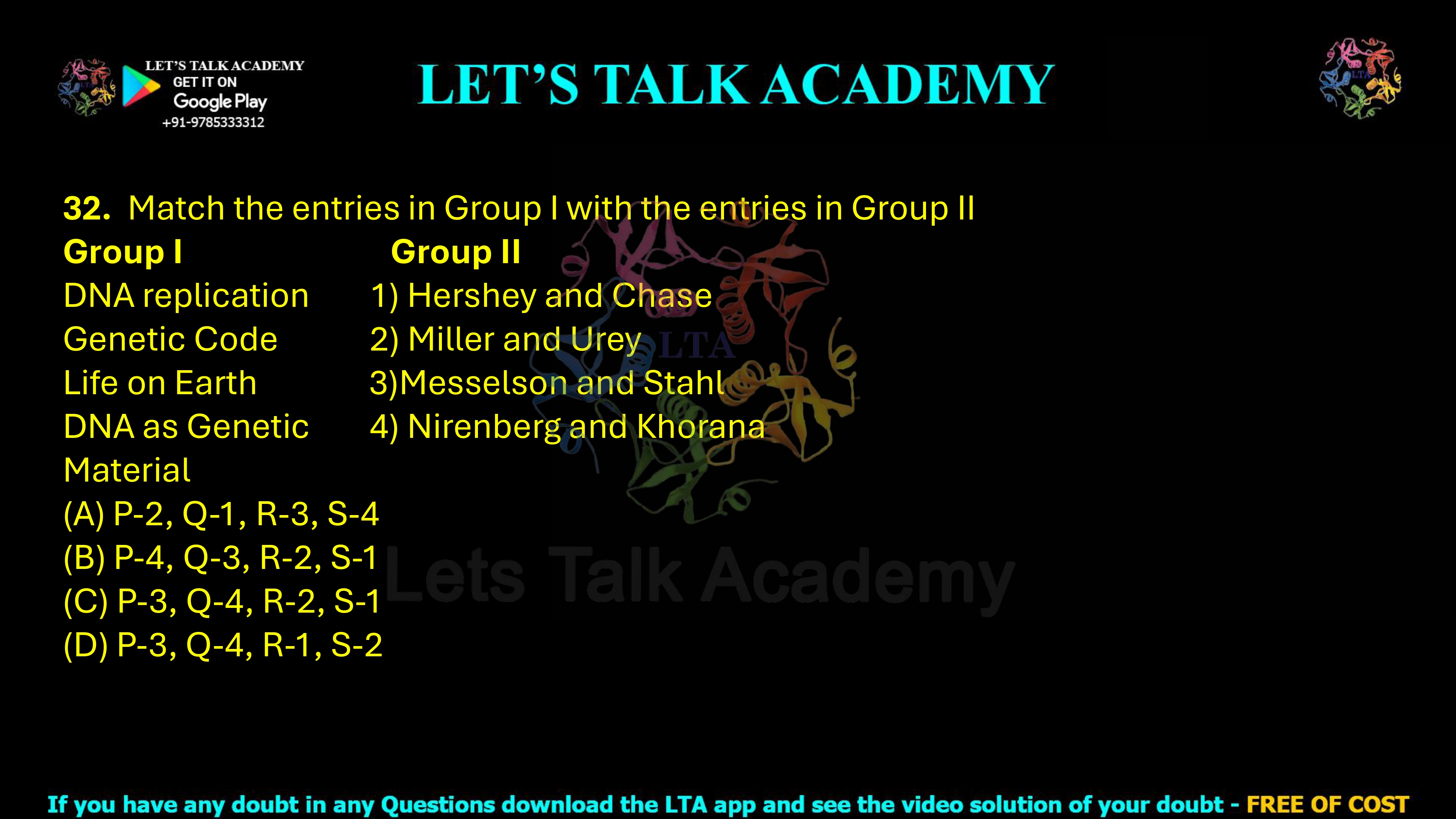
32. Match the entries in Group I with the entries in Group II
Group I Group II
DNA replication 1) Hershey and Chase
Genetic Code 2) Miller and Urey
Life on Earth 3)Messelson and Stahl
DNA as Genetic 4) Nirenberg and Khorana
Material
(A) P-2, Q-1, R-3, S-4
(B) P-4, Q-3, R-2, S-1
(C) P-3, Q-4, R-2, S-1
(D) P-3, Q-4, R-1, S-2
Match DNA Replication, Genetic Code, Life on Earth and DNA as Genetic Material with the Correct Scientists
Understanding the Correct Match Between Biological Discoveries and Scientists
This match-the-following question connects four major concepts in molecular biology and the origin of life with the scientists whose experiments provided important evidence for each concept. The four topics are DNA replication, the genetic code, the chemical origin of life on Earth, and the identification of DNA as genetic material.
The correct matching is straightforward when each concept is connected with its landmark experiment. DNA replication is associated with the Meselson and Stahl experiment, which demonstrated semiconservative replication. The genetic code is associated with the pioneering work of Nirenberg and Khorana. Experimental investigation of the chemical origin of life is associated with Miller and Urey. The demonstration that DNA is the genetic material in bacteriophages is associated with Hershey and Chase.
Therefore, the correct sequence is P-3, Q-4, R-2, S-1, making option (C) the correct answer.
DNA Replication and the Meselson–Stahl Experiment
Why Is DNA Replication Matched with Meselson and Stahl?
DNA replication is correctly matched with Meselson and Stahl. Their landmark experiment provided strong experimental evidence that DNA replication occurs by a semiconservative mechanism.
Before their experiment, three major models had been proposed to explain how DNA molecules replicate: conservative replication, semiconservative replication, and dispersive replication. These models predicted different distributions of parental and newly synthesized DNA strands after replication.
Matthew Meselson and Franklin Stahl grew Escherichia coli cells in a medium containing the heavy nitrogen isotope 15N. The nitrogen isotope became incorporated into newly synthesized DNA, producing DNA with a higher density than DNA containing the common isotope 14N.
The bacterial cells were then transferred to a medium containing 14N and allowed to replicate. DNA samples were analyzed using cesium chloride density-gradient centrifugation. After one generation, an intermediate-density DNA band was observed. After additional replication, both intermediate-density and light-density DNA bands appeared.
These observations supported the semiconservative model, according to which each daughter DNA molecule contains one parental strand and one newly synthesized strand.
Therefore, DNA replication is matched with Meselson and Stahl: P-3.
Genetic Code and the Work of Nirenberg and Khorana
Why Is the Genetic Code Matched with Nirenberg and Khorana?
The genetic code is correctly matched with Marshall Nirenberg and Har Gobind Khorana, whose pioneering experiments made major contributions to deciphering the relationship between nucleotide codons and amino acids.
The genetic code explains how sequences of three nucleotides in mRNA, called codons, specify particular amino acids during protein synthesis. Understanding this relationship was one of the central challenges of molecular biology.
Nirenberg and his colleagues used a cell-free protein-synthesizing system and synthetic RNA molecules. One famous experiment used poly-U RNA, which contains only uracil nucleotides. This RNA directed the synthesis of a polypeptide composed entirely of phenylalanine, demonstrating that the codon UUU specifies phenylalanine.
Khorana made major contributions by developing methods for synthesizing RNA molecules with defined and repeating nucleotide sequences. These synthetic RNAs helped determine the amino acids specified by additional codons.
Together, these experiments were central to deciphering the genetic code and establishing the relationship between mRNA codons and amino acids.
Therefore, Genetic Code is matched with Nirenberg and Khorana: Q-4.
Life on Earth and the Miller–Urey Experiment
Why Is Life on Earth Matched with Miller and Urey?
The origin of life on Earth is correctly matched with Stanley Miller and Harold Urey. Their famous experiment investigated whether organic molecules essential for life could form under conditions proposed to resemble those of the early Earth.
The Miller–Urey experiment used a closed apparatus containing gases intended to represent a model of the primitive atmosphere. Water was heated to produce water vapor, and electrical sparks were used as an energy source to simulate lightning.
After the experiment had operated for a period of time, the apparatus contained several organic compounds, including amino acids. Amino acids are important building blocks of proteins and are essential components of living systems.
The experiment did not create life itself. Instead, it demonstrated that biologically important organic molecules could be produced abiotically from simpler chemical substances under suitable experimental conditions.
This work became a landmark in research on chemical evolution and the origin of life.
Therefore, Life on Earth is matched with Miller and Urey: R-2.
DNA as Genetic Material and the Hershey–Chase Experiment
Why Is DNA as Genetic Material Matched with Hershey and Chase?
DNA as genetic material is correctly matched with Alfred Hershey and Martha Chase. Their bacteriophage experiment provided compelling evidence that DNA, rather than protein, carries genetic information in bacteriophages.
Hershey and Chase used bacteriophages, which are viruses that infect bacteria. A bacteriophage contains DNA enclosed within a protein coat. To determine which component enters the bacterial cell and directs the production of new phages, DNA and protein were labeled with different radioactive isotopes.
Phage DNA was labeled with radioactive phosphorus, 32P, because DNA contains phosphorus in its phosphate backbone but generally does not contain sulfur. Phage proteins were labeled with radioactive sulfur, 35S, because proteins may contain sulfur-containing amino acids, whereas DNA does not contain sulfur.
After the labeled phages infected bacterial cells, the mixtures were agitated to separate attached phage coats from the bacterial cells and then centrifuged. Most of the radioactive phosphorus associated with DNA was found with the bacterial cells, whereas much of the radioactive sulfur associated with protein remained outside the cells.
These observations showed that phage DNA enters the bacterial cell and directs the production of new viral particles. Therefore, DNA functions as the genetic material in the bacteriophage system studied.
Therefore, DNA as Genetic Material is matched with Hershey and Chase: S-1.
Complete Correct Matching
The four biological concepts can now be matched with their associated scientists and experiments. DNA replication is connected with Meselson and Stahl because their experiment demonstrated semiconservative DNA replication. The genetic code is connected with Nirenberg and Khorana because their experiments helped decipher codon assignments.
Life on Earth is connected with Miller and Urey because their experiment demonstrated the abiotic formation of biologically important organic molecules under simulated early-Earth conditions. DNA as genetic material is connected with Hershey and Chase because their bacteriophage experiment demonstrated the genetic role of DNA.
Thus, the complete matching is P-3, Q-4, R-2, S-1.
Detailed Analysis of Option (A)
(A) P-2, Q-1, R-3, S-4
This option is incorrect because all four associations are mismatched. DNA replication is not associated with Miller and Urey; their work concerned chemical evolution and the origin of life. The genetic code is not associated with Hershey and Chase; their experiment focused on identifying DNA as genetic material.
Similarly, life on Earth is not matched with Meselson and Stahl, whose work demonstrated semiconservative DNA replication. DNA as genetic material is not matched with Nirenberg and Khorana, who contributed to deciphering the genetic code.
Hence, option (A) is incorrect.
Detailed Analysis of Option (B)
(B) P-4, Q-3, R-2, S-1
This option is incorrect because although the matches R-2 and S-1 are correct, the first two matches are reversed.
Life on Earth is correctly associated with Miller and Urey, and DNA as genetic material is correctly associated with Hershey and Chase. However, DNA replication should be matched with Meselson and Stahl, not Nirenberg and Khorana.
Similarly, the genetic code should be matched with Nirenberg and Khorana, not Meselson and Stahl. Because P and Q are incorrectly matched, this option cannot be correct.
Hence, option (B) is incorrect.
Detailed Analysis of Option (C)
(C) P-3, Q-4, R-2, S-1
This option is correct because every entry in Group I is matched accurately with the corresponding scientists in Group II.
DNA replication is matched with Meselson and Stahl, who demonstrated semiconservative replication. The genetic code is matched with Nirenberg and Khorana, who made major contributions to deciphering codon assignments.
Life on Earth is matched with Miller and Urey because of their landmark experiment on the abiotic formation of organic molecules. DNA as genetic material is matched with Hershey and Chase because their bacteriophage experiment demonstrated that DNA carries genetic information.
Therefore, P-3, Q-4, R-2, S-1 is the completely correct matching.
Hence, option (C) is the correct answer.
Detailed Analysis of Option (D)
(D) P-3, Q-4, R-1, S-2
This option is incorrect because the first two matches are correct, but the last two matches are reversed.
DNA replication is correctly matched with Meselson and Stahl, and the genetic code is correctly matched with Nirenberg and Khorana. However, life on Earth should be matched with Miller and Urey, not Hershey and Chase.
Similarly, DNA as genetic material should be matched with Hershey and Chase, not Miller and Urey. Therefore, the incorrect matching of R and S makes this option wrong.
Hence, option (D) is incorrect.
Final Answer
The correct associations are based on four landmark developments in biology. DNA replication is matched with Meselson and Stahl (3), who experimentally demonstrated semiconservative DNA replication. The Genetic Code is matched with Nirenberg and Khorana (4), whose research helped decipher the relationship between codons and amino acids.
Life on Earth is matched with Miller and Urey (2), whose experiment demonstrated the abiotic formation of organic molecules under simulated early-Earth conditions. DNA as Genetic Material is matched with Hershey and Chase (1), whose bacteriophage experiment provided strong evidence that DNA carries genetic information.
Therefore, the correct matching is P-3, Q-4, R-2, S-1.
Correct Option: (C)


