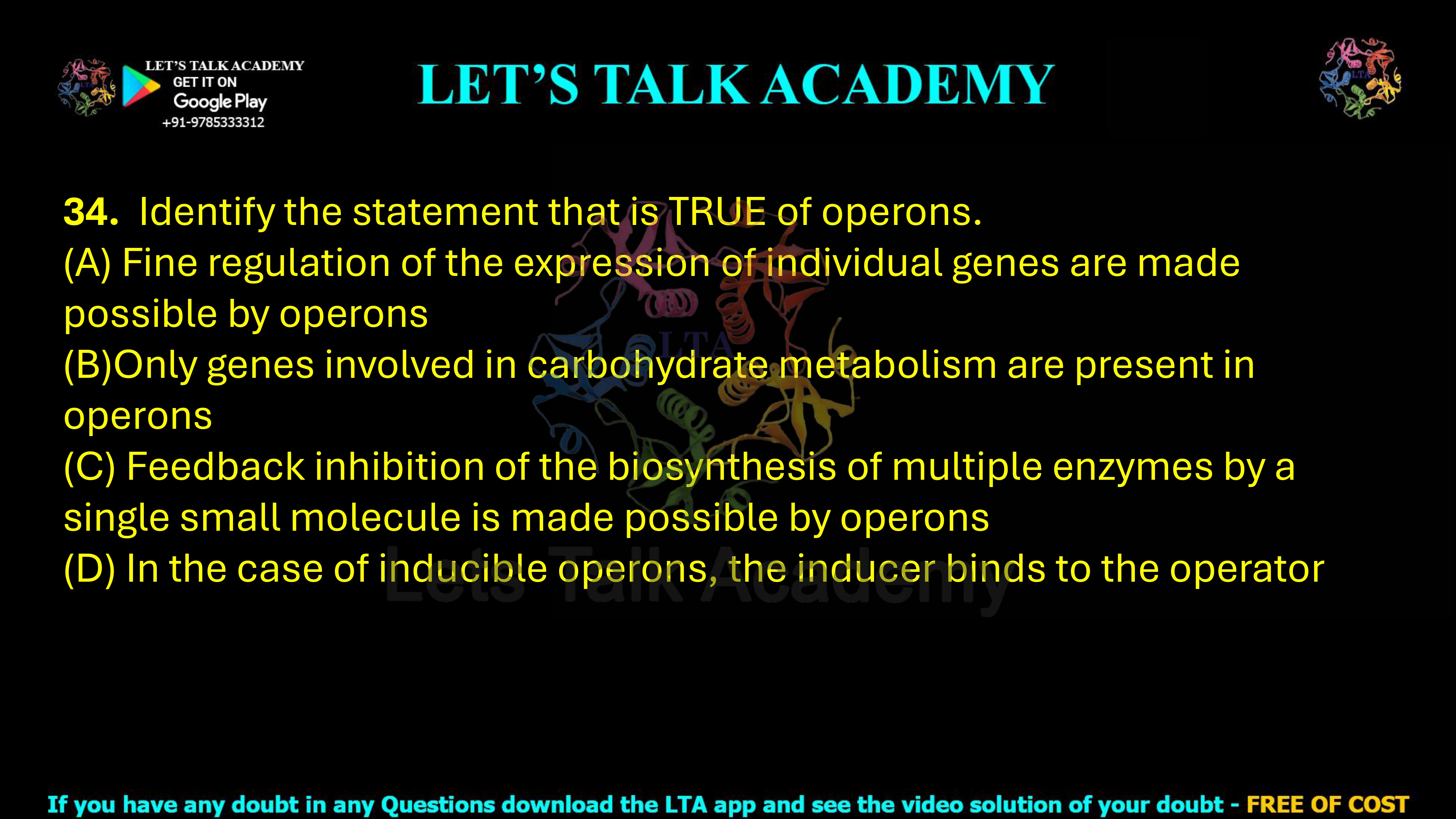
34. Identify the statement that is TRUE of operons.
(A) Fine regulation of the expression of individual genes are made possible by operons
(B)Only genes involved in carbohydrate metabolism are present in operons
(C) Feedback inhibition of the biosynthesis of multiple enzymes by a single small molecule is made possible by operons
(D) In the case of inducible operons, the inducer binds to the operator
Which Statement Is True of Operons?
Understanding the Correct Answer
The correct answer is (C). The major biological advantage of an operon is that several functionally related genes can be regulated together as a single unit. These genes are commonly controlled by the same promoter and operator and are transcribed together into a polycistronic mRNA.
Because multiple genes are placed under common regulatory control, a single regulatory signal can simultaneously alter the expression of several enzymes involved in the same metabolic pathway. This makes cellular regulation highly efficient because the bacterium does not have to independently switch every gene on or off.
A small regulatory molecule can influence a regulatory protein, such as a repressor, and thereby affect the transcription of all structural genes in the operon. Consequently, the synthesis of multiple enzymes can be coordinately controlled by a single metabolic signal.
This principle is clearly illustrated by biosynthetic operons such as the trp operon. When the end product of the pathway becomes abundant, it can participate in a regulatory mechanism that reduces the transcription of genes encoding several enzymes required for its own biosynthesis.
Therefore, among the given options, statement (C) best describes a major regulatory advantage made possible by the organization of genes into operons.
What Is an Operon?
An operon is a functional unit of gene regulation commonly found in prokaryotes. It generally consists of a group of structural genes whose expression is controlled by shared regulatory DNA elements.
The genes present in an operon are often involved in the same metabolic pathway or biological process. Instead of being regulated independently, they are commonly transcribed together from a single promoter into one polycistronic mRNA molecule.
This organization allows a bacterial cell to coordinate the production of several proteins according to its metabolic requirements. If the proteins are needed, the operon can be activated. If the proteins are unnecessary, transcription of the entire group of genes can be reduced or switched off.
Thus, an operon provides a highly efficient mechanism for the coordinated regulation of functionally related genes.
Major Components of an Operon
The Promoter
The promoter is a regulatory DNA sequence where RNA polymerase binds to initiate transcription. Because several structural genes in an operon are commonly transcribed from the same promoter, regulation at this site can affect the expression of all downstream genes.
The promoter is therefore essential for determining whether transcription of the operon can begin efficiently.
The Operator
The operator is a regulatory DNA sequence that acts as a binding site for a regulatory protein, particularly a repressor in classical negative-control systems.
When a functional repressor binds to the operator, it can prevent or strongly reduce transcription of the structural genes. When the repressor is removed or inactivated, transcription may proceed.
The operator itself is not usually the molecule that binds the inducer. Instead, the operator serves as the DNA-binding site for the regulatory protein.
The Structural Genes
The structural genes encode the proteins or enzymes that perform the biological functions associated with the operon. Several structural genes may be organized together when their products participate in the same metabolic pathway.
Because these genes are controlled together, the cell can simultaneously increase or decrease the production of multiple related proteins.
The Regulatory Protein
A regulatory protein, such as a repressor or activator, controls the transcriptional state of the operon. Small molecules can bind to these regulatory proteins and change their ability to interact with DNA.
This interaction between a small molecule and a regulatory protein allows the metabolic state of the cell to influence the expression of multiple genes.
Why Do Operons Allow Coordinated Regulation of Multiple Genes?
The central advantage of an operon is that several genes can respond to the same regulatory signal. If multiple enzymes are required for a metabolic pathway, producing only one enzyme while failing to produce the others would often be inefficient.
By organizing the corresponding genes into an operon, the bacterial cell can regulate all of them together. A change in the activity of a single promoter-operator regulatory system can influence the transcription of the entire group of structural genes.
For example, if three enzymes are required for three consecutive reactions in a biosynthetic pathway, the genes encoding those enzymes can be placed under common control. When the pathway is needed, all three genes can be expressed. When the final product is already abundant, expression of all three genes can be reduced.
Therefore, operons are particularly well suited for the coordinated control of multiple functionally related genes.
How Can a Single Small Molecule Control the Synthesis of Multiple Enzymes?
A small molecule does not usually regulate every structural gene separately. Instead, it interacts with a regulatory protein that controls the entire operon.
Consider a biosynthetic pathway in which several enzymes are required to produce a final product. When the final product is scarce, the genes encoding these enzymes can be expressed, allowing the pathway to operate.
When the final product accumulates, it can act as a regulatory signal. In a repressible operon, the small molecule may bind to a repressor protein and alter its conformation. The activated repressor can then interact with the operator and reduce transcription of the entire set of structural genes.
Because all of these genes are controlled together, a single small molecule can influence the biosynthesis of multiple enzymes. This coordinated response is the principle described by option (C).
Understanding Feedback Control in Operons
Feedback control occurs when the product of a metabolic pathway influences the activity or production of components required earlier in that pathway. This prevents unnecessary expenditure of cellular energy and raw materials.
In the context of an operon, an abundant end product can function as a regulatory signal that reduces the expression of genes encoding multiple enzymes involved in its biosynthesis. Because the genes are organized under common regulatory control, the entire pathway can respond in a coordinated manner.
This type of gene-level regulation is more precisely described as feedback repression or end-product repression when the small molecule reduces transcription of biosynthetic genes. It is related to, but mechanistically distinct from, direct feedback inhibition of an already synthesized enzyme.
For the terminology and answer framework used in this question, option (C) refers to the ability of an operon to allow one small molecule to coordinately reduce the biosynthesis of several enzymes.
The trp Operon as an Example of Coordinated Regulation
What Happens When Tryptophan Is Scarce?
The trp operon contains genes encoding enzymes involved in the biosynthesis of the amino acid tryptophan. When intracellular tryptophan levels are low, the bacterium needs to synthesize more tryptophan.
Under these conditions, the trp repressor is not efficiently activated by tryptophan. Therefore, transcription of the structural genes can proceed, and the enzymes required for tryptophan biosynthesis are produced.
What Happens When Tryptophan Is Abundant?
When tryptophan becomes abundant, it can bind to the trp repressor and act as a corepressor. This binding changes the conformation of the repressor and allows the regulatory protein to interact effectively with the operator.
Binding of the activated repressor reduces transcription of the structural genes. As a result, the cell decreases the synthesis of multiple enzymes involved in tryptophan biosynthesis.
This example demonstrates how one small molecule can influence the coordinated production of several enzymes through operon-based regulation.
Detailed Explanation of Each Option
Option (A): Fine Regulation of the Expression of Individual Genes Is Made Possible by Operons
Option (A) is incorrect. The defining advantage of an operon is not the independent fine regulation of each individual gene. Instead, an operon primarily allows the coordinated regulation of a group of functionally related genes.
Several structural genes are commonly controlled by the same promoter and operator and are transcribed together into a polycistronic mRNA. Therefore, a regulatory event at the promoter-operator region can affect the entire set of genes.
If every gene needed completely independent regulation, placing all of them under one common regulatory system would not provide that level of individual control. Although additional regulatory mechanisms can modify the expression of particular genes in some operons, this is not the fundamental advantage described by the operon concept.
Hence, option (A) is incorrect.
Option (B): Only Genes Involved in Carbohydrate Metabolism Are Present in Operons
Option (B) is incorrect. Operons are not restricted to genes involved in carbohydrate metabolism. The lac operon is involved in lactose utilization and is therefore related to carbohydrate metabolism, but it represents only one example of an operon.
Other operons regulate many different biological processes. The trp operon controls genes involved in amino acid biosynthesis. Operons can also contain genes involved in purine and pyrimidine metabolism, stress responses, transport systems, metal homeostasis and many other cellular functions.
Therefore, the statement that only genes involved in carbohydrate metabolism are present in operons is far too restrictive.
Hence, option (B) is incorrect.
Option (C): Feedback Inhibition of the Biosynthesis of Multiple Enzymes by a Single Small Molecule Is Made Possible by Operons
Option (C) is correct in the context of this question. An operon allows several genes encoding functionally related enzymes to be controlled together. A single small regulatory molecule can interact with a regulatory protein and thereby influence the transcription of all structural genes present in the operon.
In a biosynthetic operon, the final product of a metabolic pathway may function as a regulatory signal. When the product becomes abundant, it can participate in reducing the expression of genes encoding several enzymes required for its own synthesis.
Thus, a single small molecule can coordinate the biosynthesis of multiple enzymes because their genes are organized under common regulatory control.
More precisely, regulation of enzyme synthesis at the transcriptional level is often called feedback repression or end-product repression. Nevertheless, among the given options, statement (C) correctly captures the major advantage of operon organization: coordinated control of multiple enzyme-coding genes by a single regulatory signal.
Hence, option (C) is correct.
Option (D): In the Case of Inducible Operons, the Inducer Binds to the Operator
Option (D) is incorrect. In a classical inducible operon such as the lac operon, the inducer does not bind directly to the operator DNA sequence.
Instead, the inducer binds to the repressor protein. This interaction causes an allosteric conformational change in the repressor and decreases its ability to bind the operator.
Once the repressor is removed from the operator, RNA polymerase can transcribe the structural genes more effectively. Therefore, the operator is the binding site for the repressor, whereas the inducer binds to the repressor protein.
Hence, option (D) is incorrect.
Why Is Option (A) Not the Best Description of an Operon?
Operons are designed primarily for coordinated rather than completely independent regulation. If several proteins participate in the same pathway, it is often beneficial for the cell to produce them together.
For example, if five enzymes are required for a biosynthetic pathway, producing large amounts of only one enzyme while failing to produce the remaining four may not help the cell. Coordinated regulation ensures that the required set of enzymes can be produced in response to the same physiological signal.
Therefore, the operon arrangement emphasizes the regulation of a functional group of genes rather than the fine and independent control of every individual gene.
Why Are Operons Not Limited to Carbohydrate Metabolism?
The lac operon is one of the most widely studied examples of bacterial gene regulation, and it controls genes involved in lactose metabolism. This may create the incorrect impression that operons are primarily associated with carbohydrate utilization.
In reality, operon organization is used for many different biological functions. The trp operon regulates tryptophan biosynthesis, while other operons regulate amino acid metabolism, nutrient transport, ion balance, stress responses and numerous other cellular processes.
The important requirement is not the type of nutrient involved. Instead, genes are often organized into operons when their products perform related functions and benefit from coordinated regulation.
Why Does an Inducer Bind to a Repressor Rather Than the Operator?
The operator is a sequence of DNA. In a classical negatively controlled inducible operon, it serves as the recognition and binding site for the repressor protein.
The inducer is a small molecule that changes the activity of the regulatory protein. When the inducer binds to the repressor, it causes a conformational change that reduces the repressor’s affinity for the operator.
The repressor then dissociates from the operator, allowing transcription of the structural genes. Therefore, the sequence of interaction is:
Inducer binds repressor → repressor changes conformation → repressor loses affinity for operator → transcription increases
This is why statement (D), which says that the inducer binds directly to the operator, is incorrect.
Inducible and Repressible Operons
Inducible Operons
An inducible operon is generally switched off or expressed at a low level until the presence of an inducer promotes gene expression. The lac operon is the classic example.
In the lac operon, the inducer interacts with the lac repressor and reduces its ability to bind the operator. This permits increased transcription of genes required for lactose utilization.
Repressible Operons
A repressible operon is generally active when the end product of a biosynthetic pathway is scarce. When the end product becomes abundant, it can participate in a regulatory mechanism that reduces transcription.
The trp operon is the classic example. Tryptophan acts as a corepressor by binding to the trp repressor. The activated repressor can then bind the operator and reduce transcription of genes required for tryptophan biosynthesis.
Both systems demonstrate how small molecules can regulate the expression of multiple genes through interactions with regulatory proteins.
Operons and Polycistronic mRNA
One of the important consequences of operon organization is the production of a polycistronic mRNA. A polycistronic mRNA contains coding regions for more than one protein.
Because several structural genes are transcribed as part of the same RNA molecule, one transcriptional regulatory event can influence the production of multiple proteins.
This arrangement is highly efficient for bacterial cells. When a metabolic pathway is needed, several required proteins can be produced in a coordinated manner. When the pathway is unnecessary, transcription of the entire group can be reduced.
This coordinated control is one of the major reasons why operons are such an effective system of gene regulation.
Feedback Inhibition and Feedback Repression: An Important Distinction
The terminology used in option (C) deserves careful explanation. Feedback inhibition in the strict biochemical sense usually refers to a final product directly inhibiting the activity of an enzyme that has already been synthesized, often the first committed enzyme of a metabolic pathway.
Feedback repression, in contrast, refers to a final product reducing the synthesis of enzymes by controlling gene expression. Operons are particularly important for this second type of regulation because multiple enzyme-coding genes can be transcriptionally controlled together.
The wording of option (C) refers to inhibition of the biosynthesis of multiple enzymes by a single small molecule. Therefore, the statement is describing coordinated control of enzyme production rather than direct inhibition of the catalytic activities of all enzymes.
For this reason, option (C) is the intended and correct statement among the choices provided.
Final Answer
Correct Answer: (C) Feedback inhibition of the biosynthesis of multiple enzymes by a single small molecule is made possible by operons
Operons organize several functionally related genes under common regulatory control. Because the genes are regulated together, a single small regulatory molecule can influence the expression of multiple genes encoding enzymes of the same pathway.
Option (A) is incorrect because operons primarily provide coordinated regulation of groups of genes rather than independent fine regulation of each gene. Option (B) is incorrect because operons regulate genes involved in many biological processes, not only carbohydrate metabolism. Option (D) is incorrect because, in a classical inducible operon, the inducer binds to the repressor protein rather than directly to the operator.
Therefore, the statement that best describes a true property of operons is option (C).
Final Answer: (C)


