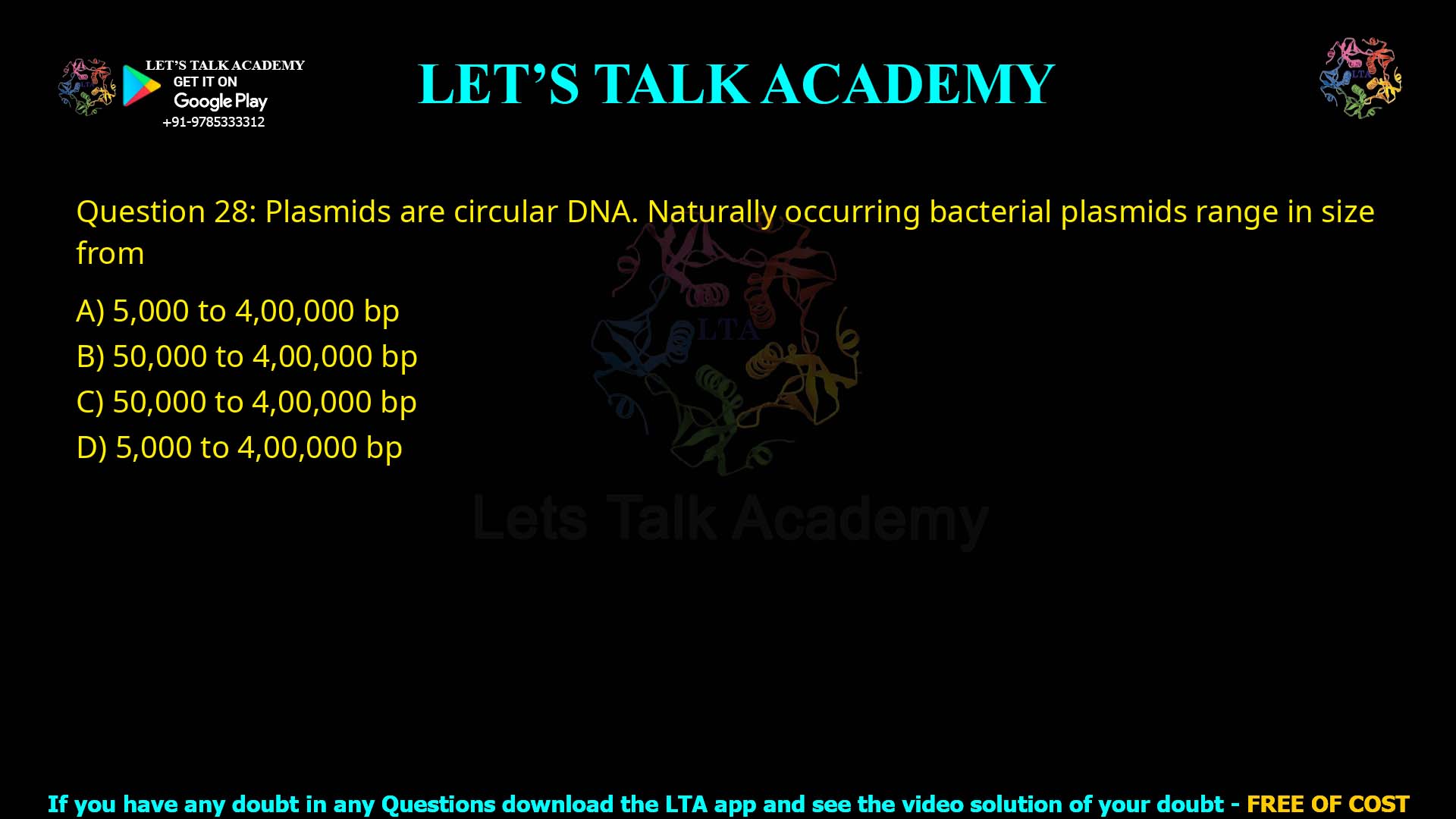
Q.28 Plasmids are circular DNA. Naturally occurring bacterial plasmids range in size from
Naturally occurring bacterial plasmids range in size from 5,000 to 4,00,000 bp. Small plasmids (~5-10 kb) like ColE1 carry few genes at high copy number, while large conjugative plasmids (100-400 kb) encode multiple traits (antibiotic resistance, virulence, heavy metal resistance) for horizontal gene transfer.
Option Analysis
-
(1) 5,000 to 4,00,000 bp: Correct—matches bimodal distribution: ~5 kb cryptic plasmids and 30-400 kb megaplasmids (peaks at 4-8 kb, 65 kb, up to 2.5 Mb extremes).
-
(2) 50,000 to 4,00,000 bp: Wrong—excludes small plasmids (<50 kb, ~70% of total) like pMB1 derivatives, Col plasmids.
-
(3) 50,000 to 4,00,000 bp: Duplicate error of option 2; incorrect for same reason.
-
(4) 5,000 to 4,00,000 bp: Identical to (1)—likely printing error, but technically correct range.
Answer: (1) 5,000 to 4,00,000 bp.
Introduction to Plasmid Size Range
Plasmids are circular DNA naturally occurring in bacteria with size range from 5,000 bp (small cryptic) to 4,00,000 bp (conjugative megaplasmids). This bimodal distribution reflects functional specialization: small = high copy/replication focus; large = gene cargo for adaptation.
Plasmid Size Distribution
-
Small plasmids (1-10 kb): ColE1 (6.5 kb), pBR322 (4.3 kb), high copy (~50-500/cell)
-
Medium plasmids (20-65 kb): R100 resistance plasmid
-
Large plasmids (100-400+ kb): RP4 (60 kb), F plasmid (100 kb), megaplasmids >1 Mb
Average: ~80 kb across 4600+ sequenced plasmids.
Why 5,000-400,000 bp Range?
Excludes linear chromosomes (Mb) and tiny cryptic (<1 kb, unstable). Captures biological reality: replication origin + partitioning + cargo capacity limits.
GATE Microbiology Application
Tests plasmid biology basics: 5 kb minimum for ori + rep genes; 400 kb maximum for self-transmissible elements. Key for cloning vectors, HGT, antibiotic resistance questions.


