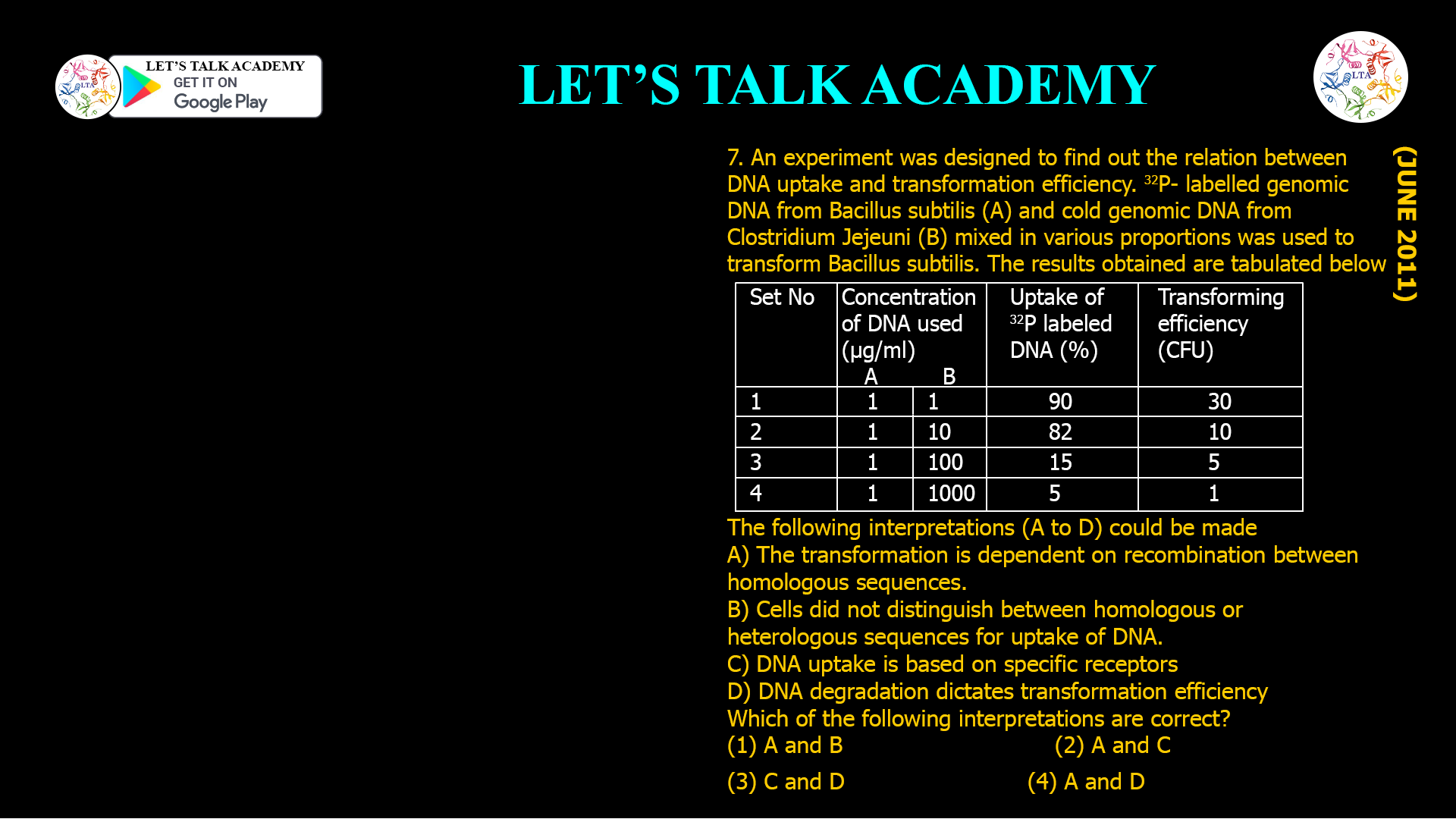
- An experiment was designed to find out the relation between DNA uptake and transformation efficiency. 32P- labelled genomic DNA from Bacillus subtilis (A) and cold genomic DNA from Clostridium Jejeuni (B) mixed in various proportions was used to transform Bacillus subtilis.
The results obtained are tabulated below
| Set No | Concentration of DNA used (μg/ml)
A B |
Uptake of 32P labeled DNA (%) | Transforming efficiency (CFU) | |
| 1 | 1 | 1 | 90 | 30 |
| 2 | 1 | 10 | 82 | 10 |
| 3 | 1 | 100 | 15 | 5 |
| 4 | 1 | 1000 | 5 | 1 |
The following interpretations (A to D) could be made
A) The transformation is dependent on recombination between homologous sequences.
B) Cells did not distinguish between homologous or heterologous sequences for uptake of DNA.
C) DNA uptake is based on specific receptors
D) DNA degradation dictates transformation efficiency
Which of the following interpretations are correct?
(1) A and B (2) A and C
(3) c and D (4) A and D
The correct answer is option (2) A and C: DNA transformation in Bacillus subtilis requires recombination between homologous sequences, and DNA uptake occurs through specific receptor machinery on competent cells.
Question recap and data interpretation
In this experiment, radiolabeled genomic DNA from Bacillus subtilis (A) and unlabeled genomic DNA from Clostridium jejuni (B) were mixed in different proportions and used to transform B. subtilis cells.
As the amount of heterologous DNA B increased (while A was kept constant), the uptake of labeled DNA (%) decreased sharply, and transformant CFU also decreased, indicating that heterologous DNA competes for uptake sites but does not contribute to homologous recombination–based transformation.
Option A: Transformation depends on homologous recombination
Natural transformation in B. subtilis involves uptake of double‑stranded DNA, conversion to single strand, and RecA‑mediated pairing with homologous chromosomal regions, followed by recombination to generate stable transformants.
Because only DNA from B. subtilis is homologous, increasing non‑homologous C. jejuni DNA lowers the number of CFU even though total DNA uptake is still occurring, showing that stable transformation depends on recombination between homologous sequences, so option A is correct.
Option B: No distinction between homologous and heterologous DNA for uptake
The decreasing percentage of labeled DNA taken up as unlabeled heterologous DNA increases shows that both A and B compete for the same uptake machinery, but the cell does not preferentially select homologous DNA at the binding/uptake step.
However, the statement in B says “cells did not distinguish between homologous or heterologous sequences for uptake of DNA,” which is partly supported by the competition data but ignores the fact that only homologous DNA yields transformants; in CSIR’s key, this option was considered incorrect because the question is about conclusions explaining both uptake and transformation efficiency, not uptake alone.
Option C: DNA uptake is based on specific receptors
Competent B. subtilis cells express a specialized DNA uptake system (ComG pilus, ComEA, ComEC, etc.) that acts as specific receptors or binding sites for extracellular DNA on the cell surface.
The strong competition by excess heterologous DNA B for uptake of labeled DNA A implies that a limited number of such receptor sites are present; when they are saturated by any DNA, uptake of labeled A falls, supporting that DNA uptake is receptor‑mediated, so option C is correct.
Option D: DNA degradation dictates transformation efficiency
During transformation, one strand of incoming DNA is degraded while the other enters the cytoplasm and recombines with the chromosome.
In this experiment, the change in transformant CFU correlates with the amount of homologous DNA available and competition at uptake sites, not with any measured change in DNA degradation; there is no evidence that differential degradation controls transformation efficiency here, so option D is incorrect.
Introduction
Understanding Bacillus subtilis DNA uptake and transformation efficiency is crucial for CSIR NET Life Sciences, because it integrates concepts of natural competence, receptor-mediated DNA binding and RecA‑dependent homologous recombination.
The classic CSIR NET June 2011 problem, using labeled B. subtilis DNA mixed with heterologous Clostridium jejuni DNA, tests whether students can interpret how competition at DNA receptors and the requirement for sequence homology together determine the percentage of DNA uptake and the final number of transformants.
Stepwise solution summary
-
The proportion of labeled B. subtilis DNA is constant, but increasing excess of unlabeled heterologous DNA progressively lowers the percentage uptake of labeled DNA, showing competition for a finite number of DNA uptake receptors on competent cells.
-
Transforming efficiency (CFU) falls even more sharply because only homologous B. subtilis DNA can recombine via RecA and related proteins, confirming that stable transformation depends on homologous recombination, not merely on DNA entry into the periplasm or cytosol.
Evaluation of each interpretation (A–D)
-
A is correct: Chromosomal transformation in B. subtilis needs RecA‑mediated pairing of incoming single‑stranded DNA with homologous chromosomal sequences, so only homologous DNA A can generate stable transformants, matching the CFU pattern.
-
B is not accepted: Although heterologous DNA clearly competes for uptake, the option does not explain why transformation efficiency specifically tracks homologous DNA and, within the exam’s framework, is not considered a valid overall interpretation of the experiment.
-
C is correct: The saturable decrease in labeled DNA uptake with rising total DNA concentration indicates that DNA binding occurs through specific competence receptors and uptake complexes such as ComG and ComEA.
-
D is incorrect: No parameter in the table reflects altered DNA degradation; instead, the data are fully explained by competition at receptors and the need for homologous recombination, so degradation cannot be concluded to dictate transformation efficiency in this setup.
Thus, the experimentally justified interpretations are A and C, corresponding to option (2).


