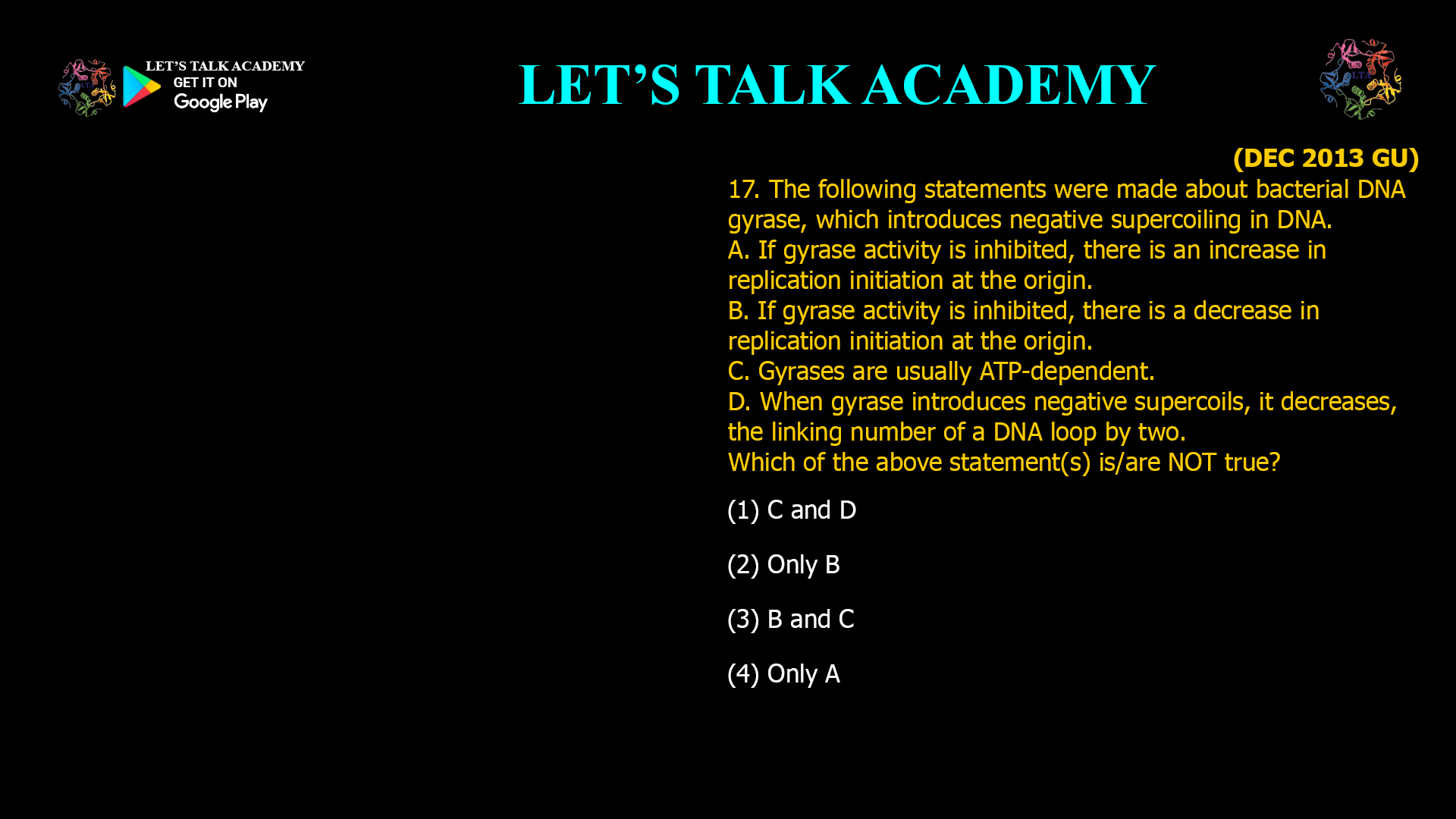
- The following statements were made about bacterialDNA gyrase, which introduces negative supercoiling inDNA.
A. If gyrase activity is inhibited, there is an increase inreplication initiation at the origin.
B. If gyrase activity is inhibited, there is a decrease inreplication initiation at the origin.
C. Gyrases are usually ATP-dependent.
D. When gyrase introduces negative supercoils, itdecreases, the linking number of a DNA loop by two.
Which of the above statement(s) is/are NOT true?
(1) C and D(2) only B
(3) B and C(4) only A
Introduction
Bacterial DNA gyrase is a unique enzyme that introduces negative supercoils into DNA, facilitating essential processes such as replication and transcription. Understanding its mechanism, energy requirements, and influence on DNA replication initiation is crucial in molecular biology and antibiotic development. Several statements about gyrase activity are often discussed, but not all are accurate. This article clarifies which statements about DNA gyrase are not true based on current scientific knowledge.
The Statements Under Review
A. If gyrase activity is inhibited, there is an increase in replication initiation at the origin.
B. If gyrase activity is inhibited, there is a decrease in replication initiation at the origin.
C. Gyrases are usually ATP-dependent.
D. When gyrase introduces negative supercoils, it decreases the linking number of a DNA loop by two.
Evaluating Each Statement
Statement A: If gyrase activity is inhibited, there is an increase in replication initiation at the origin.
-
This is not true. Inhibition of gyrase reduces negative supercoiling, which is necessary to relieve topological stress and facilitate replication initiation. Therefore, inhibition typically decreases replication initiation.
Statement B: If gyrase activity is inhibited, there is a decrease in replication initiation at the origin.
-
This is true. Gyrase activity is essential for maintaining DNA topology conducive to replication. Its inhibition hampers initiation.
Statement C: Gyrases are usually ATP-dependent.
-
This is true. DNA gyrase is an ATP-dependent enzyme; it hydrolyzes ATP to introduce negative supercoils.
Statement D: When gyrase introduces negative supercoils, it decreases the linking number of a DNA loop by two.
-
This is true. Each catalytic cycle of gyrase changes the DNA linking number by -2 through a mechanism involving double-strand breaks and strand passage.
Which Statements Are NOT True?
-
Statement A is false.
-
Statements B, C, and D are true.
Correct Answer
(4) only A
Summary Table
| Statement | True/False | Explanation |
|---|---|---|
| A | False | Gyrase inhibition decreases, not increases, replication initiation |
| B | True | Gyrase activity is required for replication initiation |
| C | True | Gyrase requires ATP hydrolysis for supercoiling |
| D | True | Gyrase changes linking number by -2 per catalytic cycle |
Biological Significance
DNA gyrase plays a vital role in bacterial DNA metabolism by introducing negative supercoils, which facilitates replication fork progression and transcription. Its ATP-dependent mechanism and precise control over DNA topology make it an attractive target for antibiotics. Understanding which statements about gyrase are accurate helps in studying bacterial replication and designing gyrase inhibitors.
Keywords
DNA gyrase, bacterial gyrase, ATP-dependent enzyme, negative supercoiling, DNA replication initiation, linking number, gyrase inhibition, replication origin, molecular biology, topoisomerase II
Conclusion
Among the given statements about bacterial DNA gyrase, only statement A is incorrect. Inhibiting gyrase does not increase replication initiation; rather, it decreases it. Gyrase’s ATP dependence and its ability to reduce the DNA linking number by two per cycle are well-established facts critical for DNA replication and cellular function.


17 Comments
Manisha choudhary
July 25, 20254th option itna samajh nhi aaya sir kya kahna chahta h linking number of DNA loop mtlb
Khushi Agarwal
July 29, 2025Option b, c , are correct –
In b option – if gyrase inhibit the dna supercoiled that means dna does not unwind so replication origin par initiate ni krega
C optn – atp required bcz dna cut then twist and then rejoin so energy chahiye
But 4 th optn can’t understand properly
Diksha Chhipa
July 29, 2025Only first opt is wrong because if we inhibit dna gyease initiation of replication affect
Heena
July 29, 2025Dna gyrase induces negative supercoils and removes positive supercoils and helps in replication.
HIMANI FAUJDAR
July 30, 2025Option B and C is correct
Priya Dhakad
July 30, 2025A is wrong becoz gyrase inhibition does not increase replication initiation, its decreases.
Aafreen
July 30, 2025A is wrong
Khushi Vaishnav
July 31, 2025statement A is incorrect because gyrase does not increase replication initiation rather, it decreases it.
Shivani
July 31, 2025Correct answer 4th
Dipti Sharma
July 31, 2025correct answer is 4.
because with inhibition of gyrase , replication initiation decreases .
Dharmpal Swami
August 1, 2025Gyrase -remove super coiling
Increase replication rate
Khushi Mehra
August 1, 2025Answer is 1
Inhibition of gyrase activity results into decrease replication initiation.
Mahima Sharma
August 2, 2025❔❓
Aman Choudhary
August 2, 2025Option 4 is correct answer
Soniya Shekhawat
August 3, 2025Only A is incorrect bcz inhibition of gyrase then replication intiation also inhibit or decrease bcz gyrase induces negative supercoiling that is essential for replication intiation .
Anita Choudhary
August 28, 2025Option 4 is correct
Deepika Sheoran
November 6, 2025Option 4 th is correct