
1. Introduction
During development, cells do not immediately become fully specialized. Instead, they gradually acquire information about what type of cell they are likely to become.
An early step in this process is called specification.
Specification occurs when a cell becomes biased toward a particular developmental fate because of its internal properties or signals from its environment.
At this stage, the cell has not necessarily become permanently committed. Therefore, under suitable experimental or environmental conditions, its developmental fate may still be changed.
Basic sequence
Undifferentiated cell
↓
Developmental signals/information
↓
Specification
↓
Determination
↓
Differentiation
↓
Mature specialized cell
2. Definition of Specification
Specification is the early developmental process in which a cell acquires the tendency to develop into a particular cell type when placed in a neutral environment.
In simple words:
Specification means that a cell has started choosing a particular developmental path, but the decision is not yet completely fixed.
This is why specification is generally considered a relatively reversible stage of cell-fate determination.
3. Easy Example
Suppose a group of embryonic cells can potentially become:
- muscle cells,
- nerve cells,
- skin cells.
After receiving particular developmental signals, one cell may become biased toward a muscle fate.
At this stage:
Cell
→ muscle tendency
→ specification
But if the cell is experimentally placed in a different developmental environment, it may still change its fate.
Therefore:
Specification = early and relatively reversible cell-fate decision.
4. Specification and Commitment
Specification is closely related to commitment, but they are not exactly identical.
Specification
Represents an early stage in which the cell is biased toward a particular fate.
Commitment
Represents the broader process of progressively restricting the developmental potential of a cell.
Therefore:
Specification is an important early stage of commitment.
Relationship
Potency
↓
Specification
↓
Determination
↓
Differentiation
↓
Specialized cell
5. Specification and Determination
These two terms are frequently compared.
Specification
A cell tends to follow a particular fate in a relatively neutral environment, but the fate can still be altered by changing the environment.
Determination
A cell has become more stably committed to a particular fate and generally continues toward that fate even when placed in a different environment.
Simple memory trick
Specification = “I am leaning toward this fate.”
Determination = “I am committed to this fate.”
6. Specification vs Determination
| Feature | Specification | Determination |
|---|---|---|
| Developmental stage | Earlier | Later |
| Commitment | Partial | Strong |
| Reversibility | Relatively reversible | More stable |
| Environmental influence | Greater | Lower |
| Cell fate | Biased toward a fate | More firmly established |
| Developmental potential | More remaining | More restricted |
7. Basis of Specification
Specification is produced through interactions between:
- intrinsic cellular factors,
- extracellular signals,
- transcription factors,
- cell-cell interactions,
- morphogens,
- signaling pathways,
- epigenetic mechanisms.
General mechanism
Developmental information
↓
Signal reception or inherited cellular factors
↓
Intracellular signaling
↓
Transcription-factor activation
↓
Changes in gene expression
↓
Cell becomes biased toward a particular fate
↓
Specification
8. Intrinsic Specification
Intrinsic specification occurs when developmental information is present within the cell itself.
This may result from:
- cytoplasmic determinants,
- maternal RNAs,
- maternal proteins,
- specific transcription factors,
- inherited cellular components.
These factors can influence which genes are expressed after cell division.
Basic mechanism
Cytoplasmic determinant
↓
Gene regulation
↓
Specific transcription factors
↓
Lineage-specific gene expression
↓
Cell-fate specification.
9. Cytoplasmic Determinants
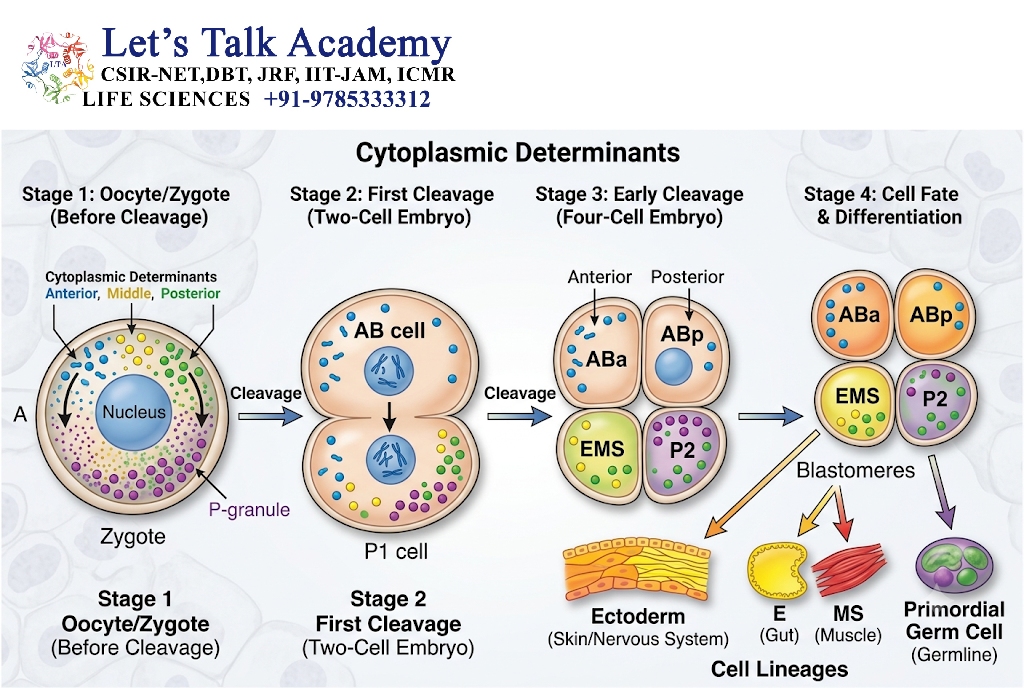
Cytoplasmic determinants are molecules present in the cytoplasm that can influence cell fate.
They may include:
- messenger RNAs,
- proteins,
- transcriptional regulators,
- signaling molecules.
During asymmetric cell division, these molecules may become unequally distributed between daughter cells.
As a result, the daughter cells can receive different developmental information.
Example
Parent cell
↓
Asymmetric division
↙ ↘
Cell A Cell B
↓
Different cytoplasmic factors
↓
Different gene expression
↓
Different cell fates.
10. Autonomous Specification
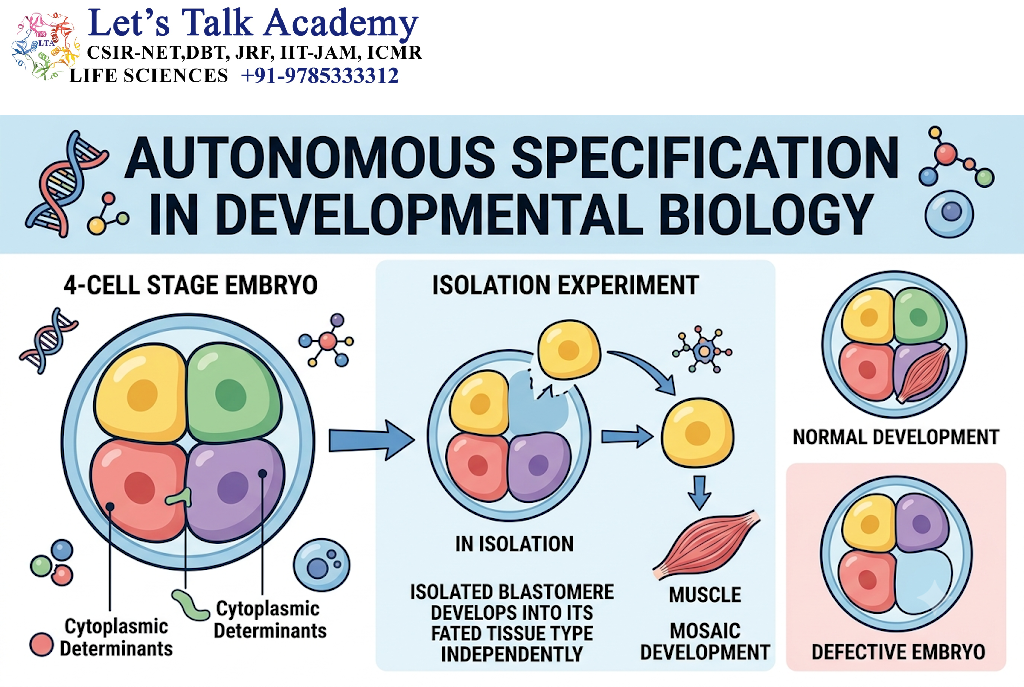
A type of intrinsic specification is called autonomous specification.
In autonomous specification, the developmental fate of a cell is largely determined by factors inherited within the cell.
If such cells are separated experimentally, they may still follow their original developmental pathway.
Example
Early embryonic cells containing different cytoplasmic determinants may independently follow different developmental fates.
Main idea
Cell-internal information
→ determines developmental tendency.
11. Conditional Specification
Conditional specification occurs when cell fate depends strongly on interactions with neighboring cells and the surrounding environment.
This is particularly important in many vertebrate developmental processes.
A cell may initially have more than one possible fate, and signals from neighboring cells influence which fate it adopts.
Mechanism
Cell
↓
Receives environmental signal
↓
Signal activates receptor
↓
Intracellular pathway
↓
Transcription-factor changes
↓
Specific gene expression
↓
Cell-fate specification
12. Autonomous vs Conditional Specification
| Feature | Autonomous specification | Conditional specification |
|---|---|---|
| Main control | Intrinsic factors | Extrinsic signals |
| Important source | Cytoplasmic determinants | Neighboring cells/environment |
| Cell interaction | Less important initially | Very important |
| Fate flexibility | Lower | Higher |
| Example | Determinant-based embryonic patterning | Inductive developmental interactions |
13. Syncytial Specification
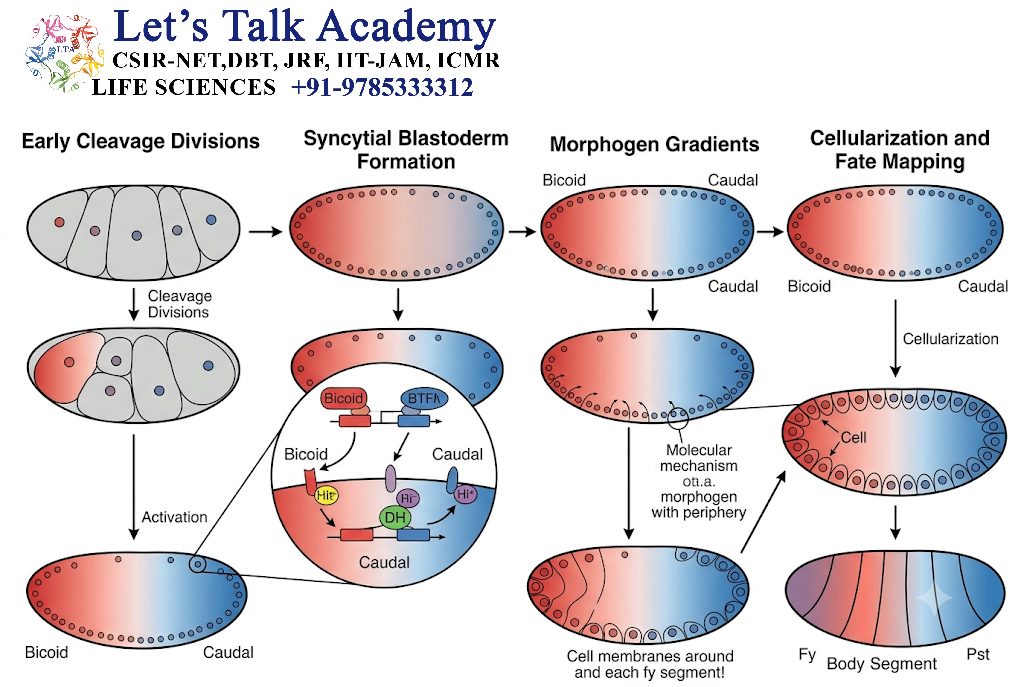
Another developmental mechanism is syncytial specification.
In a syncytium, nuclei share a common cytoplasm without complete cellular separation.
A classic developmental example is the early embryo of Drosophila.
Different concentrations of regulatory molecules can establish positional information across the embryo.
General mechanism
Maternal factors
↓
Different concentration gradients
↓
Different gene-expression patterns
↓
Different positional identities
↓
Developmental specification.
14. Morphogens and Specification
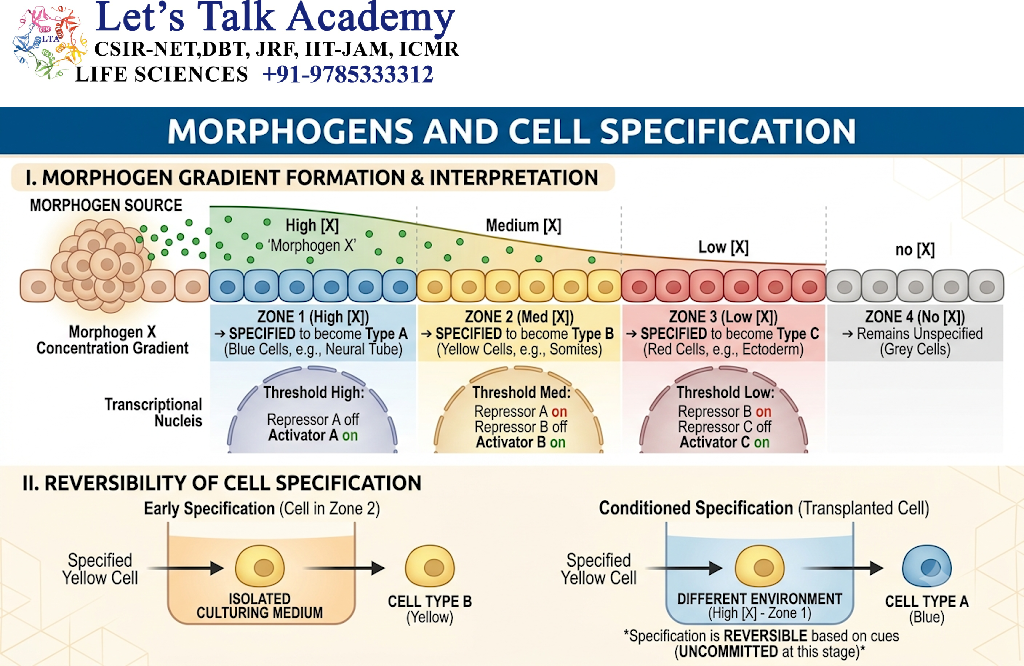
Morphogens are signaling molecules that provide positional information.
A morphogen can form a concentration gradient across developing tissue.
Different concentrations can activate different genes.
General model
High morphogen concentration
→ fate A
Intermediate concentration
→ fate B
Low concentration
→ fate C.
Thus, a single signaling molecule can contribute to specification of different cell fates depending on its concentration and the response of the cell.
15. Induction and Specification
Induction occurs when one group of cells influences the developmental fate of another group.
The responding cells can become specified toward a particular fate.
Example
Signaling tissue
↓
Produces developmental signal
↓
Signal reaches neighboring cells
↓
Receptor activation
↓
Gene-expression change
↓
Specification of responding cells
Therefore, induction is an important mechanism through which environmental information controls specification.
16. Cell-Cell Signaling
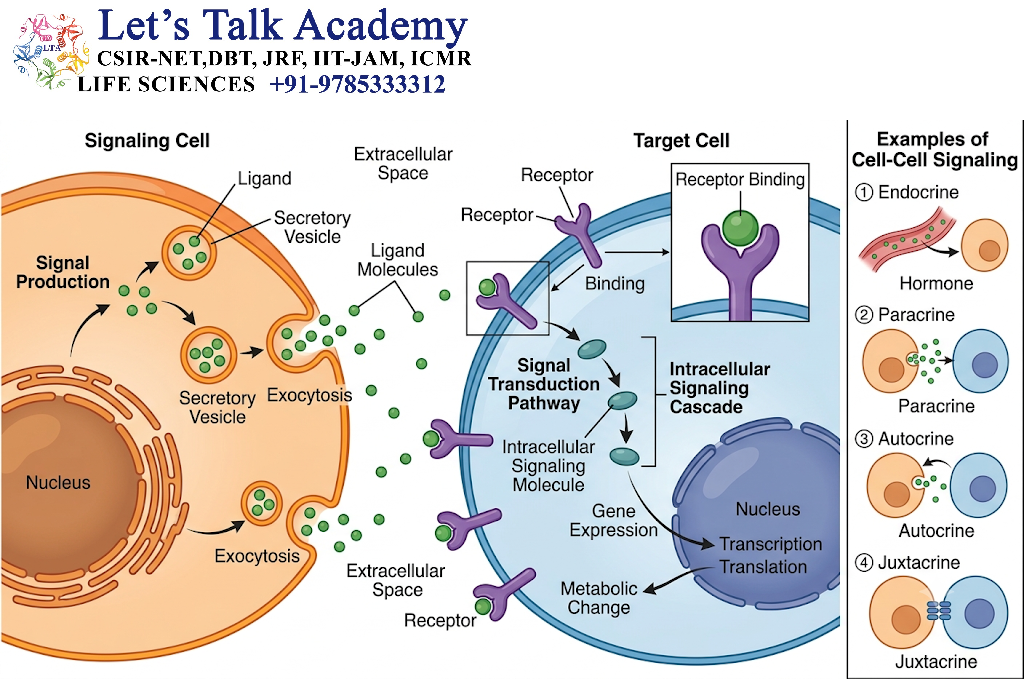
Cells communicate through several types of signaling.
Important mechanisms
- Paracrine signaling
- Juxtacrine/contact-dependent signaling
- Autocrine signaling
- Endocrine signaling
In embryonic development, paracrine and contact-dependent signaling are especially important for local cell-fate decisions.
17. Important Signaling Pathways
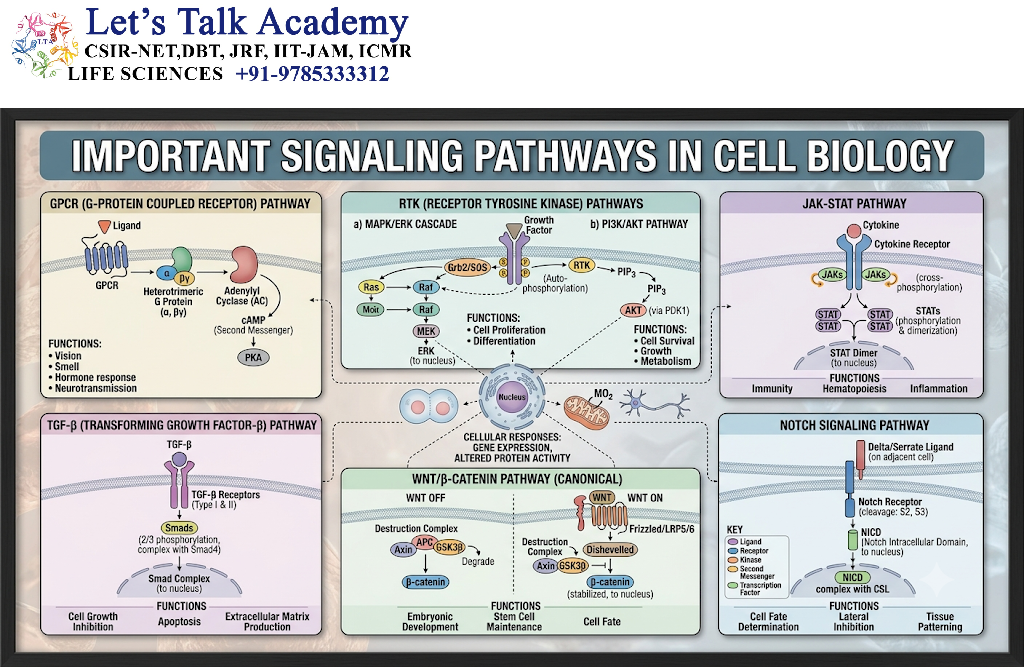
Several conserved pathways participate in developmental specification.
WNT
Important for:
- axis formation,
- tissue patterning,
- stem-cell regulation,
- cell-fate decisions.
Notch
Important for:
- lateral inhibition,
- cell-fate choices,
- nervous-system development.
Hedgehog
Important for:
- patterning,
- positional information,
- organ development.
FGF
Important for:
- proliferation,
- migration,
- differentiation,
- tissue development.
TGF-β/BMP
Important for:
- mesodermal development,
- tissue patterning,
- differentiation.
18. Transcription Factors in Specification
Specification requires changes in gene expression.
Transcription factors bind regulatory DNA sequences and influence the activity of developmental genes.
Examples include:
- PAX family,
- SOX family,
- GATA family,
- MYOD1,
- RUNX proteins.
Different combinations of transcription factors create different developmental programs.
19. Gene Regulatory Networks
Specification usually does not depend on one gene.
Instead, multiple genes interact to form a gene regulatory network.
Simplified model
Developmental signal
↓
Transcription factor A
↓
Transcription factor B
↓
Lineage-specific genes
↓
Additional regulatory factors
↓
Stable developmental program
↓
Specification
Once this network becomes established, the cell becomes increasingly biased toward a particular fate.
20. Epigenetic Regulation
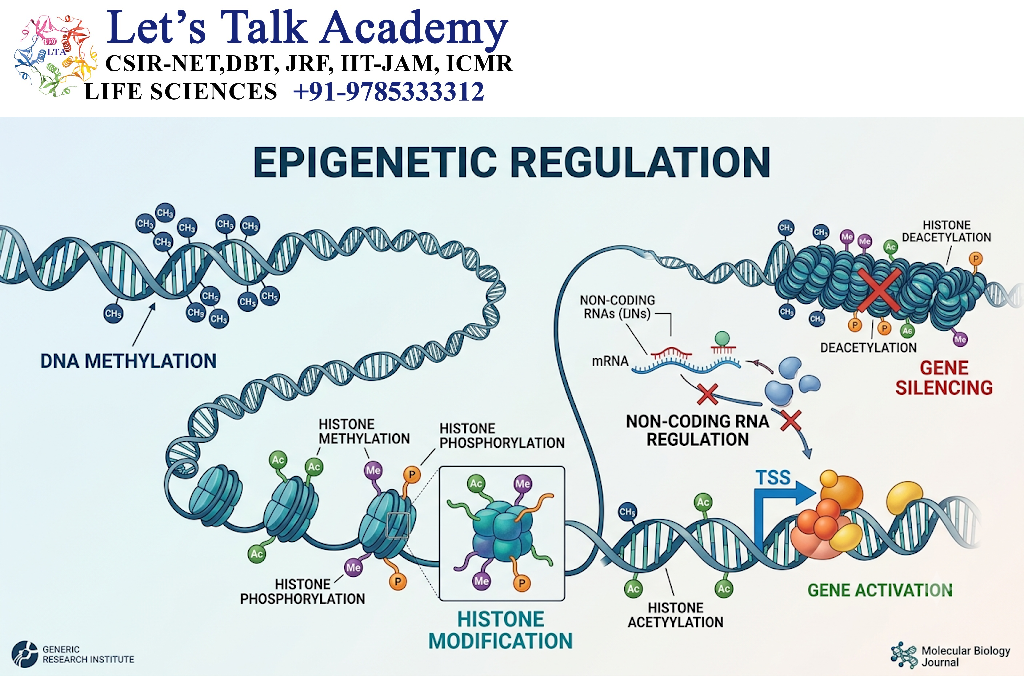
Epigenetic mechanisms help regulate the genes that are active or inactive during specification.
Important mechanisms include:
- DNA methylation,
- histone modification,
- chromatin remodeling,
- non-coding RNA regulation.
Example
During specification:
Lineage-specific genes
→ become more accessible/active
while
Alternative lineage genes
→ may become less active.
This helps establish a particular developmental identity.
21. Specification and Cell Fate
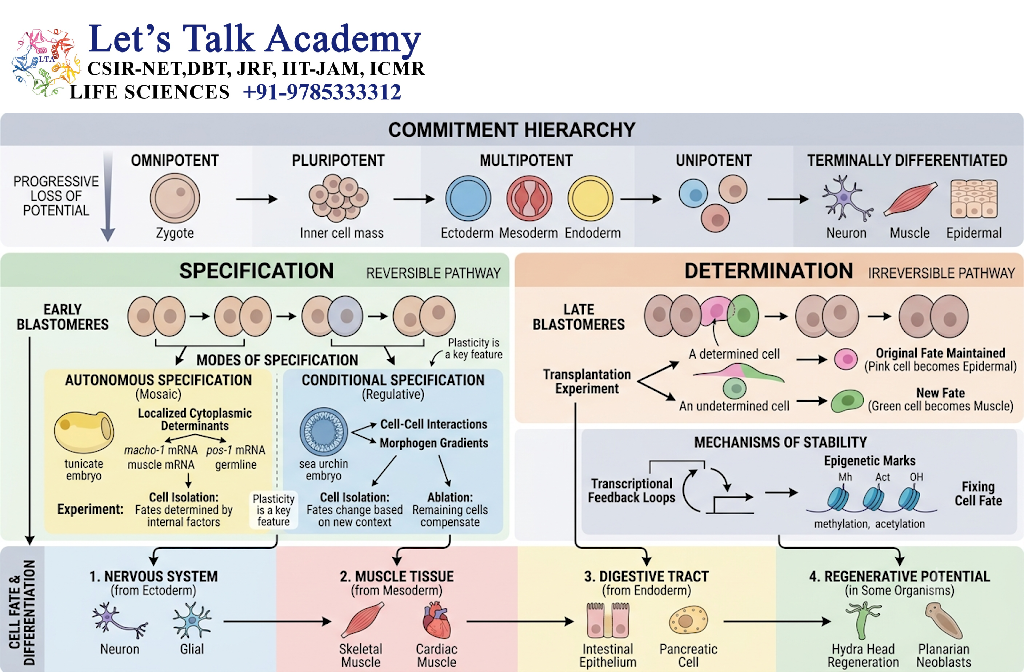
Cell fate refers to the developmental outcome of a cell.
Specification represents an early stage in establishing that fate.
Example
Early progenitor
→ possible neural or epidermal fate
↓
Developmental signal
↓
Neural genes activated
↓
Neural specification
↓
Neural determination
↓
Neuronal/glial differentiation.
22. Specification in Nervous System Development
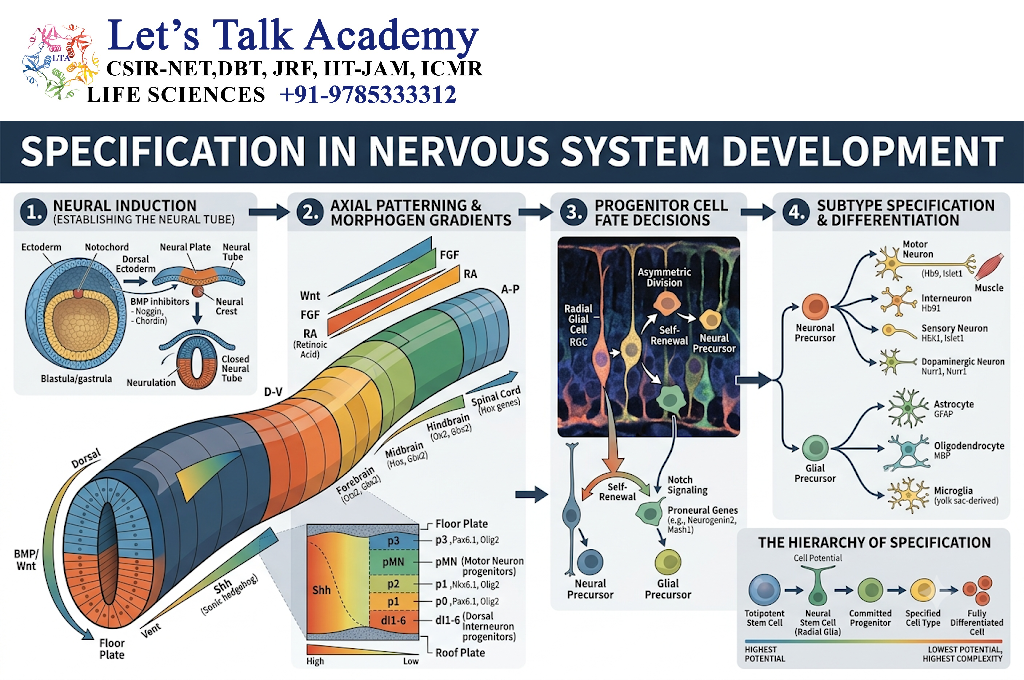
During nervous-system development, some embryonic cells become specified toward neural fates.
Signals from surrounding tissues influence neural specification.
After specification, neural progenitors can undergo further lineage decisions.
Simplified pathway
Embryonic ectoderm
↓
Developmental signaling
↓
Neural specification
↓
Neural progenitor
↓
Neuronal/glial lineage decisions
↓
Differentiation
↓
Mature neural cells.
23. Specification in Muscle Development
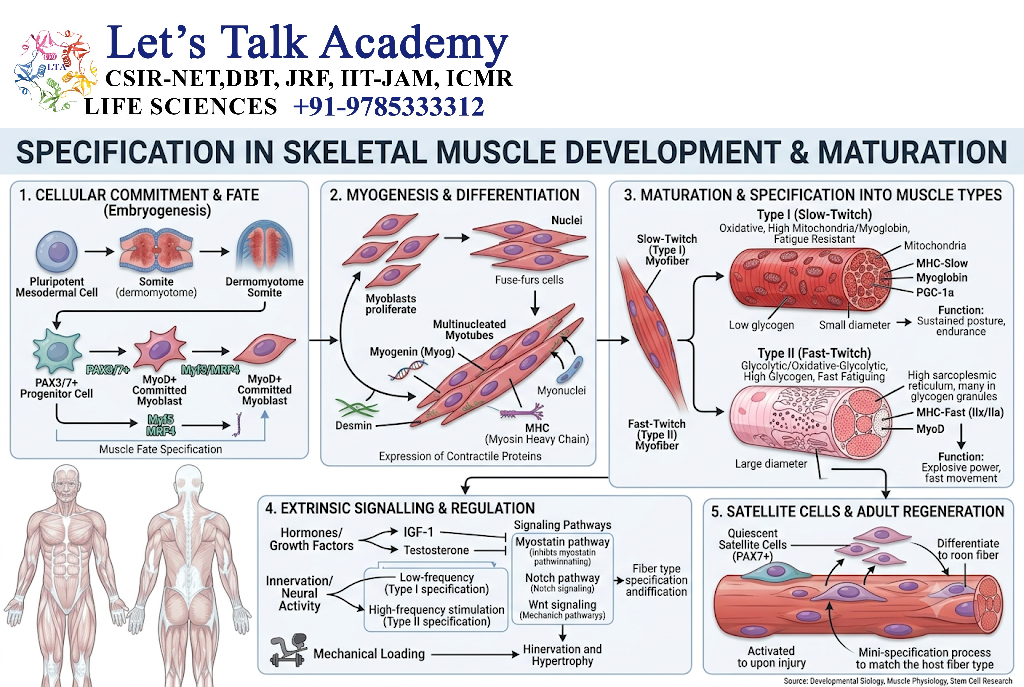
Mesodermal cells can become specified toward a muscle lineage.
Important regulatory factors include:
- MYOD1,
- MYF5,
- myogenin,
- MRF4.
Simplified pathway
Mesodermal progenitor
↓
Muscle-inducing signals
↓
MYOD1/MYF5 activity
↓
Muscle specification
↓
Muscle determination
↓
Muscle differentiation
↓
Mature muscle cell.
24. Specification in Blood Development
Blood-cell development involves progressive specification and commitment.
Simplified pathway
Hematopoietic stem/progenitor cell
↓
Lineage-associated signals
↓
Myeloid or lymphoid specification
↓
More restricted progenitor
↓
Specific blood-cell differentiation.
For example:
Progenitor
→ erythroid specification
→ erythroid differentiation
→ red blood cell.
25. Specification and Potency
A cell’s potency determines the range of possible fates available to it.
Specification begins to narrow these possibilities.
Relationship
High potency
↓
Many possible cell fates
↓
Developmental signals
↓
Specification
↓
Fewer likely cell fates
↓
Determination
↓
One major developmental pathway
↓
Differentiation.
26. Specification and Commitment
| Specification | Commitment |
|---|---|
| Early developmental bias | Progressive restriction of fate |
| Relatively reversible | Can become increasingly stable |
| One component/stage of commitment | Broader developmental process |
| Strongly influenced by environment in conditional systems | Stability increases with progression |
Therefore:
Specification is an early form/stage of developmental commitment.
27. Specification and Differentiation
Specification happens before or during the early stages of differentiation.
Specification
The cell acquires a developmental identity or bias.
Differentiation
The cell develops specialized:
- morphology,
- proteins,
- metabolism,
- functions.
Example
Cell
→ neural specification
→ neural differentiation
→ neuron.
28. Role of Environmental Conditions
Environmental conditions are particularly important in conditional specification.
Factors include:
- neighboring cells,
- growth factors,
- morphogens,
- extracellular matrix,
- oxygen,
- nutrients,
- mechanical forces.
Changing these conditions can sometimes alter the developmental pathway of a cell during early specification.
29. Experimental Demonstration of Specification
Developmental biologists have studied specification using experiments such as:
- cell transplantation,
- tissue isolation,
- tissue recombination,
- embryo manipulation,
- lineage tracing.
Basic principle
If a tissue maintains its developmental fate after isolation, it may contain strong intrinsic specification.
If its fate changes after environmental manipulation, environmental signals are likely important.
These experiments helped establish the concepts of specification and determination.
30. Specification and Developmental Plasticity
Because specification is relatively reversible, cells at this stage may show greater developmental plasticity.
Plasticity means that developmental outcomes can be altered by changes in:
- environment,
- signaling,
- gene expression,
- cellular interactions.
As determination and differentiation progress, plasticity generally decreases.


