
1. Introduction
During embryonic development, a single fertilized egg gives rise to many different types of specialized cells.
For example:
Zygote
→ embryonic cells
→ ectoderm, mesoderm, endoderm
→ tissue-specific progenitors
→ specialized cells.
A major question in developmental biology is:
How does a cell decide what type of cell it will become?
The answer involves several related concepts:
- potency,
- cell fate,
- specification,
- determination,
- commitment,
- differentiation.
Commitment describes the progressive process through which a cell becomes restricted toward a particular developmental fate.
2. Definition of Commitment
Commitment is the developmental process through which a cell becomes progressively restricted to a particular cell fate.
In simple words:
Commitment means that a cell becomes increasingly “set” toward becoming a particular type of cell.
For example:
Undifferentiated cell
→ commitment toward muscle lineage
→ muscle progenitor
→ muscle cell.
Commitment therefore represents an important transition between broad developmental potential and specialized cellular identity.
3. Commitment and Cell Fate
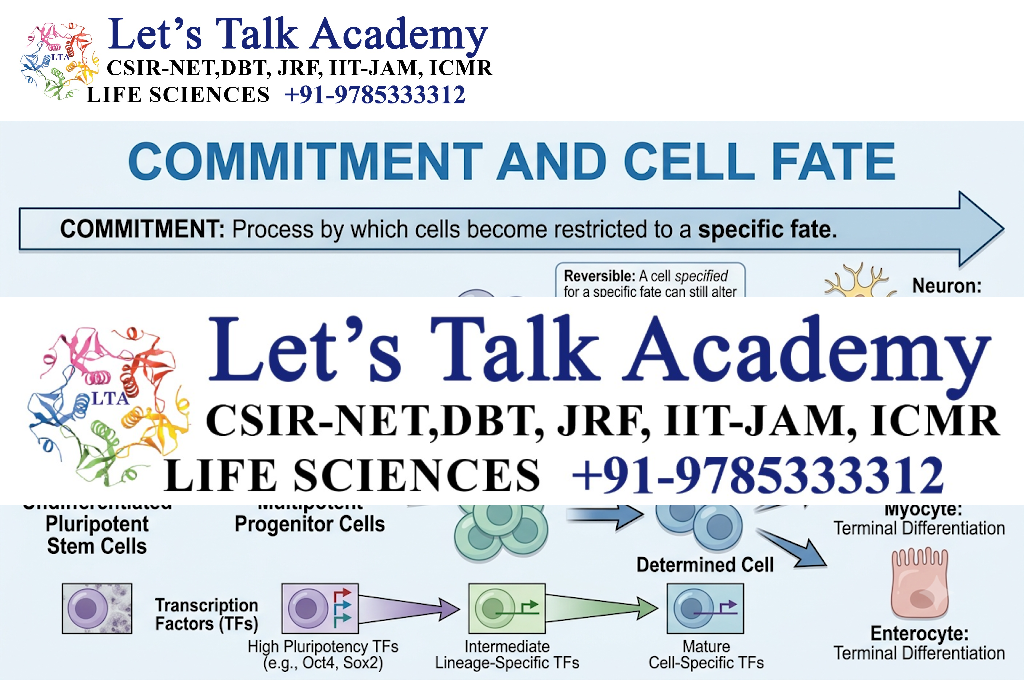
Cell fate refers to the developmental outcome that a cell will normally follow.
Commitment determines or restricts the range of possible fates available to a cell.
For example:
A highly potent cell may have several possible developmental pathways:
Cell
→ neural fate
→ muscle fate
→ blood-cell fate
→ epithelial fate.
After commitment toward a particular lineage:
Committed cell
→ restricted developmental pathway
→ specialized cell.
4. Commitment and Potency
Potency and commitment are closely related but represent opposite aspects of developmental potential.
Potency
Describes what a cell can potentially become.
Commitment
Describes how restricted the cell has become toward a particular fate.
Relationship
High potency
↓
Multiple possible cell fates
↓
Lineage commitment
↓
Fewer possible cell fates
↓
Differentiation
↓
Specialized cell
Therefore, as commitment increases, developmental potential generally decreases.
5. General Developmental Sequence
A simplified developmental sequence is:
Totipotent cell
↓
Pluripotent cell
↓
Multipotent cell
↓
Progenitor cell
↓
Committed cell
↓
Differentiated cell
The exact biological sequence can vary between tissues, and developmental states are not always perfectly linear.
6. Why Commitment Is Important
Commitment is essential for:
- formation of different tissues,
- organ development,
- embryonic patterning,
- cell differentiation,
- maintenance of tissue identity,
- regeneration,
- stem-cell biology.
Without appropriate commitment, cells would not reliably form organized tissues and organs.
7. Specification and Determination
Two important concepts associated with commitment are:
- Specification
- Determination
These describe different degrees of commitment.
General relationship
Specification
→ early commitment
↓
Determination
→ stronger commitment
↓
Differentiation
→ specialized phenotype.
8. Specification
Specification is an early stage of cell commitment in which a cell is capable of developing into a particular cell type when placed in a neutral environment.
The cell has acquired a tendency toward a particular fate, but its fate may still be altered by changes in its environment.
Example
A developing cell may be specified toward a muscle fate.
If removed from its normal environment and placed in a suitable neutral environment, it may still change its developmental fate under appropriate experimental conditions.
Therefore:
Specification = relatively reversible commitment.
9. Determination
Determination is a later and more stable stage of commitment.
A determined cell is strongly committed to a particular developmental fate.
Even if the cell is experimentally moved to a different environment, it generally continues toward its predetermined developmental pathway.
Therefore:
Determination = relatively stable commitment.
10. Specification vs Determination
| Feature | Specification | Determination |
|---|---|---|
| Stage | Earlier | Later |
| Commitment | Partial | Strong |
| Stability | Relatively reversible | More stable |
| Environmental influence | Greater | Lower |
| Cell fate | Becoming specified | Strongly established |
This distinction is particularly useful in classical experimental embryology.
11. Determination Is Not the Same as Differentiation
These terms should not be confused.
Determination
Determines or stabilizes what the cell is going to become.
Differentiation
Produces the specialized characteristics and functions of that cell.
For example:
Progenitor cell
→ determination toward muscle lineage
→ expression of muscle-specific genes
→ structural changes
→ contractile proteins
→ mature muscle cell.
Thus:
Determination precedes or accompanies differentiation, depending on the developmental context.
12. Commitment vs Differentiation
| Commitment | Differentiation |
|---|---|
| Establishes developmental direction | Produces specialized characteristics |
| Concerns cell fate | Concerns cell structure and function |
| Can occur before obvious morphological changes | Often produces visible molecular/cellular changes |
| Restricts developmental potential | Creates specialized phenotype |
13. Example of Muscle Cell Commitment
Consider development of a muscle cell.
Step 1: Multipotent progenitor
The cell can produce several related cell types.
Step 2: Muscle lineage specification
Signals favor a muscle developmental pathway.
Step 3: Determination
The cell becomes strongly committed to the muscle lineage.
Step 4: Differentiation
Muscle-specific genes become active.
Step 5: Mature muscle cell
The cell develops specialized structures and contractile functions.
Flowchart
Progenitor
↓
Muscle-inducing signals
↓
Specification
↓
Determination
↓
Muscle-specific gene expression
↓
Differentiation
↓
Mature muscle cell.
14. Molecular Basis of Commitment
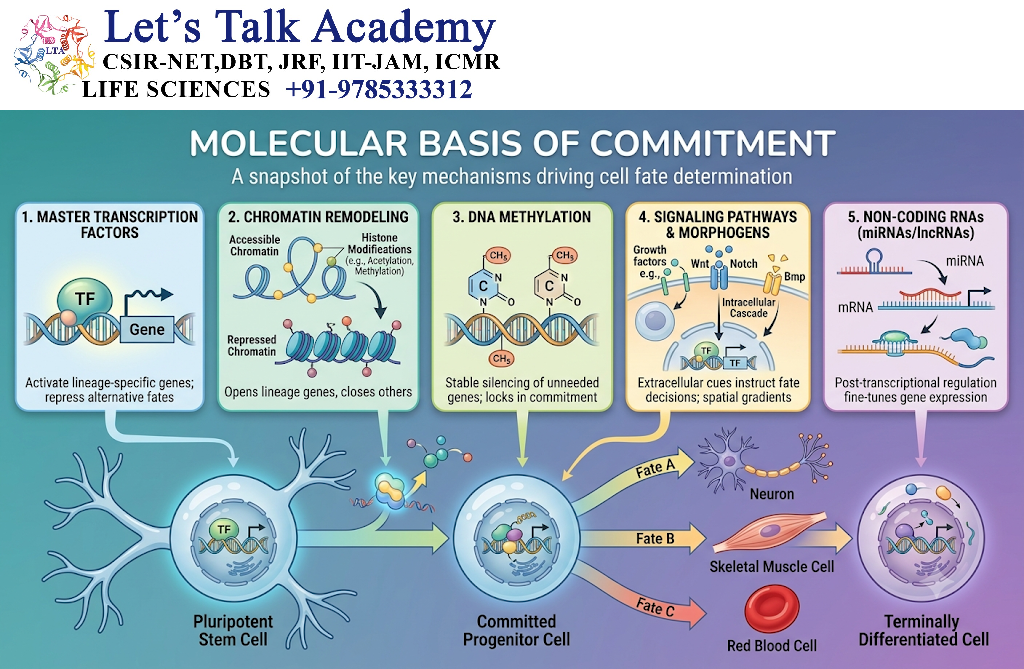
Commitment is controlled by changes in gene expression.
Major components include:
- transcription factors,
- signaling pathways,
- epigenetic changes,
- cell-cell interactions,
- extracellular signals,
- chromatin remodeling.
These mechanisms change which genes are active or inactive.
15. Role of Transcription Factors
Transcription factors regulate the expression of genes required for specific cell fates.
For example, different transcription factors are associated with different developmental lineages.
Examples
| Transcription factor | Important developmental role |
|---|---|
| MYOD1 | Myogenic differentiation |
| PAX6 | Eye and neural development |
| GATA1 | Erythroid and megakaryocytic lineage development |
| SOX9 | Chondrogenic development |
| RUNX2 | Osteoblast differentiation |
| NEUROG/NeuroD family | Neuronal differentiation |
These factors help establish lineage-specific gene-expression programs.
16. Master Regulatory Genes
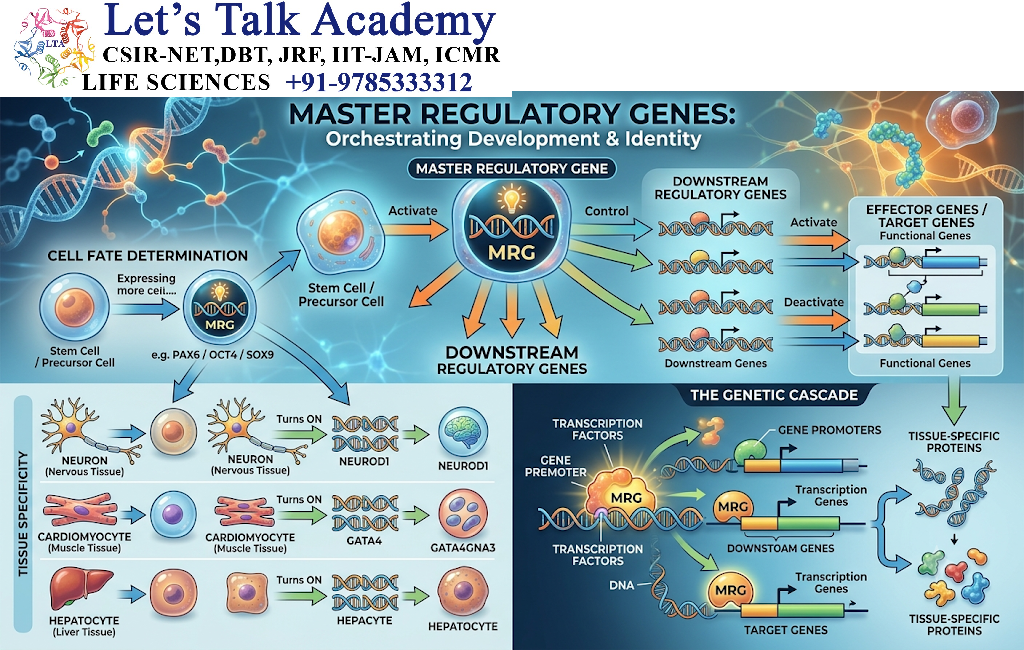
Some transcription factors can have particularly strong effects on cell identity.
These are sometimes called master regulatory transcription factors.
For example:
MYOD1
can activate a network of genes associated with skeletal muscle differentiation.
Simplified mechanism:
Developmental signals
↓
MYOD1 activation
↓
Muscle-specific gene expression
↓
Muscle differentiation program
↓
Muscle cell characteristics.
17. Role of Cell Signaling
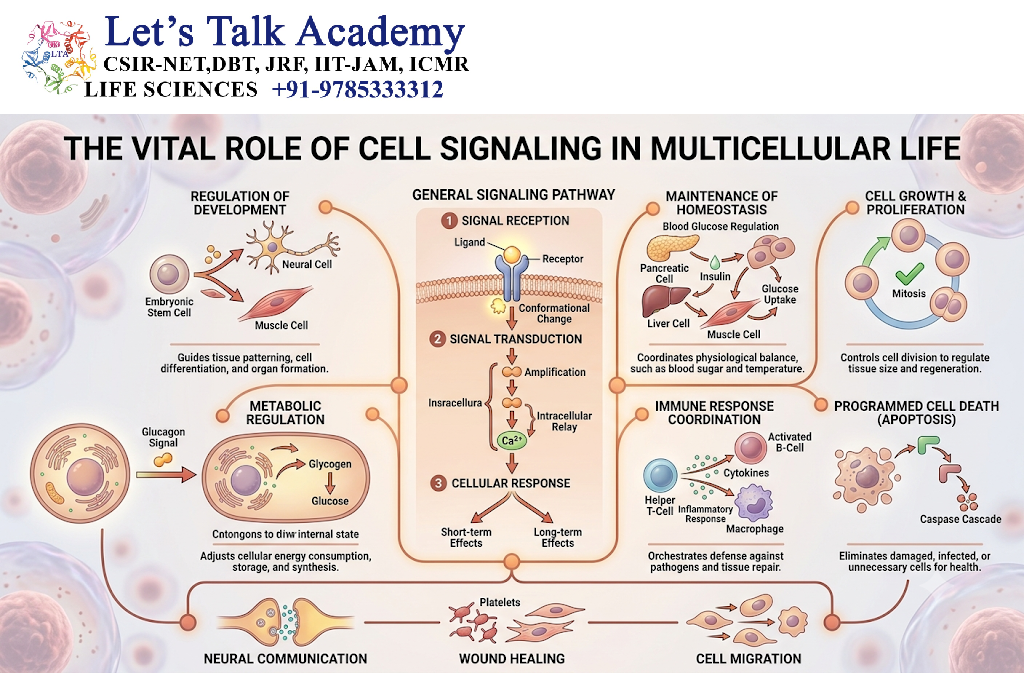
Cells receive information from their environment through signaling pathways.
Important developmental pathways include:
- WNT,
- Notch,
- Hedgehog,
- FGF,
- TGF-β/BMP.
These pathways can influence whether a cell:
- remains undifferentiated,
- proliferates,
- becomes specified,
- commits to a lineage,
- differentiates.
18. Inductive Signaling
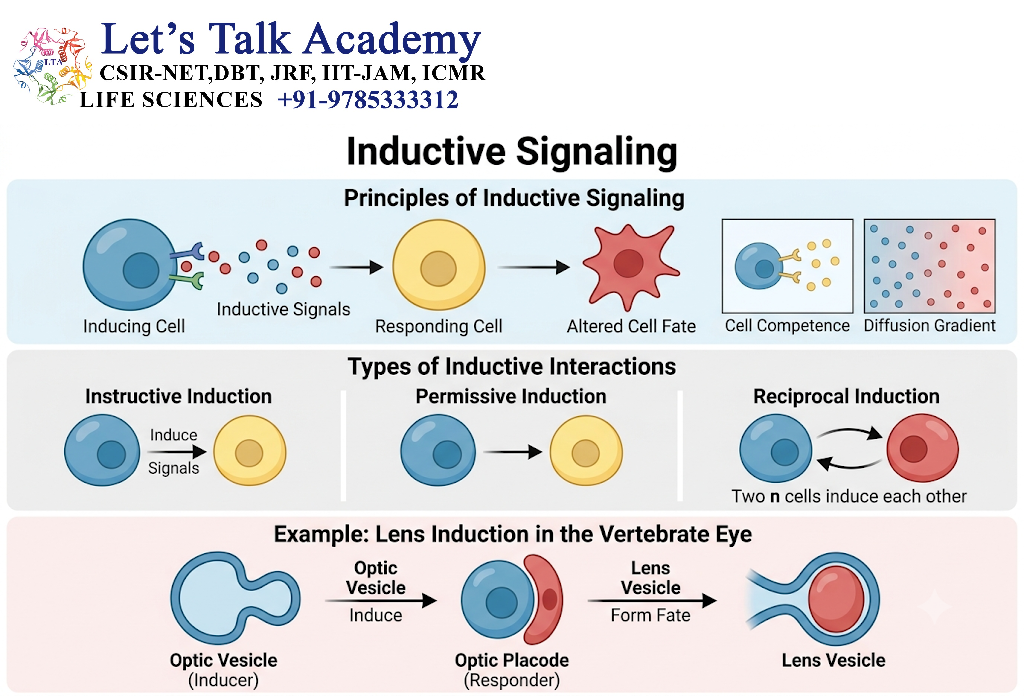
Induction occurs when one group of cells influences the developmental fate of another group through signals.
General mechanism
Signaling cell
↓
Signal molecule
↓
Receptor on responding cell
↓
Intracellular signaling
↓
Changes in gene expression
↓
Altered cell fate
↓
Commitment.
Induction is therefore an important mechanism through which the developmental environment influences commitment.
19. Cell-Cell Interaction
Developing cells communicate directly or indirectly with neighboring cells.
Communication can involve:
- membrane-bound signals,
- secreted growth factors,
- extracellular matrix,
- cell adhesion molecules.
For example, one cell may send a signal that activates a receptor on a neighboring cell and changes its developmental pathway.
20. Extrinsic and Intrinsic Control
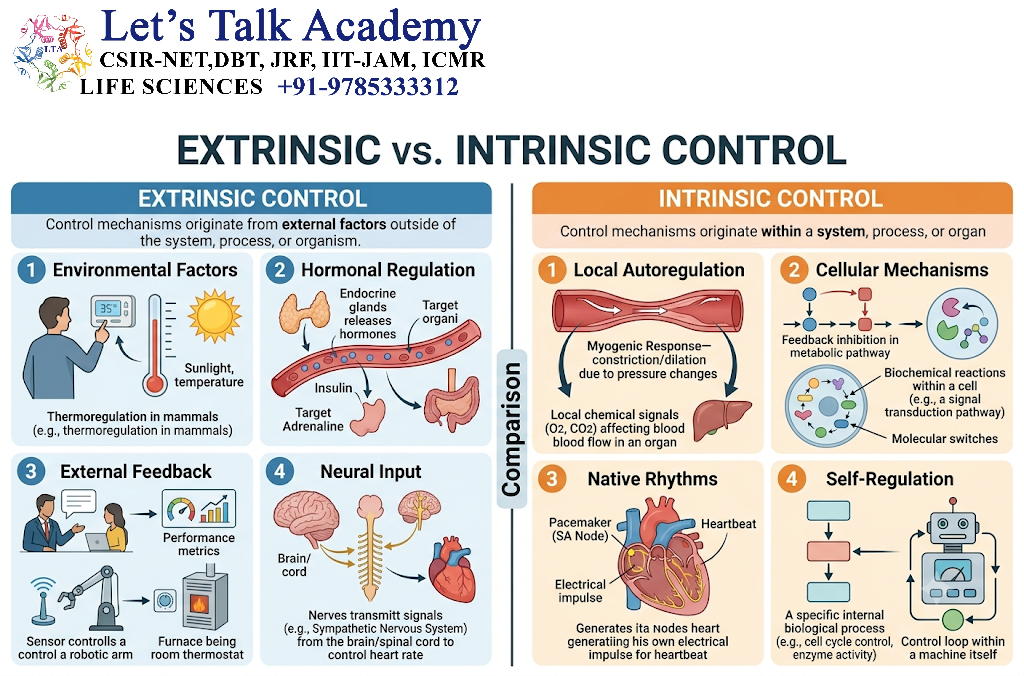
Commitment is controlled by both internal and external factors.
Intrinsic factors
- transcription factors,
- gene regulatory networks,
- epigenetic state,
- inherited cellular components.
Extrinsic factors
- growth factors,
- morphogens,
- neighboring cells,
- extracellular matrix,
- mechanical signals.
Integrated mechanism
External signal
↓
Cell-surface receptor
↓
Intracellular signaling pathway
↓
Transcription factor activation
↓
Gene-expression changes
↓
Cell-fate commitment.
21. Epigenetic Changes During Commitment
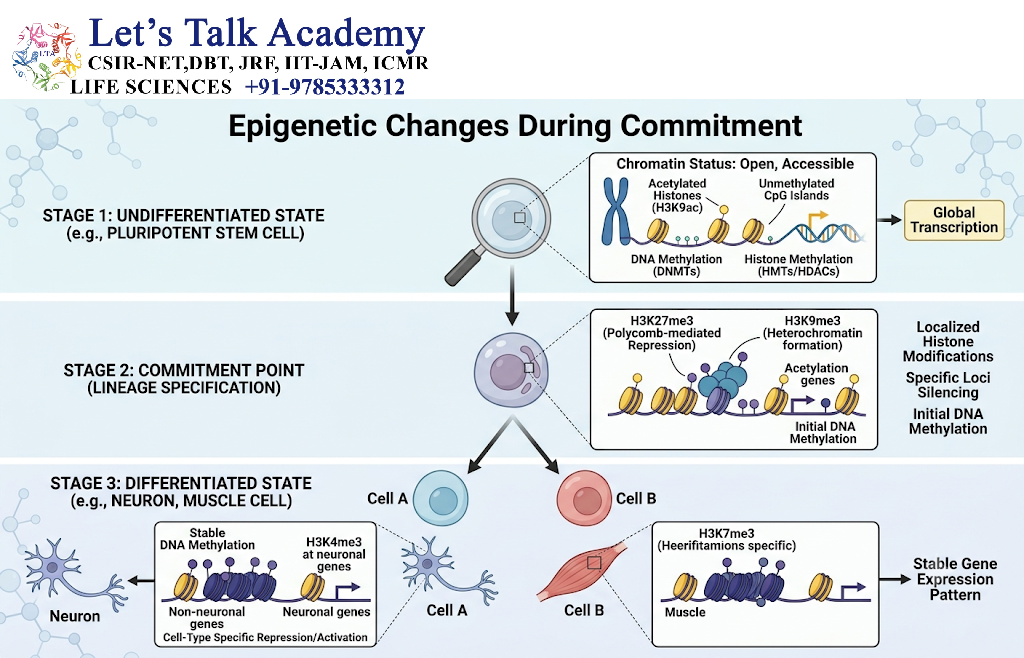
Epigenetic mechanisms help stabilize cell identity.
Important mechanisms include:
- DNA methylation,
- histone modification,
- chromatin remodeling,
- non-coding RNA regulation.
During commitment, genes associated with alternative developmental pathways may become less accessible or less active, while lineage-specific genes become more active.
This helps maintain the committed state.
22. Commitment and Gene Regulatory Networks
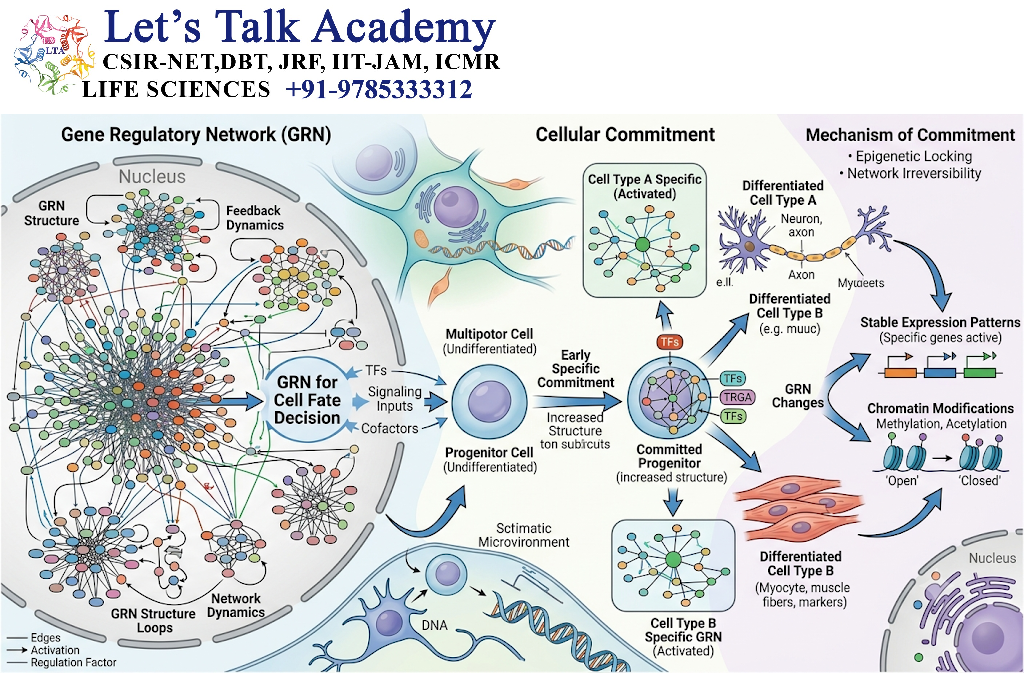
Cell commitment usually does not depend on one gene alone.
Instead, many genes interact in a gene regulatory network.
For example:
Signal
→ transcription factor A
→ transcription factor B
→ lineage-specific genes
→ additional regulatory factors
→ stable cell identity.
Positive feedback loops can help maintain the chosen developmental state.
23. Positive Feedback in Commitment
Positive feedback can stabilize a developmental decision.
For example:
Initial developmental signal
↓
Activation of lineage-specific transcription factor
↓
Activation of genes supporting that lineage
↓
Further activation of the same regulatory program
↓
Stable lineage commitment.
This helps prevent the cell from easily returning to its previous state.
24. Lateral Inhibition and Commitment
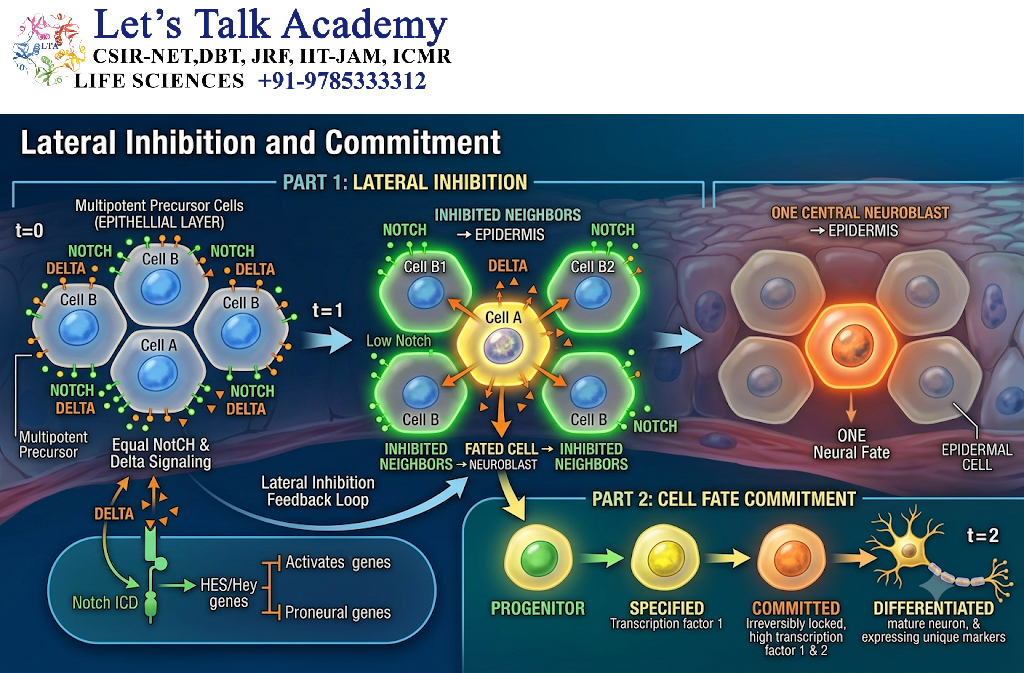
The Notch signaling pathway can influence cell-fate decisions through a process called lateral inhibition.
One developing cell may adopt a particular fate and activate Notch signaling in neighboring cells.
The neighboring cells may then be inhibited from adopting the same fate.
This mechanism helps generate different cell types from initially similar cells.
Simplified example
Similar neighboring cells
↓
One cell receives stronger differentiation signal
↓
Cell adopts fate A
↓
Notch signaling to neighboring cells
↓
Neighbors are directed away from fate A
↓
Different cell fates emerge.
25. Morphogens and Commitment
Morphogens are signaling molecules that provide positional information.
Cells may respond differently depending on:
- morphogen concentration,
- exposure duration,
- receptor expression,
- intracellular signaling state.
Thus, different regions of an embryo can develop different cell fates.
26. Commitment in Nervous System Development
During nervous system development, progenitor cells become committed to particular neural lineages.
A simplified sequence is:
Neural progenitor
↓
Neuronal commitment
↓
Neuronal differentiation
↓
Mature neuron.
Other progenitors can become:
- astrocytes,
- oligodendrocytes,
- other neural cell types.
Different signaling pathways and transcription factors help regulate these choices.
27. Commitment in Blood Cell Development
Blood formation provides a clear example of progressive commitment.
Simplified hierarchy
Hematopoietic stem cell
↓
Multipotent progenitor
↓
Myeloid or lymphoid lineage
↓
More restricted progenitor
↓
Specific blood-cell type
For example:
Hematopoietic stem cell
→ erythroid lineage
→ erythroblast
→ red blood cell.
Or:
Hematopoietic stem cell
→ lymphoid lineage
→ B-cell pathway
→ mature B cell.
At each stage, developmental options become more restricted.
28. Commitment in Muscle Development
Muscle development involves progressive restriction of cell fate.
Important regulators include:
- MYOD1,
- MYF5,
- myogenin,
- MRF4.
These factors belong to the myogenic regulatory network.
Simplified pathway
Mesodermal progenitor
↓
MYF5/MYOD1 activity
↓
Muscle lineage commitment
↓
Myogenin activation
↓
Muscle differentiation
↓
Myotube
↓
Mature skeletal muscle fiber.
29. Commitment in Bone Development
Bone-forming cells arise through specific developmental pathways.
A simplified pathway is:
Mesenchymal progenitor
↓
Osteoblast lineage commitment
↓
Osteoblast differentiation
↓
Matrix production
↓
Bone formation.
Important regulatory factors include RUNX2 and OSX/Sp7.
30. Commitment and Developmental Potential
Commitment causes a progressive decrease in developmental potential.
Example
A highly potent cell may have:
5 possible developmental pathways
After commitment:
3 possible pathways
After further commitment:
1 major pathway
After differentiation:
specialized cell.
Therefore:
Commitment = progressive restriction of developmental possibilities.


