
1. Introduction
The immune system recognizes foreign molecules through highly specific interactions between antigens and immune receptors. A complete antigen may contain many different regions that can be recognized by antibodies or T-cell receptors. These specific regions are called epitopes or antigenic determinants.
An epitope is therefore the particular part of an antigen that is recognized by an antibody, B-cell receptor, or T-cell receptor.
B-cell and T-cell epitopes differ considerably in the way they are recognized. B-cell epitopes are recognized directly by antibodies or B-cell receptors, whereas T-cell epitopes are generally recognized as peptide fragments presented by major histocompatibility complex (MHC) molecules to T-cell receptors.
Understanding epitopes is important for explaining antigen recognition, antibody production, T-cell activation, vaccine development, immune diagnostics, transplantation, allergy and autoimmune responses.
2. Definition of an Epitope
An epitope is the specific molecular region of an antigen that is recognized by an immune receptor.
The receptor may be:
- B-cell receptor (BCR)
- Antibody
- T-cell receptor (TCR)
An antigen may contain several distinct epitopes.
Basic Concept
Antigen → Multiple epitopes → Recognition by different immune receptors
This means that a single protein does not necessarily stimulate only one type of immune response.
3. Antigen and Epitope
The terms antigen and epitope are related but different.
| Feature | Antigen | Epitope |
|---|---|---|
| Meaning | Molecule recognized by the immune system | Specific region recognized by an immune receptor |
| Size | Usually larger | Smaller region |
| Number | May contain multiple epitopes | Represents one antigenic determinant |
| Recognition | Overall antigenic molecule | Specific molecular site |
| Example | Viral protein | Particular peptide or surface region of that protein |
An antigen can therefore be considered a molecular structure containing one or more potential epitopes.
4. Major Types of Epitopes
Epitopes can broadly be divided into:
- B-cell epitopes
- T-cell epitopes
B-cell epitopes can additionally be classified according to their structural organization into:
- Linear epitopes
- Conformational epitopes
T-cell epitopes are generally peptide fragments generated from antigen processing and presented by MHC molecules.
5. B-Cell Epitopes
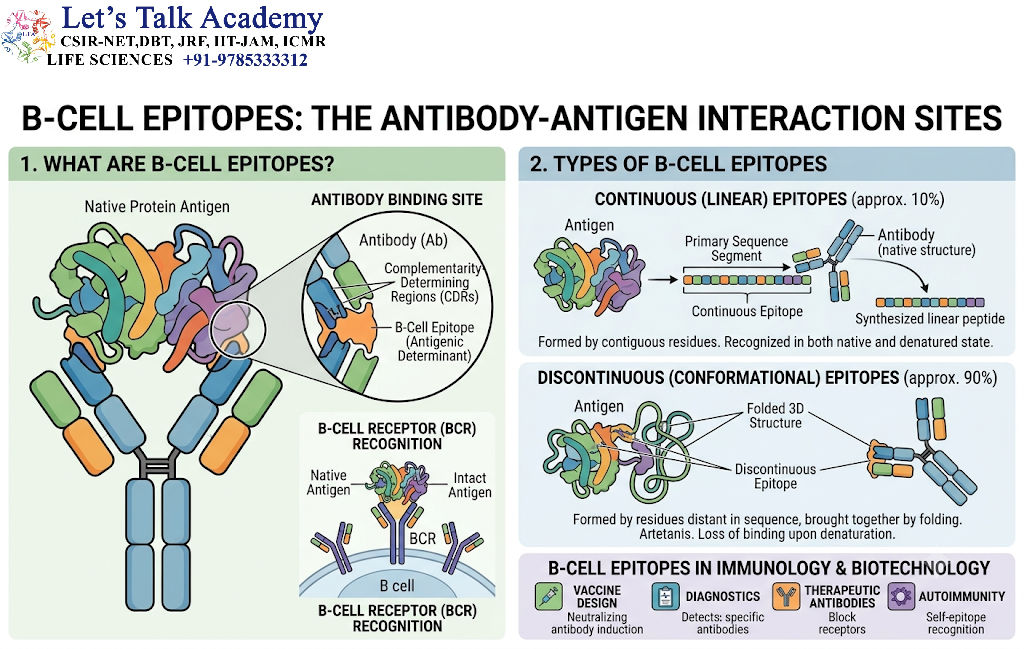
A B-cell epitope is the region of an antigen that is recognized directly by a B-cell receptor or antibody.
B-cell recognition does not normally require the antigen to first be processed and presented by MHC molecules.
The B-cell receptor binds directly to the three-dimensional molecular structure of the antigen.
General Process
Antigen → BCR recognition → B-cell activation → Clonal expansion → Plasma cells → Antibody production
The antibody produced by the activated B cell can recognize the same or closely related epitope.
6. Structural Characteristics of B-Cell Epitopes
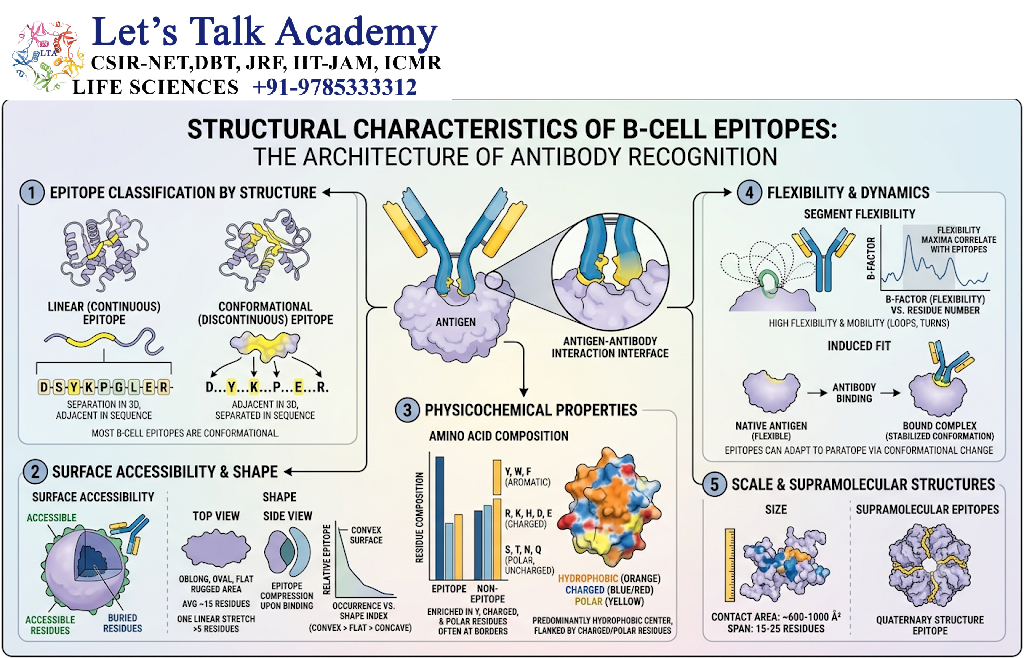
B-cell epitopes can be:
- Linear
- Conformational
Their accessibility to antibodies is an important factor.
An epitope buried inside a folded protein may not be accessible to an antibody, whereas an exposed region on the molecular surface can be readily recognized.
Important properties include:
- Surface accessibility
- Hydrophilicity
- Flexibility
- Molecular shape
- Charge
- Amino-acid composition
7. Linear B-Cell Epitopes
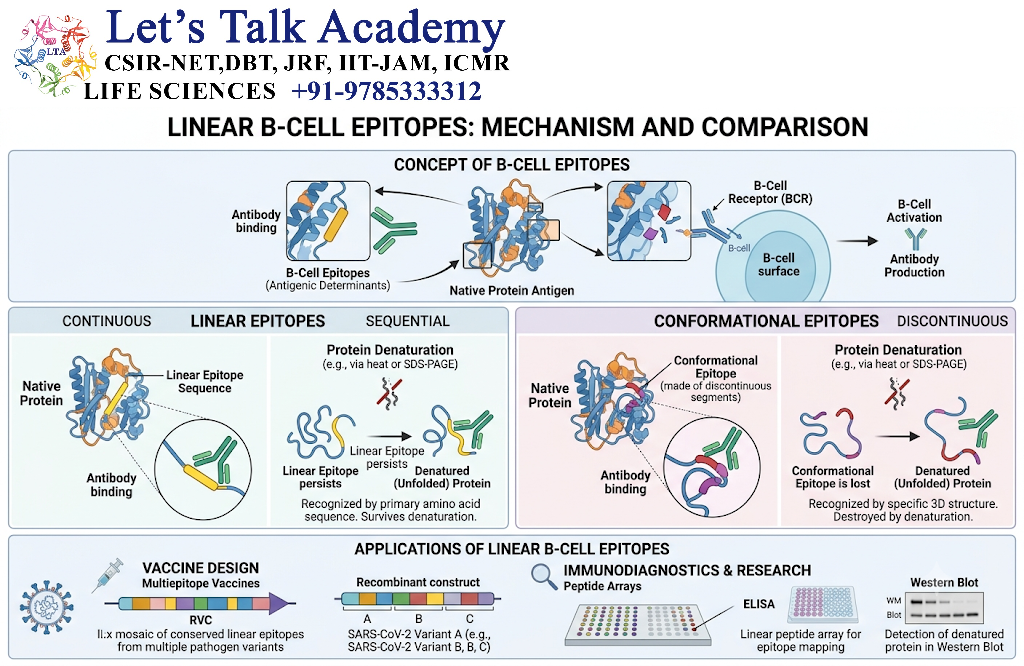
A linear epitope consists of a continuous sequence of amino acids in a protein.
For example:
A–B–C–D–E–F–G
A particular continuous segment may act as an epitope.
The amino acids responsible for recognition are therefore close together in the primary sequence.
Characteristics
- Continuous amino-acid sequence
- May remain recognizable after protein denaturation
- Can sometimes be represented by synthetic peptides
- Useful in peptide-based immunological studies
However, not every exposed peptide sequence becomes an effective B-cell epitope.
8. Conformational B-Cell Epitopes
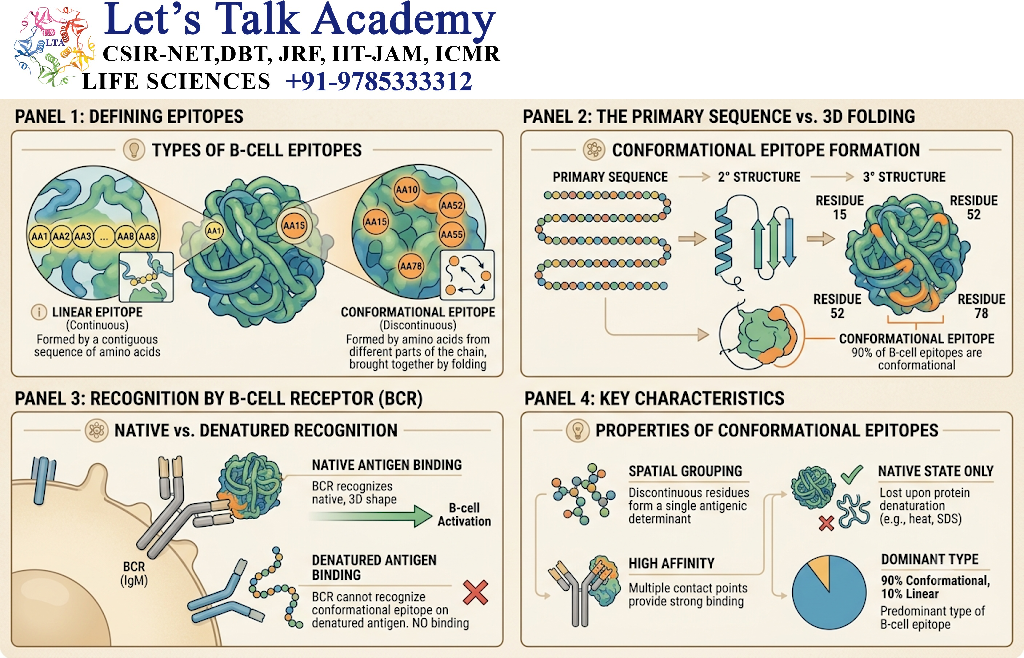
A conformational epitope is formed by amino acids that may be distant from one another in the primary sequence but become close together when the protein folds into its three-dimensional structure.
For example:
Primary sequence:
A—B—C—D—E—F—G—H— I—J—K—L
After folding:
A + F + J + L → One three-dimensional epitope
The antibody recognizes the spatial arrangement of these residues rather than simply their linear sequence.
9. Linear vs Conformational B-Cell Epitopes
| Feature | Linear Epitope | Conformational Epitope |
|---|---|---|
| Sequence | Continuous | Discontinuous |
| Structure | Mainly dependent on primary sequence | Dependent strongly on 3D structure |
| Protein folding | Less dependent | Highly important |
| Denaturation | May remain recognizable | Often disrupted |
| Antibody recognition | Based on continuous region | Based on spatial arrangement |
| Peptide representation | Often possible | Usually more difficult |
10. B-Cell Receptor Recognition
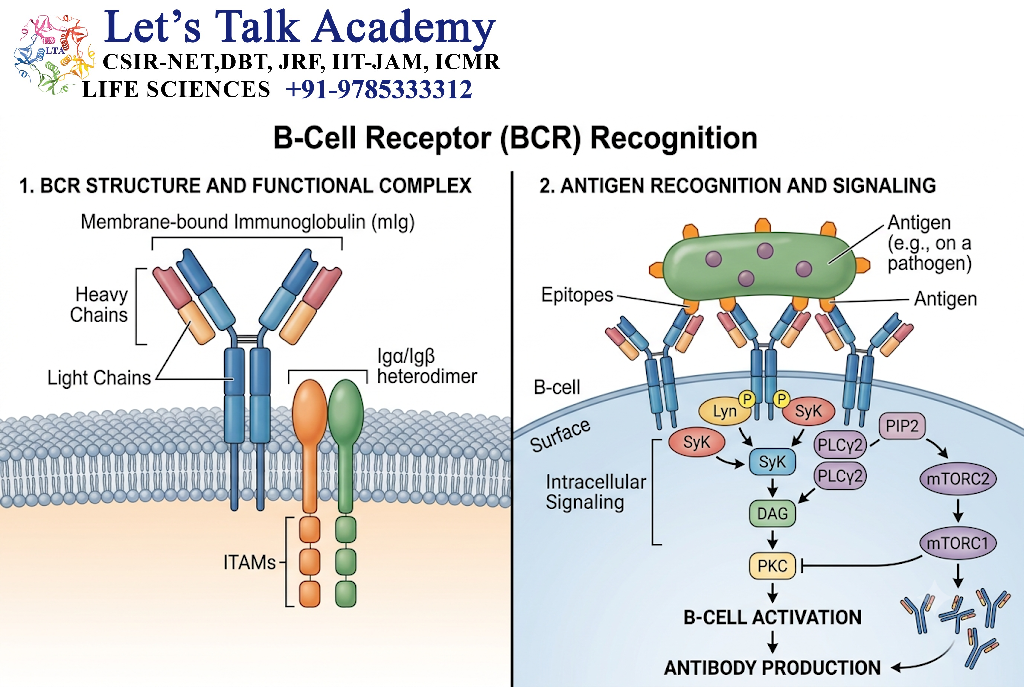
The B-cell receptor is a membrane-bound immunoglobulin associated with signaling proteins.
When an epitope binds to the BCR:
Epitope binding → BCR cross-linking/signaling → B-cell activation
Additional signals may be required for strong activation, particularly for many protein antigens.
Activated B cells can differentiate into:
- Plasma cells
- Memory B cells
Plasma cells produce antibodies, while memory B cells provide long-term immunological memory.
11. Antibody-Epitope Interaction
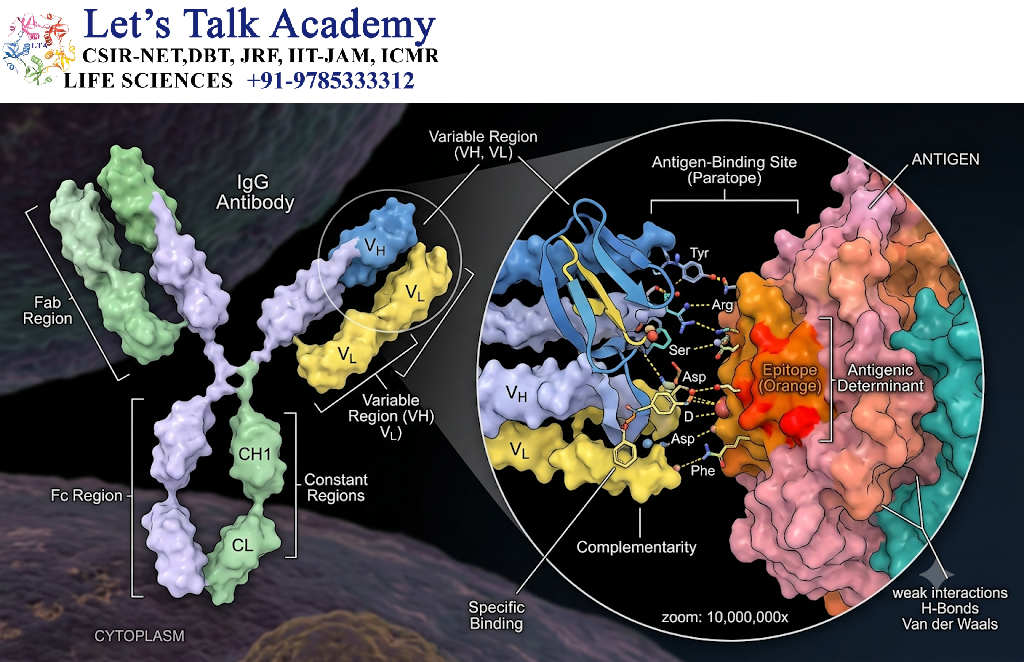
Antibodies recognize epitopes through non-covalent interactions.
These include:
- Hydrogen bonds
- Electrostatic interactions
- Hydrophobic interactions
- Van der Waals forces
The antibody-binding region contains complementary structural features that interact with the epitope.
The antibody-binding site is commonly called the paratope, while the corresponding antigenic region is the epitope.
Relationship
Epitope ↔ Paratope
This interaction determines the specificity of antibody binding.
12. T-Cell Epitopes
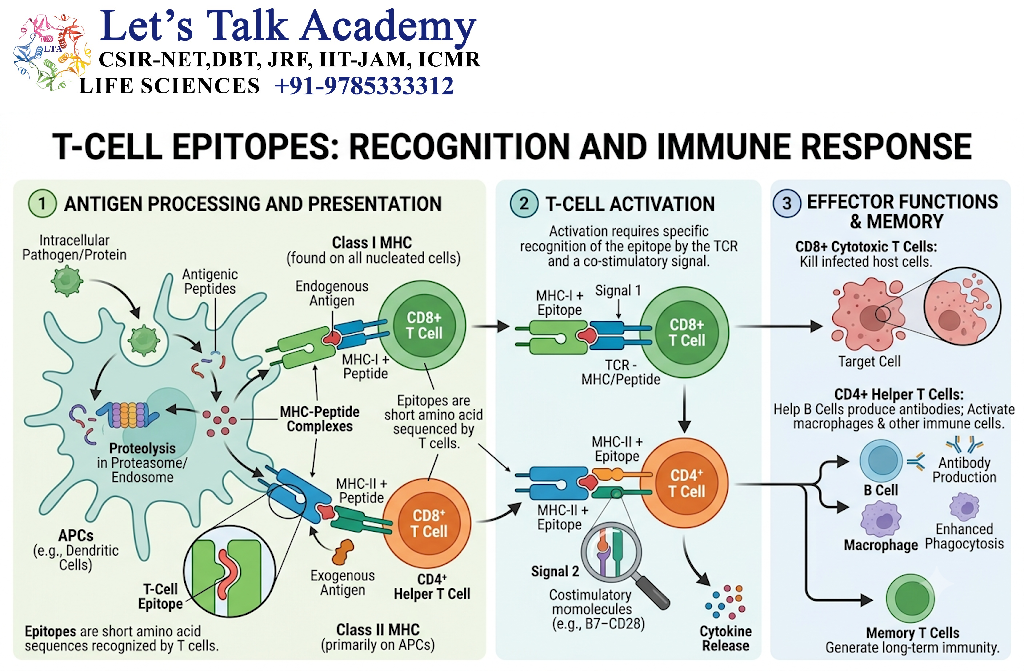
A T-cell epitope is generally a peptide fragment derived from an antigen that is presented by an MHC molecule and recognized by a T-cell receptor.
Unlike B cells, T cells generally do not recognize intact proteins directly.
The general process is:
Protein antigen → Antigen processing → Peptide generation → MHC binding → Cell-surface presentation → TCR recognition
This distinction is fundamental to adaptive immune recognition.
13. Antigen Processing for T-Cell Recognition
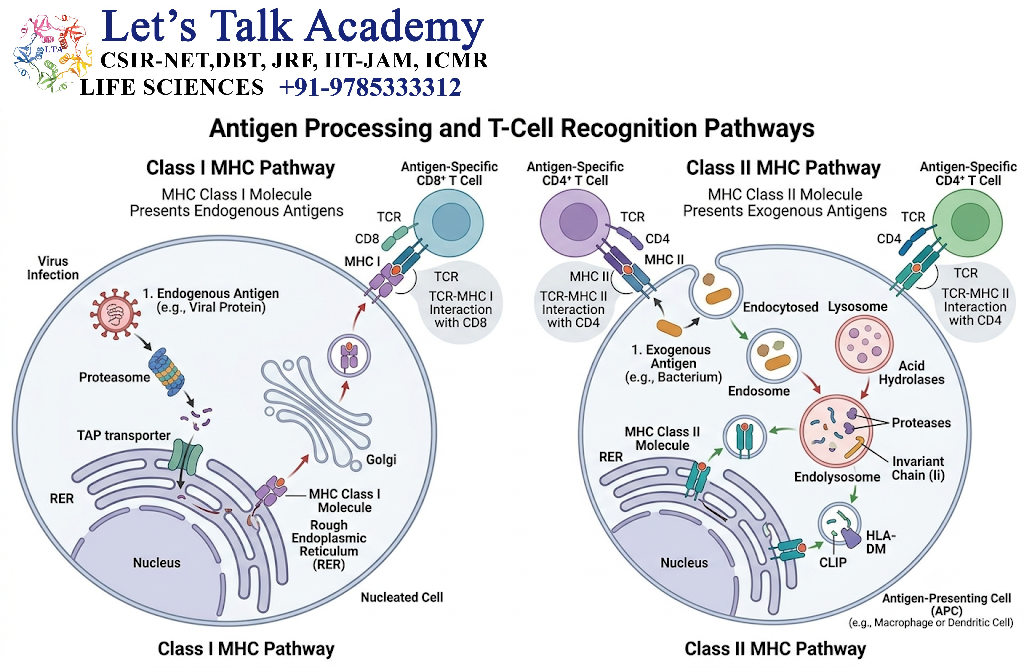
Proteins must usually be degraded into smaller peptides before they can be presented to T cells.
Proteolytic enzymes generate peptide fragments.
These peptides are then loaded onto MHC molecules.
The peptide-MHC complex is transported or displayed on the cell surface where it can be recognized by T cells.
14. MHC Class I and T-Cell Epitopes
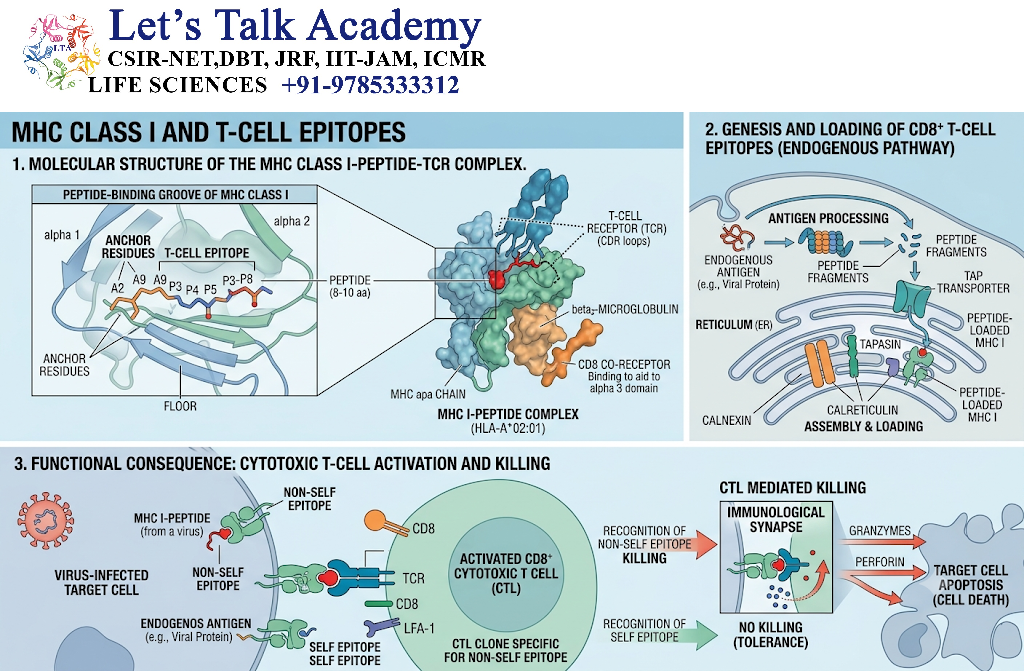
MHC class I molecules generally present peptides derived from proteins produced within cells.
These may include proteins from:
- Viruses replicating inside cells
- Abnormal cellular proteins
- Normal intracellular proteins
MHC class I molecules are primarily recognized by CD8⁺ cytotoxic T cells.
Simplified Pathway
Intracellular protein → Proteasomal processing → Peptide → MHC-I → Cell surface → CD8⁺ T cell recognition
15. MHC Class II and T-Cell Epitopes
MHC class II molecules generally present peptides derived from extracellular proteins that have been taken up by antigen-presenting cells.
These antigens are processed in endosomal/lysosomal compartments.
MHC class II molecules are primarily recognized by CD4⁺ helper T cells.
Simplified Pathway
Extracellular antigen → Endocytosis/phagocytosis → Endosomal processing → Peptide → MHC-II → Cell surface → CD4⁺ T cell recognition
16. T-Cell Receptor Recognition
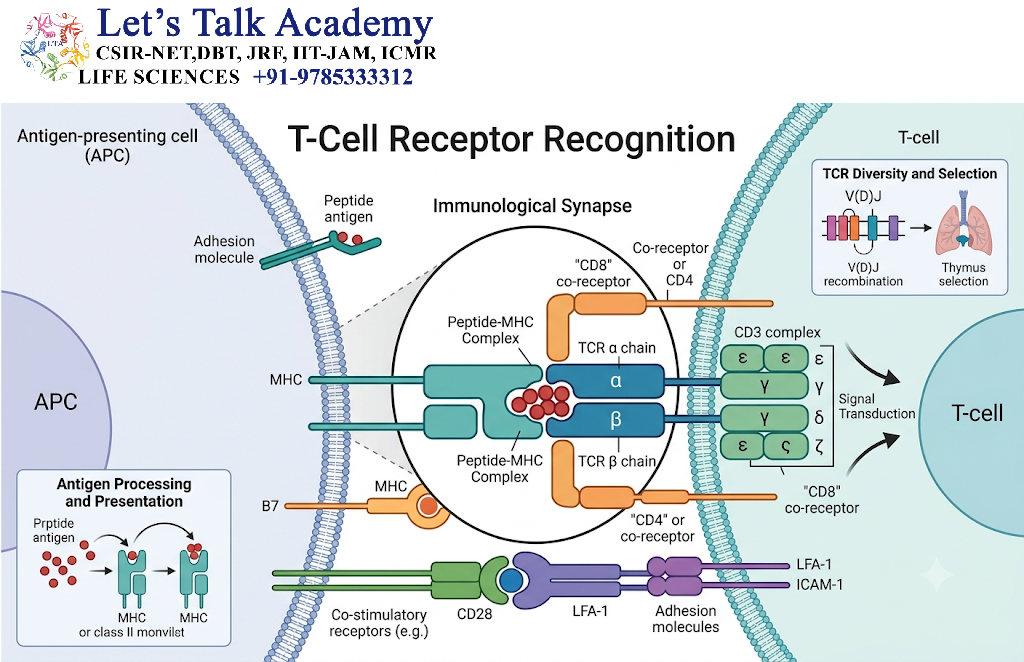
The T-cell receptor recognizes a combination of:
Peptide + MHC molecule
Therefore, a T-cell epitope cannot generally be considered independently of its MHC presentation context.
The TCR interacts with both the peptide and portions of the MHC molecule.
This differs fundamentally from B-cell recognition of intact antigen.
17. B-Cell vs T-Cell Epitope Recognition
| Feature | B-Cell Epitope | T-Cell Epitope |
|---|---|---|
| Recognized by | BCR/antibody | TCR |
| Antigen form | Usually intact antigen | Processed peptide |
| MHC requirement | Not required for direct epitope binding | Usually required |
| Structural dependence | Can be linear or conformational | Generally peptide sequence and MHC binding dependent |
| Recognition site | Surface of antigen | Peptide-MHC complex |
| Main outcome | Antibody response | T-cell activation |
18. Size of T-Cell Epitopes
T-cell epitopes are usually short peptides.
The exact length depends on:
- MHC class
- Species
- MHC allele
- Peptide-binding groove
- Peptide sequence
MHC class I commonly presents relatively short peptides, whereas MHC class II can accommodate longer peptide sequences.
The actual TCR-contacting region may be only part of the presented peptide.
19. MHC Binding and Epitope Selection
Not every peptide generated during antigen processing becomes a T-cell epitope.
For a peptide to be presented effectively, it generally needs to:
- Be generated during antigen processing
- Reach the appropriate antigen-presentation pathway
- Bind an available MHC molecule
- Be transported to the cell surface
- Be recognized by a compatible T-cell receptor
Therefore:
Protein sequence ≠ automatically a T-cell epitope
MHC binding is a major determinant of which peptide fragments can participate in T-cell recognition.
20. MHC Restriction
T-cell recognition is described as MHC-restricted because the T-cell receptor recognizes antigenic peptide in association with an appropriate MHC molecule.
For example:
CD8⁺ T cell → Peptide-MHC I
CD4⁺ T cell → Peptide-MHC II
This provides specificity to T-cell antigen recognition.
21. Antigenic Determinants and Immune Dominance
An antigen can contain many potential epitopes, but immune responses may focus strongly on only a subset.
Such epitopes can become immunodominant.
Immunodominance can be influenced by:
- Antigen processing
- MHC binding
- TCR availability
- Epitope abundance
- Competition among peptides
- B-cell receptor affinity
- Antigen structure
Thus, the presence of an epitope does not necessarily mean that it will generate the strongest immune response.
22. Epitope Accessibility
Accessibility is particularly important for B-cell recognition.
An antibody cannot efficiently recognize a region that is physically inaccessible.
Factors affecting accessibility include:
- Protein folding
- Glycosylation
- Molecular interactions
- Membrane localization
- Protein complexes
- Structural flexibility
A surface-exposed region is generally more accessible than a buried internal region.
23. Epitope Affinity and Specificity
The interaction between an immune receptor and an epitope is influenced by molecular complementarity.
Two related epitopes may be recognized differently because of differences in:
- Amino-acid sequence
- Charge
- Shape
- Hydrophobicity
- Conformation
High-affinity interactions generally result from favorable molecular complementarity.
24. Cross-Reactive Epitopes
Sometimes antibodies or T cells generated against one antigen can recognize a structurally similar epitope on another antigen.
This is known as cross-reactivity.
Cross-reactivity may occur when different antigens share:
- Similar amino-acid sequences
- Similar structural motifs
- Similar chemical groups
Cross-reactivity can contribute to protective immunity but may also participate in some immune-mediated diseases.
25. Epitope Spreading
During some chronic immune responses, the immune response can gradually expand from an initial epitope to additional epitopes within the same antigen or different related antigens.
This phenomenon is called epitope spreading.
It can occur when:
- Initial tissue damage releases additional antigenic material.
- New antigenic regions become available.
- Additional B-cell and T-cell populations are activated.
Epitope spreading has been studied in several chronic inflammatory and autoimmune conditions.
26. B-Cell Epitope Mapping
B-cell epitope mapping identifies regions of an antigen recognized by antibodies.
Approaches include:
- Synthetic peptide arrays
- Overlapping peptides
- Mutational analysis
- Antibody-binding assays
- Structural analysis
- Computational prediction
Basic Strategy
Antigen → Generate fragments → Test antibody binding → Identify reactive region
27. T-Cell Epitope Mapping
T-cell epitope mapping identifies peptide sequences capable of stimulating specific T cells.
Methods can involve:
- Overlapping peptide libraries
- MHC-binding assays
- T-cell activation assays
- Cytokine-release assays
- Tetramer-based detection
- Computational prediction followed by experimental validation
The goal is to determine which peptide sequences are presented and recognized by T cells.
28. Computational Epitope Prediction
Bioinformatics can be used to predict potential epitopes.
For B-cell epitopes, algorithms may consider:
- Surface accessibility
- Hydrophilicity
- Flexibility
- Amino-acid composition
- Structural information
For T-cell epitopes, prediction commonly focuses on:
- MHC-binding affinity
- Peptide sequence
- Processing likelihood
- Presentation probability
Computational predictions are useful for narrowing experimental targets but generally require experimental validation.
29. Role of Epitopes in Vaccines
Epitope-based vaccine strategies aim to stimulate immune responses against selected antigenic regions.
Potential advantages include:
- Targeted immune responses
- Reduced inclusion of unnecessary antigenic regions
- Ability to combine multiple epitopes
- Potential for precise immune targeting
However, epitope-based vaccine design must consider:
- MHC diversity
- Population variation
- Epitope conservation
- Antigen processing
- Structural stability
- Immunogenicity
- Potential unwanted immune responses
30. B-Cell Epitopes in Antibody-Based Diagnostics
Specific antibodies can be used to detect antigenic molecules.
If an antibody recognizes a particular epitope, it can be used in techniques such as:
- ELISA
- Western blotting
- Immunohistochemistry
- Immunofluorescence
- Immunoprecipitation
The specificity of the antibody-epitope interaction is central to these methods.
31. T-Cell Epitopes and Cellular Immunity
T-cell epitopes are essential for cellular immune responses.
CD8⁺ T Cells
CD8⁺ T cells recognize peptide-MHC I complexes and can destroy infected or abnormal cells.
CD4⁺ T Cells
CD4⁺ T cells recognize peptide-MHC II complexes and regulate immune responses through cytokines and interactions with other immune cells.
Thus:
T-cell epitope recognition → T-cell activation → Cellular immune response
32. Epitope Recognition and Immune Memory
After activation, some B and T cells differentiate into memory cells.
Memory cells respond more efficiently during subsequent exposure to the same or related antigenic determinants.
Therefore:
Epitope recognition → Lymphocyte activation → Clonal expansion → Effector cells + Memory cells
The persistence of memory populations contributes to long-term adaptive immunity.
33. Epitope Variation
Pathogens can undergo genetic changes that alter epitope sequences.
Mutations may:
- Reduce antibody binding
- Alter T-cell recognition
- Affect MHC binding
- Create new epitopes
- Change immune dominance
However, the biological effect of a mutation depends on its location and molecular consequences.
34. B-Cell and T-Cell Epitope Cooperation
Effective immune responses often involve cooperation between B cells and T cells.
A protein antigen can contain:
- A B-cell epitope recognized by a B cell
- A T-cell epitope presented to a helper T cell
In a typical T-dependent antibody response:
B cell binds antigen through BCR
↓
Antigen is internalized and processed
↓
Peptide is presented on MHC-II
↓
CD4⁺ helper T cell recognizes peptide-MHC-II
↓
T-cell help is provided
↓
B-cell proliferation and differentiation
↓
Plasma cells + Memory B cells
This cooperation is particularly important for strong and durable antibody responses to many protein antigens.
35. Integrated Comparison of B-Cell and T-Cell Epitopes
| Feature | B-Cell Epitope | T-Cell Epitope |
|---|---|---|
| Primary receptor | BCR/antibody | TCR |
| Antigen recognized | Usually intact antigen | Processed peptide |
| MHC requirement | No direct requirement | Required for conventional T-cell recognition |
| Structure | Linear or conformational | Primarily peptide sequence presented by MHC |
| Recognition location | Antigen surface | MHC-peptide complex |
| Main immune outcome | Antibody production | T-cell activation |
| Structural dependence | Often strongly influenced by 3D structure | Strongly influenced by peptide sequence and MHC binding |
| Mapping methods | Peptide arrays, structural studies | Peptide libraries, MHC assays, T-cell assays |
| Major immune role | Humoral immunity | Cellular immunity and T-cell help |
36. Integrated Flowchart
Antigen enters the body
↓
Antigen contains multiple epitopes
↙︎ ↘︎
B-cell epitope T-cell epitope
↓
BCR/antibody recognition
↓
B-cell activation
↓
Plasma cells + Memory B cells
↓
Antibody response
For T-cell pathway:
Antigen processing
↓
Peptide generation
↓
MHC loading
↓
Peptide-MHC complex
↓
TCR recognition
↓
CD4⁺ or CD8⁺ T-cell activation
↓
Cellular immune response + Memory T cells
37. Biological Significance of Epitopes
Epitopes are fundamental to adaptive immunity because they determine the specificity of antigen recognition.
They are important in:
- Antibody production
- T-cell activation
- Immune memory
- Vaccine development
- Diagnostic assays
- Infectious disease research
- Autoimmunity research
- Transplantation studies
- Cancer immunology
- Immunological biotechnology
The concept of epitopes provides a molecular explanation for why the immune system can distinguish highly similar molecules.
38. Key Terms
| Term | Definition |
|---|---|
| Epitope | Specific antigenic region recognized by an immune receptor |
| Antigen | Molecule capable of being recognized by the immune system |
| B-cell epitope | Region recognized by BCR or antibody |
| T-cell epitope | Peptide recognized by TCR in association with MHC |
| Linear epitope | Continuous antigenic sequence |
| Conformational epitope | Epitope formed by spatially separated residues brought together by folding |
| Paratope | Antigen-binding region of an antibody or BCR |
| BCR | B-cell receptor |
| TCR | T-cell receptor |
| MHC | Major histocompatibility complex |
| Immunodominance | Preferential immune recognition of particular epitopes |
| Cross-reactivity | Recognition of similar epitopes by the same immune receptor |
| Epitope spreading | Expansion of immune recognition to additional epitopes |


