
1. Introduction
DNA replication is a highly coordinated molecular process in which an existing DNA molecule is accurately copied to produce two daughter DNA molecules. The process requires several enzymes and accessory proteins that work together in a specific sequence.
No single enzyme can complete DNA replication alone. Different enzymes perform specialized functions such as:
- Unwinding the DNA double helix
- Removing torsional stress
- Synthesizing RNA primers
- Synthesizing new DNA
- Proofreading newly synthesized DNA
- Removing RNA primers
- Joining DNA fragments
- Maintaining chromosome ends
The major enzymes involved in DNA replication include helicase, primase, DNA polymerases, topoisomerases, nucleases, DNA ligase, and telomerase.
2. DNA Helicase
2.1 Definition
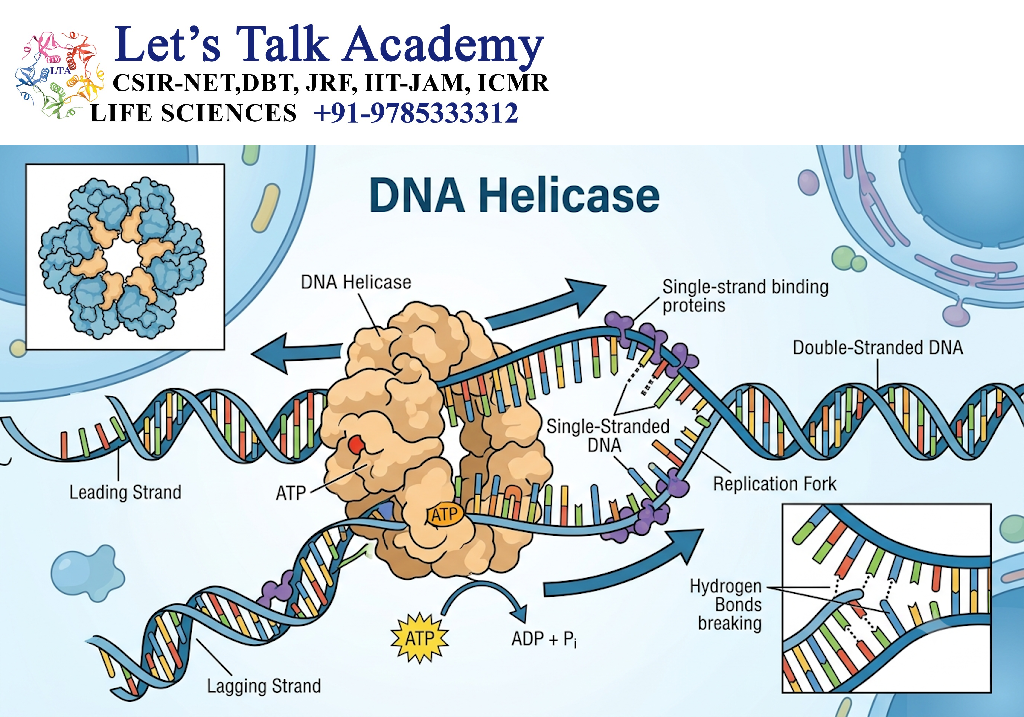
DNA helicase is an enzyme that separates the two complementary strands of double-stranded DNA during replication.
The two DNA strands are held together primarily by hydrogen bonds between complementary bases. Helicase uses energy, generally from ATP hydrolysis, to promote strand separation.
2.2 Function
The major function of helicase is:
Double-stranded DNA → DNA unwinding → Two single-stranded templates
This creates the structure known as the replication fork.
2.3 Importance
Helicase is essential because DNA polymerase requires a single-stranded DNA template to synthesize a new complementary strand.
2.4 Examples
In Escherichia coli, DnaB is the principal replicative helicase.
In eukaryotes, the MCM2–7 complex forms the catalytic core of the replicative helicase within the active CMG complex.
3. DNA Topoisomerases
3.1 Definition
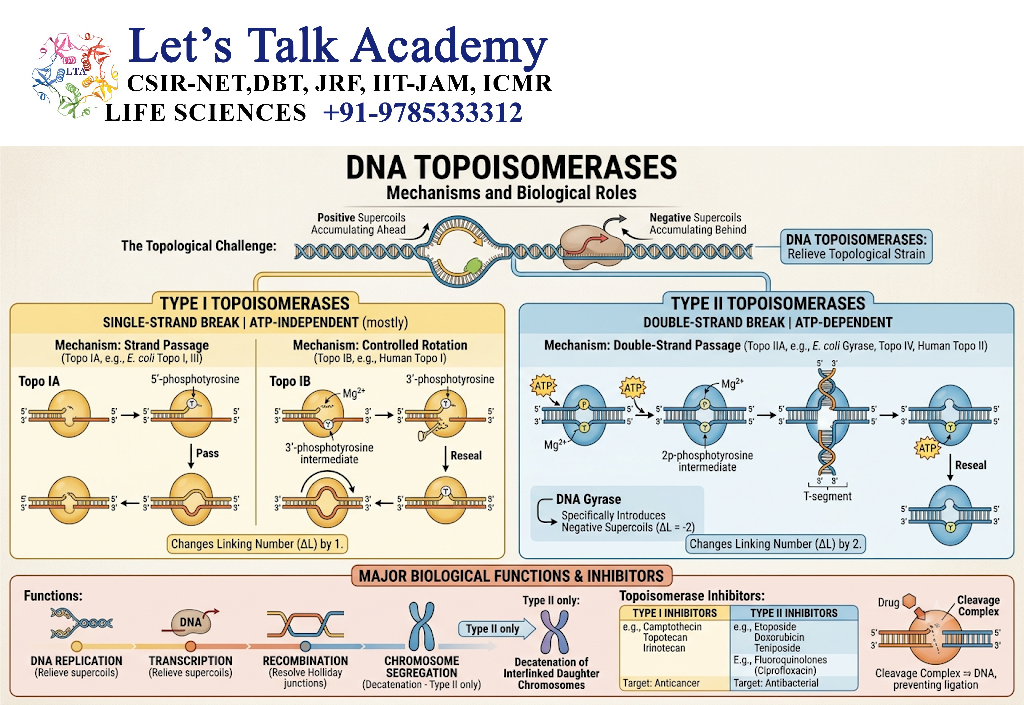
Topoisomerases are enzymes that control the topological state of DNA.
When helicase unwinds DNA, torsional stress develops in the DNA molecule ahead of the replication fork. If this stress is not relieved, replication can become difficult or stall.
3.2 Major Function
Topoisomerases temporarily break DNA strands, allow the DNA topology to change, and then reseal the DNA.
They therefore help prevent excessive:
- Supercoiling
- Torsional stress
- DNA tangling
3.3 Type I Topoisomerases
Type I topoisomerases generally make a transient break in one DNA strand.
They allow controlled rotation or passage of DNA to relieve torsional stress.
3.4 Type II Topoisomerases
Type II topoisomerases temporarily break both DNA strands and pass another DNA segment through the break before resealing it.
They are important in:
- DNA replication
- Chromosome segregation
- Resolution of DNA topological problems
4. DNA Gyrase
4.1 Definition
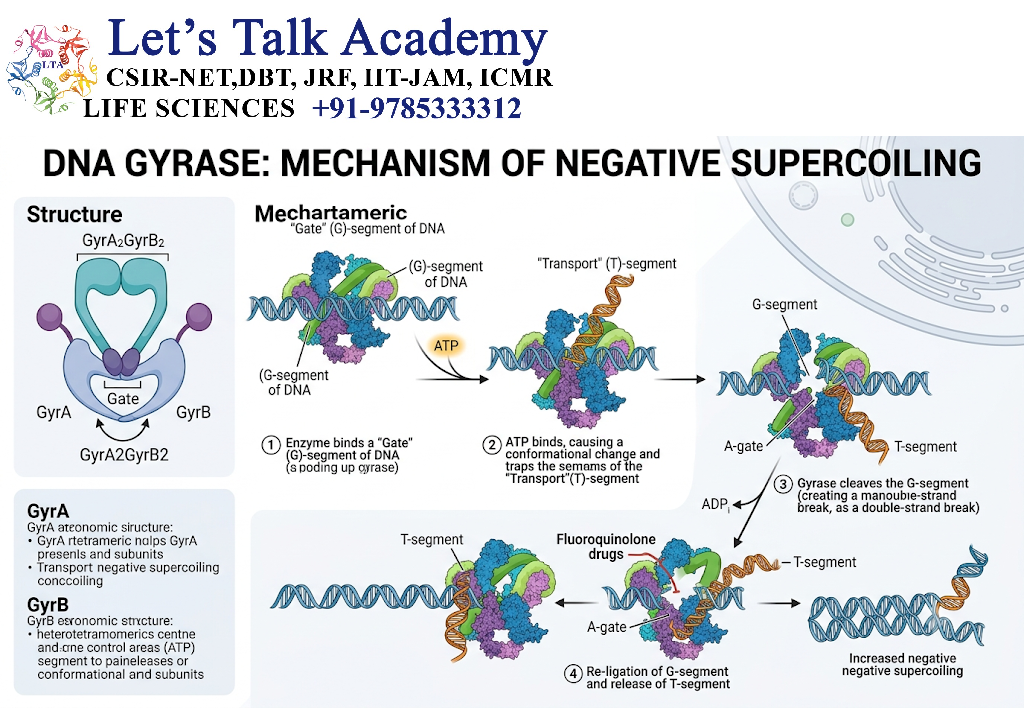
DNA gyrase is a bacterial type II topoisomerase.
It is particularly important in managing DNA topology during replication and transcription.
4.2 Function
DNA gyrase can introduce negative supercoils and remove positive supercoiling generated ahead of the replication fork.
Simplified Process
Helicase unwinds DNA
↓
Positive supercoiling develops
↓
DNA gyrase acts
↓
Torsional stress decreases
↓
Replication can continue efficiently
4.3 Biological Significance
DNA gyrase is an important bacterial enzyme and is also a target of certain antibacterial drugs.
5. Primase
5.1 Definition
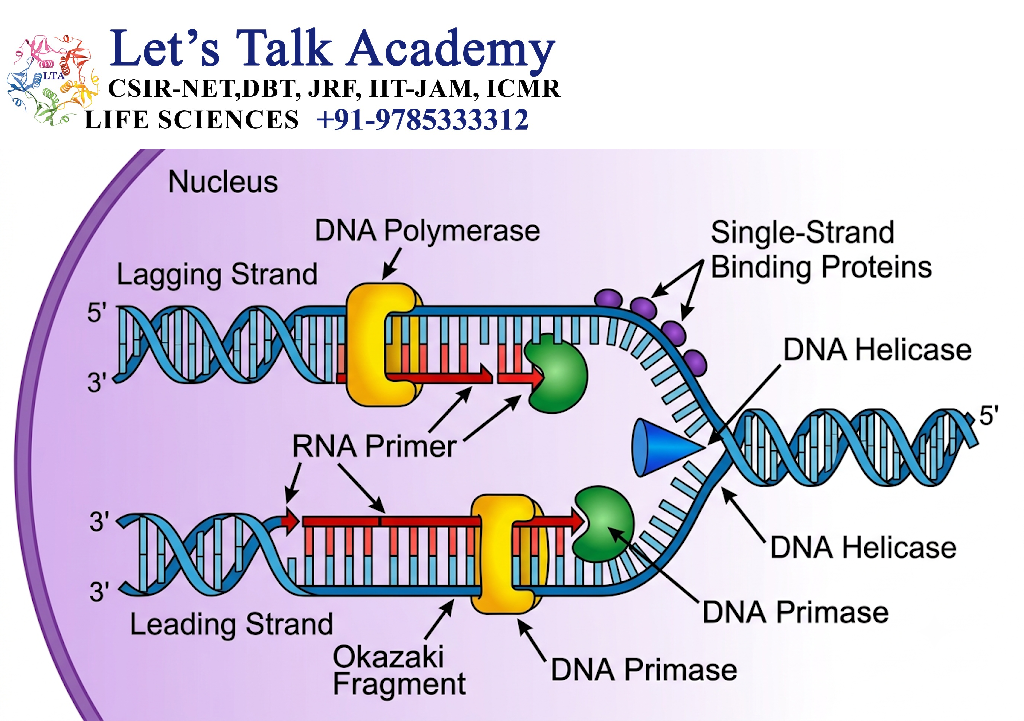
Primase is an enzyme that synthesizes a short RNA primer using the DNA template as a guide.
5.2 Why Is Primase Necessary?
DNA polymerase cannot begin DNA synthesis de novo. It requires a pre-existing free 3′-OH group.
Primase provides this starting point by synthesizing an RNA primer.
General Process
DNA template
↓
Primase
↓
RNA primer
↓
DNA polymerase
↓
New DNA strand
5.3 Primase on the Leading Strand
A primer is required to initiate synthesis of the leading strand.
5.4 Primase on the Lagging Strand
The lagging strand is synthesized discontinuously, so multiple RNA primers are required.
Each primer initiates synthesis of an Okazaki fragment.
6. DNA Polymerases
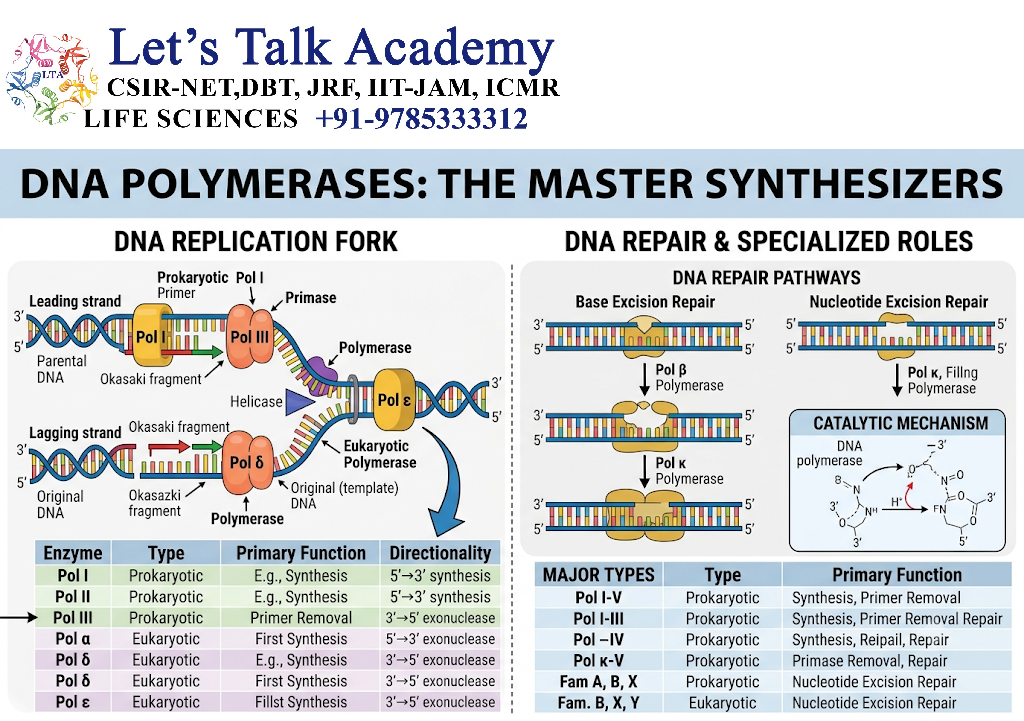
6.1 Definition
DNA polymerases are enzymes that synthesize DNA by adding deoxyribonucleotides to the 3′ end of a growing DNA strand.
DNA synthesis occurs in the:
5′ → 3′ direction
6.2 Substrates of DNA Polymerase
DNA polymerases use the four major deoxyribonucleoside triphosphates:
- dATP
- dTTP
- dGTP
- dCTP
6.3 General Reaction
Growing DNA strand + dNTP → Extended DNA strand + PPi
The incoming nucleotide is selected according to complementary base pairing.
A pairs with T
G pairs with C
6.4 Important Properties
DNA polymerases generally have:
- Template dependence
- Primer dependence
- 5′ → 3′ polymerization
- High fidelity
- Proofreading ability in many replicative polymerases
7. DNA Polymerase III
7.1 Definition
In bacteria such as E. coli, DNA polymerase III holoenzyme is the major enzyme complex responsible for chromosomal DNA replication.
7.2 Functions
DNA polymerase III is responsible for:
- Leading-strand synthesis
- Lagging-strand synthesis
- Rapid DNA polymerization
- High processivity
- Proofreading
7.3 Proofreading
The polymerase has a 3′ → 5′ exonuclease activity that can remove incorrectly incorporated nucleotides.
Process
Incorrect nucleotide incorporated
↓
Polymerase detects mismatch
↓
Incorrect nucleotide removed
↓
Correct nucleotide inserted
This greatly increases replication fidelity.
8. DNA Polymerase I
8.1 Definition
DNA polymerase I is an important bacterial DNA polymerase involved in DNA repair and processing of replication intermediates.
8.2 Major Functions
In E. coli, DNA polymerase I has:
- 5′ → 3′ polymerase activity
- 3′ → 5′ proofreading exonuclease activity
- 5′ → 3′ exonuclease activity
8.3 Role in Okazaki Fragment Processing
DNA polymerase I can remove RNA primers and replace them with DNA.
Process
RNA primer
↓
Primer removal
↓
DNA synthesis
↓
Remaining nick
↓
DNA ligase
9. Eukaryotic DNA Polymerases
Eukaryotic cells contain multiple specialized DNA polymerases.
Important examples include:
| Polymerase | Major Role |
|---|---|
| DNA polymerase α | Initiation of nuclear DNA replication with primase |
| DNA polymerase δ | Major role in lagging-strand synthesis |
| DNA polymerase ε | Major role in leading-strand synthesis |
| DNA polymerase γ | Mitochondrial DNA replication |
| Specialized polymerases | DNA repair and translesion synthesis |
The exact contribution of individual polymerases can vary depending on the cellular context and organism.
10. Sliding Clamp
10.1 Definition
The sliding clamp is a ring-shaped protein complex that holds DNA polymerase onto DNA.
It is not itself an enzyme, but it is essential for efficient DNA replication.
10.2 Function
The sliding clamp increases the processivity of DNA polymerase.
Processivity refers to the number of nucleotides a polymerase can add before dissociating from its template.
10.3 Examples
- β clamp in bacteria
- PCNA in eukaryotes
11. Clamp Loader
11.1 Definition
A clamp loader is a protein complex that uses ATP to load the sliding clamp onto DNA.
11.2 Function
Clamp loader + ATP
↓
Sliding clamp opened
↓
Clamp placed around DNA
↓
DNA polymerase binds efficiently
This system is particularly important during lagging-strand synthesis, where the polymerase must repeatedly engage new Okazaki fragments.
12. Single-Strand DNA-Binding Proteins
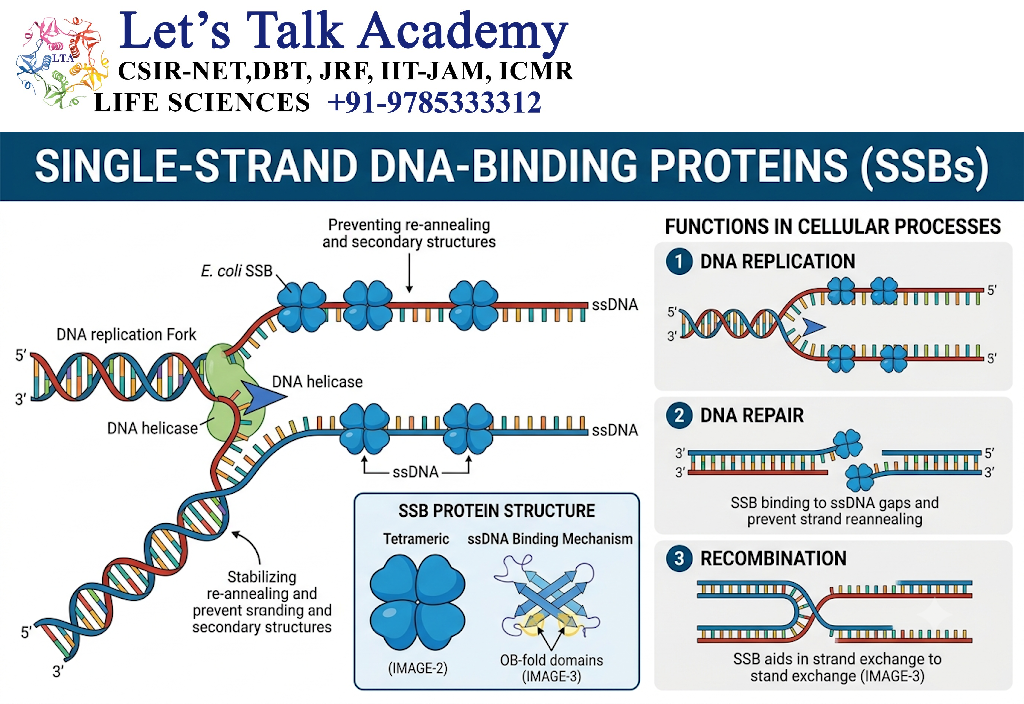
12.1 Definition
Single-strand DNA-binding proteins stabilize DNA after the double helix has been unwound.
Although these proteins are not generally classified as enzymes, they are essential components of the replication machinery.
12.2 Bacterial SSB
In bacteria, single-stranded DNA-binding protein (SSB) binds exposed single-stranded DNA.
12.3 Eukaryotic RPA
In eukaryotes, Replication Protein A (RPA) performs the major single-stranded DNA-binding function.
12.4 Functions
They:
- Prevent reannealing of DNA strands
- Protect single-stranded DNA
- Reduce formation of unwanted secondary structures
- Facilitate replication and repair
13. RNase H
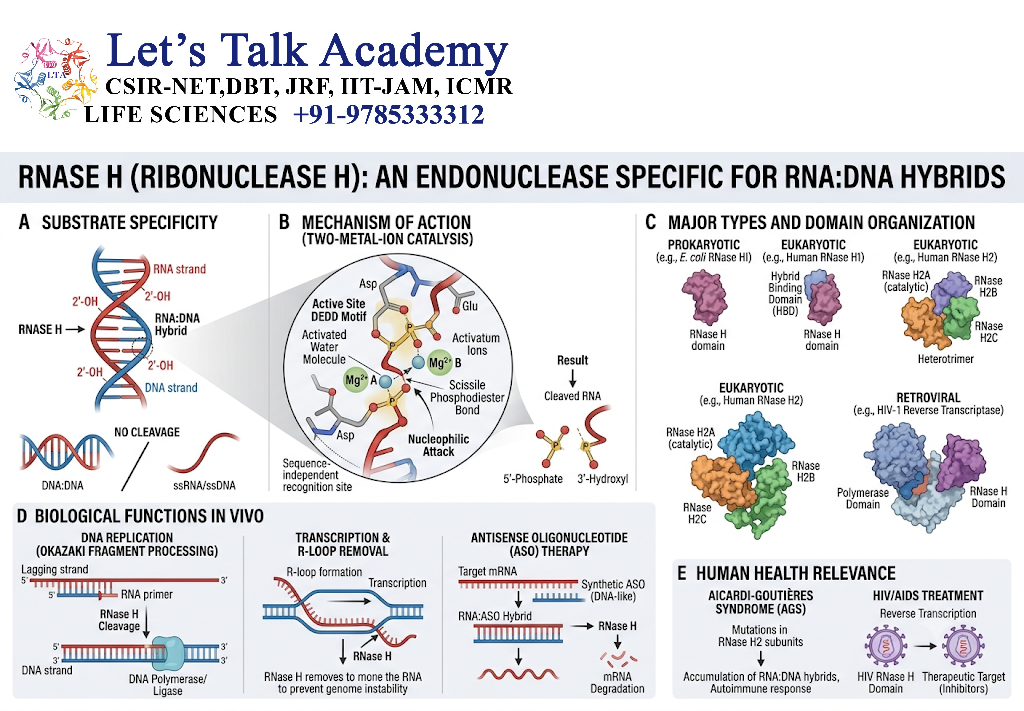
13.1 Definition
RNase H is a nuclease that degrades RNA within RNA-DNA hybrid structures.
13.2 Role in Replication
During DNA replication, RNA primers must eventually be removed.
RNase H participates in primer removal in many organisms and systems.
Process
RNA-DNA hybrid
↓
RNase H activity
↓
RNA portion degraded
↓
DNA polymerase fills the gap
14. Nucleases
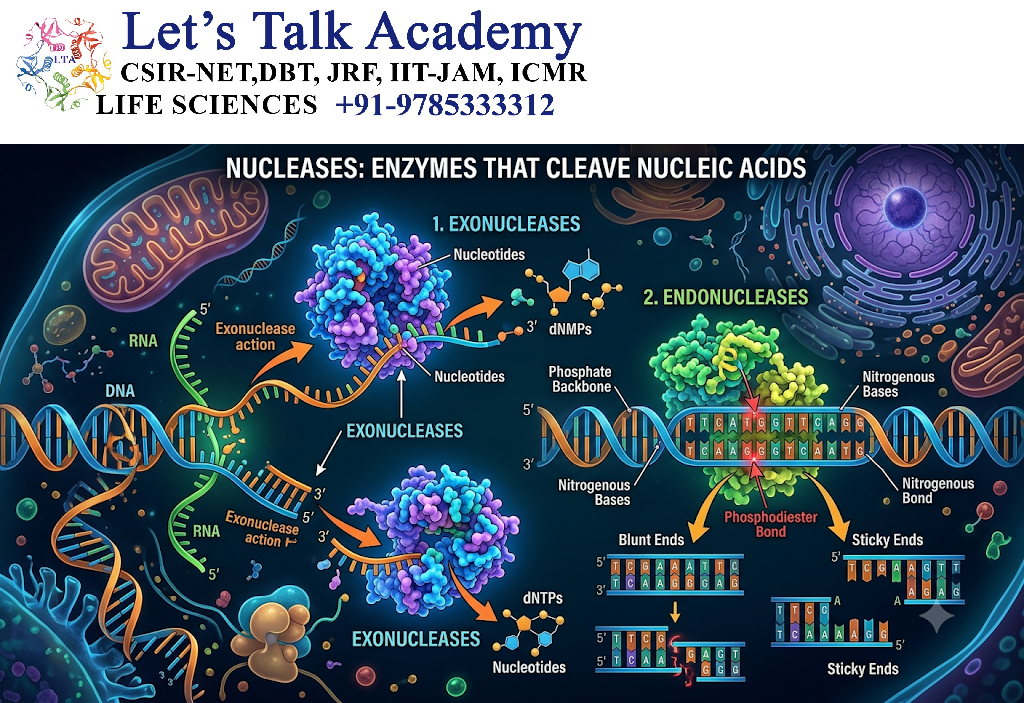
14.1 Definition
Nucleases are enzymes that cleave phosphodiester bonds in nucleic acids.
They are broadly divided into:
- Exonucleases
- Endonucleases
14.2 Exonucleases
Exonucleases remove nucleotides from the ends of nucleic-acid molecules.
14.3 Endonucleases
Endonucleases cleave phosphodiester bonds within a nucleic-acid strand.
14.4 Role in DNA Replication
Nucleases participate in:
- Primer removal
- Proofreading
- DNA repair
- Processing of DNA intermediates
15. DNA Ligase
15.1 Definition
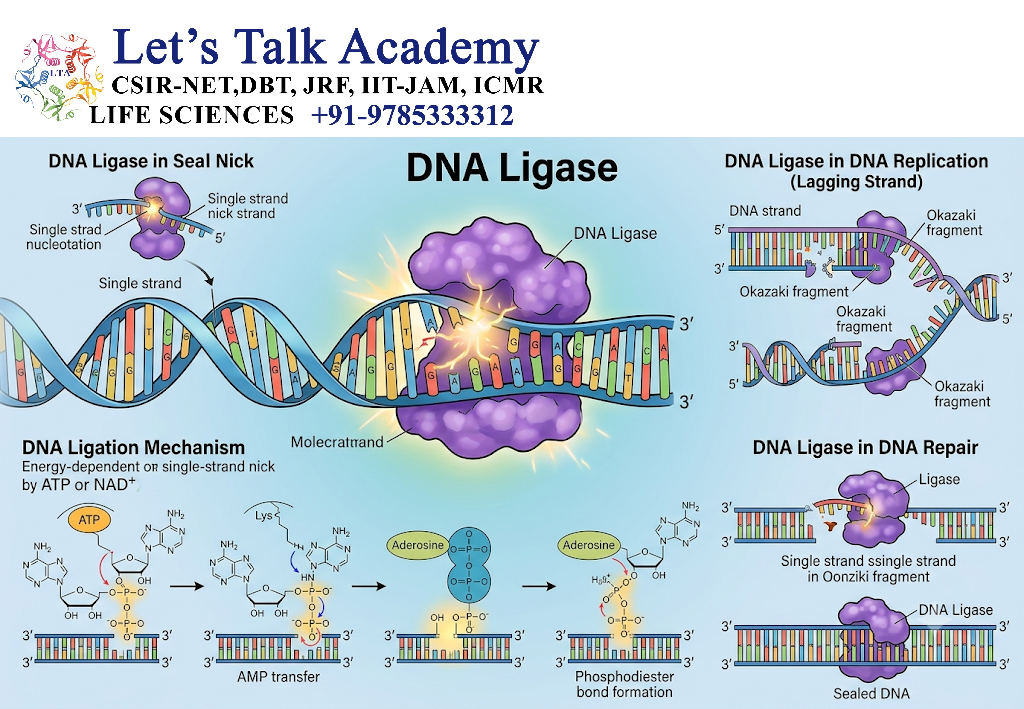
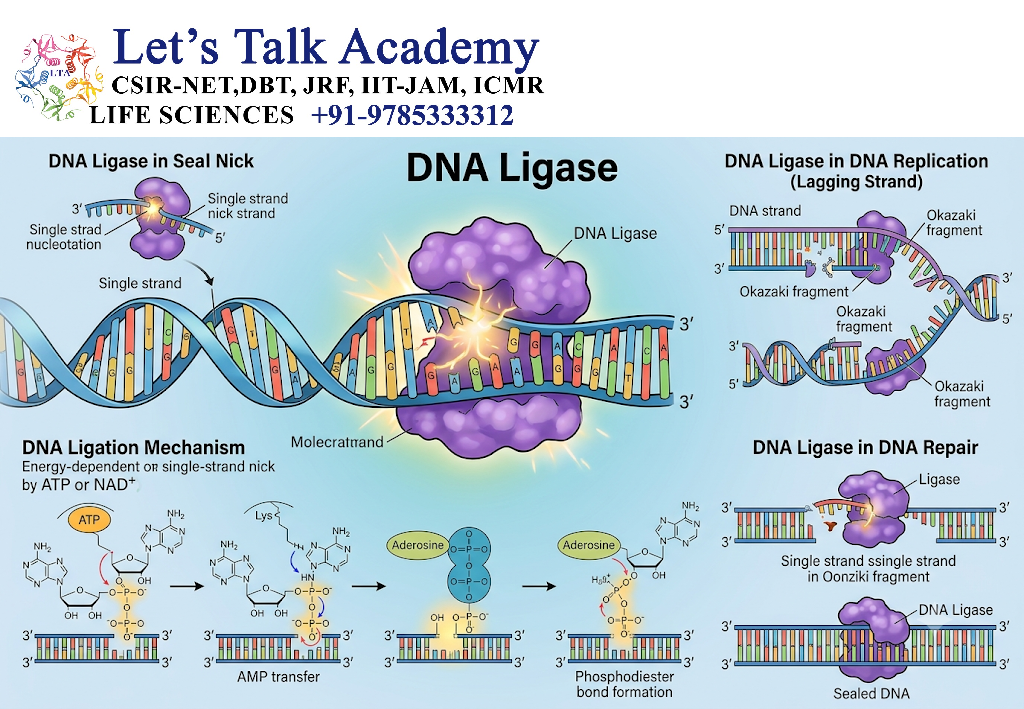
DNA ligase is an enzyme that joins adjacent DNA fragments by sealing breaks or nicks in the DNA backbone.
15.2 Role in Lagging-Strand Synthesis
The lagging strand is initially produced as separate Okazaki fragments.
DNA ligase joins these fragments.
Process
Okazaki fragment 1
↓
Okazaki fragment 2
↓
Primer removal and gap filling
↓
Nick remains
↓
DNA ligase
↓
Continuous DNA strand
15.3 Importance
DNA ligase is essential for producing a continuous DNA strand from discontinuous DNA fragments.
16. Telomerase
16.1 Definition
Telomerase is a specialized ribonucleoprotein enzyme that extends telomeric DNA at the ends of linear chromosomes.
16.2 The End-Replication Problem
DNA polymerases require a primer and synthesize DNA only in the 5′ → 3′ direction.
Because of this, the extreme ends of linear chromosomes cannot be completely replicated by the conventional replication machinery after removal of the final RNA primer.
This is known as the end-replication problem.
16.3 Structure of Telomerase
Telomerase contains:
- A catalytic protein component
- An internal RNA template
The RNA component provides the template used for synthesis of telomeric repeats.
16.4 Function
Telomerase extends the chromosome end, providing additional template DNA that allows completion of the complementary strand.
16.5 Biological Significance
Telomerase activity is particularly important in:
- Germline cells
- Many stem-cell populations
- Certain proliferating cell types
Telomerase is also frequently reactivated in cancer cells, contributing to their ability to maintain telomeres during continued proliferation.
17. Proofreading Enzymatic Activity
17.1 Definition
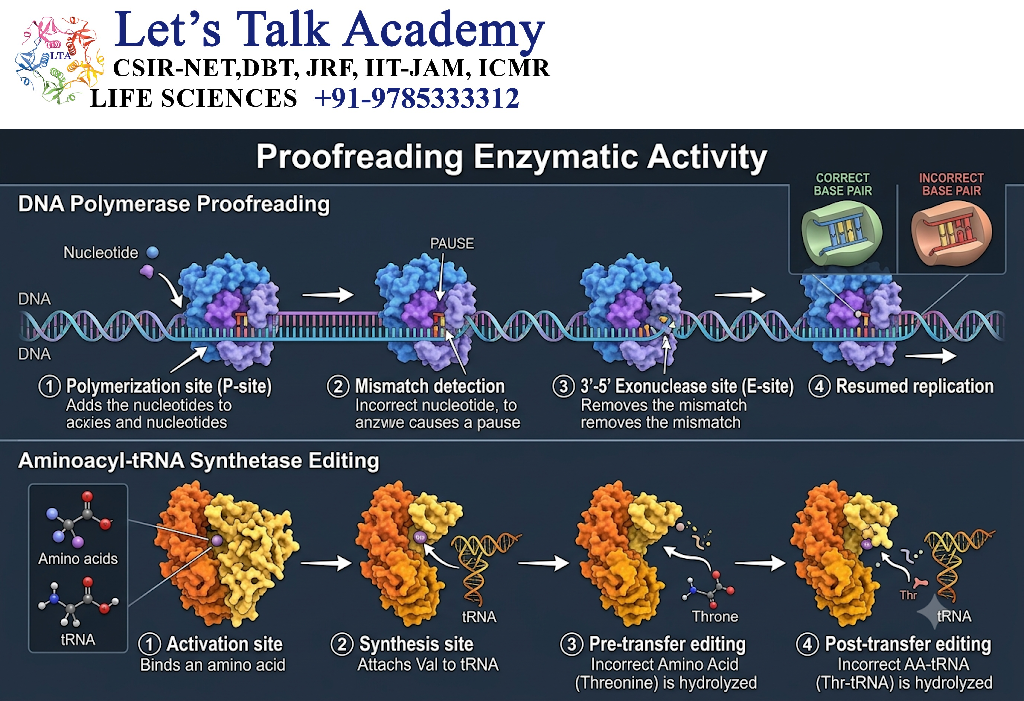
Proofreading is the process through which DNA polymerases detect and remove incorrectly incorporated nucleotides during DNA synthesis.
17.2 3′ → 5′ Exonuclease Activity
Many replicative DNA polymerases possess a 3′ → 5′ exonuclease proofreading function.
Process
DNA synthesis
↓
Incorrect nucleotide added
↓
Polymerase detects mismatch
↓
3′ → 5′ exonuclease removes nucleotide
↓
DNA synthesis resumes
17.3 Importance
Proofreading significantly increases the accuracy of DNA replication and helps maintain genome stability.
18. Enzymes Involved in DNA Replication: Complete Sequence
The enzymes act in a coordinated manner rather than independently.
Step 1: Origin Recognition
Initiation proteins recognize the replication origin.
Step 2: DNA Unwinding
Helicase separates the DNA strands.
Step 3: Removal of Torsional Stress
Topoisomerases relieve supercoiling and torsional stress.
Step 4: Primer Formation
Primase synthesizes RNA primers.
Step 5: DNA Synthesis
DNA polymerases synthesize new DNA.
Step 6: Proofreading
DNA polymerase proofreading activity removes many incorrectly incorporated nucleotides.
Step 7: Primer Removal
RNase H and other nucleases, together with specialized polymerase activities, participate in RNA-primer removal and processing.
Step 8: Gap Filling
A DNA polymerase fills the gaps left after primer removal.
Step 9: Fragment Joining
DNA ligase seals remaining nicks.
Step 10: Chromosome-End Maintenance
In appropriate eukaryotic cells, telomerase maintains telomeric DNA.
19. Enzyme Coordination at the Replication Fork
The replication fork functions as an integrated molecular machine.
Helicase
↓
DNA strands separate
↓
SSB/RPA stabilizes single-stranded DNA
↓
Topoisomerase controls DNA topology
↓
Primase produces primers
↓
DNA polymerase synthesizes DNA
↓
Sliding clamp increases processivity
↓
Nucleases process primers
↓
DNA polymerase fills gaps
↓
DNA ligase seals nicks
This coordination allows rapid and accurate duplication of the genome.
20. Comparison of Major Replication Enzymes
| Enzyme | Main Function | Major Importance |
|---|---|---|
| Helicase | DNA unwinding | Opens DNA duplex |
| Topoisomerase | Controls DNA topology | Relieves torsional stress |
| DNA gyrase | Bacterial topoisomerase | Controls supercoiling |
| Primase | RNA primer synthesis | Provides 3′-OH for polymerase |
| DNA polymerase | DNA synthesis | Builds new DNA |
| RNase H | RNA degradation in RNA-DNA hybrids | Primer processing |
| Nucleases | DNA/RNA cleavage | Processing and repair |
| DNA ligase | DNA joining | Seals nicks |
| Telomerase | Telomere extension | Maintains chromosome ends |
21. Leading and Lagging Strand Enzyme Activity
21.1 Leading Strand
The leading strand is synthesized continuously.
Important components include:
- Helicase
- Primase
- DNA polymerase
- Sliding clamp
- Topoisomerase
21.2 Lagging Strand
The lagging strand is synthesized discontinuously.
It requires repeated:
- Primer synthesis
- DNA synthesis
- Primer removal
- Gap filling
- Fragment joining
Therefore, the lagging strand requires particularly extensive coordination between primase, DNA polymerases, nucleases, and DNA ligase.
22. Bacterial and Eukaryotic Replication Machinery
| Feature | Bacteria | Eukaryotes |
|---|---|---|
| Major replicative polymerase | DNA polymerase III in E. coli | Pol δ and Pol ε |
| Primer synthesis | DnaG primase | Pol α–primase complex |
| Single-strand binding | SSB | RPA |
| Sliding clamp | β clamp | PCNA |
| Main helicase | DnaB | CMG helicase |
| Topology control | DNA gyrase/topoisomerases | Topoisomerases |
| Chromosome ends | Usually circular | Telomeres present |
| Telomerase | Generally not required | Important in specific cell types |
23. Energy Requirements
DNA replication is an energy-dependent process.
ATP or other nucleotide-triphosphate energy sources are used by several components of the replication machinery.
Energy is required for processes such as:
- Helicase activity
- Clamp loading
- DNA synthesis
- DNA ligation
- Topological regulation
DNA synthesis itself is driven by the chemical energy stored in incoming deoxyribonucleoside triphosphates.
24. Fidelity of DNA Replication
The combined action of several enzymes ensures high replication fidelity.
Correct nucleotide selection
↓
DNA polymerization
↓
Polymerase proofreading
↓
Mismatch repair
↓
Accurate genome duplication
Errors that escape these systems can become permanent mutations after subsequent rounds of replication.
25. Replication Stress and Enzymes
Replication may become stalled when the replication machinery encounters:
- DNA damage
- Difficult DNA structures
- DNA-protein complexes
- Limited nucleotide availability
- Conflicts with transcription
Cells respond through checkpoint and DNA-repair pathways.
Enzymes involved in DNA replication and repair cooperate to restart or complete replication while minimizing genomic damage.


