
1. Introduction
The cell cycle is a highly organized sequence of events through which a cell grows, duplicates its genetic material, and divides into two daughter cells. Because DNA replication and chromosome segregation must occur with extraordinary accuracy, cell division cannot be allowed to proceed continuously without supervision.
Cells therefore possess an elaborate regulatory system that coordinates the major events of the cell cycle. This system determines when a cell should divide, when it should pause, and when division should be prevented.
Cell-cycle regulation is particularly important because uncontrolled cell proliferation can lead to abnormal tissue growth and cancer, whereas excessive inhibition of cell division can interfere with development, tissue repair, and normal growth.
The major regulatory components include:
- Cyclins
- Cyclin-dependent kinases (CDKs)
- CDK inhibitors
- Checkpoints
- DNA-damage response proteins
- Tumor-suppressor proteins
- Anaphase-promoting complex/cyclosome (APC/C)
- Ubiquitin-dependent protein degradation
- Growth-factor signaling pathways
The overall purpose of these mechanisms is to ensure that each stage of the cell cycle occurs in the correct order and only when the necessary conditions have been satisfied.
2. Overview of the Cell Cycle
The cell cycle is generally divided into two broad phases:
- Interphase
- M phase
Interphase includes:
- G1 phase
- S phase
- G2 phase
M phase consists primarily of:
- Mitosis
- Cytokinesis
2.1 G1 Phase
During G1 phase, the cell:
- Grows in size
- Synthesizes proteins and RNA
- Produces cellular organelles
- Responds to extracellular signals
- Prepares for DNA replication
A major decision is made during G1: whether the cell should continue toward DNA replication or enter a non-dividing state.
2.2 S Phase
The S phase is characterized by DNA replication.
Each chromosome is duplicated to produce two sister chromatids.
The cell must ensure that DNA replication occurs accurately and that each segment of DNA is replicated only once.
2.3 G2 Phase
During G2 phase, the cell:
- Continues growing
- Produces proteins required for mitosis
- Checks replicated DNA
- Repairs DNA damage
- Prepares the mitotic machinery
2.4 M Phase
M phase includes chromosome segregation and cell division.
During mitosis:
- Chromosomes condense.
- The mitotic spindle forms.
- Chromosomes align at the metaphase plate.
- Sister chromatids separate.
- Daughter nuclei form.
Cytokinesis then divides the cytoplasm.
3. Need for Cell-Cycle Regulation
Cell-cycle regulation is essential because cell division involves potentially dangerous processes such as DNA replication and chromosome segregation.
The regulatory system prevents:
- Replication of damaged DNA
- Replication of DNA more than once
- Entry into mitosis before DNA replication is complete
- Chromosome segregation before proper spindle attachment
- Uncontrolled cell proliferation
Therefore, cell-cycle regulation maintains genomic stability and tissue homeostasis.
4. Central Molecular Regulators of the Cell Cycle
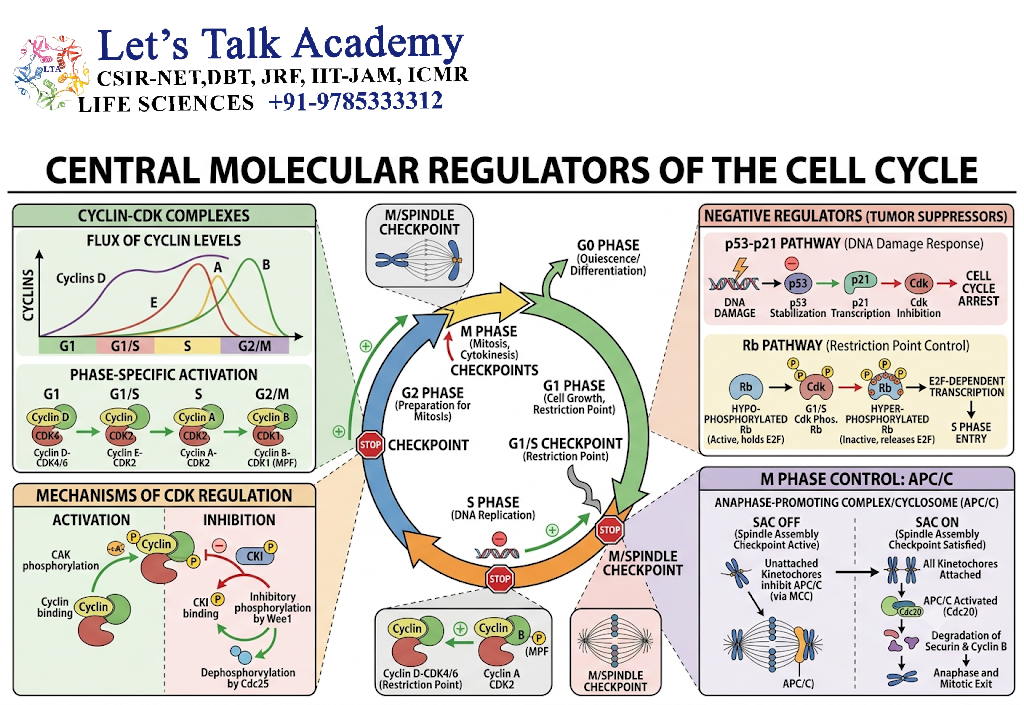
The major molecular regulators of the cell cycle are cyclins and cyclin-dependent kinases.
CDKs are protein kinases whose activity depends on association with specific cyclins.
The basic regulatory principle is:
Cyclin production → Cyclin-CDK complex formation → Protein phosphorylation → Cell-cycle progression
Cyclins themselves fluctuate in concentration during the cell cycle, whereas many CDKs are present more continuously but become active only when associated with appropriate cyclins and regulatory factors.
5. Cyclins
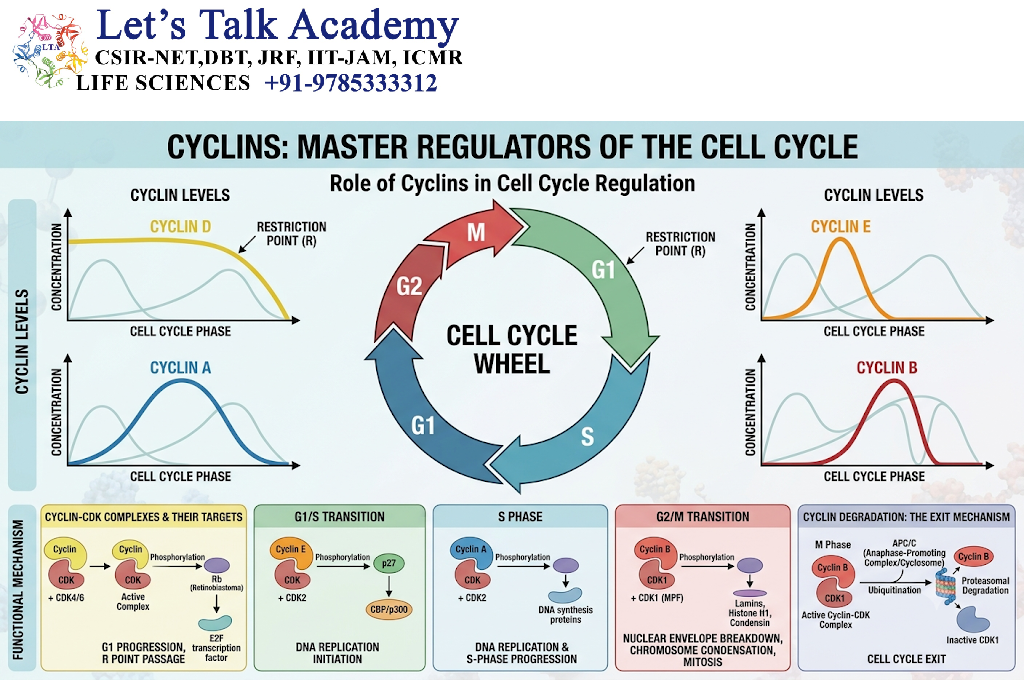
Cyclins are regulatory proteins that control CDK activity.
Their concentrations rise and fall at specific stages of the cell cycle.
Different cyclins function at different stages.
5.1 Major Cyclins
Important cyclins include:
| Cyclin | Major associated CDK | Major role |
|---|---|---|
| Cyclin D | CDK4/6 | G1 progression |
| Cyclin E | CDK2 | G1/S transition |
| Cyclin A | CDK2/CDK1 | S and G2 progression |
| Cyclin B | CDK1 | Entry into mitosis |
The precise regulatory relationships can vary among cell types and organisms, but this organization provides a useful framework for understanding cell-cycle control.
6. Cyclin-Dependent Kinases
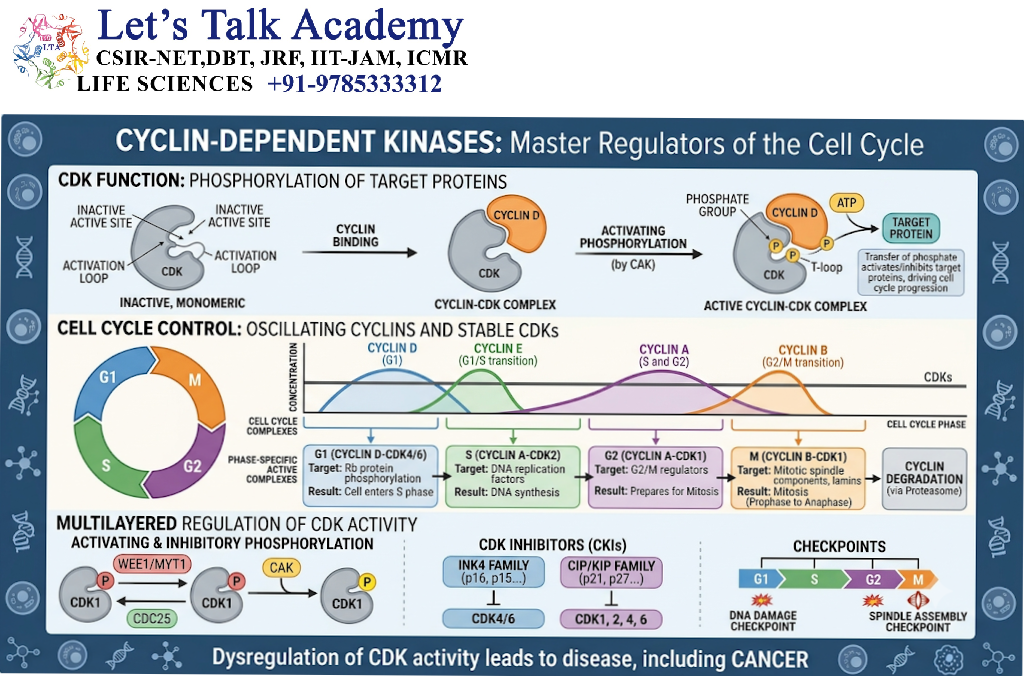
Cyclin-dependent kinases are enzymes that phosphorylate target proteins.
Phosphorylation can alter the:
- Activity
- Stability
- Localization
- Interaction with other proteins
of the target protein.
6.1 CDK Activation
A CDK generally requires:
- Association with an appropriate cyclin
- Appropriate phosphorylation state
- Removal of inhibitory phosphorylation
- Proper cellular conditions
Thus, CDKs function as molecular switches controlling cell-cycle transitions.
7. G1 Regulation
G1 is one of the most important control phases because the cell decides whether to commit to another round of division.
Growth factors and nutrients stimulate pathways that promote cyclin D production.
Cyclin D associates with CDK4 and CDK6.
These complexes phosphorylate the retinoblastoma protein, commonly called Rb.
8. Retinoblastoma Protein and E2F
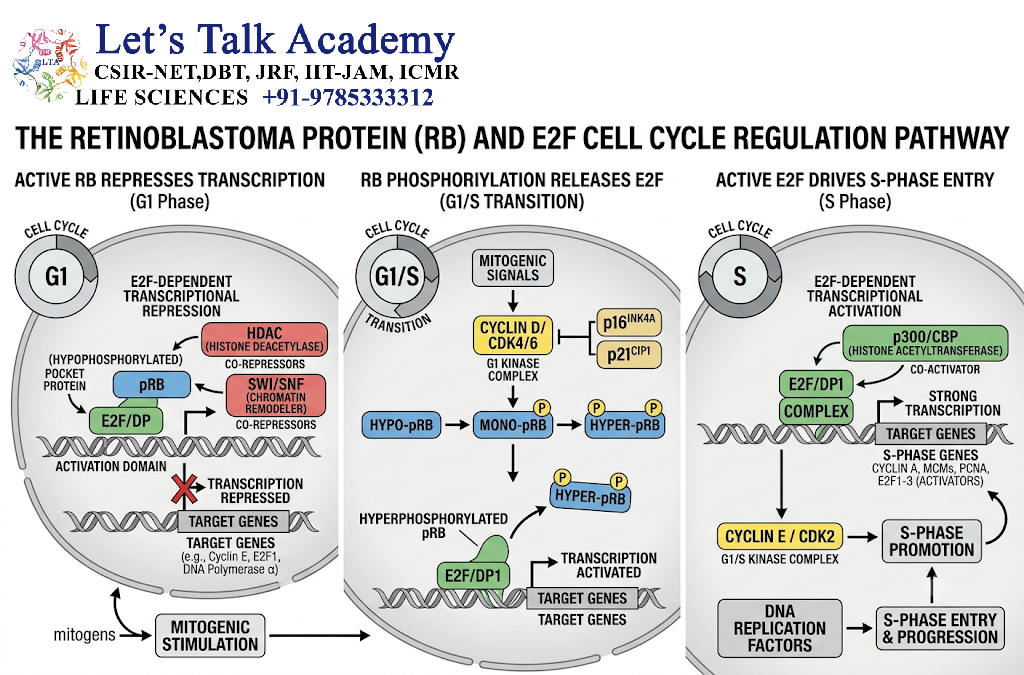
Rb is an important regulator of the G1/S transition.
In its active state, Rb binds to and inhibits E2F transcription factors.
When Rb becomes sufficiently phosphorylated:
Rb inhibition decreases → E2F becomes active → S-phase genes are expressed
E2F stimulates the expression of proteins required for DNA replication and S-phase progression.
This creates a regulatory pathway:
Growth signals → Cyclin D-CDK4/6 → Rb phosphorylation → E2F activation → S-phase gene expression
9. Restriction Point
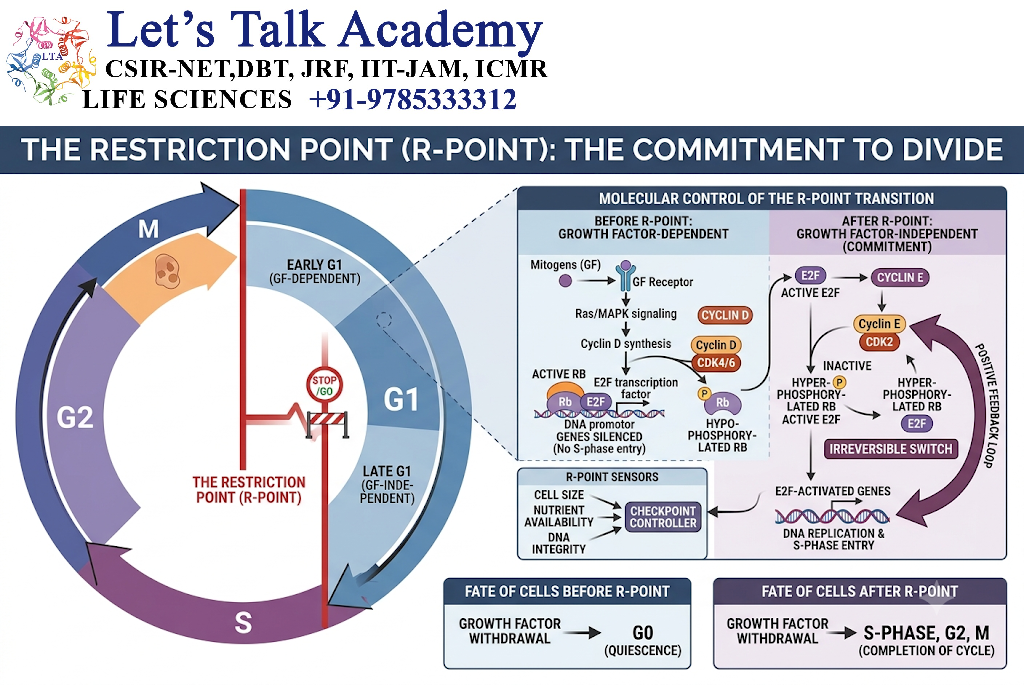
A major control point in G1 is often called the restriction point.
Before this point, cell-cycle progression strongly depends on external growth signals.
After passing the restriction point, the cell becomes increasingly committed to completing the cell cycle.
This mechanism helps prevent cells from entering DNA replication when appropriate growth conditions are absent.
10. G1/S Transition
The transition from G1 to S phase is controlled by increasing CDK activity.
Cyclin E-CDK2 contributes strongly to this transition.
Later, Cyclin A-CDK2 supports progression through S phase.
The G1/S transition therefore represents a major molecular decision:
Should the cell begin DNA replication?
The answer depends on:
- Growth signals
- Nutrient availability
- Cell size
- DNA integrity
- Regulatory protein activity
11. Regulation of S Phase
Once S phase begins, the cell must replicate the entire genome accurately.
A major principle is that each DNA replication origin should be activated only once per cell cycle.
Replication licensing mechanisms help achieve this.
11.1 Replication Licensing
Before S phase, replication origins are prepared for replication by assembly of protein complexes.
During S phase, CDK activity and other regulatory mechanisms prevent origins from being licensed again.
Thus:
Origin licensing → DNA replication → Prevention of re-licensing
This ensures that genomic DNA is not duplicated more than once.
12. G2 Regulation
G2 phase provides an important opportunity to check whether DNA replication has been completed successfully.
The cell evaluates:
- DNA replication status
- DNA damage
- Chromosome integrity
- Availability of mitotic proteins
If significant problems are detected, entry into mitosis is delayed.
13. Cyclin B-CDK1 and Entry into Mitosis
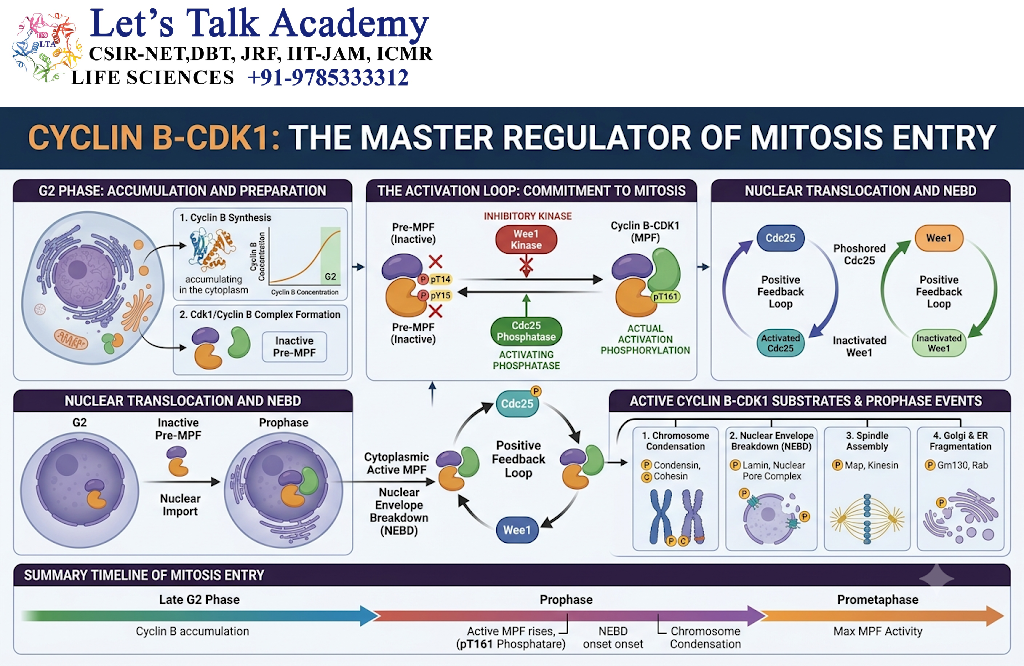
A central regulator of mitotic entry is the Cyclin B-CDK1 complex.
CDK1 is also known as the major maturation-promoting or M-phase kinase in many classical descriptions.
Its activation promotes:
- Chromosome condensation
- Nuclear-envelope breakdown
- Mitotic spindle formation
- Reorganization of the cytoskeleton
However, CDK1 activity is tightly controlled.
14. Regulation of CDK1
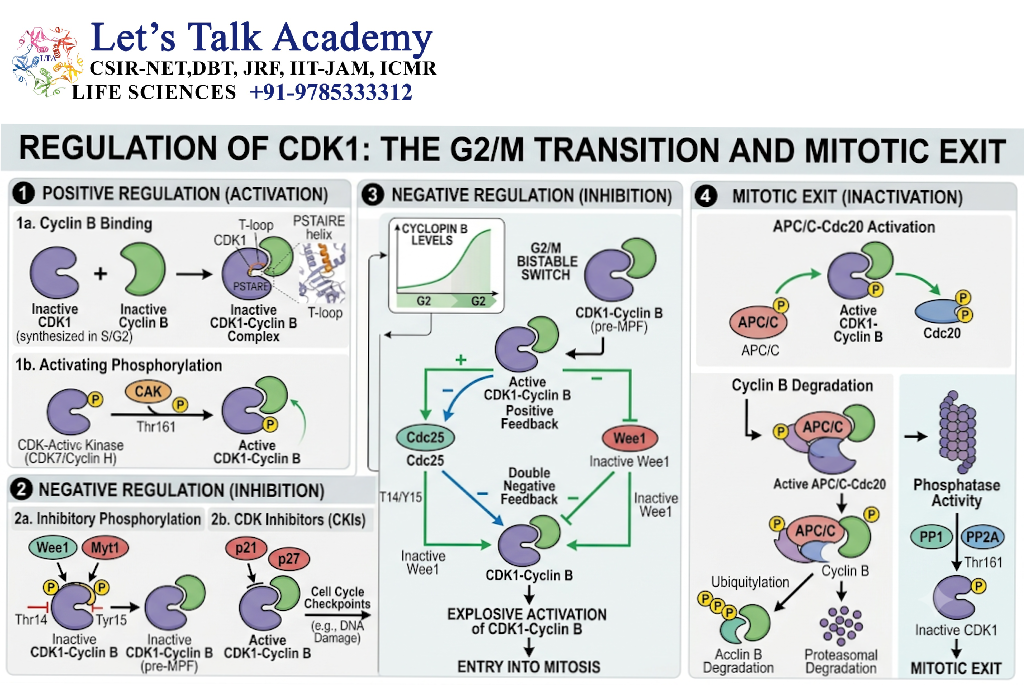
CDK1 can be kept inactive through inhibitory phosphorylation.
The protein kinase Wee1 contributes to inhibitory phosphorylation of CDK1.
The phosphatase Cdc25 removes inhibitory phosphate groups.
Therefore:
Wee1 → CDK1 inhibition
while:
Cdc25 → CDK1 activation
Once activated, CDK1 can promote further activation of Cdc25 and inhibition of Wee1, producing a positive-feedback loop.
This creates a rapid switch into mitosis.
15. Positive Feedback in Cell-Cycle Regulation
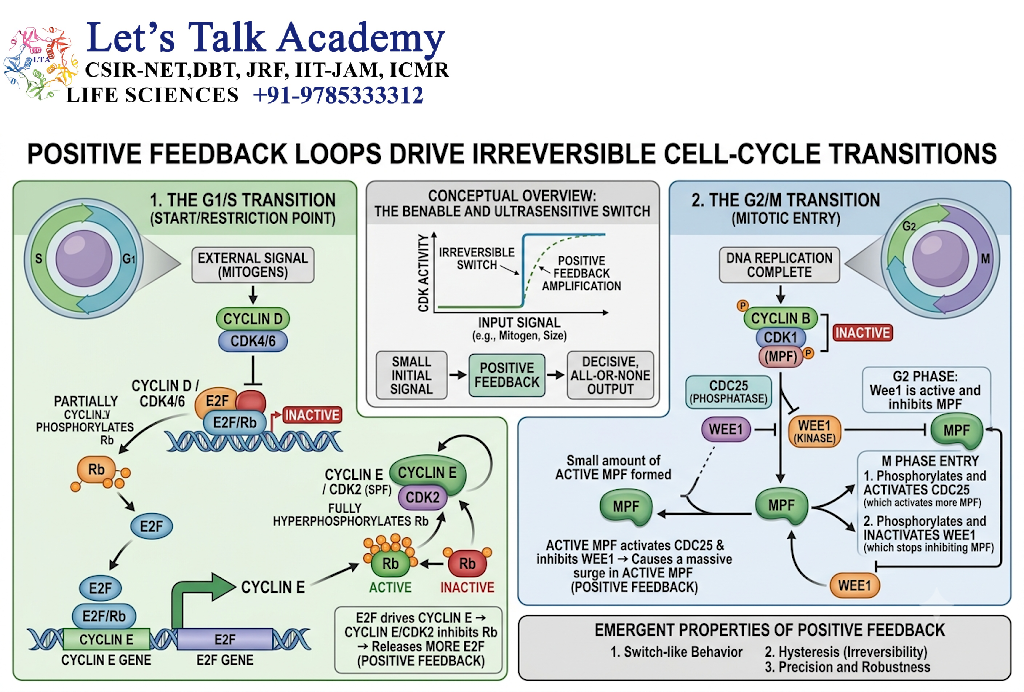
Positive feedback allows some cell-cycle transitions to occur rapidly and decisively.
For example:
Cyclin B-CDK1 activation → Cdc25 activation → more CDK1 activation
At the same time:
CDK1 activation → Wee1 inhibition → reduced CDK1 inhibition
Together, these mechanisms generate a strong transition from interphase to mitosis.
16. Cell-Cycle Checkpoints
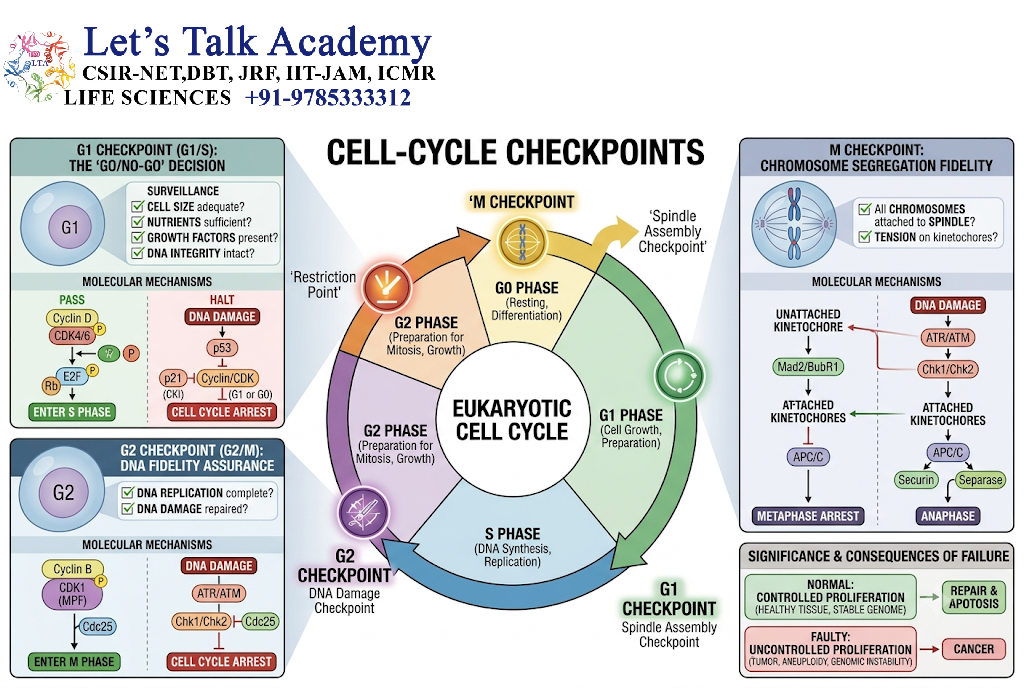
Checkpoints are surveillance mechanisms that monitor whether important cellular events have been completed correctly.
The major checkpoints include:
- G1/S checkpoint
- G2/M checkpoint
- Spindle assembly checkpoint
Their fundamental purpose is:
Detect problems → Stop progression → Repair or resolve the problem → Resume the cycle
17. G1/S Checkpoint
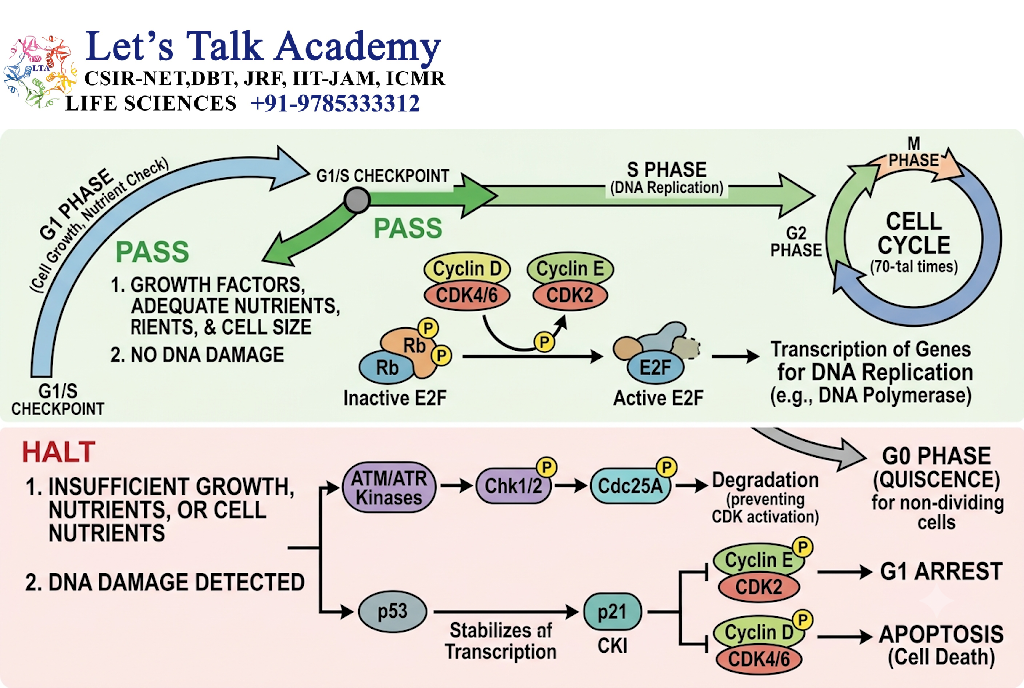
The G1/S checkpoint evaluates whether conditions are suitable for DNA replication.
Important factors include:
- DNA damage
- Cell size
- Nutrient availability
- Growth signals
- Cellular stress
If DNA damage is detected, the cell may stop before entering S phase.
18. G2/M Checkpoint
The G2/M checkpoint prevents entry into mitosis when:
- DNA replication is incomplete
- DNA is damaged
- Chromosomal abnormalities are detected
A central signaling pathway involves:
DNA damage → ATM/ATR signaling → Chk1/Chk2 activation → Cdc25 inhibition → CDK1 inhibition → Mitosis delayed
This gives the cell time to repair its DNA.
19. DNA Damage Response
Cells constantly experience DNA damage from:
- Reactive oxygen species
- Radiation
- Chemical agents
- Replication errors
- Environmental factors
DNA-damage response pathways detect such damage and coordinate:
- Cell-cycle arrest
- DNA repair
- Senescence
- Apoptosis when damage is severe
20. p53: A Major Cell-Cycle Regulator
The tumor-suppressor protein p53 is one of the most important regulators of the cellular response to DNA damage.
Under normal conditions, p53 is maintained at relatively low levels through regulated degradation.
DNA damage can stabilize and activate p53.
Activated p53 can stimulate transcription of genes such as p21.
21. p21 and CDK Inhibition
p21 is a cyclin-dependent kinase inhibitor.
The pathway can be represented as:
DNA damage → p53 activation → p21 production → CDK inhibition → Cell-cycle arrest
Cell-cycle arrest provides time for DNA repair.
If the damage cannot be adequately repaired, p53-dependent pathways can contribute to cellular senescence or apoptosis.
22. CDK Inhibitors
CDK inhibitors, or CKIs, suppress CDK activity.
They are essential for preventing inappropriate cell-cycle progression.
Two broad families are commonly described:
22.1 INK4 Family
The INK4 family includes inhibitors such as:
- p16
- p15
- p18
- p19
These primarily inhibit CDK4 and CDK6.
22.2 Cip/Kip Family
This family includes:
- p21
- p27
- p57
These can inhibit several cyclin-CDK complexes.
23. Regulation by Protein Degradation
Cell-cycle progression is controlled not only by protein synthesis but also by regulated protein degradation.
The ubiquitin-proteasome system is particularly important.
Proteins destined for degradation can be tagged with ubiquitin and subsequently degraded by the proteasome.
This irreversible removal of regulatory proteins helps drive cell-cycle transitions.
24. Anaphase-Promoting Complex/Cyclosome
The anaphase-promoting complex/cyclosome (APC/C) is a large ubiquitin ligase complex.
It controls the destruction of important mitotic regulatory proteins.
APC/C contributes to:
- Anaphase initiation
- Cyclin degradation
- Mitotic exit
- Resetting the cell cycle
25. Securin and Separase
Before anaphase, sister chromatids must remain attached.
A protein called securin inhibits the protease separase.
When the APC/C becomes appropriately activated:
Securin degradation → Separase activation → Cohesin cleavage → Sister chromatid separation
This mechanism ensures that chromosome separation occurs at the appropriate time.
26. Cohesin
Cohesin is a protein complex that holds sister chromatids together after DNA replication.
At the correct stage of mitosis:
Separase activation → Cohesin cleavage → Sister chromatid separation
The controlled removal of cohesin is therefore essential for accurate chromosome segregation.
27. Spindle Assembly Checkpoint
The spindle assembly checkpoint, or SAC, ensures that chromosomes are properly attached to the mitotic spindle before anaphase begins.
The checkpoint monitors the attachment and tension status of kinetochores.
If even one chromosome is improperly attached, the checkpoint can delay anaphase.
This prevents chromosome missegregation.
28. Kinetochores and Chromosome Attachment
Kinetochores are protein structures assembled at centromeric regions of chromosomes.
They provide attachment sites for spindle microtubules.
Proper attachment allows chromosomes to be positioned and separated accurately.
Incorrect attachment can result in:
- Chromosome loss
- Chromosome gain
- Aneuploidy
29. Mitotic Exit
After chromosome segregation, the cell must exit mitosis.
APC/C-mediated degradation of mitotic cyclins contributes to the reduction of CDK1 activity.
This promotes:
- Chromosome decondensation
- Nuclear-envelope reformation
- Reorganization of cellular structures
- Completion of cytokinesis
Thus, protein degradation is essential not only for entering mitosis but also for leaving it.
30. Cell-Cycle Regulatory Network
Cell-cycle control is best understood as an interconnected network rather than as isolated pathways.
A simplified sequence is:
Growth signals
↓
Cyclin D production
↓
CDK4/6 activation
↓
Rb phosphorylation
↓
E2F activation
↓
S-phase gene expression
↓
Cyclin E/CDK2 activation
↓
DNA replication
↓
Cyclin A/CDK activity
↓
G2 preparation
↓
Cyclin B/CDK1 activation
↓
Mitosis
↓
Spindle checkpoint satisfaction
↓
APC/C activation
↓
Securin and cyclin degradation
↓
Chromosome separation and mitotic exit
31. Growth Factors and Cell-Cycle Control
Cell proliferation is strongly influenced by extracellular growth factors.
Growth factors activate signaling pathways that can increase cyclin production.
Important signaling pathways include:
- Ras-MAPK pathway
- PI3K-AKT pathway
- mTOR-associated pathways
These pathways integrate information about:
- Growth signals
- Nutrients
- Energy status
- Survival signals
The cell therefore links external environmental information to the internal cell-cycle machinery.
32. Nutrient and Energy Regulation
Cell division requires considerable energy and biosynthetic resources.
Cells therefore coordinate cell-cycle progression with metabolic conditions.
When nutrients or energy are insufficient, cell-cycle progression may be slowed or stopped.
This prevents cells from initiating division when they lack sufficient resources to complete it.
33. Contact Inhibition
Normal cells generally regulate proliferation according to the conditions of surrounding tissue.
When cells become densely packed, cell proliferation can decrease through mechanisms collectively associated with contact inhibition.
This contributes to tissue organization and prevents excessive cell accumulation.
Loss of normal growth control can contribute to tumor development.
34. Cell-Cycle Arrest
Cell-cycle arrest means temporary or prolonged cessation of cell-cycle progression.
It can occur in response to:
- DNA damage
- Nutrient deficiency
- Cellular stress
- Differentiation signals
- Replication problems
- Loss of appropriate growth signals
Arrest gives the cell an opportunity to correct problems or change its biological state.
35. Quiescence and G0 Phase
Some cells leave the active cell cycle and enter a state known as G0 or quiescence.
Quiescent cells are metabolically active but are not actively progressing through the cell cycle.
Depending on the cell type and biological conditions, cells may:
- Remain in G0 for long periods
- Re-enter the cell cycle
- Differentiate
- Enter senescence
36. Cellular Senescence
Senescence is a state of essentially stable cell-cycle arrest.
Senescent cells remain metabolically active but generally do not continue proliferating.
Senescence can be induced by:
- Persistent DNA damage
- Telomere shortening
- Oncogenic stress
- Cellular stress
Senescence can act as a protective mechanism against uncontrolled proliferation.
37. Apoptosis and Cell-Cycle Control
If cellular damage is too severe to repair, the cell may undergo programmed cell death, or apoptosis.
A simplified decision pathway is:
Damage detected
↓
Cell-cycle arrest
↓
DNA repair
↓
If successful → Cell-cycle resumes
If unsuccessful → Apoptosis or permanent arrest
This prevents severely damaged cells from continuing to proliferate.
38. Role of Tumor-Suppressor Proteins
Tumor-suppressor proteins act as important barriers against uncontrolled cell proliferation.
Important examples include:
- p53
- Rb
- p16
- p21
These proteins can:
- Stop the cell cycle
- Promote DNA repair
- Induce senescence
- Promote apoptosis
Loss of tumor-suppressor function can remove important restraints on cell division.
39. Proto-Oncogenes and Cell-Cycle Regulation
Proto-oncogenes encode proteins that normally promote cell growth and proliferation.
Examples include proteins involved in:
- Growth-factor signaling
- Receptor signaling
- Intracellular kinase activity
- Transcriptional regulation
When proto-oncogenes become abnormally activated, they can become oncogenes, potentially promoting excessive cell proliferation.
40. Balance Between Growth and Inhibition
Normal cell proliferation depends on a balance between positive and negative regulatory signals.
Positive regulators
- Growth factors
- Cyclins
- CDKs
- E2F
Negative regulators
- Rb
- p53
- CDK inhibitors
- DNA-damage checkpoints
Normal proliferation occurs when these systems are appropriately balanced.
41. DNA Replication and Cell-Cycle Control
DNA replication must be coordinated with the cell cycle.
The cell must ensure:
- DNA replication starts at the appropriate time.
- Replication is completed before mitosis.
- Replication origins are not repeatedly activated.
- Replication errors are detected and repaired.
Failure of these mechanisms can cause genomic instability.
42. Chromosome Segregation and Cell-Cycle Control
During mitosis, duplicated chromosomes must be distributed equally between daughter cells.
This requires:
- Correct chromosome condensation
- Functional spindle formation
- Proper kinetochore attachment
- Spindle checkpoint satisfaction
- Timely cohesin removal
Accurate chromosome segregation is essential for maintaining chromosome number.
43. Regulation of the Cell Cycle in Cancer
Cancer frequently involves defects in cell-cycle regulation.
Common abnormalities include:
- Excessive cyclin activity
- Abnormal CDK activation
- Loss of CDK inhibitors
- Rb pathway disruption
- p53 pathway disruption
- Abnormal growth-factor signaling
- Defective DNA-damage responses
As a result, cells may continue dividing despite:
- DNA damage
- Lack of growth signals
- Chromosomal abnormalities
- Other unfavorable conditions
44. Cell-Cycle Regulation and Genomic Stability
The central purpose of cell-cycle checkpoints is to protect genomic integrity.
A properly regulated cell cycle ensures:
Accurate DNA replication + accurate chromosome segregation + effective DNA repair = genomic stability
When these mechanisms fail, mutations and chromosome abnormalities can accumulate.
45. Major Checkpoints at a Glance
| Checkpoint | Main question | Major regulators |
|---|---|---|
| G1/S | Is the cell ready to replicate DNA? | Rb, E2F, p53, p21 |
| Intra-S | Is DNA replication proceeding correctly? | ATR, Chk1 and replication-control pathways |
| G2/M | Is DNA replicated and undamaged? | ATM/ATR, Chk1/Chk2, Cdc25, CDK1 |
| Spindle checkpoint | Are chromosomes properly attached to spindle? | Kinetochore checkpoint proteins, APC/C regulation |
46. Integrated Control of the Cell Cycle
Cell-cycle regulation can be divided conceptually into several layers.
Layer 1: External Signals
Growth factors and environmental conditions provide information.
Layer 2: Signal-Transduction Pathways
Pathways such as Ras-MAPK and PI3K-AKT transmit these signals.
Layer 3: Cyclin-CDK System
Cyclin-CDK complexes act as major intracellular switches.
Layer 4: Checkpoints
Checkpoints verify DNA integrity, replication status, and chromosome attachment.
Layer 5: Protein Degradation
APC/C and other ubiquitin-dependent mechanisms remove proteins at appropriate times.
Layer 6: Cellular Decisions
The cell ultimately:
- Proceeds through division
- Pauses
- Repairs damage
- Enters quiescence
- Becomes senescent
- Undergoes apoptosis
47. Conceptual Flowchart of Cell-Cycle Control
External growth signals
↓
Cyclin expression
↓
CDK activation
↓
Cell-cycle progression
↓
Checkpoint surveillance
↓
Problem detected?
↙ ↘
Yes No
↓ ↓
Cell-cycle arrest Progression
↓
DNA repair
↓
Successful?
↙ ↘
Yes No
↓ ↓
Resume cycle Senescence/Apoptosis
48. Important Regulatory Proteins
| Protein | Major function |
|---|---|
| Cyclins | Activate CDKs |
| CDKs | Phosphorylate cell-cycle substrates |
| Rb | Restrains E2F-dependent S-phase entry |
| E2F | Activates genes required for S phase |
| p53 | Coordinates responses to cellular stress and DNA damage |
| p21 | Inhibits CDKs |
| Wee1 | Inhibits CDK1 through phosphorylation |
| Cdc25 | Activates CDK1 by removing inhibitory phosphate |
| APC/C | Promotes degradation of selected cell-cycle proteins |
| Securin | Inhibits separase |
| Separase | Cleaves cohesin during anaphase |
| Cohesin | Holds sister chromatids together |
49. Positive and Negative Regulation
Cell-cycle regulation involves both positive and negative controls.
Positive regulation
Positive regulators promote progression.
Examples:
- Cyclins
- CDKs
- E2F
- Growth-factor signaling
Negative regulation
Negative regulators prevent progression when conditions are unfavorable.
Examples:
- p53
- p21
- Rb
- CDK inhibitors
- DNA-damage checkpoints
The interaction between these opposing systems produces precise control.
50. Feedback Mechanisms
Feedback mechanisms make cell-cycle transitions reliable.
Positive feedback
Positive feedback can make transitions rapid and switch-like.
Example:
CDK1 → Cdc25 activation → increased CDK1 activity
Negative feedback
Negative feedback can help prevent excessive or inappropriate activity.
Together, feedback mechanisms stabilize cell-cycle progression.
51. Cell-Cycle Control and Development
During development, cell proliferation must be carefully coordinated with:
- Differentiation
- Cell migration
- Tissue organization
- Programmed cell death
Different tissues therefore use different combinations of cell-cycle regulators.
Some differentiated cells divide frequently, whereas others remain largely non-dividing.
52. Cell-Cycle Regulation in Tissue Repair
Cell-cycle control is also essential for tissue regeneration.
After injury:
Tissue damage → Growth signals → Cell-cycle activation → Cell proliferation → Tissue repair
Once sufficient repair has occurred, proliferative signals are reduced and cells return to an appropriate non-proliferative state.
53. Evolutionary Conservation of Cell-Cycle Regulation
Many components of cell-cycle regulation are highly conserved across eukaryotes.
Conserved regulators include:
- Cyclins
- CDKs
- Checkpoint pathways
- DNA-damage response mechanisms
- APC/C
- Chromosome-segregation machinery
This conservation reflects the fundamental importance of accurate cell division.
54. Relationship Between Cell Cycle and DNA Repair
DNA repair and cell-cycle regulation are closely interconnected.
A simplified model is:
DNA damage
↓
Damage recognition
↓
Checkpoint activation
↓
Cell-cycle arrest
↓
DNA repair
↓
Damage resolved
↓
Cell-cycle restart
If repair fails:
↓
Senescence or apoptosis
This relationship protects organisms from propagating damaged genetic information.
55. Consequences of Failed Cell-Cycle Regulation
Failure of cell-cycle control may lead to:
- Mutation accumulation
- Aneuploidy
- Chromosomal instability
- Uncontrolled proliferation
- Tumor formation
- Developmental abnormalities
- Tissue dysfunction
Thus, cell-cycle regulation is a major component of cellular quality control.
56. Cell-Cycle Regulation: Integrated Summary Table
| Regulatory level | Major components | Main purpose |
|---|---|---|
| Growth signaling | Growth factors, Ras, PI3K-AKT | Stimulate proliferation |
| G1 control | Cyclin D-CDK4/6, Rb, E2F | Control S-phase entry |
| S-phase control | Cyclin A-CDK2 and replication machinery | Coordinate DNA replication |
| G2 control | Cyclin B-CDK1, Cdc25, Wee1 | Control mitotic entry |
| DNA damage | ATM, ATR, Chk1, Chk2, p53 | Arrest and repair |
| CDK inhibition | p21, p27, p16 | Suppress inappropriate CDK activity |
| Spindle checkpoint | Kinetochore-associated checkpoint machinery | Prevent premature anaphase |
| Proteolysis | APC/C, ubiquitin-proteasome system | Remove key regulatory proteins |
| Chromosome separation | Securin, separase, cohesin | Control sister-chromatid separation |


