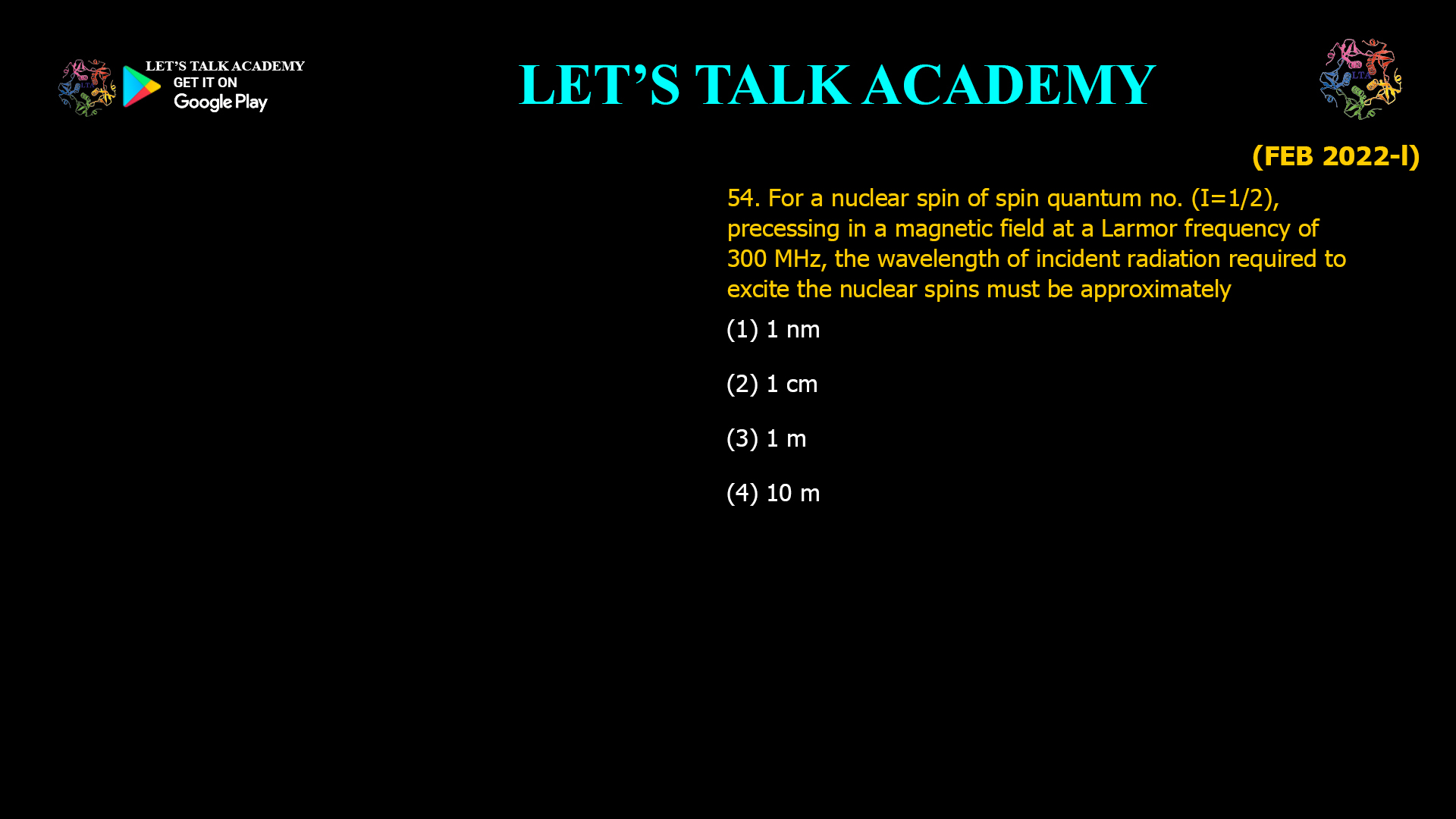
54. For a nuclear spin of spin quantum number (I = 1/2), precessing in a magnetic field at a Larmor frequency of 300 MHz, the wavelength of incident radiation required to excite the nuclear spins must be approximately
(A) 1 nm
(B) 1 cm
(C) 1 m
(D) 10 m
Calculating the Wavelength of Radiation Required for NMR Excitation at 300 MHz8
Correct Answer
Option (3): 1 m
Explanation
Nuclear Magnetic Resonance (NMR) spectroscopy is based on the absorption of radiofrequency electromagnetic radiation by atomic nuclei possessing non-zero nuclear spin. When such nuclei are placed in an external magnetic field, they precess around the field direction at a characteristic frequency known as the Larmor frequency. Resonance occurs only when electromagnetic radiation having the same frequency as the Larmor frequency is applied.
To determine the wavelength of the radiation, the relationship between the speed of light, frequency, and wavelength is used.
Formula Used
The wavelength of electromagnetic radiation is given by
λ = c / ν
where
λ = wavelength (m)
c = speed of light = 3 × 10⁸ m s−1
ν = frequency (Hz)
Step-by-Step Calculation
The given Larmor frequency is
ν = 300 MHz = 300 × 106 Hz = 3 × 10⁸ Hz
Substituting into the wavelength equation:
λ = (3 × 10⁸ m s−1) / (3 × 10⁸ s−1)
λ = 1 m
Therefore, electromagnetic radiation with a wavelength of approximately 1 metre is required to excite the nuclei at a Larmor frequency of 300 MHz.
Why Option (1) is Incorrect
A wavelength of 1 nm lies in the X-ray region of the electromagnetic spectrum. NMR spectroscopy does not use X-rays because nuclear spin transitions require far lower energies corresponding to radiofrequency radiation rather than high-energy electromagnetic waves.
Why Option (2) is Incorrect
A wavelength of 1 cm corresponds to microwave radiation with frequencies in the tens of gigahertz range. NMR experiments operating at 300 MHz require much longer wavelengths in the radiofrequency region, making this option incorrect.
Why Option (3) is Correct
Using the relationship λ = c/ν with a frequency of 300 MHz gives a wavelength of approximately 1 metre. This falls within the radiofrequency region of the electromagnetic spectrum used in Nuclear Magnetic Resonance spectroscopy. Therefore, this is the correct answer.
Why Option (4) is Incorrect
A wavelength of 10 metres corresponds to a frequency of approximately 30 MHz. Since the required resonance frequency is 300 MHz, a wavelength of 10 metres is ten times larger than required and therefore does not satisfy the resonance condition.
Larmor Frequency in NMR Spectroscopy
The Larmor frequency is the frequency at which nuclear magnetic moments precess around an external magnetic field. It is directly proportional to the magnetic field strength and depends on the gyromagnetic ratio of the nucleus. Stronger magnetic fields produce higher Larmor frequencies, which improve spectral resolution and sensitivity. Modern high-field NMR spectrometers commonly operate at frequencies such as 400 MHz, 500 MHz, 600 MHz, 800 MHz, and even higher for proton NMR.
Radiofrequency Region Used in NMR
NMR spectroscopy employs radiofrequency radiation rather than visible light, ultraviolet radiation, or X-rays. Radiofrequency waves possess relatively low energy, which is sufficient to induce transitions between nuclear spin states without altering the electronic structure of atoms or breaking chemical bonds. This non-destructive nature makes NMR one of the most valuable techniques for studying molecular structure in solution.
Relationship Between Frequency and Wavelength
Frequency and wavelength are inversely proportional according to the equation λ = c/ν. As the frequency increases, the wavelength decreases. Consequently, high-field NMR instruments operating at higher resonance frequencies use shorter radiofrequency wavelengths, although they still remain within the radiofrequency region of the electromagnetic spectrum.
Conclusion
A nucleus precessing at a Larmor frequency of 300 MHz requires electromagnetic radiation of the same frequency to achieve resonance. Using the relationship between frequency and wavelength gives a wavelength of approximately 1 metre. Therefore, the correct answer is Option (3): 1 m.


