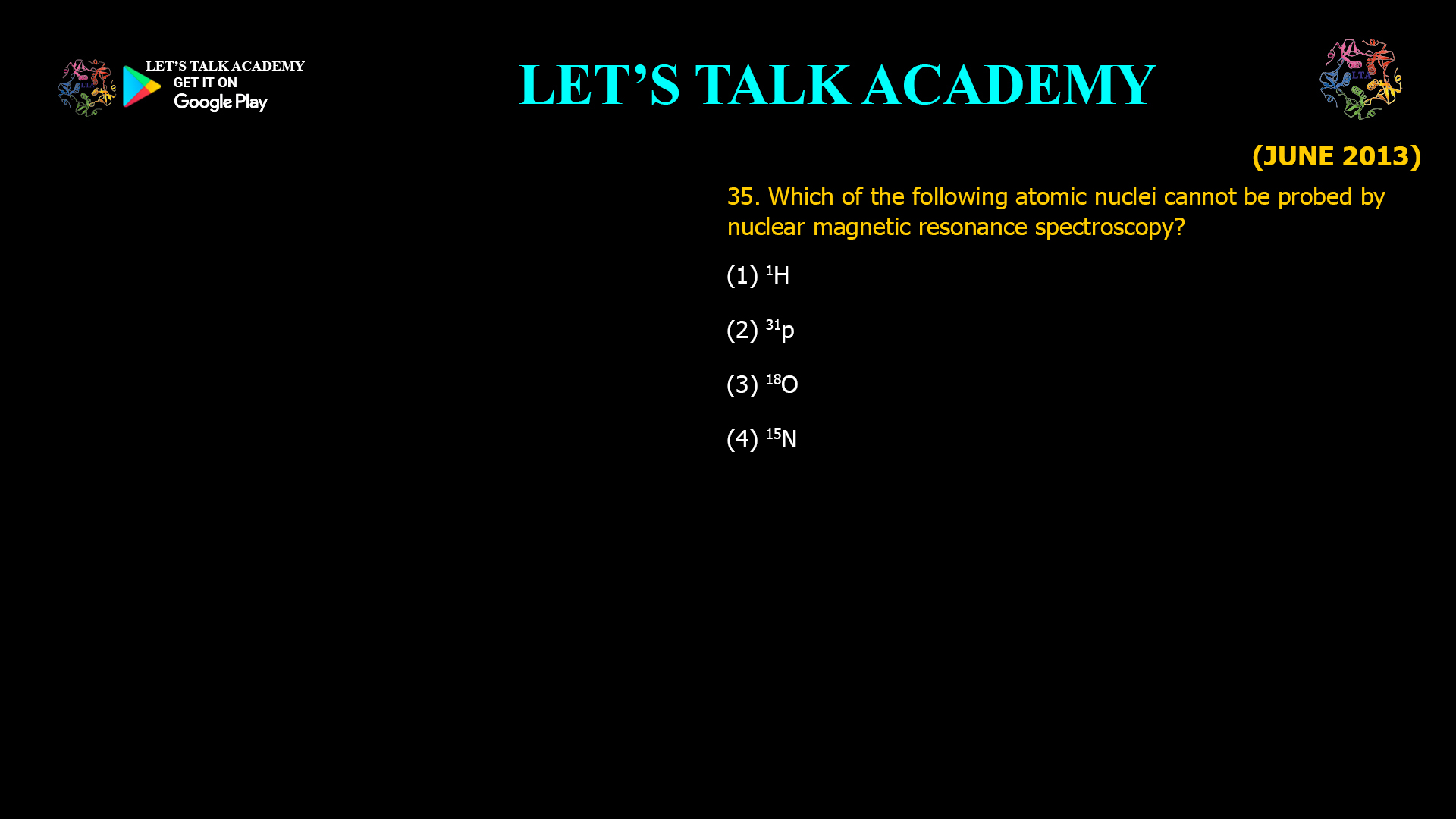
35. Which of the following atomic nuclei cannot be probed by nuclear magnetic resonance spectroscopy?
(A) ¹H
(B) ³¹P
(C) ¹⁸O
(D) ¹⁵N
Nuclei That Can and Cannot Be Studied by Nuclear Magnetic Resonance (NMR) Spectroscopy
Correct Answer
Option (3): 18O
Explanation
Nuclear Magnetic Resonance (NMR) spectroscopy is based on the interaction between an external magnetic field and the magnetic moments of atomic nuclei. For a nucleus to be detected by NMR, it must possess a non-zero nuclear spin quantum number (I). Only nuclei with non-zero spin generate a magnetic moment that can align with an applied magnetic field and absorb radiofrequency radiation. Nuclei with a spin quantum number of zero do not possess a magnetic moment and therefore cannot produce an NMR signal.
The value of the nuclear spin depends on the number of protons and neutrons present in the nucleus. Isotopes containing an odd number of protons or an odd number of neutrons generally possess a non-zero nuclear spin and are NMR active. In contrast, isotopes with both even numbers of protons and neutrons usually have a nuclear spin of zero, making them NMR inactive.
Among the isotopes listed in the question, 18O contains 8 protons and 10 neutrons. Both numbers are even, giving the nucleus a spin quantum number of I = 0. Because it has no magnetic moment, 18O cannot interact with the magnetic field in the manner required for Nuclear Magnetic Resonance spectroscopy. Consequently, it does not produce an NMR spectrum.
Why Option (1) is Incorrect
1H is one of the most important nuclei used in NMR spectroscopy. It has a nuclear spin of I = 1/2, a high natural abundance of nearly 100%, and a large magnetic moment, making it highly sensitive for NMR analysis. Proton NMR is therefore one of the most widely used techniques for determining molecular structure.
Why Option (2) is Incorrect
31P possesses a nuclear spin of I = 1/2 and has a natural abundance of 100%. It is fully NMR active and is extensively used to study phosphates, nucleotides, phospholipids, phosphorylated proteins, and organophosphorus compounds. The high sensitivity of 31P makes it particularly useful for investigating biological and chemical systems containing phosphorus.
Why Option (3) is Correct
18O has a nuclear spin quantum number of I = 0. Since it lacks a magnetic moment, it cannot absorb radiofrequency energy in an external magnetic field and therefore cannot be detected by Nuclear Magnetic Resonance spectroscopy. This makes it NMR inactive.
Why Option (4) is Incorrect
15N has a nuclear spin of I = 1/2 and is therefore NMR active. Although its natural abundance is relatively low, isotopic enrichment with 15N allows detailed investigation of proteins, nucleic acids, amino acids, and other nitrogen-containing biomolecules using NMR spectroscopy.
Nuclear Spin and NMR Activity
The ability of a nucleus to produce an NMR signal depends entirely on its nuclear spin quantum number. Nuclei with I = 0 have no magnetic moment and are invisible in NMR spectroscopy. Nuclei with I = 1/2, 1, 3/2, 5/2, or higher possess magnetic moments that interact with an external magnetic field, allowing resonance to occur when the appropriate radiofrequency is applied.
Common NMR Active Isotopes
Several isotopes are routinely used in NMR spectroscopy because they possess non-zero nuclear spin and produce strong resonance signals. These include 1H, 13C, 15N, 19F, 31P, and 29Si. Each isotope provides unique structural information depending on the type of atoms present within the molecule.
Conclusion
Nuclear Magnetic Resonance spectroscopy can only detect nuclei that possess a non-zero nuclear spin. Among the isotopes listed, 18O has a nuclear spin of zero and therefore does not produce an NMR signal. The remaining nuclei, 1H, 31P, and 15N, are all NMR active. Hence, the correct answer is Option (3): 18O.


