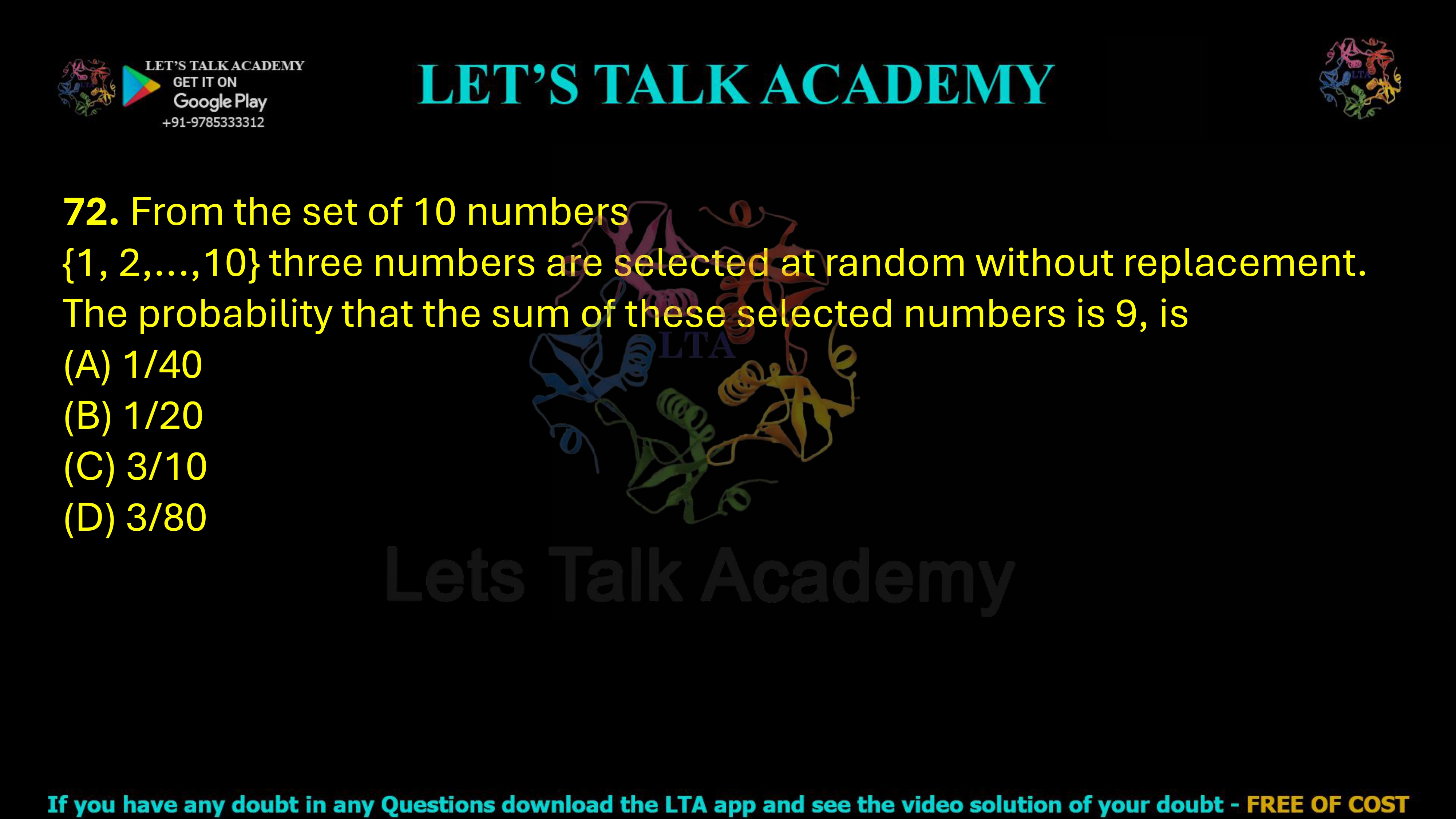
72. From the set of 10 numbers
{1, 2,…,10} three numbers are selected at random without replacement. The probability that the sum of these selected numbers is 9, is
(A) 1/40
(B) 1/20
(C) 3/10
(D) 3/80
Probability That the Sum of Three Selected Numbers Is 9
The present question requires us to select three numbers from a set containing ten distinct numbers. Instead of calculating probabilities directly, we first determine the total number of equally likely selections and then identify only those selections whose sum equals 9. This systematic approach is one of the most reliable methods for solving probability questions involving combinations.
Correct Answer
Option (A): 1/40
Understanding the Concept
Whenever objects are selected without replacement, every possible combination of the selected objects is equally likely. Since the order in which the numbers are selected does not matter, we use combinations rather than permutations.
The classical definition of probability states:
Probability = Number of Favorable Outcomes / Total Number of Possible Outcomes
Therefore, our task is divided into two parts:
- Find the total number of ways to choose three numbers from ten numbers.
- Count the selections whose sum is exactly 9.
Step 1: Calculate the Total Number of Possible Selections
We are selecting three numbers from ten distinct numbers.
The total number of possible selections is
¹⁰C₃
Using the combination formula,
ⁿCᵣ = n! / [r!(n−r)!]
Substituting the values,
¹⁰C₃ = (10 × 9 × 8)/(3 × 2 × 1)
= 120
Thus, there are
120 equally likely ways
to select three numbers.
Step 2: Find All Favorable Selections
Now we search for all distinct combinations of three different numbers whose sum equals 9.
Starting with the smallest numbers:
1 + 2 + 6 = 9 ✔
1 + 3 + 5 = 9 ✔
2 + 3 + 4 = 9 ✔
No other combination of three distinct numbers from the given set adds up to 9.
Therefore, the total number of favorable selections is
3.
Step 3: Calculate the Probability
Using the probability formula,
Probability = Favorable Outcomes / Total Outcomes
= 3/120
Dividing numerator and denominator by 3,
= 1/40
Hence, the required probability is
1/40.
Mathematical Verification
Total combinations:
¹⁰C₃ = 120 ✔
Favorable combinations:
{1,2,6}, {1,3,5}, {2,3,4}
Number of favorable combinations = 3 ✔
Probability = 3/120 = 1/40 ✔
The result is therefore mathematically verified.
Explanation of Every Option
Option (A): 1/40
This option is correct. There are exactly three favorable combinations out of 120 equally likely selections, giving a probability of 1/40.
Option (B): 1/20
This option is incorrect because it corresponds to six favorable outcomes instead of the actual three combinations.
Option (C): 3/10
This option is much larger than the actual probability. It incorrectly assumes that a large proportion of the selections satisfy the required condition, whereas only three out of 120 combinations do.
Option (D): 3/80
This option is incorrect because it assumes only 80 total combinations instead of the correct value of 120.
Alternative Method Using Systematic Enumeration
Instead of testing every possible combination, begin with the smallest number and gradually increase the remaining numbers while maintaining the required sum. This organized approach avoids duplicate counting and ensures that every valid combination is found exactly once.
For a target sum of 9, the only possible distinct combinations are:
- {1,2,6}
- {1,3,5}
- {2,3,4}
Thus, the answer is obtained quickly without checking all 120 combinations individually.
Related Practice Example
From the set
{1,2,3,4,5,6}
three numbers are selected at random. Find the probability that their sum is 10.
The favorable combinations are:
{1,3,6}
{1,4,5}
{2,3,5}
Total favorable combinations = 3.
Total selections = ⁶C₃ = 20.
Therefore, the probability equals
3/20.
Practising such examples helps develop systematic counting techniques for examination problems.
Key Takeaways
Whenever objects are selected without replacement and the order does not matter, always use combinations rather than permutations. First determine the total number of possible selections, then count only the favorable combinations satisfying the given condition. Finally, apply the classical probability formula and simplify the fraction to its lowest terms.
Final Answer
The total number of ways to choose three numbers from ten numbers is
¹⁰C₃ = 120.
The only combinations whose sum equals 9 are
{1,2,6}, {1,3,5}, {2,3,4}.
Therefore,
Probability = 3/120 = 1/40.
Correct Option: (A) 1/40


