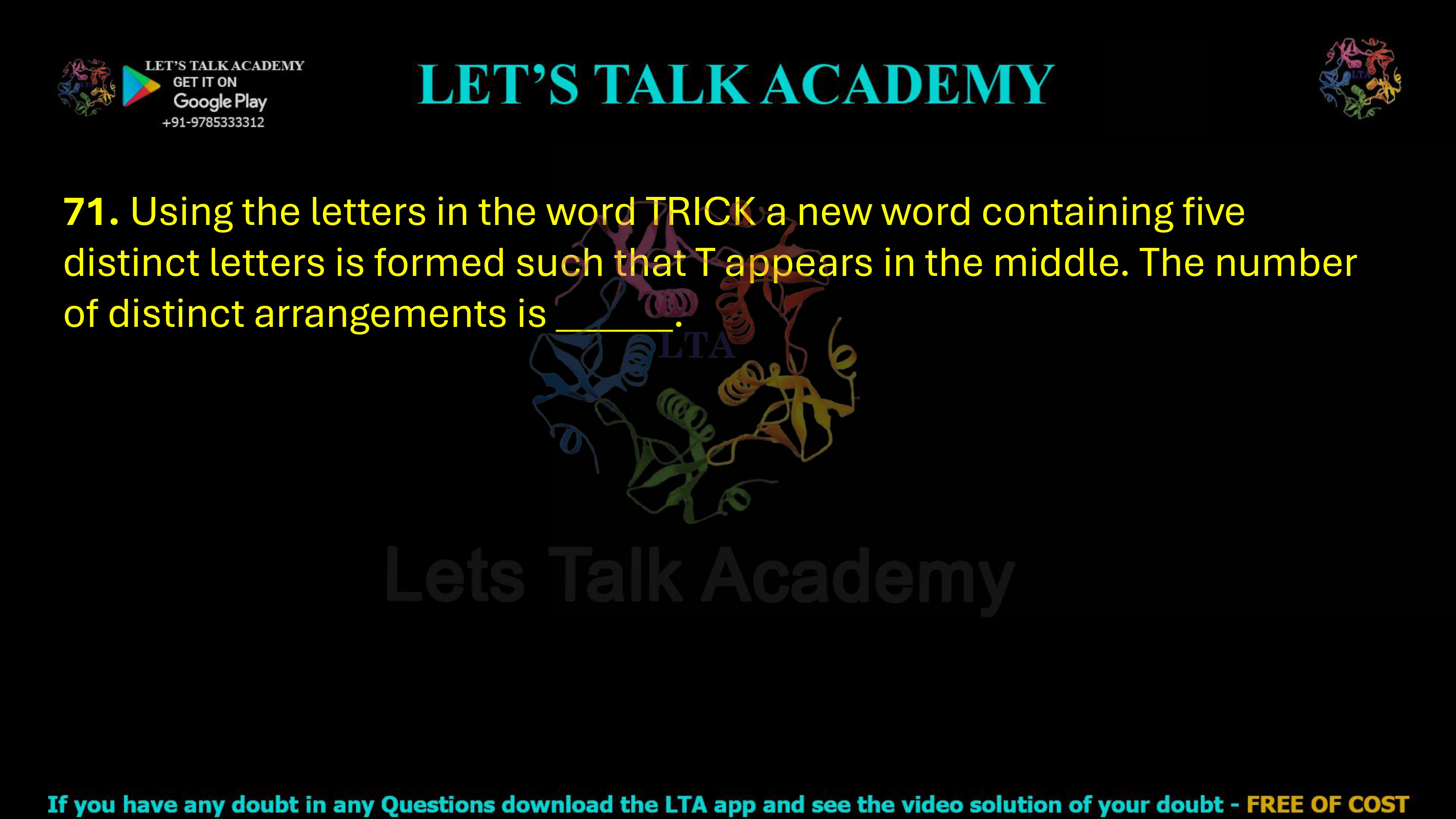
71. Using the letters in the word TRICK a new word containing five distinct letters is formed such that T appears in the middle. The number of distinct arrangements is ______.
Number of Arrangements of the Word TRICK with T Fixed in the Middle
The present question is an excellent example of a permutation with a fixed position. Instead of arranging all letters freely, one particular letter is required to occupy the middle position. Such restrictions reduce the total number of possible arrangements and require students to apply the multiplication principle along with factorial notation. Understanding this concept is essential because many advanced permutation problems involve one or more fixed positions.
Correct Answer
24
Understanding the Problem
The word TRICK contains five distinct letters:
T, R, I, C, K
Since all five letters are different, there are no repeated letters. Therefore, under normal circumstances, the total number of arrangements would simply be
5! = 120.
However, the question introduces an important restriction:
The letter T must always appear in the middle position.
This restriction changes the counting process because one position is no longer available for rearrangement.
Step 1: Fix the Middle Position
A five-letter word has the following positions:
1 2 3 4 5
The middle position is the third position.
Since the question requires T to appear in the middle, we immediately place it there.
_ _ T _ _
Now the position of T is fixed permanently and does not change.
Step 2: Count the Remaining Letters
After fixing T, four letters remain to be arranged.
These letters are
R, I, C, K
Since all four letters are distinct, they may occupy the remaining four positions in any order.
Step 3: Apply the Permutation Formula
The number of ways to arrange four distinct objects is
4!
Calculating the factorial,
4! = 4 × 3 × 2 × 1
= 24
Therefore, the required number of arrangements is
24.
Mathematical Verification Using the Multiplication Principle
Another way to verify the answer is by counting the choices sequentially.
After fixing T in the third position,
- The first empty position can be filled in 4 ways.
- The second empty position can then be filled in 3 ways.
- The fourth position has 2 choices remaining.
- The fifth position is filled by the remaining 1 letter.
Hence, the total number of arrangements is
4 × 3 × 2 × 1 = 24.
This confirms the previous result.
Alternative Method Using the General Formula
Whenever one object is fixed in a specific position among n distinct objects, the remaining n − 1 objects can be arranged freely.
Therefore, the required number of arrangements is
(n − 1)!
Here,
n = 5
Thus,
(5 − 1)! = 4!
= 24
This provides a quick shortcut for solving similar competitive examination problems.
Why Factorial Appears in Permutation Problems
Factorial notation represents the number of possible arrangements of distinct objects. Every time one object is placed, the number of available choices decreases by one. Consequently, the multiplication principle naturally leads to factorial expressions. This is why factorials appear repeatedly in permutation and combination problems.
For example, arranging
- 3 distinct objects gives 3! = 6 arrangements.
- 4 distinct objects gives 4! = 24 arrangements.
- 5 distinct objects gives 5! = 120 arrangements.
Recognizing these standard factorial values helps students solve objective questions rapidly.
Related Practice Example
Using the letters of the word HOUSE, how many arrangements are possible if the letter O must always occupy the second position?
Fix O in the second position.
The remaining four letters H, U, S, and E can be arranged freely.
Therefore, the total number of arrangements is
4! = 24.
This follows exactly the same reasoning used in the present question.
Key Takeaways
Whenever one or more objects are fixed in predetermined positions, do not include them in the permutation count. Instead, arrange only the remaining unfixed objects. If one object is fixed among five distinct objects, the total number of arrangements immediately becomes 4!, making the calculation simple and fast during competitive examinations.
Final Answer
Since the letter T is fixed in the middle position, only the remaining four distinct letters need to be arranged.
Therefore, the required number of arrangements is
4! = 24.
Final Answer: 24


